

Packaging for an open-ear audio frame is simpler than packaging for a camera frame, and that is the first thing a procurement manager should understand. No model in the Bluetooth audio range publishes a charging-case row, so the box never has to accommodate a second lithium cell, a hinge and a charging circuit. What it does have to accommodate is a frame, a charging accessory, and whatever the brand wants to say to the customer before they have touched the product. This page sets out the four structures that matter, the channel that decides between them, the sequence the work has to follow, and the three cost variables that catch buyers out after the print run rather than before it.
Bluetooth audio glasses packaging options start with the contents list
Before any artwork is discussed, the contents list has to be written. It is the shortest list in the whole packaging programme and it determines almost everything that follows: the tray geometry, the carton plan, the dimensional weight, the accessory stock the buyer has to carry, and the number of components in the assembly sequence.
What the catalogue does and does not settle about the box
No audio model publishes a charging case. This is worth stating explicitly because it is the opposite of the situation in the camera models, and the two are routinely confused. Five camera models publish a charging-case capacity — the L1 Pro and the CY03, and the CY05 — each at 1400 mAh, the L2 Utral at 900 or 1400 mAh, and the MT6 at a 1200 mAh foldable case. Two more camera models publish a case with no capacity figure. Four camera models have no case row at all, and no model in the range is published as having no case. For the audio range the position is simpler and it is uniform: one cell per unit, inside the frame, and no charging-case row. A buyer who has read the camera documentation and assumed the audio line behaves the same way will design a box around a second cell that is not there.
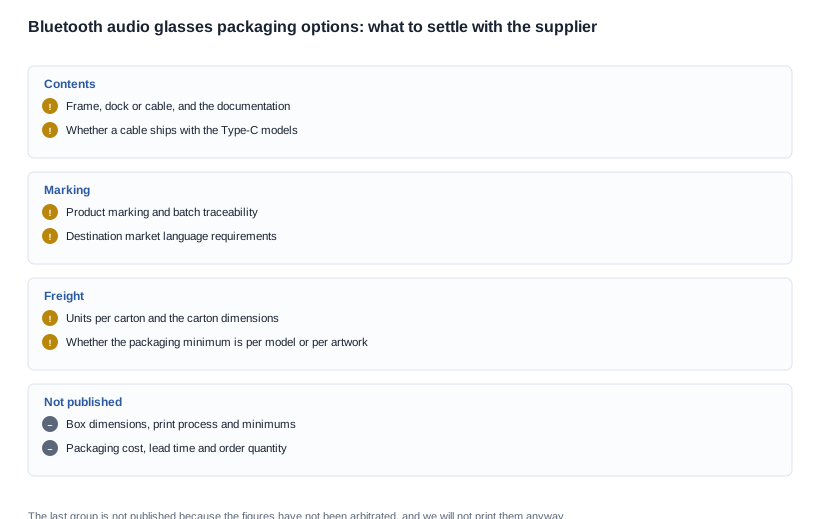
The charging accessory is not the same thing as a case. Six of the eight audio models charge magnetically, and the D11 and the D12 charge over a Type-C port. A magnetically charging model in this range needs a charging interface and its cable or dock in the box; a Type-C model needs a cable. What is actually supplied with each model is not published, so the contents list is a question to the supplier rather than a row to read.
The frame itself is the only substantial object. The tray therefore has to do two contradictory jobs: hold the frame securely enough for a parcel journey, and present it in a way that lets the customer pick it up and put it on. That is a tooling problem rather than a printing problem, and it is the single biggest cost difference between the structures below.
The three variables that decide the cost
Dimensional weight. A boxed frame is light, but a light product in a large box is charged by volume, and the surcharge on a bulky-light parcel can exceed the margin on the product itself. This is a packaging decision with a direct effect on landed cost per unit, and it belongs in the modelling stage rather than after the first freight invoice.
Units per carton. The carton plan drives freight cost per unit more than the retail box does. A carton that holds forty units when it could hold sixty is a shipping decision that nobody in the packaging team sees, and it is the one that compounds across the whole order.
Artwork economy per run. Whether the packaging minimum applies per model or per artwork run changes the economics of a range entirely. A range where every model has its own box pays the minimum several times over; a range where several models share one box pays it once and carries a printed variant insert. The buyer should establish which of those two structures they are in, because the supplier's answer determines whether a second model is nearly free or nearly a full price.

Four structures and the channel that decides between them
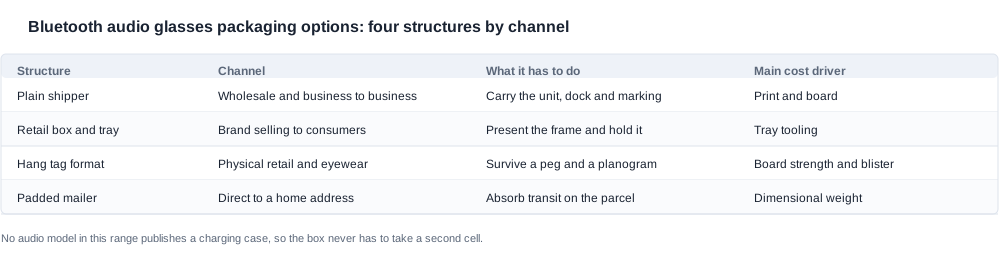
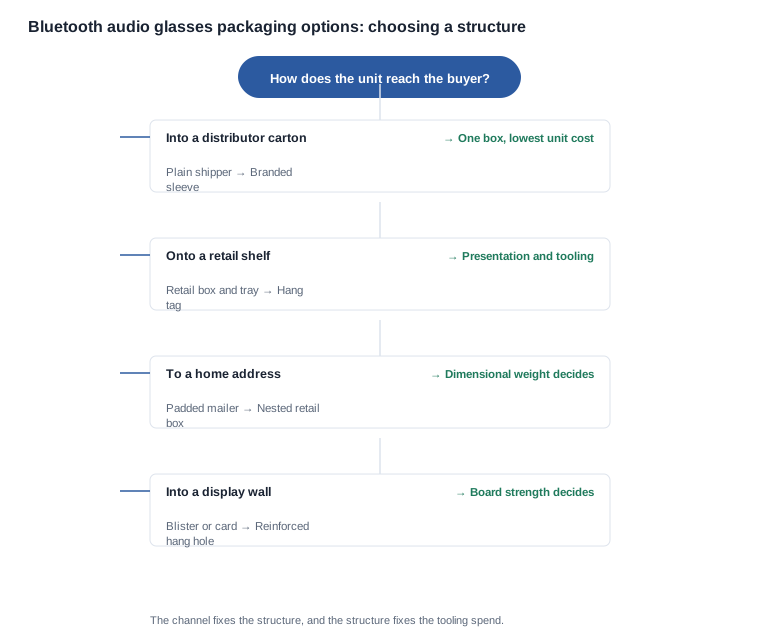
The right structure is a consequence of the channel, and the channel is a commercial fact that is usually decided before the packaging conversation starts. The table above sets out the four, and the decision chart below turns the channel question into a choice.
Structure one: a plain shipper with a branded sleeve
This is the default for a wholesale or business-to-business channel, and it is the cheapest structure per unit. The frame sits in moulded pulp or foam, the charging accessory and cable sit in a separate compartment, and the box carries a shipping label, a product label and whatever regulatory and traceability marking the destination market requires.
The reason it is the default for wholesale is that the buyer is often re-boxing anyway. A distributor who puts your product into their own packaging means that spending money on a retail-quality box is spending it twice. The other side of this decision is worth reading before deciding that the inner box is disposable: a returns process that assumes a plain box is a returns process that works, and the mechanics are covered in packaging for returns.
Structure two: a retail box with an inner tray
This is the structure for a brand selling into a consumer channel where the product is opened rather than dropped into a bag. A printed folding carton holds a moulded or folded inner tray that shows both temples and the charging accessory.
The frame position in the tray is a sizing decision as well as a presentation one. A tray that holds the temples at their widest opens the sizing question for the customer immediately, which is good, and a tray that holds them pinched teaches the customer that the frame is a tight fit, which is bad and hard to unlearn. The tray is also where a generic insert ends up holding the frame badly, which is why it has to be built to the frame rather than to the box.
Structure three: a hang-tag retail format
For a physical retail channel — an electronics store, an eyewear retailer, a department store — the packaging has to survive a peg, a planogram and a security fixture. That means a reinforced hang hole, a printed card or a blister, and a barcode in a position a scanner can reach.
A blister is the more robust option and it protects the lens surfaces from the scuffing that eyewear suffers on a peg, which matters more for this product than it would for a phone accessory. An eyewear channel also raises a question that a gadget channel does not: the product sits next to real glasses and is judged on how it appears on a display wall next to a premium frame. This is where the packaging does the work the product cannot, because the customer handles the box before the product.
Structure four: the padded e-commerce mailer
For a direct-to-consumer channel where a single frame ships to a home address, the outer packaging carries the transit risk rather than the presentation job. A padded mailer or a rigid box with corner protection, with the inner presentation box nested inside it.
The common mistake is treating the retail box as the shipping box, which produces a box that is either over-protected and expensive to ship or unprotected and damaged in transit. Dimensional weight is the number to watch here, and it should be modelled before the artwork is finalised rather than after the first freight invoice arrives.
The six steps the packaging work has to follow
The order of operations matters more than the visual result, because each step is cheaper than the one after it and more expensive than the one before it. Doing the sequence in the wrong order produces a handsome box that ships badly and costs more than the product it contains.
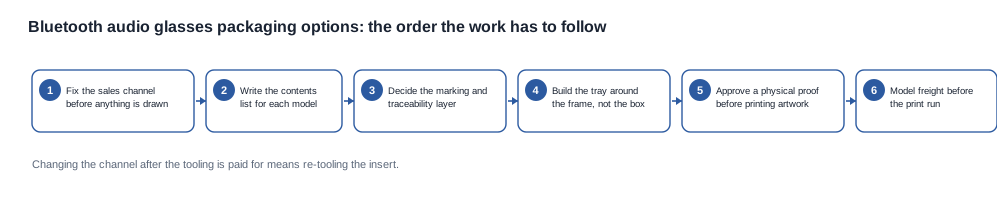
- Fix the channel first. The channel determines the structure, and changing it later means re-tooling the insert. This is the one decision that is effectively irreversible once money is spent.
- Establish the contents list. The frame, the charging accessory, the cable for the models that use one, and any documentation the destination market requires in the box. For the Type-C models a cable belongs on that list; for the magnetic models the dock or charging interface does.
- Decide the regulatory and traceability layer. Product marking, batch or serial traceability and the market's language requirements are fixed by the destination rather than by the brand, and they are cheaper to add before the artwork is approved.
- Build the tray or insert to the frame, not to the box. This is where the tooling cost sits, and this is where a generic insert ends up holding the frame badly.
- Approve a physical proof before any artwork is printed. A screen proof of a package proves the colour; a physical proof proves the fit, the tray geometry and the assembly sequence. Two of those three are invisible on a screen.
- Model the freight before the print run. Dimensional weight, units per carton and units per shipping container are packaging decisions, and they belong in the same conversation as the artwork rather than after it.

Where packaging decisions cost money after the print run
The carton plan that nobody checked. A buyer who approves a retail box and lets the carton be derived from it can end up with a carton that holds far fewer units than the volume allows. The freight cost per unit rises across the whole order, and because it is spread across every unit it is invisible on any single-unit calculation. This is the most expensive quiet mistake in the whole programme.
The artwork minimum applied per model. If each model in the range carries its own printed box and the print minimum applies per artwork, the second and third models in the range are structurally more expensive than the first. A buyer who discovers this after the artwork is approved has no leverage left. Establishing the minimum's basis before the artwork is the fix.
The accessory that was never counted. Magnetic and Type-C are not cosmetic differences in a range: they are two accessory chains, two packaging specifications and two spare-parts plans, and the buyer who forgot one of them discovers it when the first order lands.
The mark that was not designed in. Product marking, batch traceability and the destination's language requirements are layer items, and adding them after the artwork is approved is a re-run. On a multi-market programme the cost of that re-run is multiplied by the number of destinations.
The dimension that was measured on a prototype. Dimensional weight is computed from the packed carton, not from the retail box, and a carton built to the prototype rather than to the plan can be out by enough to change the freight class. The check is cheap and it has to be done on the final carton, not on a sample.
A worked example: a brand selling into three channels
This is a hypothetical scenario rather than a client project, and it is written to show the sequence of decisions rather than to report a result.
Assume a consumer electronics brand with three channels: a large national retailer that buys by the carton, a regional distributor that re-boxes into its own packaging, and a direct-to-consumer website shipping one unit at a time to a home address. The brand has decided to launch one audio model to start, and it has a fixed artwork deadline.
Step one, the channel. Rather than designing one package and hoping, the brand works backwards from each channel. The national retailer needs a hang-tag format with a barcode position it can scan and a hang hole that will carry the security fixture. The distributor needs a plain shipper, because it re-boxes and pays for that labour itself. The direct channel needs an outer mailer with an inner presentation box.
Step two, the contents. The brand writes the contents list once and confirms it with the supplier: the frame, the charging accessory for the interface the model uses, the cable where the interface requires one, and the documentation the destination markets need. It notes that no charging case is in the list, because no audio model publishes one, and it checks the packed weight on that basis rather than on an assumption imported from the camera models.
Step three, the tooling. The brand realises it needs two physical components — the retail tray and the shipper insert — and asks whether the shipper can use a generic insert for the first production run. It also asks whether the tray can be shared with the model's later colour variants, because a tray built for one colourway can be a second tooling cost if the range grows.
Step four, the freight. Before approving the artwork, the brand models the carton plan for the retail channel, checks the units per carton against the volume, and models the single-unit parcel for the direct channel. The direct channel produces the surprise: the box is light enough to look cheap but large enough to fall into a volumetric band, so the brand changes the outer mailer dimensions rather than the inner box.
Step five, the artwork deadline. With the structure, the contents and the freight model settled, the brand approves a physical proof and then the artwork. The artwork revision that was budgeted for is spent on the logo and the regulatory layer, not on correcting a carton that was never modelled.
The result is three structures, two tooling components, one artwork master with a market variant, and a freight model that was checked before the print run rather than after it. Nothing in that sequence needed a packaging cost figure from the supplier, because the cost of a packaging programme is dominated by decisions the buyer makes rather than by numbers the buyer receives.

How to evaluate a packaging proposal before you approve it
A packaging proposal arrives as a visual, and a visual is a poor basis for a procurement decision. The buyer who evaluates a proposal on appearance alone approves a structure whose cost drivers have not been checked, and the cost drivers are the part that arrives on the freight invoice. Here is how to assess a proposal as a buyer rather than as a customer.
The six questions to ask about any packaging proposal
What is the contents list for each model, and does it include the charging accessory for that model's interface? This is the first question because everything else depends on it. A proposal drawn for a magnetic model and a proposal drawn for a Type-C model are different drawings, and a buyer who has not asked which interface each model uses is approving a drawing for the wrong product. Questions to ask about the contents before anything else, because a proposal with the wrong contents in it is not a proposal to evaluate.
What is the print minimum and what does it apply to — per model or per artwork run? This is the question that decides whether the second and third models in a range are nearly free or nearly a full price, and it is the question that determines how to structure the range. A buyer who wants to evaluate a range structure should ask this before choosing the artwork, not after.
How many units fit in a shipping carton, and what are the carton dimensions? The unit count per carton drives freight cost per unit more than the retail box does. Without it, no landed-cost model is possible, and the landed-cost model is what the packaging decision is actually for.
What is the packed weight and the packed dimension of the final carton? Dimensional weight is computed from the packed carton, not the retail box. A proposal that quotes the retail box dimensions has not answered the freight question, and the gap between the two is often the entire difference between a profitable and an unprofitable direct channel.
Is a physical proof available before the print run, and what does it prove? A screen proof proves the colour and the artwork; a physical proof proves the tray geometry, the assembly sequence and how the frame sits in the tray. The second of those is what a customer reacts to, and it is invisible on a screen.
What happens to the tooling if the programme is discontinued, and is it retained? Tooling is a one-off that is amortised across the first order, so the useful question is over what volume it is amortised and what the buyer's position is if the programme ends early.
The signs that a packaging proposal is not ready to evaluate
There are three red flags worth naming, because each of them produces a cost that appears later and cannot be recovered.
A proposal quoted per unit without a carton plan. That means the freight model has not been built, and the buyer is being asked to approve a structure whose shipping cost is unknown. Total cost is the only number that matters here, and it cannot be built without the carton.
A single artwork master offered for multiple destinations. If the proposal does not address the language and traceability layer per market, then either those requirements have been missed or they are being treated as identical across destinations. Both are expensive to discover after approval.
A tray described as generic. A generic insert is a cost saving that moves the problem into the returns desk, because a generic insert holds a specific frame badly. Whether the insert is built to the frame is a question to ask before approval, not after the first complaint.
How to compare two packaging proposals properly
The comparison method is straightforward and most buyers get it wrong by comparing the wrong things. Two proposals should be compared on total cost per unit delivered for the channel each is intended for, on the number of tooling components, on the number of artwork runs, and on the number of accessory chains. They should not be compared on the retail box itself, because the retail box is the smallest of the four cost terms and the one with the least influence on the outcome.
The practical way to run that comparison is to build a shortlist of two or three structures per channel, put the freight model against each, and take the one that survives the total-cost calculation — which is frequently not the one that looked best in the first proposal. How to choose between them is a total-cost question, and the total cost is dominated by freight, by tooling count and by artwork runs rather than by the box.
The packaging figures we will not quote
Packaging is a channel decision before it is a branding decision, and the order of operations matters more than the visual result. Get the channel right, fix the contents list, build the insert around the frame, and then decide what the box says.
Box dimensions, the print process, the print minimums, the artwork minimums, the packaging cost, the packaging lead time and the packaging order quantity are not published, because the figures behind them have not been arbitrated and we will not print a number we cannot stand behind. What we will do is confirm the contents list and the packaging routes for a model, and be straightforward about the parts that are open. Two questions are worth asking specifically: the unit count per shipping carton and the carton dimensions, because that number drives freight cost per unit more than the box does, and whether the packaging minimum applies per model or per artwork run, because a range where each model has its own artwork has very different print economics from a range where several models share one box.
If you tell us the channel, the models, the volume and the destination markets, we will come back with what is available and what is not, including the cases where the audio range is the wrong shape for your plan. The family is on our Bluetooth audio glasses collection page, the same problem for a camera channel is covered in camera packaging options, and the returns side is in packaging for returns.
Related reading
- How the same product is boxed for a camera channel — camera packaging options
- How packaging affects what comes back — packaging for returns
- The accessory chain behind the contents list — Bluetooth audio glasses charging options
Tell us the channel, the models, the volume and the destination markets, and we will come back with what is available and what is not.


