
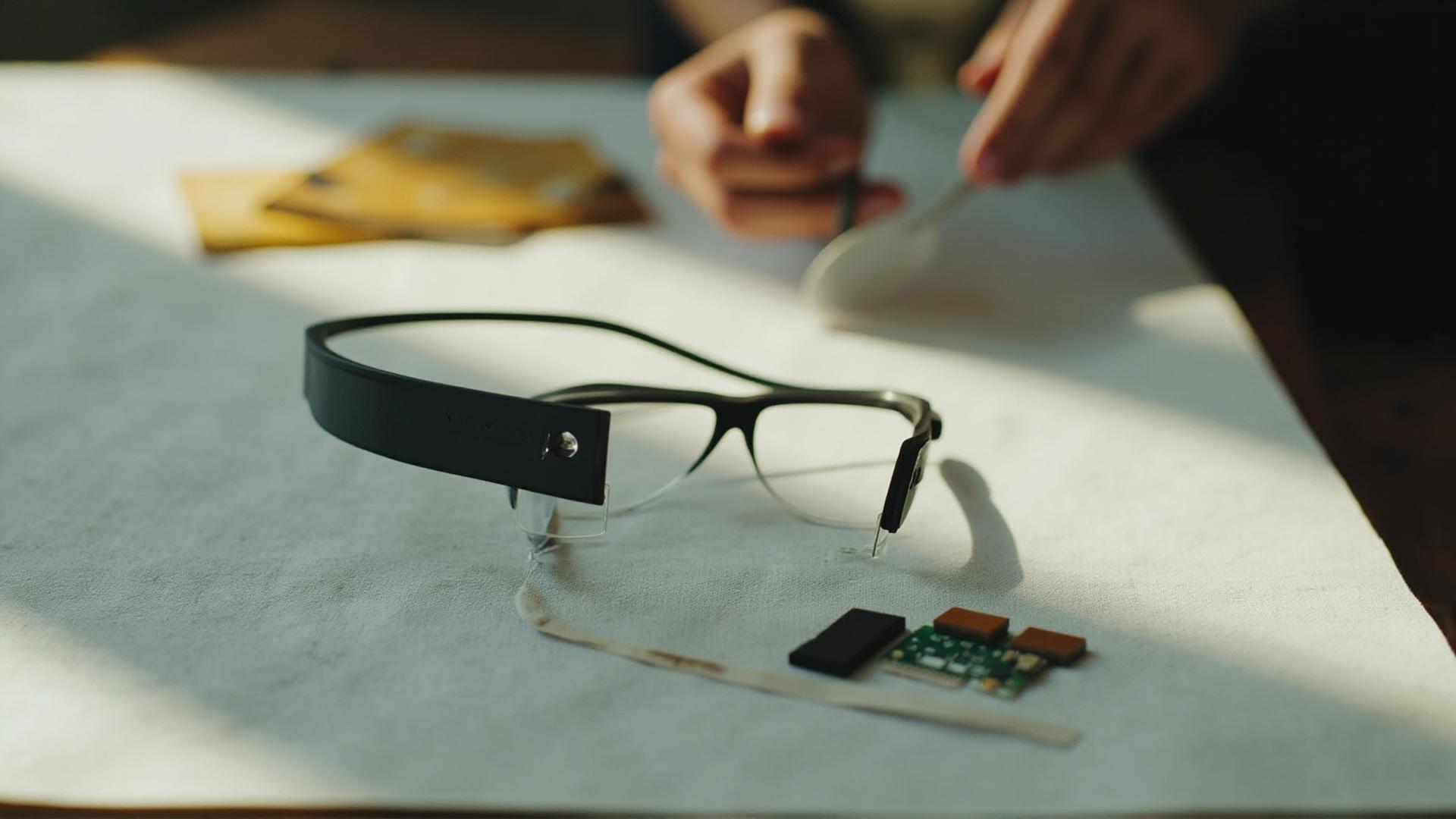
Most buyers who search "KY06 smart glasses how to customize" are not looking for styling advice. They are trying to decide which parts of this model they can commit to on a purchase order, and which parts they have to close with the supplier before artwork, packaging or a costed bill of materials exists. The published row for this model is thin: a 260 mAh battery, an 8 MP camera, and a charging case that is listed but never quantified. Most of what a private-label programme touches from there — the case's own capacity, what the case actually charges from, the runtime it buys, the charge time in practice, the unit weight, the colourways — is either absent from the row or expressed as a ceiling.
That combination shapes this guide. It does not propose a design direction, and it does not rank models. It separates the rows that are published from the rows that are not, explains why the case is the part of this model that most often stalls a programme, and gives the order in which each closure should be asked for, along with the consequence of leaving one open.
If you are still choosing between models in this range, our guide on how to pick an AI camera glasses model is the right place to start; this article only covers what changes once the model has been fixed.
KY06 customisation: the published rows and what they leave open
The catalogue we sell from holds 28 models: 11 camera glasses, 8 audio glasses, 3 sport models, 3 children's models and 3 entries that carry no model designation at all. For a camera model, the rows a buyer normally depends on are camera resolution, battery capacity, charging method, charging time, Bluetooth version, protection rating and weight. For this model, four of those carry a value and the rest do not.
KY06 smart glasses how to customize: what the catalogue actually publishes. The battery row states 260 mAh. The camera row states 8 MP, which puts this model in the group of eight that publish an 8 MP sensor, against three models that publish 13 MP. A charging case appears on the row, so the case is part of the product, but no capacity figure travels with it. The charging time row follows the house format of the catalogue, which is an upper bound of two hours. Two rows in the library state about one hour instead — D17 and ZH12 — and this model is not one of them, so the two-hour figure is a ceiling, not a measured average.
Now the rows that are open, which matter more for customisation than the ones that are filled in. Case capacity appears as a number on five models in the library, appears as a case without a number on two, and this model is one of those two, alongside the MT5. Three models carry no case row at all and one states explicitly that it has no case. So "a case with no published capacity" is a precise statement about this row, not a vague one. There is no Bluetooth version row for any of the 11 camera models — the catalogue publishes a radio version on 14 rows in total — so the radio specification has to come from the supplier. There is no protection rating: only two models in the library publish one. There is no weight row: the catalogue publishes a weight for one model only, so the shipping weight for this model is unconfirmed until someone measures it. There is no colour row: only two models publish colour options, and this is not one of them.
Two further gaps matter specifically for customisation work. No row anywhere in the library publishes a capacitive touch surface, a touch panel or a gesture control; the only control surface published anywhere is an indicator light and a button on one AR glasses row, which is a different product from this one. And no row anywhere publishes a translation function. If either feature comes up in a sales conversation for this model, it is a claim to be verified against the firmware that will actually ship, not a catalogue specification, and it must not be printed on a carton or a listing.
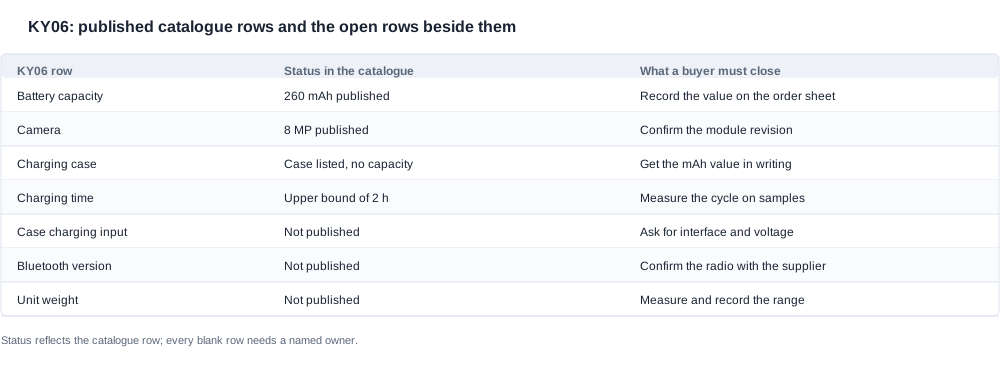
The practical result is that four values are available to you today — 260 mAh, 8 MP, a two-hour charging ceiling and the presence of a case — and everything else is an open row with a named owner. Use the table as the starting worksheet rather than as a finished specification. The third column is the part most programmes skip: for every blank row, the question has to go to a named supplier contact and come back in writing.
Separating the KY06 surface work from the platform line
Customisation work on this model splits into two layers, and confusing them is what causes expensive rework.
The brand surface is everything a buyer can decide: the mark on the temple, the finish and colour of the case, the print on the carton, the layout of the manual, the structure and print of the insert, the serial and label format, the accessory pouch, the colour of any cable. None of these depend on the internal design of the product, and most of them can be frozen early.
The platform line is everything inherited: the camera module behind the 8 MP row, the cell behind the 260 mAh row, the charging architecture, the firmware and the companion app, the feature set the app exposes, the factory inspection routine, and — less obviously — the physical envelope of the case itself.
That last item is where the two layers touch. The exterior of a case can be designed and printed before anything else is settled, because a logo, a colour and a texture do not depend on what sits inside. The interior cannot: the moulded insert, the cavity that seats the glasses, the space reserved for a cable and the closed-case footprint all follow from what the case is specified to hold. If the capacity is later confirmed with a different internal layout than the sample you approved, the printed shell usually survives, while the carton dimensions and the insert tooling may not.
The mistake to avoid is sending print-ready artwork for a case whose interior is still undefined. That mistake is paid twice — once in tooling, once in cartons — and it is far cheaper to sequence correctly. The right order is:
- Close the rows that set the envelope: case capacity, what the case holds, the case's own charging input.
- Freeze the case exterior: colour reference, print method, logo position, print area.
- Freeze the packaging that depends on the closed case footprint: carton size, insert, accessory count.
- Run everything that does not touch the envelope in parallel: manual, insert card, carton print content beyond the size.
A second mistake is treating firmware features as customisation levers. A translation function, a touch surface, a runtime read-out in the app — none of these are published for this model, and none of them become yours by asking for them. They are platform claims that can only be made against a named firmware version, in writing.
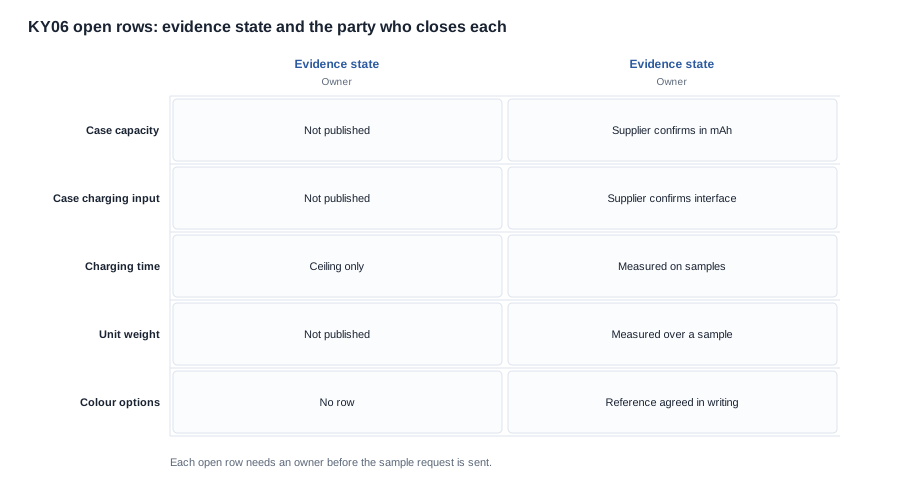
The matrix is the working version of the split. Each row names an item, its evidence state and the party who has to close it, and it should be read as a work plan: if a row still has no owner when the sample request goes out, it will still have no owner at the inspection. This is also the fastest way to see that the open rows are not equally urgent. A missing colour reference blocks artwork, while a missing radio version only blocks an accessory you may never sell.
The KY06 charging interface: the question the catalogue does not answer
There are three different charging questions, and the catalogue speaks to them unevenly: how the glasses are charged, how the case is charged, and how long each takes.
Across the library, a charging method is published on most rows: seventeen rows state a magnetic interface and seven state Type-C. Four rows state no method at all, and this model is not among the rows where a method is printed, so the interface here is an open item rather than a specification you can carry over from a sibling model. This is not a one-model slip worth treating as an exception. The two sibling camera models that do publish a case capacity, the 290 mAh and 1400 mAh pair, also leave the charging method unstated. If you are comparing the camera range, expect the same question on more than one row.
Ask for the answers in this order, in writing, and do not accept a description of the accessory bundle in place of an answer:
- What input does the case accept — a magnetic pad, a USB-C port or a barrel connector — and is the lead included or optional?
- What input voltage and current does the case draw, and does it accept a standard wall adapter?
- Does the case charge independently of the glasses, or only through the seated glasses?
- How long does the case take from empty to ready, and how long do the glasses take in the case?
- What is the case's own capacity in mAh?
- What does the indicator show at each state — charging, ready, fault?
The order matters because each answer unlocks a different piece of work. The case input determines whether a cable is in the box, which changes the accessory list, the carton contents and the unboxing sequence your customer sees. The capacity determines whether you may make any promise about a spare charge, and it sets the envelope described in the previous section. The charging behaviour determines whether you can publish a status description at all. The timings determine the language that is allowed on a carton.
One point deserves emphasis because it is easy to get wrong in the wrong direction. The catalogue expresses a charging time as an upper bound. A carton that says "charges in 2 hours" states something the evidence does not support; "up to 2 hours" is defensible only if your own sample measurement is consistent with it; the safest carton line, until samples exist, is no charge-time claim at all. The same rule applies to runtime language: if nobody has measured a unit, the only supported statement is the published row.
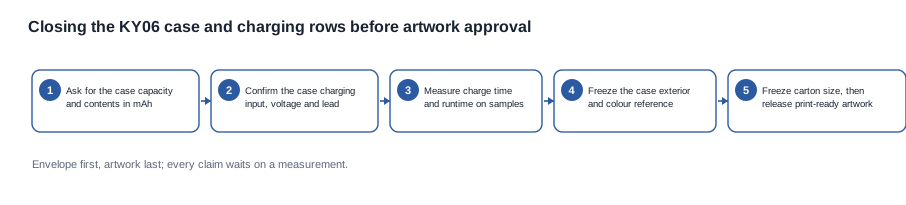
The flow is the closure sequence for the case and the charging questions specifically. It puts the envelope before the artwork, the artwork before the carton, and the measurement before any claim, which is the only order in which a private-label programme for this model stays on schedule. One caution while you work through it: a charging pad is not a control surface, and nothing in the catalogue for this model publishes touch behaviour, so do not let a supplier's gesture demonstration become a product specification.
Naming the KY06 on the order, the carton and the inspection sheet
A model designation is not a name, and a programme that treats it as one pays for the confusion at inspection. Three identifiers have to travel together for this model: the supplier's catalogue code, your own purchase-order code, and the customer-facing name that appears on the carton, the manual, the app listing and the after-sales record. All three belong on the purchase order, and the supplier should be required to use the same customer-facing string on every printed and digital surface.
Where these drift, the failure is rarely dramatic at the factory. It appears as a rejected carton at pre-shipment inspection, a customs description that does not match the invoice, an after-sales lookup that cannot find the unit because the code on the device differs from the code on the paperwork, or a listing that ships with a name the manual does not contain. Each of those is fixable, and each is expensive, because the fix happens after production instead of before it.
The inspection sheet is where that risk is either closed or carried forward. Every open row discussed so far should be converted into a criterion an inspector can check, with a tolerance and a method. For this model that list includes:
- Battery capacity measured at the cell terminals in mAh, with the tolerance and the number of units sampled stated.
- Camera resolution verified against the published 8 MP row.
- Charging time measured from a stated starting state, with the method written down.
- Case capacity matched against the value in the supplier's written confirmation, since the sample itself may carry no marking.
- Unit weight measured across a sample of N units, with the observed range recorded instead of a single figure.
- Case colour against an agreed reference, with the tolerance and the light source stated.
- Mark position and print method on both the temple and the case, checked against the approved artwork.
- Serial format, prefix and placement, matching the label file.
- Carton print content, including any destination-market marking that is required.
- Accessory count and the contents list per unit.
Then put the consequence of a failure on the order sheet itself: rework at whose cost, a credit against the balance, or rejection of the lot. Ambiguity is the expensive part. "Non-conforming to specification" without a stated remedy is the clause that ends in a dispute at the port, and the lot has already travelled by then.
Two rules keep this section short. First, never let a claim onto the carton that the evidence file does not support. The conformity documentation for a destination market is requested per market and recorded against your own documentation checklist; the catalogue itself is not a conformity document, because it publishes no CE, FCC or RoHS text, and the export page in our catalogue is a picture page of patents — eight design patents and two utility models. A patent filing is not a market-access certificate, and the two are regularly confused in supplier conversations. Second, keep the customer-facing name identical on the physical and the digital surfaces, because a listing that names the model differently from the carton breaks the link between your product page and the box that arrives.
A KY06 evidence file before the first bulk order
Before the first bulk order there should be one folder that answers every question raised in this article, and one person who owns it. The evidence file is not documentation for its own sake: it is the thing that makes the inspection criteria enforceable and the artwork defensible.
It has seven parts, and each part needs an owner:
- A dated snapshot of the catalogue page that carries the published row for this model.
- The supplier's written confirmations, one per open row: case capacity in mAh, case charging input, measured charging time, measured runtime, unit weight, colour options, and the radio version if your app depends on it.
- Sample measurement records — the same measurements repeated on more than one unit, with the date, the sample identifier and the instrument used.
- The approved artwork files and the agreed colour reference, with the version number the supplier has acknowledged.
- Packaging and label approvals, including the carton print proof and the destination-market markings.
- The signed inspection sheet, with tolerances and remedies attached.
- A version log recording every change to the specification, because supplier revisions — a different cell vendor, a camera module revision — can move a published row without changing the model code.
The closure order is fixed by dependency rather than by convenience:
- Case capacity and case contents first, because they set the envelope and therefore block artwork tooling and carton sizing.
- The case charging input second, because it fixes the accessory list and the language on the carton and in the manual.
- Measured charge time and runtime third, because every time-based claim waits on them.
- Unit weight fourth, because shipping cost and packaging dimensions wait on it.
- Colour and print last, because the artwork freeze waits on the envelope.
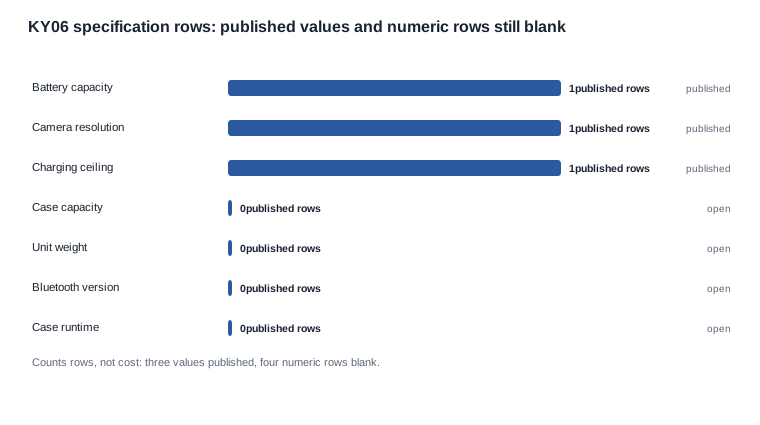
The chart counts rows rather than money, and it is the honest picture of this specification today: three numeric values you can put into a specification right now — 260 mAh, 8 MP and a two-hour charging ceiling — and four numeric rows still blank, namely case capacity, unit weight, the Bluetooth version and a measured runtime.
There are also answers you should refuse. A supplier who offers a case sample but no capacity value has given you the easy evidence and withheld the decision-relevant evidence. A catalogue screenshot is not a confirmation of a charging method. A sample that charges faster than the published ceiling is a sample result, not a specification. A manual or a listing that mentions a touch surface, a translation function or a runtime the catalogue does not publish is a draft that has outrun its evidence.
If you are running this review on a sibling camera model, our buyer review checklist for the CY05 shows the same closing sequence applied to a model whose rows are published more completely, which makes it a useful contrast. Re-confirm the whole file periodically rather than once, because supplier revisions move published rows quietly and the file is only useful while it is current.
Where CYNRIN stands on the KY06's open rows
Where CYNRIN stands on the KY06's open rows. Our position is deliberately narrow. We publish what the catalogue publishes, and we do not fill the gaps with estimates.
For this model that means stating it plainly: a 260 mAh battery, an 8 MP camera, a charging case that appears on the row without a published capacity, a charging time expressed as an upper bound of two hours, and no published Bluetooth version, protection rating, weight, colour row, control surface or translation function.
What we will do:
- Put every open row on the order sheet as a named item with a named owner, rather than leaving it inside a generic specification.
- Run a sample with you so that the case, the charge cycle, the runtime and the weight are measured rather than asserted.
- Assemble the evidence file in the order described above and hand it over before the first bulk order, rather than after the first complaint.
- Hold the inspection criteria you set, including the tolerances, so the acceptance decision is made against a document both sides signed.
What we will not do:
- Quote a case capacity for this model, because we do not hold a published one.
- Present the two-hour ceiling as a measured charging time.
- Repeat a control surface, a translation function or a runtime that the catalogue does not carry for this model.
- Choose the model for you and present it as a recommendation. The screen is yours to run.
One filter is worth stating for buyers who want to apply it across a range rather than to one model. If your programme cannot proceed with a case whose capacity is unquantified, that is a legitimate filter — and the catalogue itself shows it is a real open row rather than a formatting habit, because sibling camera models publish a case capacity of 1400 mAh. If the filter is acceptable, the closure sequence in this article is the work plan. The AI camera glasses range page is where to run that filter across the eleven camera models we publish before a sample request goes out.
Start with a sample rather than a specification sheet. When you request a KY06 sample, tell us which rows you want closed — case capacity, charging interface, measured charge time, unit weight — and we will run them on the unit before it ships. The catalogue answers the specification question for the parts it publishes, and the sample answers the rest.
Related reading: how to pick an AI camera glasses model for the range-level screen, and a buyer review checklist for a sibling camera model for the review sequence applied to a fully published row. Request a KY06 sample when you are ready to close the open rows.


