
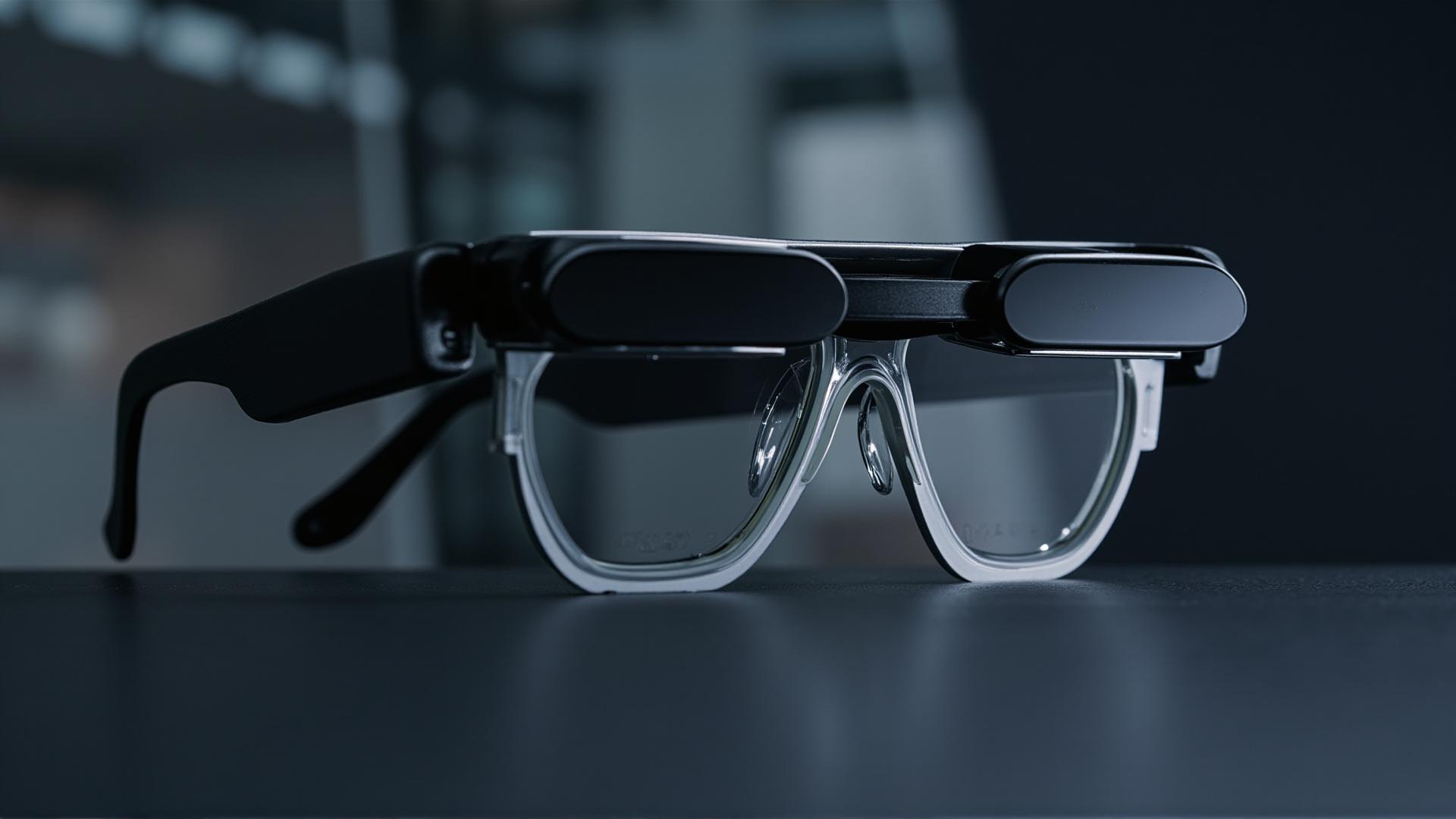
The CY05 is one of eleven camera models in this catalogue, and for a buyer it is a well-behaved product with an unusual paperwork profile. Its rows are simple enough to recite in a sentence — an eight megapixel camera class, a 290 mAh frame cell, a rated use of about seven hours, a charge time of two hours or less, and a 1400 mAh charging case — and the rest of what a buyer would normally read off a specification sheet is simply absent from the catalogue. There is no sensor model, no field of view, no video format, no frame weight, no ingress marking, no radio version and no per-model certification line. That combination is not unusual in this category; what makes it useful is that the gaps are systematic and can be written down before the sample arrives, so that the sample review is a short, decisive session rather than an open-ended search.
This article is that written-down sheet. It separates the rows that can be closed on paper, the rows that can only be closed by handling a unit, and the rows that nobody can close except the supplier in writing. Each of the seven checks below says which of the three kinds it is, and what evidence closes it. Nothing here needs a price comparison, and nothing here needs a recommendation about which model to buy. What it needs is a buyer who wants to know, before the deposit, exactly which questions will still be open when the sample lands on the desk.
Five published rows and six gaps on the CY05
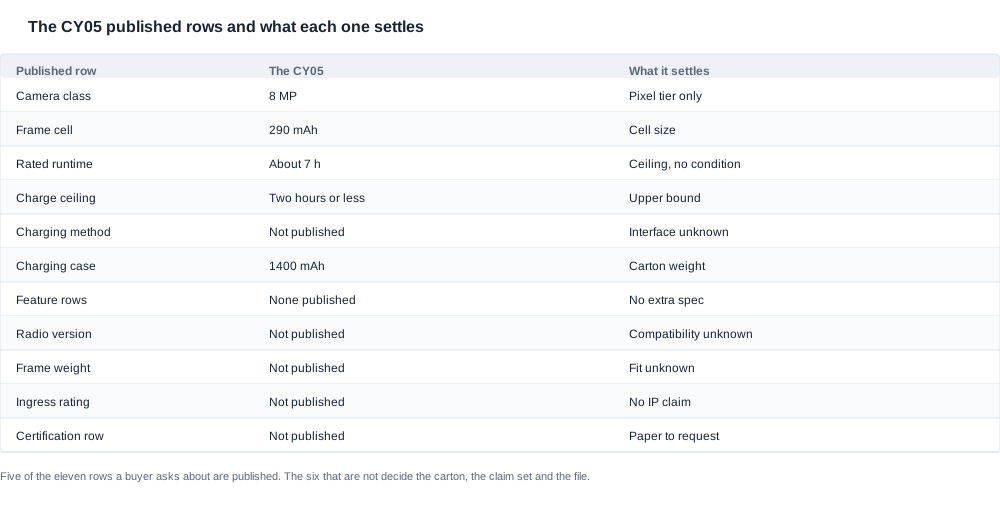
Counting the rows a procurement conversation normally turns on, the CY05 publishes five of them and leaves six open. Published are the camera class at eight megapixels, the 290 mAh frame cell, the rated use of roughly seven hours, the charge ceiling of two hours or less, and the 1400 mAh charging case. Open are the charging method, the feature lines, the radio version, the frame weight and dimensions, the ingress position and the certification scope. None of those six is unusual. What matters is that each one is closed in a different way, and that a buyer who treats them as a single category of missing information will spend a sample session on questions that no sample can answer.
The catalogue itself is a useful frame for this, because it is structured rather than partial. There are twenty-eight models in total, and eleven of them carry a camera. Those eleven split cleanly by pixel tier: eight are published at eight megapixels and three at thirteen, which are the L1 Pro and the S7, and the L2 Utral. The CY05 sits in the wider eight-megapixel group alongside the V03 Pro and the MT6, the CY03 and the V03, and the MT5 and the KY06, and the V06. That structural fact is what makes the CY05's own pixel class easy to evaluate: there is no room on this platform to move up within the camera tier without moving to one of three specific models, and there is a long tail of models that publish nothing at all about their camera beyond the tier.
Two more structural facts belong on the same sheet because they are the ones that get borrowed from other models by mistake. The first is that the CY05's charging method is not published, which is true of exactly four camera models in the range, and the CY03 and the L1 Pro, and the MT6 are the other three. The second is that the only published frame weight anywhere in the catalogue belongs to the MT6, at 158 g for the glasses body including its cell and its camera and excluding its folding case. Neither fact is a CY05 specification, and both are the kind of number that travels informally between models in a conversation until it lands on a product page.
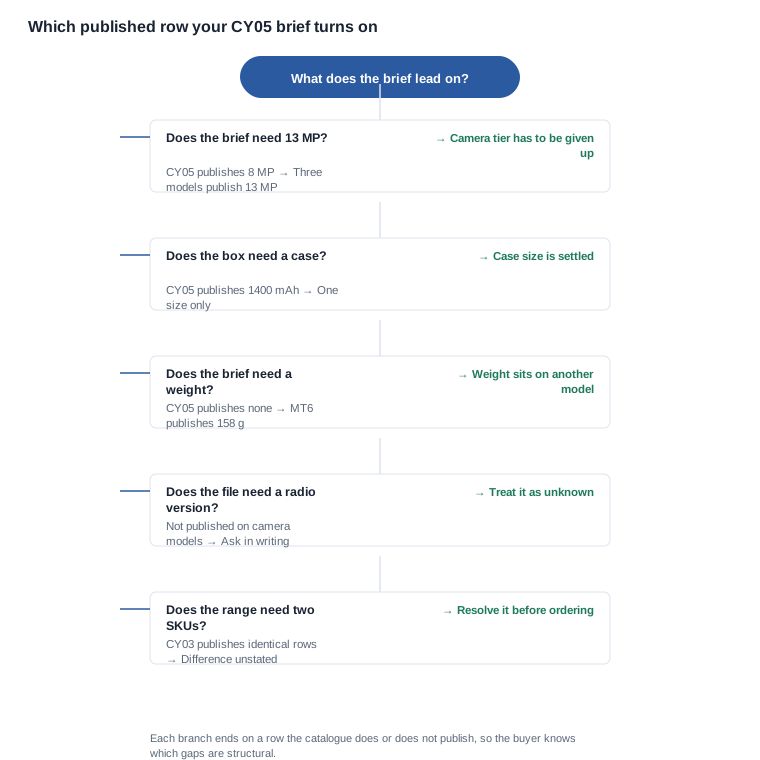
The screening order that follows from this is worth stating plainly, because it is the difference between a review sheet and a questionnaire. Start with the requirement that is least forgiving, not the requirement that is easiest to satisfy. If the brief turns on thirteen megapixels, the CY05 is out of scope on a published row and no sample will change that, so it should be settled before the units are shipped rather than after they arrive. If the brief turns on the box, the CY05's published 1400 mAh case is the largest published case capacity in the range and the question becomes what else travels in the carton. If the brief turns on a frame weight, the CY05 publishes none and the only figure in the catalogue belongs to a different model, so the weight has to be measured rather than sourced. If the brief turns on two camera models in the same range, the CY03 twin question has to be answered before either is ordered, because the answer determines whether the two are two configurations or one configuration listed twice.
The imaging row is a pixel tier, not a quality claim
Eight megapixels is a published number and it is not an image quality claim, and the distinction has to survive contact with a product page. The catalogue publishes a resolution class and nothing further for this model. There is no sensor part, no field of view, no video format, no frame rate, no stabilisation behaviour, no low-light characteristic and no storage capacity or file format. A page that says "8 MP camera" is accurate. A page that says "sharp 8 MP camera", or "HD recording", or "night photography", is making claims the documentation cannot carry, because each of those phrases implies a condition the catalogue does not state.
The reason this matters commercially, rather than legally, is that buyers respond to the gap in a predictable way. A buyer who receives a unit whose first-person framing feels narrow, or whose captured video disappoints in low light, concludes that the product is weak — not that the specification is missing. The sample review is where that conclusion gets formed, so the imaging check belongs first on the sheet even though it is the least conclusive of the checks.
The check itself is a framing test, and it is deliberately simple because it does not need instrumentation. Shoot a walk-through in the condition the customer will actually use, play it back, and judge whether the result reads as a person's view of the path rather than a narrow crop of it. A narrow field of view produces a framing that no amount of resolution repairs, and the buyer who has seen it will not accept a resolution figure as a substitute. Write down what was in the frame and what was outside it, because that observation, recorded next to the unit's identification, is the evidence that survives into a product page or a claim file. The camera imaging notes set out why the field of view and the sensor are the two numbers that decide whether a camera glasses product works in the first place.
Two boundaries should be written onto the sheet alongside the result. The first is that the framing test produces a verdict about this unit in this condition, not a specification: it cannot be turned into a published number, and it should not be quoted as one. The second is that the test does not transfer between models silently. The CY03 publishes the same eight-megapixel class and the same 290 mAh cell, and a result recorded against one unit is evidence about one unit. A sample session produces a result per unit per configuration, and the sheet should say so before the session rather than after it, because the alternative is a buyer who assumes one sample covers the order.
Storage and endurance: the two rows only a unit can close
Storage exhaustion is the most common cause of a returned camera glasses product, and it returns for a specific reason: a camera that stops recording when it is full presents exactly like a camera with a fault. Nothing in the published documentation distinguishes the two, for this model or any other in the range, because capacity, format and overwrite behaviour are not published at all. That makes this the clearest case on the sheet of a gap that has to be closed by handling a unit, and it makes it the one most likely to be skipped because nothing prompts the question until a customer files a return.
Fill the storage deliberately, capture again, and record what happens. Whether the recording is refused, whether the oldest footage is overwritten, whether the device warns first, and whether the behaviour is a setting or a fixed rule are all observable on one unit in a few minutes. Each of them changes what a product page may say about the camera, and each of them changes what the support script says. The AI camera glasses troubleshooting order puts this check first for the same reason, since a camera that stops recording is indistinguishable from a camera that has failed.
Endurance is the second row of this kind, and the complication is that the CY05 does publish a figure — about seven hours — so it will be treated as settled unless something forces the question. The 290 mAh cell and the published rating are real rows, and the figure is written as a rated use rather than as a measured runtime under a stated condition. That distinction is the whole substance of the check: a rating without a condition is a number that cannot be reproduced, so asking for the condition is not pedantry. What was the camera doing during the measurement, was the Bluetooth link active, was the figure taken from one unit or from a batch, and was the case involved in the cycle at all.
Then measure it on the unit, in the condition a customer will create, and write the condition next to the number rather than in a separate document. The charge ceiling interacts with this the same way: two hours or less is an upper bound on charging time, which means a customer who charges overnight is fine and a customer who charges between shifts may not be, and the review sheet has to establish which customer the product is being sold to. The CY05 battery life analysis covers the same ground in more detail, including the way a capacity figure and a runtime figure are different documents even when they appear on the same row.
The two-hour ceiling also decides something structural. The CY05's charging method is not published, so whether the product charges over a magnetic interface, a Type-C port or something else is not answerable from the catalogue, and that gap sits directly on top of the charge-time question. A buyer who wants a two-hour-or-less ceiling to be meaningful needs to know what the customer plugs into and how long the interface takes, because a ceiling without an interface is a number with no route to the customer.
The case, the carton and the transport file
The 1400 mAh charging case is the largest published case capacity in this catalogue, and it is the reason the CY05 is worth a review sheet at all: it is a real, differentiating published row, and it changes the carton. A 1400 mAh case is roughly five times the 290 mAh frame cell, it travels in every unit, and it turns a single-cell frame into a two-cell lithium package for transport purposes. That is a freight class question, a carton-design question and a customer-expectation question at the same time, and none of them can be answered from the frame specification.
Everything about the case except its capacity is unpublished. The weight, the dimensions, the charging interface of the case itself, the charge time for the case, and whether it carries a battery indicator are all absent, and each of them lands somewhere different. Weight and dimensions land in the packaging artwork and the shipping weight calculation. The interface and charge time land in the customer's weekly routine, because a case that takes six hours to refill and a case that takes two are different products for a user who charges once a day. The indicator lands in support: a case with an indicator generates different questions from a case without one, and the question rate is visible in the first month.
The practical instruction is to weigh a packed unit while the sample is in hand, and to record the frame weight and the packed weight as two separate numbers. The frame on its own is the object the customer wears; the packed unit is the object that ships, is weighed at the carrier and is carried in a bag. On a 290 mAh frame with a camera module and a 1400 mAh case in the box, the second number is the one that governs freight, and it is the one nobody has. The charging case options analysis covers the accessory economics, the shipping weight analysis covers the parcel arithmetic, and the weight comparison across the range explains why a proxy from another model is not a substitute for a number taken off this unit.
There is a transport document behind the case as well, and it belongs on the same sheet. A frame cell and a case cell are two lithium cells in one package, and the way they are declared, tested and documented affects what can travel by air and what has to move by another route. The case capacity being published is what makes this conversation possible at all, which is the general pattern of this article: the published rows tell you which questions are worth asking, and the unpublished ones tell you which questions cannot be skipped.
The CY03 twin and the papers that have to name this model
The CY03 and the CY05 publish identical rows. Same eight-megapixel camera class, same 290 mAh cell, same rated use of roughly seven hours, same two-hours-or-less charge ceiling, same unpublished charging method, same 1400 mAh case. The catalogue does not state what separates them. That single fact has consequences well beyond curiosity, and it is the item on this sheet most likely to be deferred because it does not look like a technical question.
The consequence is a range decision. If the two models differ by a colourway, a packaging tier or a market designation, then two model numbers in a range is an ordinary merchandising structure and the documentation work is a naming exercise. If the rows are identical because the two models are the same product under two numbers, then the range is carrying a second line of freight — a second stock keeping unit, a second packaging artwork, a second set of transport documents and a second certification scope for no published difference. Which of those two situations applies is a question for the supplier in writing, and it is cheap to ask and expensive to discover after a launch.
The answer should be treated as a foundation rather than a detail, because several other rows depend on it. A certificate or test report that names one model does not automatically cover the other. A conformity file scoped to one configuration does not cover a variant with a different lens, a different cell or a changed enclosure. A product page that markets both models with different claims, on identical published rows, is a page that has to survive exactly this question. The CY05 versus CY03 price positioning analysis covers the commercial side of the same structure, and the review sheet should carry the designation question at the same time rather than as a later refinement.
The second half of this check is the paperwork that has to name this model. The catalogue's own certification position is company-level: an export certification page with images rather than text on it, showing ten patent certificates — eight appearance-design patents and two utility-model patents — and no per-model certification row for the CY05 or for any other model, with no reference to CE, FCC or RoHS in the catalogue text. A buyer asking for "our CE certificate" is therefore asking for a document that is not published, and the correct answer is the accurate one: our published material does not carry model-level certification information for this model, and the document that does cover it has to be requested in writing, naming the model and the configuration.
That written request should ask for a specific set: test reports covering the radio and safety claims for this build, a component and module list, the product description, the cell documentation for both the frame cell and the case cell, the marking artwork, the user-facing instructions, and the technical file index with the model's designation on it. The certification status for the camera range sets out the wider list, and the export documentation checklist covers the paper that travels with the goods. Note what is not on that list: no certificate number, no issuing body and no expiry date can be quoted from anything we publish, so none of them may appear on a product page until a document says otherwise.
Building the review sheet and what goes on the product page
A review sheet is only useful if it is written before the sample arrives and if every line says how it closes. The seven checks below are the CY05 sheet, ordered by how unforgiving each requirement is rather than by how quickly each can be answered. The first three are closed by handling a unit, the next three are closed by weighing, measuring or documenting, and the last one is closed only in writing by the supplier.
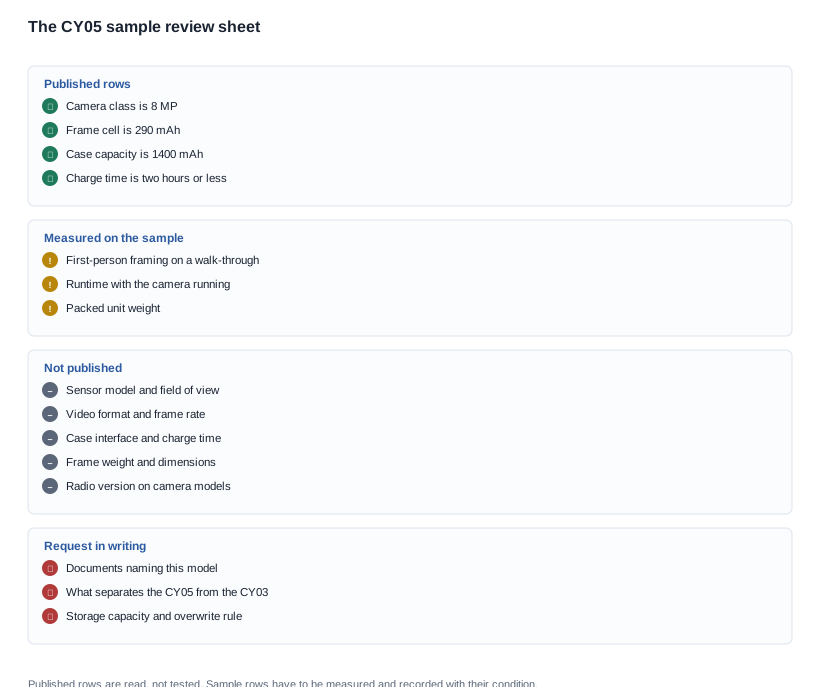
- The imaging row and the framing test. Record what was inside the frame and what was outside it, on this unit, in the condition it will be sold in. Do not convert the result into a specification.
- Storage behaviour at capacity. Fill the storage, capture again, and record whether recording is refused, overwritten or preceded by a warning.
- The endurance figure. Measure a runtime on the unit and write the condition — camera state, link state, case involvement, sample size — next to the number.
- The case. Weigh and measure the case, identify its charging interface, time its own charge cycle, and record whether it carries an indicator.
- The frame. Weigh the frame alone and record temple length and lens dimensions, which are published for no model in the range.
- The CY03 difference. Obtain in writing what separates the CY05 from the CY03, and treat the answer as a range decision rather than a catalogue footnote.
- The documents. Request the reports, the component and module list, the cell documentation for both cells, the marking artwork and the technical file index, all naming this model and this configuration.
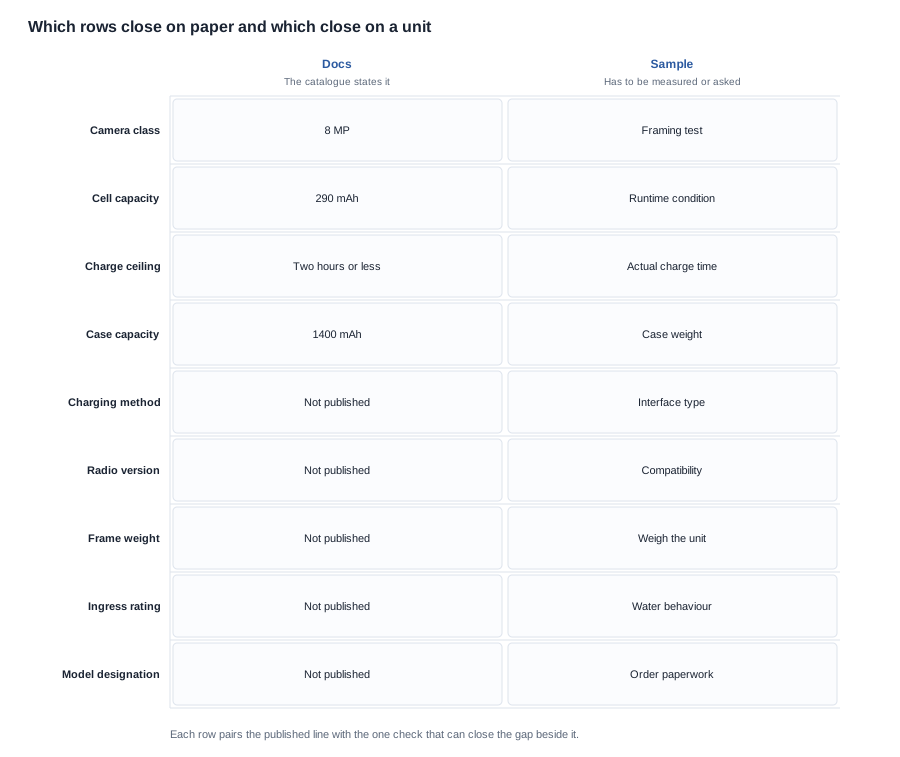
The matrix above is the part to keep after the session ends, because it is what stops a review from turning into a rewrite. Every row a buyer cares about has a published side and an open side, and the two are closed by different people: the catalogue states the row, and a unit or a written answer settles the gap beside it. A sheet that records only the outcome of the sample loses the distinction, and then the unanswered rows quietly turn into assumed ones.
On the CY05, our position is narrow and worth stating as a constraint rather than a promise. We will present eight megapixels as a published camera class and about seven hours as a published rating, and we will not turn either into an image quality claim or a working day. We will not quote a frame weight, a case interface, a case charge time, an ingress marking, a radio version or a certificate number that the documentation does not contain, because a number on a product page outlives the reason it was written. The published CY05 specification list is the honest baseline for this model, the CY05 smart glasses value for money piece covers the commercial framing of the same rows, and the CY05 common questions article puts the same ground in a form that can be handed to a supplier.
Send us the volume and the target markets, and we will tell you which of the seven checks we can answer from documentation, which have to be closed on a sample, and which have to be requested in writing before the purchase order is worth issuing.
Related reading
- The catalogue rows for this model — CY05 smart glasses specifications and features
- The commercial argument — CY05 smart glasses value for money
- The cost side of the accessories — AI camera glasses charging case options


