

Customising a product is two different projects, and on this model they are unusually well separated. The MT6 is the only product in this catalogue with a published weight and a published foldable charging case, and both of those are things a brand can shape. The 1200 mAh case is a separate object with its own artwork, its own insert and its own fold geometry, while the frame is a fixed industrial design that a brand selects rather than redraws. That separation gives a buyer a clean rule for the whole programme: the case and the packaging are the parts that carry the identity, and the frame is the part that carries the platform.
The second half of the rule is the one that gets skipped. The catalogue publishes three feature lines for this model — portable, ultra-light, and a 158 gram folding charging case — and it publishes the camera class, the cell, the rated use and the charge ceiling. It publishes no sensor model, no field of view, no video specification, no ingress marking, no charging method and no per-model certification row. So the case and the frame can be shaped within a well-documented envelope, and the camera claims have to be written inside a much smaller one. This article is about how to tell those two things apart before anybody opens a design tool, and about which cost belongs to which step.
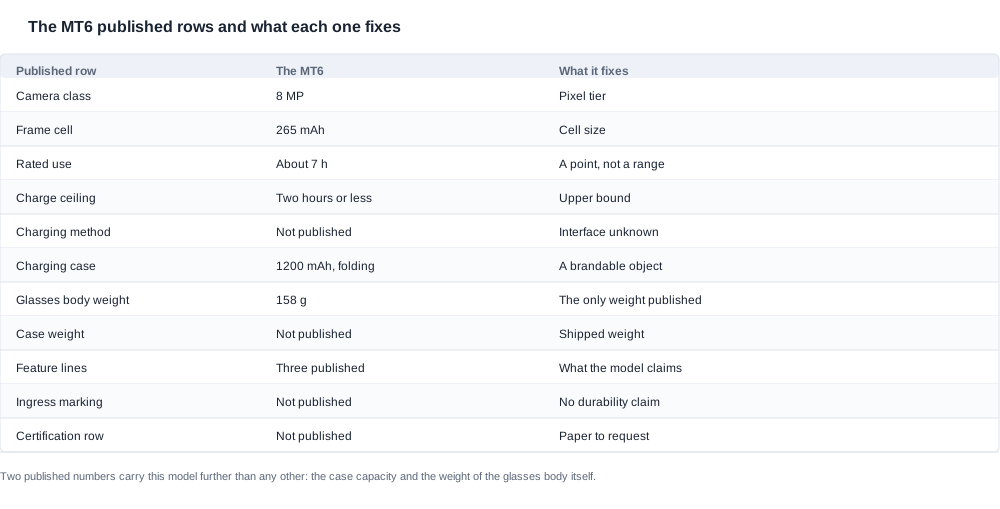
MT6 customisation: what it fixes and leaves open
Two published numbers make the MT6 easier to plan than anything else in the range. The first is the charging case: 1200 mAh, in a case that folds. A folding case is an object with a hinge, a fold geometry and an insert, which means it has an artwork surface and a mechanical tolerance, and it means the customer opens it before they put the glasses on. A brand that wants its identity in the customer's hand has a place to put it that no other model in this catalogue offers, and the fact that the capacity is published means the accessory plan can be built around a known number rather than around an assumption.
The second is the weight. The MT6 is the only model in the catalogue whose weight is published, and the qualification matters more than the figure: 158 g is the weight of the glasses body, including the 265 mAh cell and the camera, and excluding the folding charging case. A programme that publishes a weight has to publish the same qualifier, because a customer who weighs the packed unit will get a different number and will treat the difference as an error. The bare frame weight is unpublished for every other model, so this figure has no internal precedent to travel on and has to be quoted with its qualifier every time it is used.
The rows that are open are worth naming in the same breath. The charging method is not published for the MT6 — it is one of four camera models in the catalogue where that row is absent, alongside the L1 Pro and the CY03, and the CY05 — so the interface has to be established for the configuration rather than read off the page. The sensor model, the field of view and the video specification are not published, so the camera claim stays at the eight megapixel class. No ingress marking is published, so no durability statement can be made. And there is no per-model certification row, which is the subject of the step that decides the schedule.
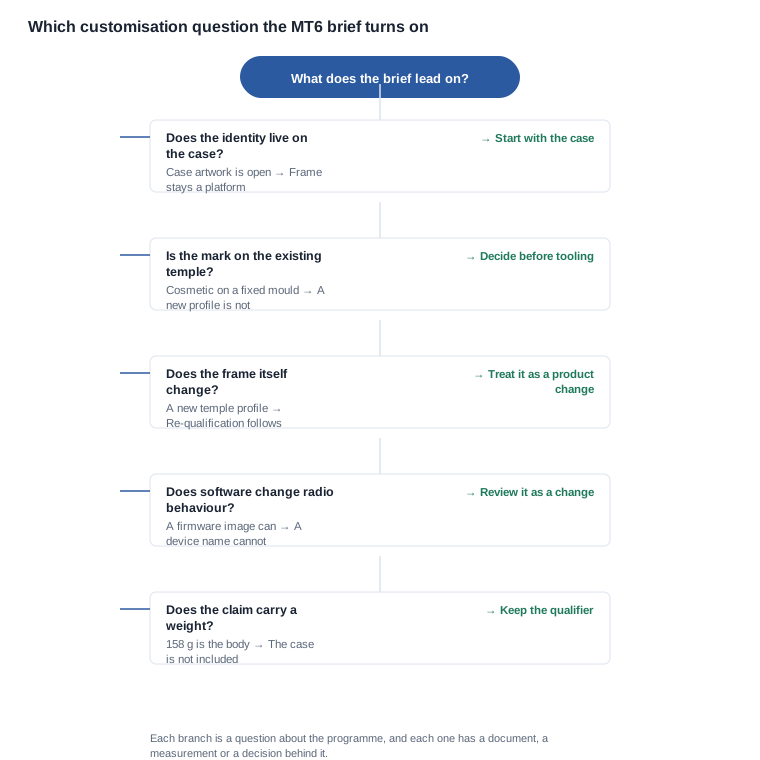
The decision tree above is the practical form of all of that. Each branch is a question about the programme rather than about the product, and each one has an owner and an evidence source: the case question is answered by artwork, the mark question by a proof, the frame question by a conformity review, the software question by a written scope, and the weight question by a qualifier.
Step one: decide what the case and the packaging carry
The case is the most brandable object on this model, and it is also the one that is easiest to treat as an afterthought. Three routes sit inside it, and they have different lead times and different failure modes: the case artwork itself, the insert that sits inside it, and the box the case ships in. A programme that specifies the case artwork and leaves the insert and the outer box to be settled later has specified one third of what the customer actually holds.
The fold geometry is what makes the case on this model different from a rigid dock. A folding case closes in a particular way, and the closing mechanism determines where a mark can sit, whether a strap or a latch is involved, and how the case stands when it is set down. Those are mechanical questions before they are artwork questions, and the way to settle them is to hold a physical sample and try the operations on it, rather than to approve a rendering of a case that has not been folded. The sequence that follows from that is straightforward: artwork first in principle, physical proof second in practice, approval of the proof third.
The packaging has its own dependencies, and the one that is most often missed is that the box has to carry the marking requirements for the destination market, which means the artwork and the compliance questions have to be resolved together rather than one after the other. The lead time analysis for private label platforms piece covers how a programme of this shape is normally sequenced, and it is worth reading alongside the certification work below, because the two run on different clocks and the artwork sits on the slower one.
The trade-off in this step is a real one, and it does not resolve into a recommendation. A brand that puts its identity on the case gets a visible, high-frequency touchpoint and takes on the mechanical work of specifying a folding object. A brand that puts its identity on the frame gets a mark that travels with the product, including into resale, and takes on the question of whether a mark on a frame is the right mark for a private label at all. What to ask, in either case, is which of the two objects the programme wants to be recognised by, because the answer determines the artwork, the proof, the lead time and the cost attribution of the whole step.
The accessory plan the case creates
A published case capacity is also an accessory plan, and it is the part of this model that a channel rarely thinks about until the first stock order. If the case ships with the product, then the case is in every unit and the accessory line above it is thin: there is no separate charging pad to sell, no dock to stock, and no second box for a buyer who already owns the frame. If the case is optional, then the programme has two configurations to describe, two artwork sets to think about, and a stock profile that changes with the mix.
The questions to ask are therefore not only about the case itself but about how the case is treated commercially: whether it ships with the product as standard or is an option, whether a spare case can be ordered on its own, and whether a case can be replaced for a customer whose case has been damaged. None of those answers is published, and each of them changes what a distributor has to hold and what a retailer has to explain. What to ask, and when, matters here: the case decision has to be made with the identity decision, not after it, because a programme that discovers late that the case is optional has to redo the packaging artwork, the insert and the insert language in the same week.
There is one more consequence of the folding case that belongs on the sheet, and it is a measurement rather than a term. The 158 g published figure excludes the case, so a programme that wants to describe the object a customer carries has to weigh the packed unit and record it against the configuration it was taken from. A packed weight is a more useful number for a channel than a frame weight, and it is also the one that nobody has.
Step two: place the mark and the colour on a fixed industrial design
A mark or a colour applied to an existing mould is a cosmetic change; a new temple profile is not. That distinction is the whole of this step, and it is the difference between a programme that can be scoped in days and one that has to be planned as a development project, because a new profile changes the industrial design of the product and carries with it a new tooling item and a fresh look at the fit.
Within the cosmetic group there are still two decisions that are worth making early rather than at artwork approval. The first is the type of mark, for the same reason it matters on every other model: an applied or printed label and a moulded or printed temple mark are different operations with different lead times, and the moulded or printed mark is the one buyers most often assume is included. The second is the position of the mark relative to the camera and the cell. On a fixed industrial design there are limited flat surfaces, and the camera housing and the hinge are exactly where a mark would destroy the product's function, so the position is constrained by the frame rather than chosen freely.
A third question is specific to a model with a published weight, and it is a question about the qualifier rather than the figure. If the programme publishes a weight for the finished product, it has to be the weight of the glasses body, excluding the folding case, and it has to say so. The alternative is to measure the packed unit and publish that, which is a different claim with a different product in the box. Either is defensible; what is not defensible is publishing 158 g as a property of the product as shipped, because the shipped product includes the case.

Step three: draw the line between a cosmetic change and a product change
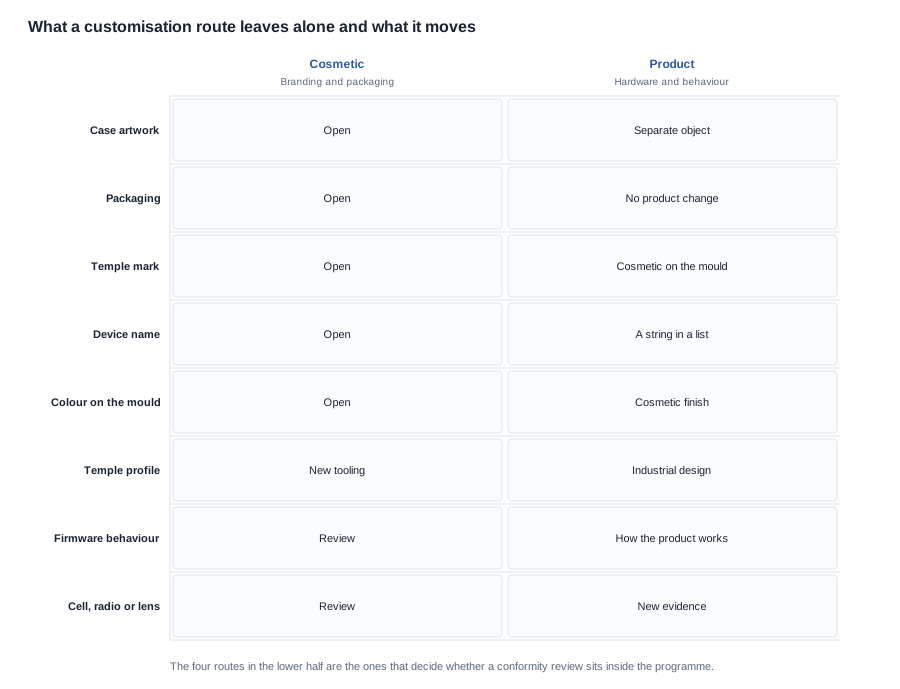
This is the step that determines the schedule, and it has to be settled on paper before artwork is approved rather than after the first sample is built. The test is simple to state and easy to apply badly: a change that leaves the radio module, the cell, the lens and the enclosure alone is a branding change, and a change that touches any of those four moves the product out of the territory of the evidence that already exists, so the conformity position has to be reviewed from the start rather than carried over.
The routes on the cosmetic side of that line are the ones a private label programme usually starts from: the mark on the temple, the colour on the existing mould, the case artwork, the insert, the packaging, and a branded name in the device list. The last of those deserves a note, because it is the smallest possible change and the one that most reliably makes a product feel private-label. A name in a settings list does not change how the radio behaves, and a Bluetooth device name is a string rather than a product modification.
The routes on the other side are the ones that trigger a review. A firmware image that changes radio behaviour, charging behaviour or the way application data is handled is a change to how the product works and has to be reviewed as one. A new cell, a different radio module or a changed lens is new evidence, not a variation. And the companion application is a separate product entirely: where it comes from, who publishes it, who supports it, and where the data it handles is stored are all undecided unless they are decided in writing. For a camera product that is a data-handling question and not a branding one, which is why it belongs in the scope document rather than in a later conversation with the application supplier.
The certification checklist sets out how the review normally runs, and the model-level documentation position for this platform is covered in the L2 Utral certification status. The point of drawing the line in advance is not paperwork for its own sake: it is that a cosmetic request that quietly becomes a certification project is the most expensive way to discover the boundary, and the boundary is much cheaper to find on a scope sheet than in a production schedule.

Step four: sequence the work so nothing waits on something else
The practical sequence, and the reason for it, is that artwork and tooling are the long poles and most of the other work can be prepared in parallel with them rather than behind them.
- Choose the model and the configuration — the platform, the case, the cell and the interface. Nothing else can start until this is fixed, and the case in particular is the part of the configuration that the whole identity plan hangs on.
- Confirm the customisation scope in writing — which routes are in, and which of them touch the radio, the cell, the lens or the enclosure. The scope document is the artefact that stops a cosmetic request becoming a certification project, and it is the artefact that the sample review is later measured against.
- Lock the case and the packaging artwork, and produce a physical proof rather than a screen proof. The fold geometry and the insert are only testable in the hand.
- Prepare the software routes in parallel — the application, the interface, the device name and the firmware — with the data-handling position settled before the listing goes live.
- Build the sample and review it against the written scope rather than against a general idea. A scope drift shows up here, and it is much cheaper here than in production.
- Re-confirm the conformity position against the final configuration, and record the outcome in the technical file so that the next order does not have to repeat the work.
The first item on that list is the one that is most often skipped, and the reason it cannot be skipped is that the configuration determines the case. A programme that fixes the identity before it fixes the case will discover the constraint when the case arrives, and the artwork will already be approved.
What the sample review is actually for
The sample review is the point where a scope written on paper meets a physical object, and its purpose is not to admire the product. It is to find the difference between what was written and what was built, while the difference is still cheap to correct. That means the review has criteria before the sample arrives, and the criteria come from the scope document rather than from a general impression of quality.
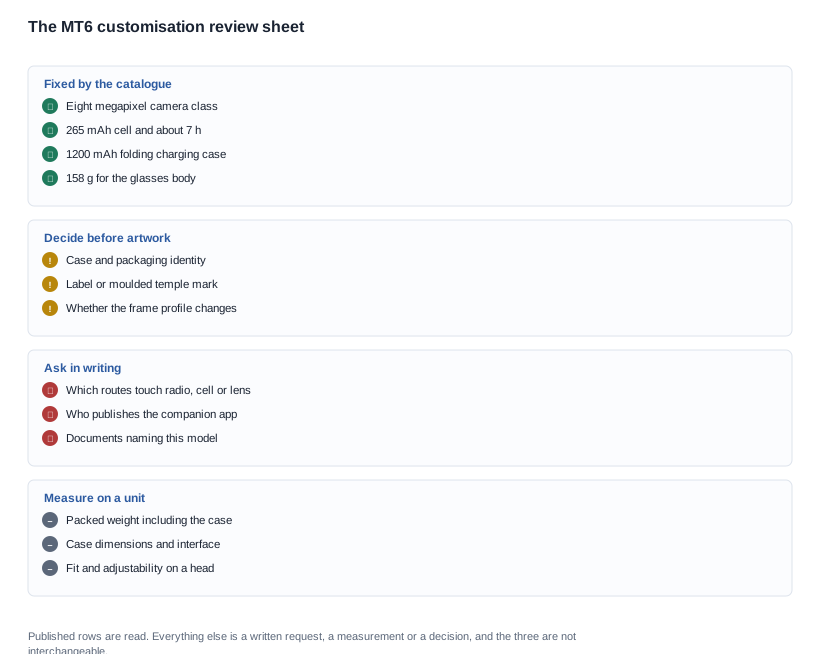
In practice, for this model, the criteria fall into three groups and each group is checked differently. The identity group is checked by handling: the mark, the colour, the insert and the case are inspected in the hand, under the lighting the retail photography uses, and the case is folded and unfolded the way a customer will fold it. The configuration group is checked by reading: the cell, the camera class, the charging method and the case capacity on the sample are compared against the rows the programme is being planned on, because a sample that does not match its own configuration sheet is a finding about the supplier rather than about the product. And the evidence group is checked by filing: the documents that arrived with the sample are put into the technical file in the order the scope sheet lists them, so that the gap between the scope and the evidence is visible immediately rather than at the end of the production run.
The review is also the moment to confirm that nothing has moved across the line drawn in step three. A firmware image that behaves differently from the one described, an interface that is not the one assumed, a lens that is not the one the configuration names — each of these is a scope drift, and each of them is much easier to correct on a sample than on a production line. A programme that reviews samples against a written scope gets a different outcome from a programme that reviews them against a general idea, and the difference shows up as rework avoided rather than as a better product.
The four questions to ask before you commit a budget
Four questions, asked at the right moment, settle most of what a customisation programme has to decide. Each one has a document behind it, which is what makes it answerable rather than a matter of opinion.
- Does this change touch the radio module, the cell, the lens or the enclosure? If it does, the conformity review is part of the project rather than a formality at the end of it, and the schedule has to be built around it.
- Who owns the tooling, and what happens to it after production? The contract terms guidance covers where the clause belongs, and it is much easier to agree before the first cut than to retrofit afterwards.
- Who publishes the companion application, and where does the data it handles go? Undecided unless it is decided in writing, and for a camera product it is part of the product a buyer owns rather than a detail of the firmware.
- What is the packaging minimum, and is it per model or per artwork run? A range where every model has its own artwork has different print economics from a range where several models share a box. We do not publish packaging minimums or print minimums, so they are quoted per programme and per artwork run, and the right time to ask is while the range is still being designed.
The criteria for deciding the order of those four are the same as the criteria for the programme as a whole: ask the questions that change the sequence first, and settle the ones that only change the paperwork later. The first question changes the schedule, the second changes the ownership position, the third changes what the product is, and the fourth changes the commercial terms of the print run.
On customising this model, our position is that the MT6 is a good private-label platform for a brand that wants the case and the packaging to carry the identity and the frame to stay a known quantity, and that the fork between a cosmetic change and a product change has to be settled on paper before anybody opens a design tool. We will not promise a customisation route for a category where the capability is not published, and we will not quote a price, a minimum order quantity or a lead time in an article, because those are terms of a programme rather than properties of a product. We will also not treat a firmware change as cosmetic without a review, and we will not publish 158 g without the qualifier that makes it true.
Tell us the model, the volume, the branding scope and the destination markets, and we will come back with what is available and what is not. The platform options are on our OEM ready platforms page, and the full route list is in the customisation notes.
Related reading
- Every route the camera family supports — customisation options
- How the certification position changes — certification checklist
- How a private-label programme is normally sequenced — lead time


