
The L2 Utral Smart Glasses certification status is not published at model level, and the reason is structural rather than accidental. The catalogue prints a hardware row for this model and no conformity row at all. What that row does print is unusually rich for a single line: a 13 MP resolution class, a 290 mAh cell, about seven hours of rated runtime, a charge time of two hours or less, a Type C charging interface, a charging case published as 900 mAh or 1400 mAh, and two feature lines carrying the variant names Utral and Pro Max.
That combination creates a documentation problem with three separate parts. A procurement team has to hold one model designation even though the row carries two variant names. It has to decide which case capacity is which configuration. And it has to source every conformity document from the supplier, because the catalogue publishes none of them.
This article sets out what the L2 Utral row does publish, what the naming question actually is, why the camera family's certification position does not move when a different camera model is selected, and which documents to request before packaging artwork is approved. The closing checklist turns that into a sign-off sequence that a sourcing team can run against a supplier, line by line, before a shipment is booked.
What the L2 Utral catalogue row publishes
Start with the page itself. The L2 Utral entry carries a 290 mAh cell, a rated runtime of about seven hours, a charge time of two hours or less, and a charging interface line reading Type C. The resolution class is 13 MP. The charging case line publishes two values on one row: 900 mAh and 1400 mAh. The feature lines are limited to two — the variant names Utral and Pro Max, and the Type C charging interface. The page is longer than the pages of its three sibling models that share the same 290 mAh cell and the same seven-hour runtime, because it adds a variant-name line and a two-value case line that those pages do not carry.
Every one of those published lines describes what the product is. None of them describes what the product is permitted to be sold as.
The catalogue's certification position is worth stating plainly, because it is the same position that applies across the whole camera range. The catalogue contains no per-model certification row anywhere. There is no certificate number, no issuing body, no validity period and no schedule of covered models published for this model or for any other. Counting the catalogue text directly, the terms CE, FCC and RoHS do not appear in it at all, and there is no record of a model-level certification reference marked as pending. The export certification page in the catalogue is an image page rather than a text page, carrying ten patent certificates — eight appearance-design patents and two utility-model patents — and a patent is not a conformity document for a radio product.
That is the material fact a buyer has to work with: the hardware rows are published, the conformity rows are not, so the conformity evidence has to be requested, and it has to be requested for a model whose designation is not yet settled.
A few structural comparisons make the model easier to place. The 13 MP resolution class contains three models in the catalogue — the L2 Utral and the S7, and the L1 Pro — while the 8 MP class contains eight. Resolution class is published for all eleven camera models, but for the L2 Utral the catalogue publishes the resolution class and nothing beyond it: no sensor model, no field of view, no frame rate, no video format and no stabilisation behaviour. Anything a buyer wants to say about image quality has to come from a sample evaluation rather than from the catalogue.
Charging method splits the eleven camera models three ways. Five are published as magnetic charging — the KY06 and the MT5, and the V06 and the S7, and the V03. Two publish a Type C interface — the V03 Pro and this model. Four publish no charging method at all — the CY03 and the CY05, and the MT6 and the L1 Pro. Four camera models carry no charging method line while publishing a case capacity, which is a reminder that a missing line is a missing line, not a negative answer. The L2 Utral is one of only two camera models with a published Type C charging interface, and the interface type matters to the file because it is what a buyer checks against the cable and charger listed in the bill of materials.
The case rows are more tangled, and the distinction between two kinds of absence has to be held carefully. Five camera models publish a case capacity: the CY05 and the CY03, and the L1 Pro — each at 1400 mAh, the L2 Utral at 900 mAh or 1400 mAh, and the MT6 with a 1200 mAh folding case. The catalogue prints no case row at all for the V03, the V06 or the S7, so for those three the case capacity is simply not published. The V03 Pro is a different case entirely, because there the catalogue states explicitly that there is no charging case. Not published and explicitly none are two separate pieces of information, and a buyer who merges them will misread the market.
Protection class narrows the picture further. The only two catalogue pages carrying an IP54 line are the V06 and the S7. The L2 Utral has no ingress rating row, so there is no protection claim available for this model and none can be printed on artwork, on a listing or in a tender response.
The remainder of the file-relevant data is simply not published for this model: weight, dimensions, sensor model, storage capacity, unit price, minimum order quantity, lead time, warranty terms and certificate numbers. One number needs an explicit warning. The only weight published anywhere in the catalogue is 158 g, and it belongs to the MT6 glasses body including its battery and camera but excluding the folding case. It cannot be carried across to the L2 Utral or to any other model, and a specification sheet that repeats it as a frame weight for this model is simply wrong. The model limitations note collects the rest of what the catalogue leaves open for this model.
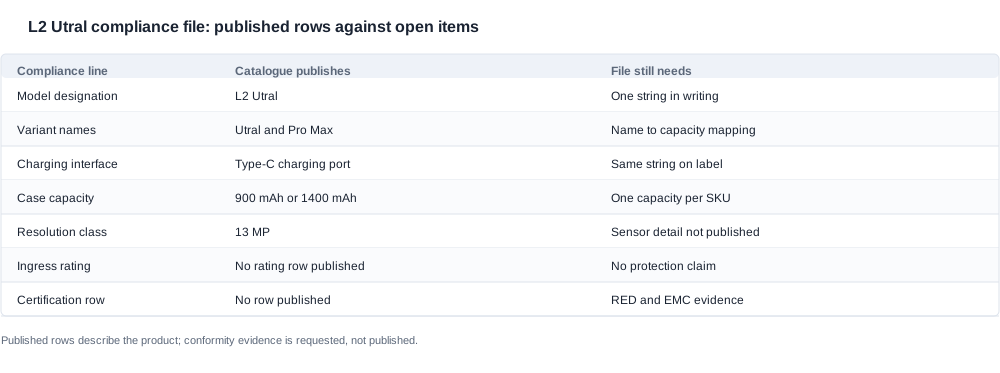
The rows that will sit in a compliance file for this model look like this:
| Compliance line | What the catalogue publishes | What has to come from a document |
|---|---|---|
| Model designation | L2 Utral | One string, confirmed in writing |
| Variant names | Utral and Pro Max | Which name goes with which capacity |
| Charging interface | Type C | Interface named on label and file |
| Case capacity | 900 mAh or 1400 mAh | One capacity defined per SKU |
| Resolution class | 13 MP | Sensor detail is not published |
| Ingress rating | No rating row published | No protection claim available |
| Certification row | No row published | RED and EMC evidence requested |
The naming question behind the L2 Utral variant rows
The row for this model names the model L2 Utral and, in the same row, prints the variant names Utral and Pro Max. The catalogue states nothing about which of the two names is the base name, nothing about which one a buyer receives by default, and nothing about which case capacity corresponds to which name. Two names and two capacities sit side by side with no correspondence published between them.
This is a documentation consistency problem, not a product problem. Nothing in the hardware row suggests a fault, and no row indicates that two different products exist. The difficulty is that a compliance file, packaging artwork, a customs declaration and warranty paperwork each need one identical string, and this catalogue row hands over two candidate names and two case capacities with no published mapping. That is the specific reason the file takes longer to assemble for this model than for a camera model whose row carries a single name.
The comparison with the rest of the camera range is instructive. Two camera models publish colour rows — the V03 Pro and the V06 — and a colour is a packaging attribute rather than a model designation. The L2 Utral is the only page among the eleven camera models that publishes a variant-name line, and it is also the only one that puts two case capacities on a single row. Two attributes that appear once each in the range are appearing together on this model, which is why the file for this model has more open items than the file for a sibling model, even though the certification position is identical.
There is one further naming trap to avoid, and it is worth naming explicitly because it is easy to walk into. A catalogue row that prints two parallel names does not authorise a buyer to join them. If artwork prints the two names run together as one string, or adds a suffix of its own, then the label no longer matches any name the catalogue or the supplier has published, and a declaration of conformity naming a published model designation does not automatically cover a string that nobody has ever declared. The same applies to the case capacity: a configuration named in artwork that does not appear on the supplier's own document set is a configuration with no evidence behind it.
The way to close this is not analysis but an instruction. Ask the supplier to confirm, in writing, one designated model string and one confirmed correspondence between the published names and the published case capacities, and then use that string everywhere without variation. A naming answer is acceptable when it is a string rather than a description, when it comes on the supplier's own letterhead or in a signed document rather than in a sales reply, when it states explicitly which capacity belongs to which name, and when it names the string that will appear on the label, the packaging artwork, the declaration of conformity, the customs declaration and the warranty card.
A practical way to test a supplier's answer before you commit: read it as a customs broker would. If the answer does not let a broker write the same string in three different places without guessing, it is not yet an answer. If the answer contains the word Pro Max with no explanation of what it distinguishes from Utral, it is a marketing label rather than a designation, and it cannot be the key in a technical file.
The questions worth putting in writing, in this order, are short:
- Which single string is the model designation for this product, exactly as it will appear on the product and on the declaration of conformity?
- Are Utral and Pro Max separately orderable configurations, or are they names for the same product?
- Which case capacity is supplied with each name — 900 mAh, 1400 mAh, or a choice?
- Is the frame supplied without a case as a third configuration, and if so does it carry a separate designation?
- Which string will the supplier's own documents use, and does the covered-model schedule list both names?
- Is the covered-model schedule able to cover both capacities under one designation, or does the supplier treat them as two entries?
Question 5 and question 6 are the ones that decide how much document work follows. If the supplier confirms that one designation covers both capacities, the file describes one product with two configurations. If the supplier treats the capacities as separate entries, the file describes two products, and the test evidence, the labelling plan and the artwork all have to be split accordingly.
Why the camera family's certification position is unchanged
Moving from one camera model to another does not change the certification position, because that position is set at catalogue level rather than at model level. One company-level export certification page sits in the catalogue whose content is images, publishes no per-model certification row, and contains no CE, FCC or RoHS reference in its text. Every one of the eleven camera models inherits the same position, and every one of them inherits the same gap: no certificate number, no issuing body, no validity period, no schedule of covered models.
What does change between models is the number of configurations that a file has to describe. A camera model with one name, one case configuration and a published interface needs a short file. This model has two names and two capacities, so its file needs more entries, more cross-checks between the label and the document set, and a careful record of which capacity ships in which carton. The underlying certification work — the radio assessment, the electromagnetic compatibility assessment, the restricted-substance documentation — is not heavier for this model. Only the mapping work on top of it is heavier.
Two frameworks are the ones a camera glasses file can be built on, and they cover different things. The Radio Equipment Directive (EU) 2014/53/EU governs the radio side, covering spectrum and radio behaviour. The EMC Directive 2014/32/EU governs electromagnetic compatibility. A radio-equipped camera model sits inside both, and a buyer should expect the supplier's document set to address them separately rather than as one combined statement. The restricted-substance regime is a third, separate piece of work with its own declaration and its own scope, and it is not part of either directive.
Three document types get confused in supplier replies, and separating them is most of the work in a first conversation. The laboratory test report is the evidence that the sample was assessed. The certificate is what the laboratory or the conformity assessment body issues, carrying a number, an issuing body and a date that can be checked against the issuing body's own register. The declaration of conformity is the manufacturer's own legal statement, signed, and it is the document that names the models it covers. Only the last one carries the model list a buyer can check against the goods in the carton, and only the last one is what a certificate actually attaches to.
There is a commercial reason to care about the distinction between a family-level statement and a model-level one. Suppliers frequently hold documentation that names a family, a brand or a product line, and that documentation does not travel to a different model or to a different configuration. For this model in particular, a family-level statement tells a buyer nothing about whether the variant names and the two case capacities sit inside the covered scope, which is the question the buyer actually needs answered.
The evidence available to you falls into four layers, and knowing which layer a fact sits in tells you how long it will take to obtain. What the catalogue publishes can be read today. What the supplier holds can be requested and usually arrives as a document. What only a third-party laboratory can issue has to be commissioned, and it sits on the critical path. What will never be published — unit price, minimum order quantity, lead time, warranty terms — has to come out of the quotation, and the camera glasses certification note sets out how that commercial file is usually assembled.
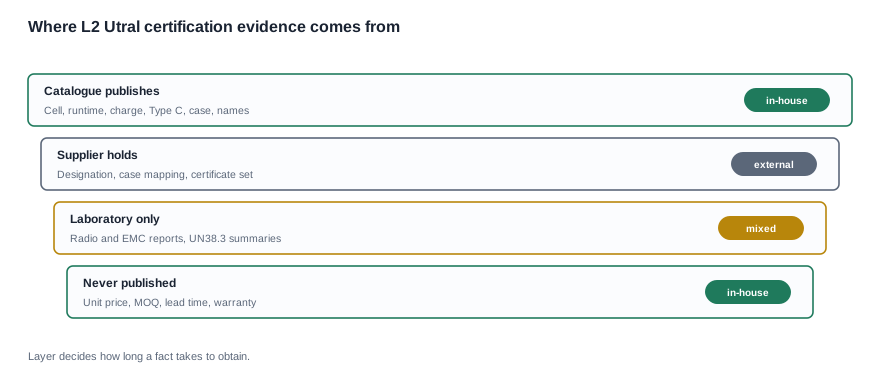
The last layer deserves a note for the sourcing team, because it is where specifications get quietly invented. Unit price, minimum order quantity, lead time and warranty terms are not published for this model, and a supplier that offers them verbally is offering something a buyer cannot put into a purchase agreement without writing it down. A quotation that carries those four items, alongside the certificate numbers and the covered-model schedule, is a file a procurement team can act on. A catalogue page is not.
What to request for the L2 Utral before artwork
Sequencing matters here more than it does for a model with a single name, and the reason is cost. Designation, variant names and case configuration are inputs to the conformity documents, not outputs of them. If artwork is approved before those three are confirmed, and any of them then changes, the artwork is reprinted, the label is reissued, and the document set has to be reissued to match. If they are confirmed first, the documents are written once and the artwork follows them.
The request itself breaks into four groups, and it is worth asking for them in one message so that a supplier is not answering in instalments.
Naming and configuration. The designated model string, the status of each published variant name, and the capacity correspondence between them, all in writing. The decision needed from the supplier is whether the frame is supplied without a case as a separate configuration, because a three-configuration answer changes the number of entries in the technical file, the number of label variants and the scope of the battery transport documentation.
Radio and electromagnetic compatibility. The declaration of conformity under the Radio Equipment Directive (EU) 2014/53/EU with its certificate number, issuing body, validity dates and a covered-model schedule that lists this model and every variant name intended to ship. Alongside it, the electromagnetic compatibility test report and the standards list used, with the EMC Directive 2014/32/EU addressed explicitly. A buyer should also ask what radio module and output power sit behind the model, since the catalogue publishes no radio parameters for any camera model, and a module reference is what lets a technical file be checked against a future product revision.
Case, packaging and battery. The case configuration per SKU, the transport documentation covering the 290 mAh frame cell and the cells in whichever case capacity is ordered, with UN38.3 test summaries for each, and confirmation of whether the frame-only configuration has its own transport scope. On packaging, the artwork string, the label content, the manual and the warranty card should each be confirmed to carry the same designated string. A case that is printed with a different name from the frame is a labelling inconsistency waiting to be found at inspection.
Where the file lands. The declaration of conformity needs a signatory, and a technical file needs an owner and a retention period. For a European Union destination, the economic operator details that appear on the label, on the accompanying documents and on the online listing need to be identified, and the listing change is often the longest lead item in a launch because it sits after the artwork rather than beside it.
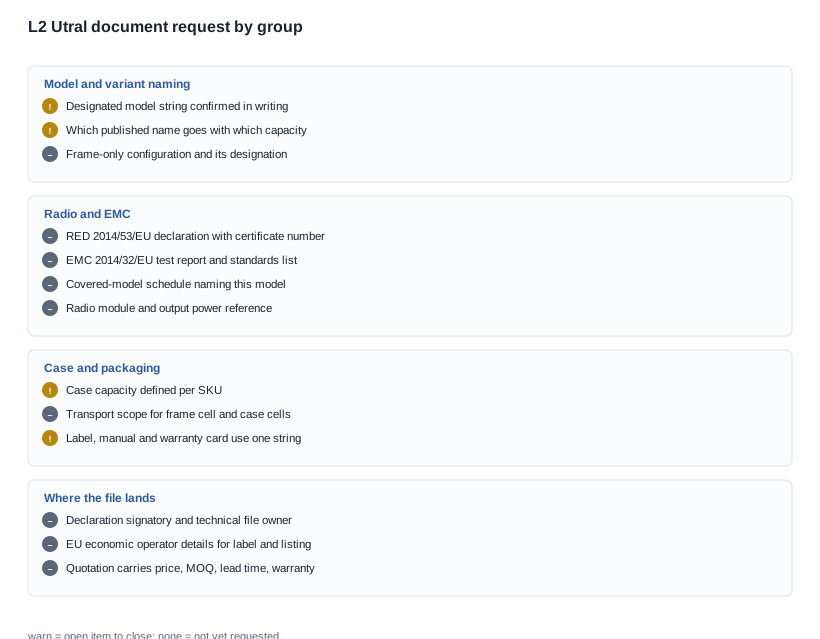
The commercial items sit alongside the technical ones and are just as often the reason a file stalls. A purchase agreement for this model should carry the designated string, the two published case capacities and their correspondence, the certificate numbers, the covered-model schedule, the unit price, the minimum order quantity, the lead time and the warranty terms. None of the commercial four is published in the catalogue, so all four have to arrive in the quotation. Sample order and bulk order terms should be settled on the same document set, because a sample that arrives under one designation and a bulk shipment under another is the most expensive version of this problem.

Radio and electromagnetic compatibility work is normally the long pole, because a laboratory slot cannot be compressed by a procurement team. Ask for the laboratory's booking position and the sample submission requirements in the same message as the document request, so that the two timelines run in parallel rather than in sequence. A supplier who can confirm a laboratory slot and a naming answer in one reply has told a buyer the two things that matter most about the schedule.
The L2 Utral certification status checklist
Three questions decide whether this model can move forward, and they are worth answering in order rather than together. Can the compliance file enter this shipment? Can the packaging print this model? Can the product enter this market? A no on the first blocks the second, and a no on the second blocks the third, so the order is also the dependency order.
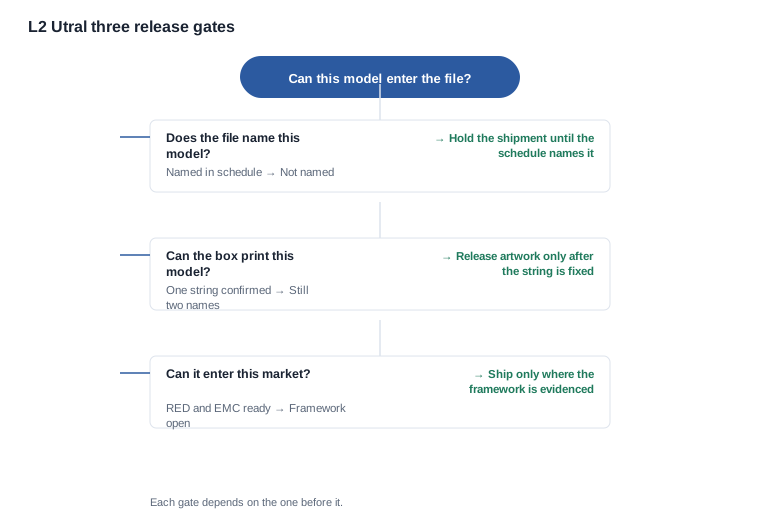
The gate on the shipment is documentary. The file is complete for this model when the designated string is confirmed in writing, the certificate numbers, issuing bodies and validity dates are stated, the covered-model schedule names this model and its variant names, the electromagnetic compatibility report is in hand, the restricted-substance declaration is separate from the radio documents, and the battery transport scope covers the cells in the case capacity being ordered.
The gate on the artwork is a consistency test. The string on the box, on the label, on the manual, on the warranty card, on the declaration of conformity and on the customs declaration must be one string, and the case capacity printed on the packaging must be the capacity that the supplier's document set covers. If the packaging artwork is still open, it should stay open until the naming answer is in, because artwork is the cheapest thing to change before it is printed and among the most expensive to change afterwards.
The gate on the market is the framework question. For a European Union destination, the file has to address the Radio Equipment Directive (EU) 2014/53/EU and the EMC Directive 2014/32/EU, and the responsible economic operator details have to be ready for the label and the listing. For other destinations the requirements differ, and the right answer to a buyer is to state the destination rather than to assume it.
The published position can be summarised without softening it. The catalogue publishes the hardware for the L2 Utral and publishes no conformity evidence at all: no certificate number, no issuing body, no validity period, no covered-model schedule, and no CE, FCC or RoHS reference anywhere in the catalogue text. The frames you can check today are the resolution class, the 290 mAh cell, the roughly seven-hour runtime, the two-hours-or-less charge time, the Type C interface, the two case capacities and the two variant names. Everything else on the list is either a document to request, a laboratory item to commission, or a term to be written into a quotation.
Two questions are worth keeping in front of the team while the file is being assembled. The first is which capacity corresponds to which published name, because that single answer determines how many entries the technical file, the label plan and the artwork each need. The second is whether the catalogue's absence of a certification row means anything about the product, and it does not: it means the catalogue does not publish one. The same distinction runs through the rest of the file, from ingress rating to weight to lead time. Nothing in this model's position is a red flag about the hardware. It is a list of items to request, in a particular order, before artwork.
Tell us the destination market, the case configuration you intend to sell and the volumes you are planning, and we will come back with which of the documents above we can supply directly, which have to come from the supplier, and which have to be commissioned.
Related reading
- The same model at the sample stage — L2 Utral buyer review checklist
- How the charging options on this model are set out — L2 Utral charging options
- The sibling 13 MP model this one is often compared with — L2 Utral versus L1 Pro
- The published hardware rows in full — L2 Utral specifications and features
- The camera range as a whole — AI camera glasses
For the L2 Utral, the compliance file closes on one designated string and one confirmed case capacity: send us those two and we will say which documents we can supply and which have to come from the supplier.


