
A sample order in this category is a specification instrument, not a purchase. Its cost is decided by what you choose to measure rather than by what the supplier chooses to send, and its value is decided by how many of your open questions it can actually close. The failure mode is not a bad sample. It is a good sample that settles nothing, followed by a production order that repeats every question the sample was supposed to answer.
That is why "increase your sample order" is usually the wrong instruction. More units of the same build answer fewer questions, not more. The productive move is to separate the questions that hardware can settle from the questions that only a production lot can settle, and then to size the sample programme against that split rather than against a number.
Smart glasses sample policy: what one unit proves, and what it cannot
The short answer on smart glasses sample policy
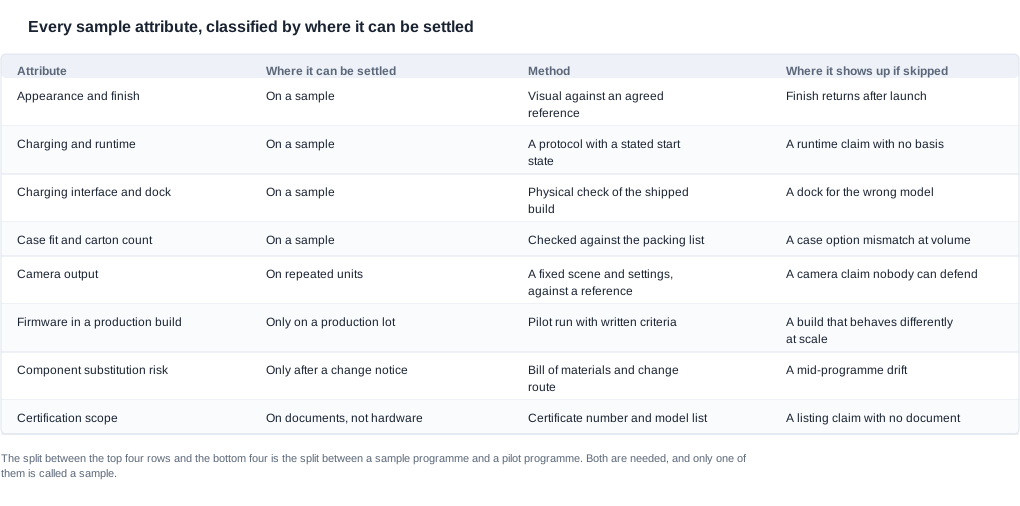
A sample settles what can be observed on a finished unit — appearance, finish, charging behaviour, the presence and fit of the charging case, the charging interface, the feel of the hardware. It does not settle production consistency, firmware behaviour inside a real production build, the effect of a component substitution, or the scope of the documentation. Those four need a pilot lot and a document file, not another sample.
So the answer to how to increase a sample programme sensibly is to increase the precision of it rather than the quantity: one evaluation sheet, written before the order, with a method and a limit per attribute; one build identity recorded against every unit received; and one number of rounds, with the cost of each stated in advance. A programme of two units with a signed sheet beats a programme of ten units without one.
The buyer behind this question and the decision the sample has to support
The reader is a brand-side procurement manager, a channel buyer or an e-commerce buyer who is either about to place a first order and wants to see the product, or who has already seen a sample and is not sure what it proved. Often they are working to a channel deadline, which is why the instinct is to ask for more units quickly.
What the sample has to support is a decision with a specific shape: whether to place an order, on which configuration, at what quantity, with which documentation. A sample programme that cannot be summarised into those four answers has not done its job, however many units arrived.
The thing they are managing is the risk of a wrong decision rather than the cost of the samples. A buyer who approves on the basis of a hand-built unit and then receives a production lot that behaves differently has not saved money on samples; they have moved the cost into the first shipment, where it is larger and where the channel is already watching. The second thing they are managing is the internal one: an evaluation sheet with methods and limits is the only artefact that can be shown to a colleague and defended.

The commercial background behind a smart glasses sample programme
Why a sample costs more than its unit price suggests
The unit price of a sample is not the cost of the sample programme. The programme also carries the evaluation sheet, the time the buyer's own people spend on it, the freight in both directions if the sample comes back, the rework implied by a second round, and the delay while a decision waits for a meeting. A sample round that has to be repeated because the sheet was written afterwards costs twice as much as one that was written first, and the second cost is not in any quotation.
There is also a version of the cost that appears later. A sample that approves a configuration the factory cannot build at volume — because it is a modified unit, or because it depends on a finish that is a special run — moves the price of the sample into the unit price of the production order and then into the returns line. The supplier is not being dishonest in that case; the buyer simply bought the wrong kind of thing.
The published position explains why the sample programme has to be designed rather than requested. Production lead times, minimum order quantities and unit prices are not published for our operation, so a buyer cannot price a sample from a list and has to ask. What the catalogue does publish is the specification set, and the specification set is what determines what a sample is for.
What the published specification set lets you settle on paper instead
Because the specification is published, a good share of the usual sample questions can be closed without a unit arriving at all, and that is where a sample budget should be saved.
- The resolution tier is published across eight camera models at 8 MP and three at 13 MP, so the tier a programme is buying is a documented choice rather than something to be discovered on a bench.
- Cell capacity and rated use are published per camera model, so a runtime expectation can be written down before the sample arrives, and the sample can then be checked against a figure rather than against an impression.
- Charge time is published for all twenty-eight models — up to two hours on twenty-six of them and about one hour on the D17 and the ZH12 — though without a starting state of charge or a termination criterion, so the sample protocol has to supply both or the figure cannot be used as a reference.
- The charging method is published on most models, so the dock or the cable in the carton is a checkable item rather than a surprise, and on the four camera models that publish no charging method row it is an item to confirm rather than to check.
- The case options are published, so the case in the sample carton is either the option that was ordered or it is not, and the difference is visible immediately.
- Colours are published for two camera models — three on the V03 Pro and four on the V06 — so a finish comparison against a reference has a bounded set to compare against.
- Not published, and therefore not sample-settled: sensor models, acoustic measurements and thresholds, ingress test report numbers, certificate numbers and validity dates, the Bluetooth version for any camera model, and the weight of any model except one.
The list of what is not published is the more useful half. Those rows cannot be closed with a unit in a box, and a sample programme that tries to close them is a sample programme that will conclude without an answer.
The thresholds that decide whether a smart glasses sample round is worth funding
How each sample attribute is classified and measured
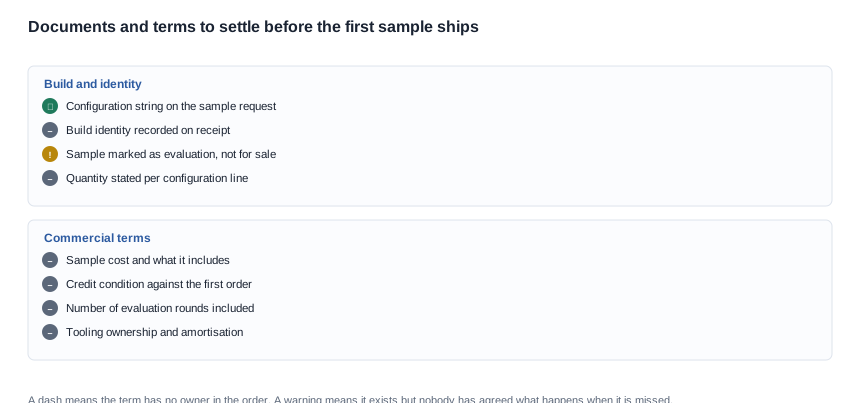
The table below is the working criteria set for a sample programme. Each row states the attribute, where it can honestly be settled, the method that makes it a measurement rather than an opinion, and where it surfaces if the classification was wrong.
| Sample attribute | Where it can be settled | The method that makes it a measurement | Where it surfaces if misclassified |
|---|---|---|---|
| Appearance and finish | On a sample | Visual comparison against an agreed reference | Finish returns and channel complaints after launch |
| Charging and runtime | On a sample | A protocol with a stated start state and duty cycle | A runtime figure that cannot be defended later |
| Charging interface and dock | On a sample | Physical check of the shipped build and its accessories | A carton with the wrong dock at volume |
| Case fit and carton count | On a sample | Checked against the packing list | A case option mismatch discovered at receiving |
| Camera output | On repeated units | A fixed scene and fixed settings, against a reference unit | A camera claim with no repeatable method |
| Firmware in a production build | Only on a production lot | A pilot run with written acceptance criteria | A build that behaves differently at scale |
| Component substitution | Only after a change notice | The bill of materials and the change route | A mid-programme drift nobody can explain |
| Certification scope | On documents, not hardware | A certificate number with the model list it covers | A listing claim with no document behind it |
The last three rows are the ones a sample programme usually gets wrong, and the reason is always the same: they look like hardware questions. They are not. A firmware build assembled by hand for evaluation behaves differently from a build assembled on a line, a substituted component changes behaviour without changing appearance, and a certificate covers a model list rather than a physical unit. Asking a sample to settle them is asking the wrong instrument to do the job.
The published figures a sample can be checked against
A sample is worth more when the acceptance limit is already written, and the published rows give a buyer most of the limits for the attributes that can be tested on hardware.
- Runtime, against the published rated use for that model: five to eight hours on the V06, the V03 Pro and the S7, and the V03; six to eight on the KY06 and the MT5; about seven on the CY03 and the CY05, and the L1 Pro and the MT6, and the L2 Utral.
- Charge time, against the published figure, provided the protocol states the start charge state and the end condition, because the published number carries neither.
- Case and dock, against the published case option and charging method for that model.
- Weight, only where a figure is published — the MT6 glasses body at 158 g including the 265 mAh cell and the camera and excluding the 1200 mAh folding charging case, whose own weight is not published. For every other model, a weight on the sample is a sample-specific figure and should be recorded as such rather than as a specification.


Verifying a smart glasses sample programme before the round closes
Working through the sample evidence in sequence
- Write the evaluation sheet before the sample is ordered. Every attribute, the method, the limit and who signs it off. A sample programme without a signed sheet ends with a subjective opinion and a second round.
- Ask what build the sample is — a stock unit, a modified unit or a pre-production build — and record that identity against the unit on receipt. A sample that cannot be traced back to a build proves nothing about the production lot.
- Photograph and log on receipt, against the sheet, before anything is powered on. The photograph is the only evidence that survives the conversation about what was different.
- Split the sheet into two columns: the attributes hardware settles, and the attributes that need a pilot lot or a document. Mark the second column as scheduled work with an owner, so it does not quietly become an open question at the order.
- Agree the number of rounds and the cost of each, before the first round starts. Unlimited revisions at the first round's price is not a term; it is an assumption.
- Write the credit condition into the order confirmation. What the sample charge is credited against, and what happens if the programme does not proceed.
The questions to ask about a smart glasses sample programme, and what completes each answer
- Is the sample a stock unit, a modified unit or a pre-production build? Completion: the build identity, recorded on receipt.
- What does the sample charge include? Completion: an itemised list, including the accessories in the carton.
- Is the charge credited against the first order, and under what condition? Completion: the condition in writing, with the order value attached.
- How many evaluation rounds are included, and what triggers another? Completion: a number and a trigger.
- Who owns any tooling or mould, and how is it amortised? Completion: an ownership statement and a treatment on cancellation.
- Can the configuration be built again at volume? Completion: a confirmation, with the minimum stated.
- What is the build identity of the unit I am approving? Completion: a recorded identity, not a description.
Seven questions, asked in this order, are enough to establish which supplier has actually priced a sample programme rather than quoted a unit.
Where smart glasses sample programmes go wrong
Four smart glasses sample programme failures that arrive as a surprise, and the control for each
The sample that was not the product. The symptom is that the approved unit has features or finishes that the production order cannot reproduce, and the gap is discovered after the order. The root cause is a modified unit shipped for evaluation, with no build identity recorded. The control is a build identity on every sample, carried onto the evaluation sheet and into the order.
The attribute tested on the wrong instrument. The symptom is a production-consistency characteristic judged on a single hand-built unit, and a disagreement at the first inspection that neither party can resolve. The root cause is that the evaluation sheet did not distinguish the hardware-settled attributes from the production-only ones. The control is the split sheet, and a pilot lot scheduled for the second group before the order is placed.
The second round that was not budgeted. The symptom is a revision, a new sample, a new cost and a new wait, all of which land after the channel date has been promised. The root cause is that the number of rounds was assumed rather than agreed. The control is to state the number of rounds and the cost of each one before the first round closes.
The credit that disappeared. The symptom is a sample charge that was expected to be credited against the first production order and was not. The root cause is that the credit was discussed but never entered into the order confirmation. The control is to write the credit condition into the order confirmation with the order value attached, so it cannot be lost in the transition from a sample order to a production order.
What follows is standard in a sample policy, and none of it is grounds for changing supplier. Each is a term that can be written down before the first unit ships.
The negotiation on sample terms, item by item
The commercial treatment of a sample programme is worth settling early, because the sample charge itself is the least important number in it.
What moves. The sample charge itself, once a configuration and a quantity are attached to it — a programme with several lines and a common accessory set is often cheaper per unit than a single unit sent alone, because the supplier is not setting up for one shipment. The credit condition against the first production order. The number of evaluation rounds included. The customisation mock-up and artwork preparation, which behave like tooling and amortise across the programme rather than acting as a one-off. The freight arrangement, including who arranges the return of a rejected unit and who pays it.
What does not move. The sample charge as a percentage of the unit price, because a sample is priced against a build, not against an order. The cost and cycle of the regulatory route for the destination market, which is a per-model and per-market cost and is not a sample item. And the cost of the tooling or mould itself, though its ownership and its amortisation across the first order are negotiable.
What must not be traded. The evaluation sheet. A supplier who accepts the sheet as part of the order has accepted the buyer's acceptance criteria, which is a far stronger position than a supplier who has agreed verbally to make changes. And the credit condition, because a credit that is not written down is a discount the buyer has already forgotten.
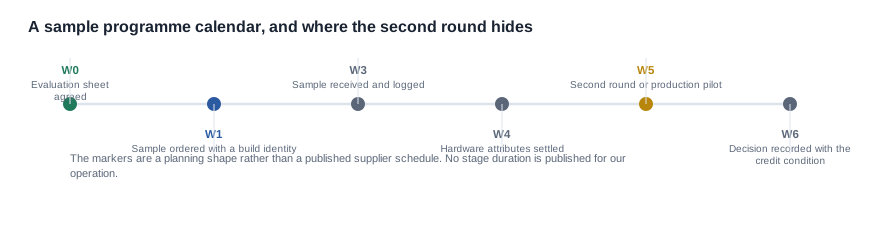
The clauses worth having are the build identity, the evaluation sheet as an agreed document, the number of evaluation rounds included and what triggers another one, the sample credit condition with its order value, the tooling ownership and amortisation statement, and the treatment of a cancelled programme. That is a short list, and it is the difference between a sample programme and a purchase.
One smart glasses sample programme, and where Cynrin draws the line
A worked example, written as a reasoning exercise
This is a reasoning exercise, not a client project. No customer is described and no order is claimed; the model, the quantity and the market are assumed so that the reasoning can be followed.
The scenario: a brand wants an audio-glasses programme for a channel buyer and has asked for three samples. One is a catalogue unit, one is a sample with the brand's logo applied, and one is a pre-production build of a colourway that has not been tooled. The channel wants a decision in three weeks.
Step one is to write the evaluation sheet, and the sheet immediately shows that the three samples answer different questions. The catalogue unit settles appearance, charging and the case. The logo sample settles branding and the packaging artwork. The pre-production build settles a colourway that is not yet buildable at volume, which is a question about tooling rather than about the product.
Step two is to split the sheet into hardware-settled and production-only attributes. The hardware column is now clear. The production column contains production consistency, firmware behaviour inside a real build, component substitution risk and the certification scope — and none of those can be closed by any of the three samples.
Step three is to schedule the production column instead of trying to sample it. Consistency and firmware behaviour need a pilot lot. Component substitution needs a bill of materials and a change route. Certification scope needs documents, and because certificate numbers and validity dates are not published for our operation, the request is for the document set for the ordered configuration with a named producer rather than for a number neither side can quote.
Step four is to settle the commercial terms before the samples ship: what the charge covers, the credit condition against the first production order, one round included with the cost of a second stated, and who owns the tooling if the programme is cancelled.
Step five is to decide. The three samples together answer the hardware questions and hand back a dated pilot and a document request for the rest. The channel gets an answer in three weeks because the decision is defined, not because more units were bought.
Where Cynrin stands on samples, and the next action
We will say plainly that we do not fill a specification gap with a number that cannot be traced to a document, and that a sample programme should be priced as a measurement programme rather than as a purchase. We publish the model data, the case options, the configuration options and the endurance figures, and we do not publish unit prices, minimum order quantities or lead times, so the sample has to be specified in terms of what it is meant to settle rather than ordered as an item.
What we will do is take a use case, a configuration and a market, and tell you which parts of your question are settled by the published data, which parts need hardware, and which parts need a pilot lot or a document. What we will not do is quote a sample from a photograph, or treat an open row as closed because a sample was sent.
The sample policy and cost section sets out what a sample programme covers, how to order a sample is the procedural version, and do you ship samples with tracking covers the freight and the return.
Send the configuration, the quantity and the market, and we will say which parts of your question a sample settles, which parts it cannot, and what the rest needs.


