
Smart glasses for education: the condition a class set has to survive
Smart glasses for education fail in a way that has nothing to do with how the device behaves. A classroom set is a scheduling problem wearing a hardware problem's clothes: twenty-eight units that must be in the right room at the right period, charged overnight, handed between staff and students, wiped down between users, and available again the next morning. Ask a school whether the devices work and they will say yes. Ask how many were actually in use in period three and the number will be smaller, and the reason will almost never be a fault — it will be that the set was not charged, or that the wipe instruction was never written down, or that nobody owns the trolley.
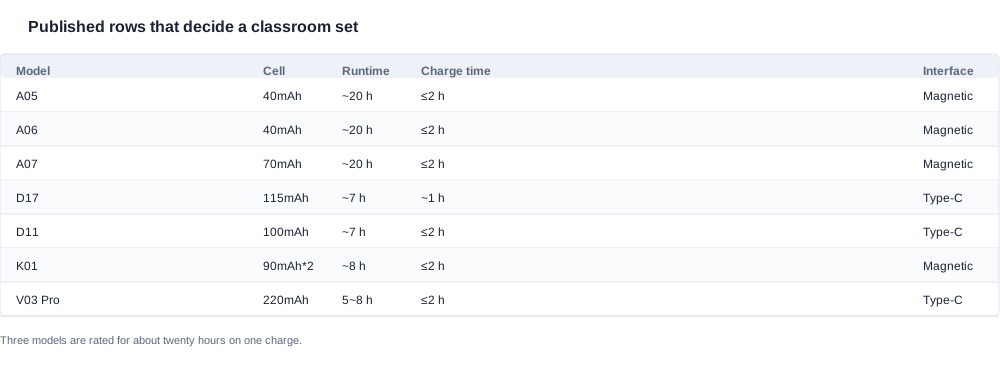
The catalogue contains exactly one row that matters more here than anywhere else in this site, and it is easy to miss because it sits in a small corner of the range. Three models publish a rated runtime of about twenty hours on a single charge: the A05 and the A06 at 40 mAh and the A07 at 70 mAh. Every other model in the catalogue is rated between roughly one hour of charge time and about eight hours of runtime. A twenty-hour rating is what makes "charged overnight, used all week" a workable plan for a shared set; a seven-hour rating turns the same plan into a daily logistics exercise that the school did not budget for. That single published row should do more work in an education procurement than any feature name, and it is the row that a buyer comparing screens will miss.
Around it sit the other facts that shape a school purchase: all three of those long-rated models charge magnetically, which on a shared classroom desk means an exposed contact face that has to be wiped between users; the catalogue publishes no per-model certification row at all, so the records a school or a district will ask for have to be requested in writing; and the A05 and the A06 publish a lens row that the supplier describes in terms of posture, distance and a fogging lens, with no measurement, no test method and no claim beyond that row — so it is a feature to evaluate, never a result to rely on.
Who this is for and what is being bought. The reader is a buyer for a school, a district, a university faculty or a channel partner supplying educational institutions, and the task is to specify the set, the charging infrastructure, the shared-handling routine and the record set that lets the purchase pass a procurement review. The commercial risk being managed is a device-availability problem that reads as a device-quality problem: a school that buys on price, receives a set with a seven-hour rating, and discovers that the set is only usable for two periods a day.
The published rows for a class set.
| Model | Cell | Runtime | Charge time | Interface |
|---|---|---|---|---|
| A05 | 40mAh | ~20 h | 2h or less | Magnetic |
| A06 | 40mAh | ~20 h | 2h or less | Magnetic |
| A07 | 70mAh | ~20 h | 2h or less | Magnetic |
| D17 | 115mAh | ~7 h | ~1 h | Type-C |
| D11 | 100mAh | ~7 h | 2h or less | Type-C |
| K01 | 90mAh*2 | ~8 h | 2h or less | Magnetic |
| V03 Pro | 220mAh | 5~8 h | 2h or less | Type-C |
What this table decides. It decides whether a set can be charged once a night or has to be charged during the day, and therefore whether the school needs one trolley or three. It decides the cable count and the dock count. It decides how many devices a staff member has to swap between periods, which is the hidden labour cost in every education deployment that has been run on a short rating. And it decides where the consumable sits in the routine: a magnetic-charging model on a shared desk puts the contact face in front of a new user several times a day.
What the school has to own, and what the supplier publishes
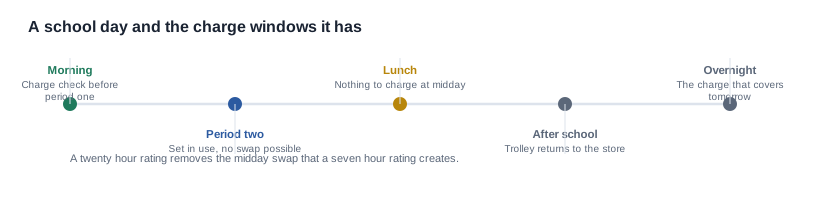
The charge plan is the product. A set with a seven-hour rating and a set with a twenty-hour rating produce different schools. The first needs a mid-day charging window, a member of staff who owns it, and a timetable built around the swap; the second needs a trolley that goes back to the store overnight and a person who plugs it in. The catalogue publishes the runtime and the charge time and nothing about the start state, so the school has to measure its own recharge and set its own plan — but the plan's shape is decided by the published rating, and that is what the buyer should evaluate first.
The shared contact face is the specific hazard in a classroom. Three of the long-rated models charge magnetically, which means the contact face is exposed on a desk where twenty-eight people handle the devices. A contact face that has been touched through the morning is a contact face that will not charge in the afternoon, and the symptom — a device that will not take a charge — is read as a dead unit. The control is a wipe material named in writing, a moment attached to the handover, and an instruction card that a member of staff can follow without reading a manual. The catalogue publishes no lens material and no coating for any model, which means the wipe has to be approved by the supplier rather than assumed by the school.
The records a school will be asked for. A school or district buying hardware for use by children will ask for the product record: the technical file, the declaration of conformity, the evidence that the product is safe for the intended user and market, and the applicable children's product standards such as EN 71 and ASTM F963 where the product is marketed to children. The catalogue contains a company-level export certification page and no per-model certification row, so the position is simple and worth stating plainly: we publish no per-model certification row, and a school should request the documentation for the specific designation it is buying rather than accept a general assurance. Nothing in this article should be read as a claim that any model in this range holds a children's product certificate.
The lens row on the A05 and the A06 needs careful handling. Both publish a lens row that the supplier describes in terms of correct and incorrect posture and distance, and a lens that is clear in one case and fogs in the other. The catalogue publishes no measurement, no test method and no claim beyond that row itself. A school should treat it as a feature to see demonstrated and evaluate, and it should not be repeated in a parent-facing document as a result the school can rely on, because no published figure supports that and we are not going to supply one.
The asset register is what makes the set auditable. A shared set is a small fleet. It needs a register of designations, a charge state, a location, and a named owner. Without it, the school cannot answer the only question that matters at the end of term — how many of the devices were in service — and the answer determines whether the next purchase is a repeat order, a top-up, or a replacement of a design that does not work.
The handover between staff and students. A device used by a teacher, a student and then a technician is a device with three different handling histories, and the instruction has to survive all three. The practical form is a short card at the trolley and a wipe item in the case, with the method written on it, because a card at the point of use is followed and a PDF in a shared drive is not.
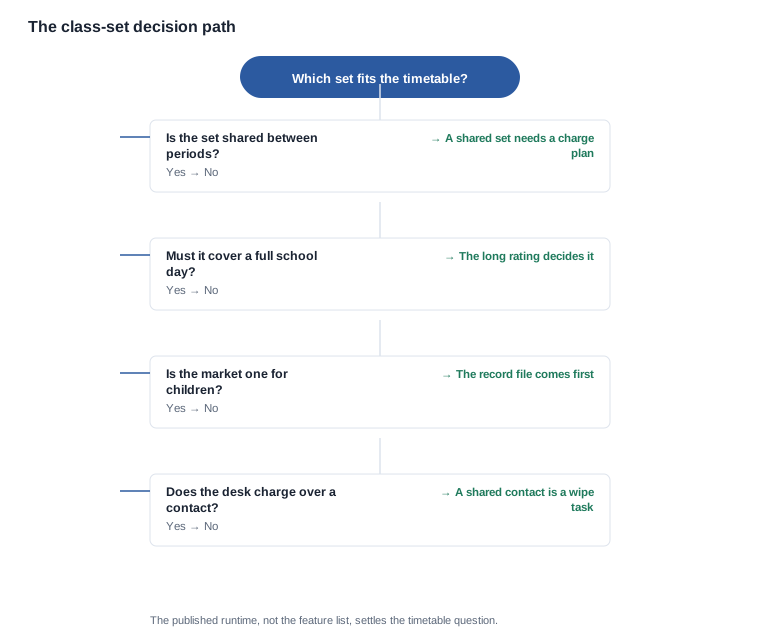
Building a class-set routine around the published charge time
The routine below assumes a school with a store, a trolley and one member of staff who owns the set.
- Count the periods the set must cover and the number of devices needed in each, before choosing a model. The demand curve is the specification.
- Check the published runtime against the longest stretch the set must cover, including the final period of the day. A model rated at about seven hours needs a mid-day charge window and a swap; a model rated at about twenty hours does not.
- Confirm the charge time and the interface for the chosen model, and count the docks and cables the trolley needs. A magnetic-charging model needs a dock per position; a Type C model needs a cable per position and can share a multi-port supply.
- Name the owner of the set and the owner of the trolley, and give them the same short instruction. A routine without an owner is a routine nobody performs.
- Set the wipe moment at the handover, with the material approved in writing by the supplier and the quantity in the box. This is the cheapest control in the whole education programme and it is the one most often left out.
- Write the register. Designation, location, charge state, and the person who last handled the unit. The register is also the evidence base for the end-of-term availability figure.
- Agree the isolation rule: a unit that will not charge comes out of the set and goes to the technician, and it does not go back in until it has been checked. It is a small rule that keeps a fault from consuming a period.
- Plan the term-end review around the availability number, not around the feedback from the teachers. Teachers report what annoyed them; the register reports how many periods ran without a device.
- Request the battery transport documentation for the configuration being shipped, including any charging case, because a set of twenty-eight units with cases is a shipment of second cells. The requirement is set out at battery transport.
- Check the certificate register entries for every designation the school will handle, at certification checklist, and request the product record for the specific designations rather than a general statement.
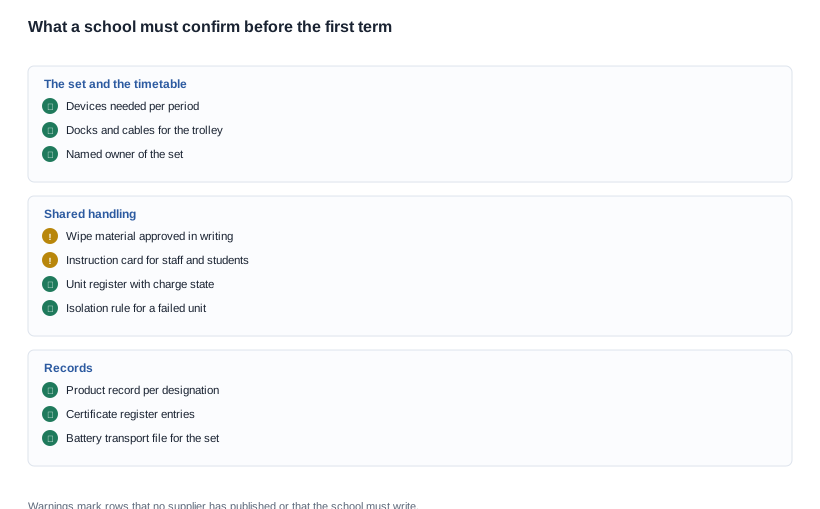
The checklist a school order should not be signed without. The demand curve by period, the runtime and charge-time comparison against the longest stretch the set must cover, the charging infrastructure list with the dock and cable count, the named owner of the set, the approved wipe material and the handover instruction, the unit register format, the isolation rule, the product record for each designation, the battery transport file for the shipped configuration, and the incoming inspection criteria. Clause language is published at contract terms, and the commercial structure of a first order is published at pricing. The camera range, where a school wants capture rather than audio, is at AI camera glasses.
A classroom set run on the published rows
Take a secondary school with 28 devices shared across six teaching groups, a mixed timetable in which the same devices move between rooms, a single technician who owns the set, and a district that has asked for the product record before payment. The first step is the demand curve: four devices are needed in period one, eleven in period two, and only two in the afternoon, which means the set does not need to cover every period simultaneously but does need to survive the longest day without a mid-day charge. The second step is the published rating, and it is decisive. A model rated at about seven hours would need a mid-day charge window and a swap, and that swap is staff time the school has not budgeted; the three models rated at about twenty hours on a single 40 mAh or 70 mAh cell do not, because they charge overnight and hold the charge through the following day. The third step is the charging infrastructure: magnetic charging on those models means a dock per position on the trolley, and a technician who plugs the trolley in at the end of the day. The fourth step is the shared-handling routine, with a wipe item in the box, a short card at the trolley and the wipe attached to the handover between rooms. The fifth step is the register, with the designation, the location and the charge state for each of the 28 units, which is also the evidence for the end-of-term availability figure the district will ask for. The sixth step is the record set: the product record and the declaration of conformity for the exact designations in the order, checked against the certificate register rather than assumed from a company page, plus the battery transport file for the shipped configuration. The result is a set that is charged once a night, available in every period, and auditable at the end of the term — and the decision that produced it was a single published runtime figure, not a feature comparison.

The education failures that arrive as a lesson that cannot run
A set chosen on price and rated for seven hours. The devices work for the first two periods and then go flat. The symptom is a school that concludes the product is unsuitable. The root cause is that the runtime row was compared against a purchase price rather than against the timetable. The prevention is to compare the published runtime against the longest stretch the set must cover, before the price is discussed.
No owner for the trolley. The set is charged when somebody remembers. The symptom is a morning with half the set unavailable. The root cause is a routine without a name against it. The prevention is a named owner and a time attached to the task.
A shared contact face and no wipe item. Devices are handled all morning and stop accepting a charge by the afternoon. The symptom is a fault rate that rises with class size. The root cause is no wipe material in the box and no instruction. The prevention is an approved material and a handover routine, and it costs cents per unit.
A device that fails silently and stays in the set. A unit that will not charge goes back into the trolley and is discovered the next morning. The symptom is a lesson that cannot run with no explanation. The root cause is no isolation rule. The prevention is the rule and a technician slot in the timetable.
A register that is kept but never used. The school records the units and never looks at the numbers. The symptom is an end-of-term report that describes opinions rather than availability. The root cause is that no one defined what the register was for. The prevention is to decide, at the outset, that the availability figure drives the next purchasing decision.
A parent-facing claim the record cannot support. A description of the device's effect is repeated in a school newsletter or a parent meeting. The symptom is a question that nobody in the school can answer. The root cause is a feature row restated as an outcome. The prevention is to describe what the device does, and to make no claim about an effect the documentation does not carry.
A unit handed to a student with no instruction. The device is issued for a task with no guidance on how it should be treated. The symptom is damage that arrives as an accident. The root cause is that the instruction card was designed for staff and never reached the classroom. The prevention is a short card that a student can read in a minute.
A term-end purchase with no usage evidence. The school orders the same number again regardless of what happened. The symptom is a procurement that repeats a mistake. The root cause is no availability figure. The prevention is the register and the review that uses it.
Where a school order has room to move and where it does not
The elements of a school order that are fixed before the price conversation. The cell configuration and the runtime ceiling, which is the scheduling constraint. The charge time. The charging interface, because it fixes the trolley. The certification cost and its lead time. A tooling line of its own, amortised over the first order.
The elements where the commercial room sits, in the order a school buyer should spend it.
- The consumable quantity. A wipe item per device in the box is a few cents and it is the cheapest available reduction in the no-charge contact in a shared set. Negotiate the quantity and the resupply interval with the term cycle.
- Whether the supplier provides the instruction artwork and the termly reminder. A supplier who has read the card is a supplier who has tested it, and the card is what makes the consumable work.
- Minimum order quantity tiers for a class set, and whether the school can take a small pilot on the pilot tier rather than a full set on the run tier. A pilot of six devices across one term produces the availability figure the whole purchase depends on.
- Splitting the first delivery across two dates, so the first batch reaches the school in time to be set up before term and the second lands after the first half-term review. That is also a staged-payment structure.
- Whether the charging infrastructure is supplied or specified by the school, and who owns the docking hardware. A trolley is a real cost line in a school order and it is often forgotten because it is not on the device quotation.
- The replacement and spare allowance. A school set needs a small number of spares from day one, and a separate spare order is slower and more expensive than a few extra units in the first delivery.
- The record set as a commercial deliverable. If the supplier can provide the product record and the declaration for each designation as part of the quotation, the school's procurement review closes faster and the buyer's due diligence cost falls.
- The trade-off between one long-rated model and a mixed set. One model simplifies the trolley, the register and the training; a mixed set can match price points but multiplies the rows the school has to manage. For a first purchase, one model is usually the better trade.
What we will substantiate for an education programme, and what we will not
We publish the rows a school buyer can order from: the rated runtime, the charging interface, the charge time, the cell capacity, the Bluetooth version where the catalogue publishes it, and the structural and lens rows where they appear. For the three long-rated models that means the 40 mAh cell and about twenty hours on the A05 and the A06, the 70 mAh cell and about twenty hours on the A07, magnetic charging and a charge time of two hours or less on all three. We publish the absence of a per-model certification row, of a lens material, of a coating and of a runtime test condition with the same prominence as the rows themselves.
What we will not do is state that any model in this range holds a children's product certificate, or describe the lens row on the A05 and the A06 as an outcome a school can rely on. We will not extend an ingress marking to models that do not carry one, and we will not state that any product is tested to a rating whose report is not published. We will not quote the one weight figure in our catalogue as an education figure — it belongs to the MT6, a camera model with a 1200 mAh folding case, it is the weight of the glasses body including its battery and camera and excluding the case, and the case weight is not published. And we will not substitute a school-friendly guarantee for a published rating.
What we will do is take the timetable, the number of devices per period, the market, the charging provision and the volumes, and return the models whose published rating covers the longest stretch of the school day, the charging infrastructure the set needs, the consumables the shared-handling routine requires, the records that have to be requested, and the documents to settle in writing before a purchase order is raised.
Send us next. Send the timetable, the devices needed per period, the charging provision, the price band and the volumes, and we will return the set specification with the runtime comparison and the trolley list worked out. The scenario entry point is smart glasses for education.
Related reading
- How to enter the scenario — smart glasses for education
- The camera range — AI camera glasses
- The field-work selection logic — choosing the right model for field work
- The field-work buying checklist — field work buying checklist
Send the timetable and the devices needed per period, and we will return the set specification with the runtime comparison worked out.


