

How to maintain smart glasses for office deployments is decided by one physical fact before any policy is written: the docking method. A desk unit that arrives with a magnetic contact docks to a cradle and is charged without anyone thinking about it; a desk unit that arrives with a Type-C port needs a cable, a port and a little discipline; and a model whose charging interface is not published cannot be docked on a plan at all. Our catalogue publishes the charge method for most models, leaves one row unpublished on four camera models, and publishes a charge time on every model in the range — but it never publishes the starting state of charge or the point at which charging counts as complete. That missing pair of facts is why an office fleet has to build its own turnaround measurement rather than inherit one.
How to maintain smart glasses for office: the desk decides the architecture
The reader is a brand owner, a channel buyer or an e-commerce seller placing smart glasses into a workplace — a shared pool on a service desk, units assigned per desk, a training room, a clinic reception, a warehouse — and the decision in front of them is what to standardise on. The risk is not a damaged lens. It is a fleet that quietly splits into two standards because one model charges magnetically and another charges over a cable, so that half the desks need a different accessory, the stores need a different spare, and the service contract covers a fleet that does not exist as a single thing.
That risk has a second component which is specific to a shared pool: the unit is handed between people, and each handover is a chance for a unit to leave the pool. If there is no unit identity in the fleet, a missing unit is an argument rather than a loss, and a returned unit cannot be traced to the desk it came from. The maintenance regime for an office deployment therefore has to contain a records system before it contains a repair instruction, and the buyer who writes the service policy before the fleet record will end up rewriting it later.
The conclusion is a procurement instruction. Standardise the docking method before you standardise the model, measure the dock turnaround yourself because the published charge time carries no start state, and give every pooled unit an identity before it enters the building. Those three steps determine the service policy, the spare ratio and the accessory cost, and all three are decided before the purchase order is signed rather than after the first complaint.

One hundred milliamp hours, four different docks
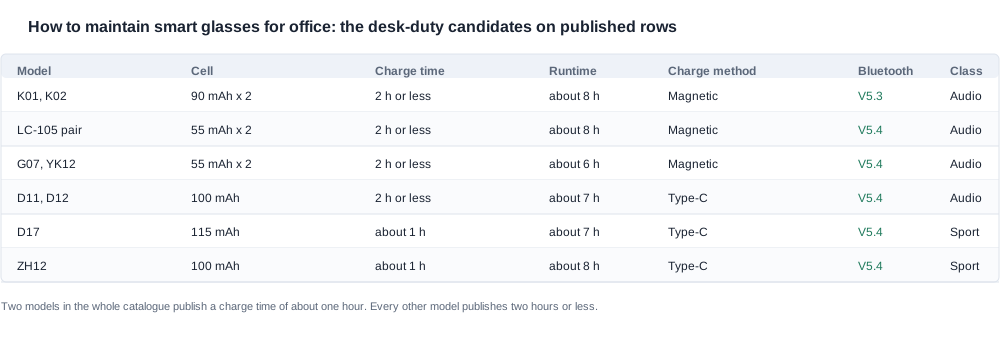
The fastest way to build an expensive mistake in this category is to standardise on a cell capacity. Four configurations in our catalogue publish 100 mAh, and they are not interchangeable in any way that matters at a desk:
| Model | Cell | Charge time | Rated runtime | Charge method | Bluetooth |
|---|---|---|---|---|---|
| AR glasses | 100 mAh | Two hours or less | About 8 h | Magnetic | V5.4 |
| AI electrochromic glasses | 100 mAh | Two hours or less | About 7 h | Magnetic | V5.4 |
| D11, D12 | 100 mAh | Two hours or less | About 7 h | Type C | V5.4 |
| ZH12 | 100 mAh | About 1 h | About 8 h | Type C | V5.4 |
A procurement spreadsheet that filters on "100 mAh" produces two docks, two spare types and two charging procedures, and it does so silently, because the filter resembles a standardisation. The published rows say something quite different: a capacity is not a product identity in this catalogue. The same discipline applies to the multi-cell models. The K01 and the K02 publish 90 mAh in two cells; the LC-105 pair and the G07 and the YK12 publish 55 mAh in two cells; the D17 publishes 115 mAh in a single cell. A buyer comparing the D11 with the LC-105 pair on capacity alone is comparing a single cell with two, and the arithmetic that follows will be wrong in a direction nobody can check afterwards.
Two of those four 100 mAh configurations carry no model designation at all. The AR glasses and the AI electrochromic glasses are catalogue entries published without a model name, and that has a direct consequence for a fleet specification: a procurement file that quotes a model number cannot reference those two entries by model, so they have to be written into the specification as catalogue lines with their rows attached. A specification that silently omits them, or that assigns them a model code the catalogue never published, creates an ambiguity the supplier will resolve in whichever way is convenient.
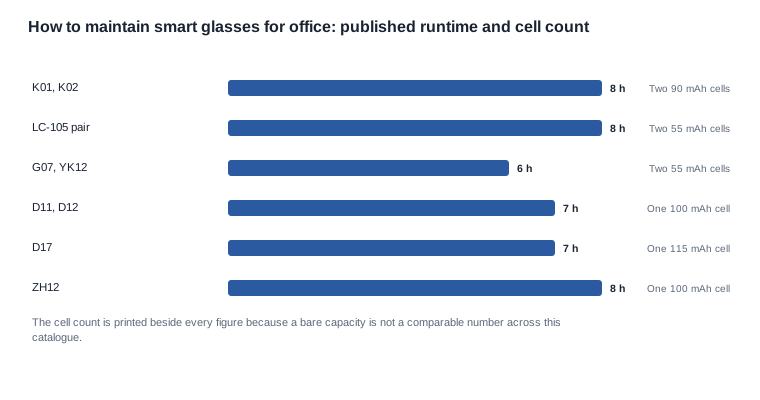
The second half of the table is the part an office buyer actually plans against. A desk shift is roughly eight hours, and the published runtimes divide the candidate set into three groups: the K01, the K02, the LC-105 pair and the ZH12 publish about eight hours; the D11, the D12 and the D17 publish about seven; the G07 and the YK12 publish about six. The published runtime is the only endurance number in the catalogue, and it carries no test condition — no volume, no paired phone state, no ambient temperature, no workload. For a device that sits on a desk between uses rather than in continuous operation, that gap is wider than it appears, because a device that is lifted once or twice an hour behaves differently from one in a continuous session. This is why the office number has to be measured on the desk rather than taken from the page.
The audio models also carry the connectivity detail that a fleet specification needs. The K01 and the K02 publish Bluetooth V5.3 and the rest of the audio models publish V5.4, and no model in the catalogue publishes a touch row, so the touch behaviour of the temple is a question for the supplier rather than a catalogue fact. The camera models publish no Bluetooth version row at all, which matters if the fleet's phones are on different versions and someone assumes a uniform pairing behaviour across the pool. The audio product family is at bluetooth audio glasses.
The charge-time column and why two hours or less is not a turnaround
Every model in the catalogue publishes a charge time: two hours or less for twenty-six of them, and about one hour for exactly two, the D17 and the ZH12. That single exception is the most useful number on this page for a desk fleet, because it is the only place where the catalogue gives a buyer a differentiated turnaround.
What the catalogue does not do is describe the cycle. There is no starting state of charge, no statement of the point at which charging is considered complete, and no indication of whether the figure applies to the unit alone or to the unit in its case. Two hours or less is therefore a ceiling, not a measurement, and it cannot be turned into a turnaround time for a docking cradle any more than it can be turned into a shift-interruption figure for a production floor. A buyer who writes "two hours" into a fleet policy is writing a number that the supplier has never asserted.
The four camera models that publish a charging-case capacity but no charge-method row — the CY05 and the CY03, and the L1 Pro and the MT6 — are the sharpest case of this. Each of them publishes a case capacity of 1400 mAh, except the MT6 with its 1200 mAh folding case, and each of them publishes no charging interface at all. A deployment that standardises on a camera model therefore has a docking procedure that cannot be written from the catalogue, and it has to ask. That question is cheap to ask before the order and expensive to discover when the fleet is already installed.
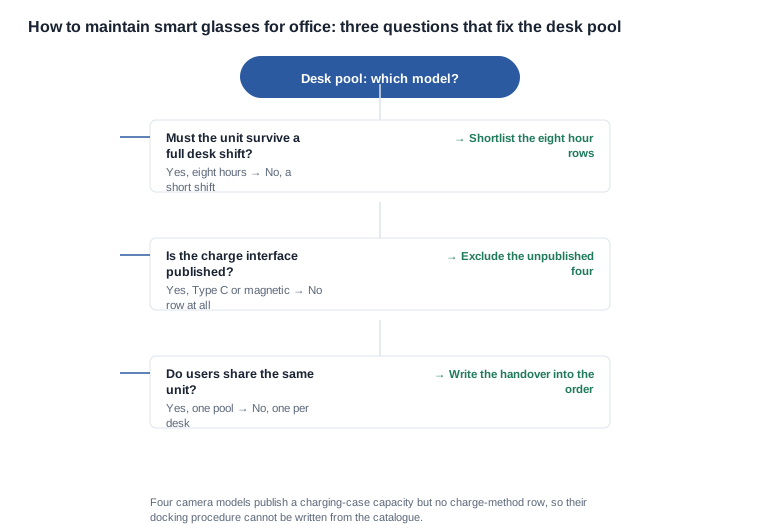
The practical consequence is that the fleet specification should be written in the order of interface, then runtime, then model. Interface first because it determines the accessory, the stores and the service procedure. Runtime second because it determines whether the unit survives a shift without a swap. Model third because it is the only one of the three that the catalogue already answers well. A specification written in the reverse order — model first, because that is how a product comparison arrives — produces a fleet that cannot be docked.
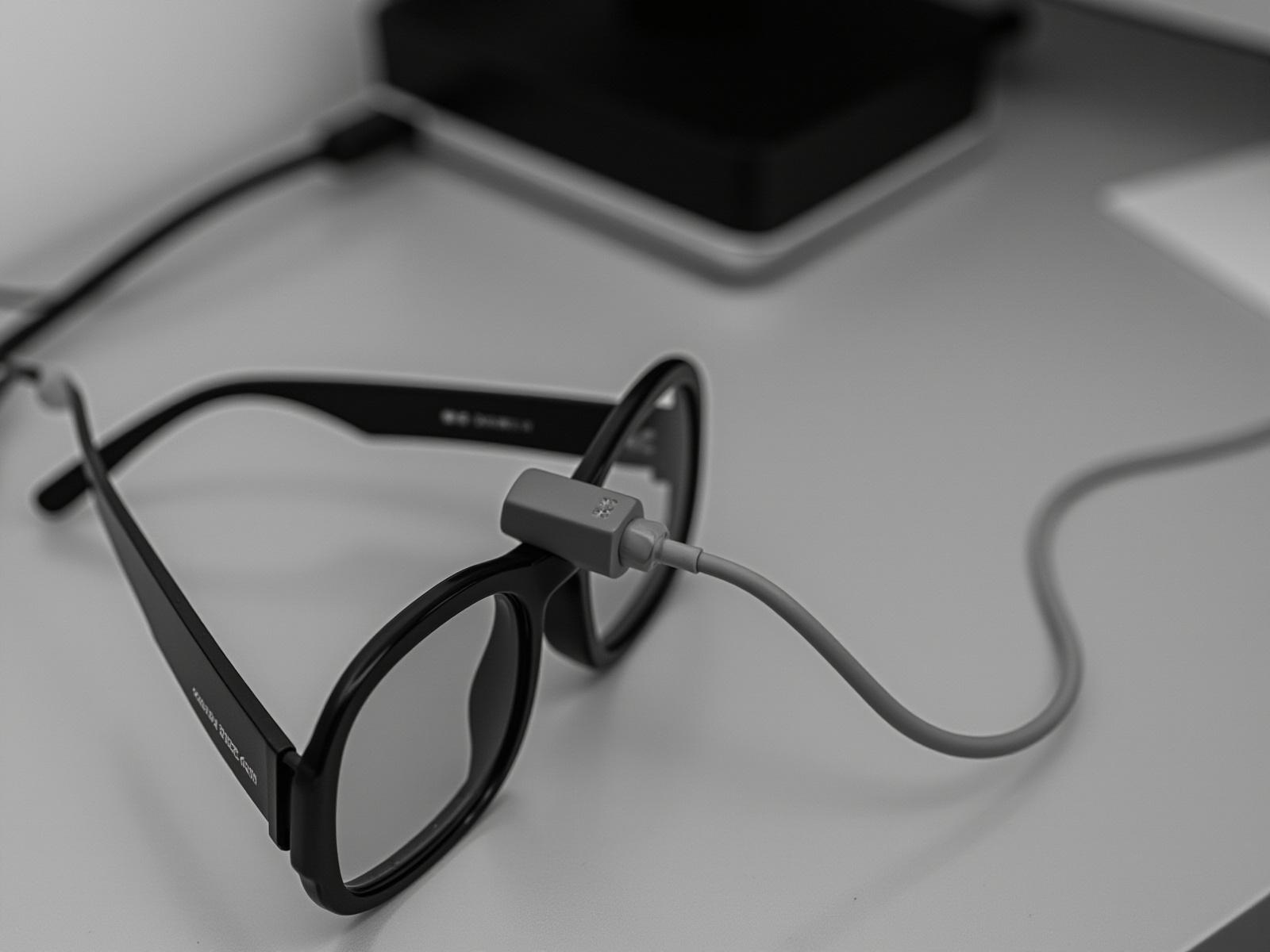
A shared desk pool is a records system before it is a service regime

A pool that is shared between desks behaves like a small logistics operation, and the six steps that make it work are mostly about records. Each has a completion standard:
- Ask for the rows per candidate model. Cell capacity, cell count, charge time, charge method, runtime and Bluetooth version where published. The completion standard is a written reply per model, so the fleet specification is built on one page.
- Ask which models are pooled and which are assigned. A pooled unit needs a handover procedure and a unit identity; an assigned unit needs neither. The completion standard is a placement list, per desk and per model.
- Fix the docking method and the handover procedure in writing. Cradle type, cable type, who charges, who wipes, where the unit is stored at the end of a shift, and what happens when a unit does not return. The completion standard is a procedure a facilities contractor can execute without asking a question.
- Run two units from one batch across a full desk shift. Fix the volume, the paired phone state, the ambient temperature and the lift frequency, and repeat it on a second unit. The completion standard is a measured figure with its conditions recorded, which replaces the catalogue's conditional figure in the fleet policy.
- Count the pool size the shift pattern requires. Units per desk, units in the spares drawer, and the ratio between them that the service contract will pay for. The completion standard is a number with its inputs attached.
- Write the pool size, the docking method and the acceptance criteria into the order. Minimum order quantity, production lead time, price tier, payment terms, spare ratio, warranty response time and the measured runtime criterion. The clause language is at contract terms and the price structure is at pricing.
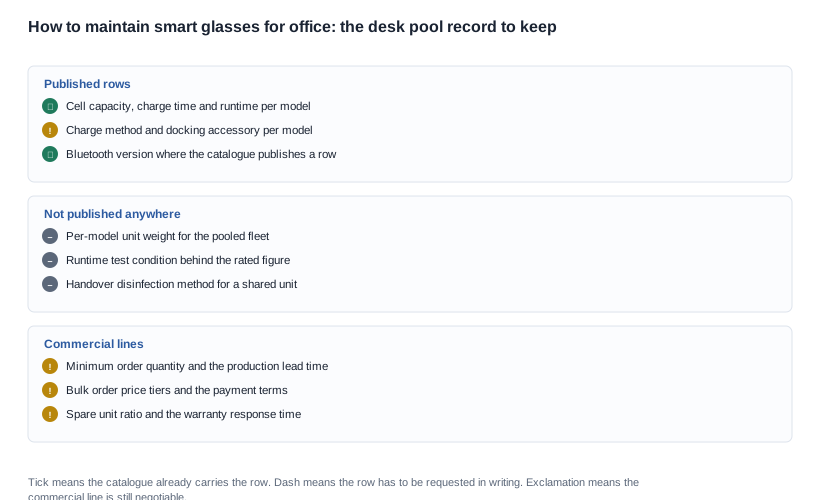
Two parts of that sequence are routinely skipped, and both are the parts that decide whether the fleet is manageable in its second year. The first is unit identity. A pooled device without a visible identifier is an inventory problem the moment it leaves a desk, and the fix — a serial in the fleet record that a user can read — costs nothing at purchase and cannot be added later. The second is the handover surface procedure. The catalogue publishes no recommended surface treatment for the frame, no lens material and no coating, so there is no documented compatibility list to hand to a facilities contractor, and the wipe material that a facilities team chooses on its own can damage an optic the buyer has no way to assess. The supplier can supply a recommended method; a buyer who does not ask will find out from returns.
The commercial arithmetic of a fleet is not the unit price. The minimum order quantity, the production lead time and the price tier decide whether eighty desk units are one order or a split delivery; the payment terms and the deposit decide how much of the schedule risk the buyer carries before the container arrives; and the landed cost, the incoterms and the distributor terms decide whether the fleet lands at the desk or at the warehouse. Add to that the accessories a fleet needs rather than a single unit — one cradle per desk position, one cable type, one spare-unit ratio — and it becomes clear why a fleet quote should be built as a bill of materials with the accessories as lines, not as a unit price multiplied by a headcount. The commercial structure of a first order is at pricing and the sample process that precedes it is at samples.
The third piece is the per-user reset. A unit handed between people accumulates state — a paired phone, a remembered configuration, a queued upload — and the reset step is what keeps a shared unit usable. That step is a configuration decision rather than a repair decision, which means it belongs in the specification, and it belongs in the acceptance criteria too, because a unit that returns to the pool in an unknown state will be reported as a defect.

Where an office fleet fails: docking, handover and the published gaps
The fleet was standardised on cell capacity. The symptom is two charging docks, two spare types and a stores list nobody trusts. The root cause is a filter that treats 100 mAh as a product identity when four different configurations publish it. The prevention is to standardise the interface first and the model second.
The turnaround was taken from the catalogue. The symptom is a dock that is still warm at the end of the window. The root cause is that the published charge time carries no start state and no completion criterion. The prevention is to measure the cycle on the desk and to write the measured figure into the fleet policy.
A camera model was pooled with no published interface. The symptom is a unit that cannot be charged on the standard cradle. The root cause is the four camera models whose page carries a case capacity but no charge-method row. The prevention is to ask for the interface before the accessory is quoted.
Units had no identity. The symptom is a pool that shrinks and cannot say which desk lost which unit. The root cause is a fleet record that holds model numbers and serial numbers of the shipment rather than of the units in service. The prevention is to make a readable identifier a condition of the delivery.
The handover procedure was never written. The symptom is a unit returned with a configuration nobody recognises, and a facilities team that stops returning units to the pool. The root cause is that the procedure was assumed to be self-evident. The prevention is a one-page procedure, with the reset step and the surface treatment in it.
The runtime was assumed rather than measured on a desk. The symptom is units that need a midday charge in a shift that was budgeted for one charge. The root cause is that the catalogue's figure is a continuous-use number and a desk unit is used in lifts. The prevention is the two-unit protocol, and the acceptance criterion that follows from it.
The cradle was quoted and the cable was not. The symptom is a desk where the unit returns to a cable that does not fit the port on the unit. The root cause is that the accessory was treated as one item when it is two, and the two belong to different interfaces. The prevention is to price the cradle, the cable and the spare by interface on the quotation.
An assumed scenario shows the sequence. A facilities buyer for a regional services company is replacing eighty desk units across four sites with a pooled model, and the previous deployment had two charging standards and no unit register. The first move is the interface decision, because it fixes the cradle, the stores and the cable count, and the two candidate models publish different interfaces for the same nominal capacity. The second is the desk protocol on two units from one batch, because the shift is eight hours and the published runtime is conditional. The third is the fleet register, because the register is cheaper to build before eighty units arrive than to reconstruct afterwards. The fourth is the order, in which the pool size, the spare ratio and the measured runtime criterion all appear as lines. The outcome is a single dock standard, a fleet record that survives a site audit, and a service contract that names a measured figure rather than a catalogue conditional.
What we publish for office deployments and where we stop
It is worth being precise: we publish the rows a fleet can be specified against, and we do not fill the gaps with figures nobody has verified. For the audio and sport models that means the cell capacity and the cell count, the charge time, the charge method, the rated runtime and the Bluetooth version. We publish the cell count alongside the capacity because a capacity without a cell count is not comparable across this catalogue.
We do not publish a runtime test condition, a per-model unit weight, an operating temperature range, a cycle-life rating, or a recommended surface treatment for the frame and lens. We do not publish a charging interface for the CY03 and the CY05, and the L1 Pro or the MT6, because the catalogue does not carry one, and we would rather say that than describe a method that may be wrong. We also do not present the two-hour charge time as a turnaround, because no starting state or completion criterion is published behind it.
What we will do is take your desk count, your shift pattern, your pool structure and your target market, and tell you which published rows apply, which models share a docking method, which gaps your own protocol has to close, and which acceptance criteria belong in the purchase order. The product families are at bluetooth audio glasses and sport smart glasses, the scenario entry point is at office, the endurance detail is at battery life, and the surface procedure for a shared unit is at the surface procedure for office units.
What to send us next. Send the desk count, the shift length, whether the units are pooled or assigned, and the quantities, and we will return the published rows that cover the fleet, the docking position per model, the gaps to close on samples, and the fleet criteria to write into the order. Transport documentation for the shipped configuration is covered at battery transport, and the evidence list for a supplier evaluation is at certification checklist.


