

Smart glasses for office have a constraint that no other scenario in this catalogue has: the person who would normally service the device is not the person who used it, and nobody owns the routine. That single fact turns the maintenance position from a consumer instruction into an office service, and it changes what the buyer is actually purchasing. The published rows for the audio tier are a Bluetooth version per model, a cell configuration, a charge time, a rated runtime, a charging interface and the structural features. The lens material, the frame material, the surface treatment, a per-model weight and any compatibility statement are not published for any model, so what the office can safely recommend has to be written from a specification the supplier provides in writing.
Smart glasses for office: the handover that nobody owns
The buying task behind this article. The reader is a brand-side purchasing lead, a channel buyer or a product manager specifying a device for a shared office, a hot-desk pool, a serviced floor or a call-centre seating plan. The task is to turn an implicit habit into a written procedure, to decide what supports it, and to decide who performs it. The commercial risk being managed is the one that arrives quietly: a shared device that nobody services, a user who notices the mark left by the previous user, and a complaint that is read as a quality problem when it is a procedure problem. That complaint costs a device, a return and a replacement, and it arrives in a form nobody can trace.
Why a shared device needs a procedure rather than a habit. A personal product gets serviced because the owner notices it is dirty. A shared product does not, because every user sees it after the previous user's mark and each of them assumes somebody else will deal with it. The failure is not carelessness; it is that the responsibility is unowned. A shared-device procedure fixes that by naming the moment — the handover — rather than the intention, and by naming a role rather than a person, because the rota changes.
What the published audio rows settle for an office buyer. The audio tier publishes Bluetooth V5.3 on the K01 and the K02 and V5.4 across the rest of the tier. It publishes cell configurations of 55 mAh twice on the LC-105 pair, the G07 and the YK12, 90 mAh twice on the K01 and the K02, and a single 100 mAh cell on the D11 and the D12. It publishes charge times of two hours or less, rated runtimes of roughly six to eight hours, magnetic charging on the LC-105 pair, the G07 and the YK12 and Type-C charging on the D11 and the D12, no touch row for any model in the tier, surround sound and slim detachable temples on the YK12 and ultra-slim detachable temples on the G07. Not published for any model: the frame material, the surface treatment, the lens material, a per-model weight, a runtime test condition and any cleaning compatibility statement.
The published runtime is the rotation constraint, and it is the number an office buyer should start with. A device that runs roughly six hours on a single charge cannot cover a two-shift floor without a swap, and a device that runs roughly eight hours on the K01, the K02 or the LC-105 pair can. That is a published difference with an operational consequence, and it decides the size of the pool and the shape of the charging point. It also decides how often a device returns to the cart, and therefore how often the handover procedure actually runs.
The rows that decide the rotation are these, and the last column is the published structural feature that a floor buyer should be told about.
| Model | Published cell | Rated runtime | Charging interface | Feature published |
|---|---|---|---|---|
| K01 | 90 mAh x 2 | ~8 h | Magnetic | Bluetooth V5.3, no touch row published |
| D11 | 100 mAh | ~7 h | Type C | Bluetooth V5.4 |
| D12 | 100 mAh | ~7 h | Type C | Bluetooth V5.4 |
| LC-105-1 | 55 mAh x 2 | ~8 h | Magnetic | Bluetooth V5.4 |
| G07 | 55 mAh x 2 | ~6 h | Magnetic | Ultra-slim detachable temples |
| YK12 | 55 mAh x 2 | ~6 h | Magnetic | Slim detachable temples, surround sound |

Two routine designs, and the second one is usually chosen by accident. A handover wipe performed by every user costs one item per device per day and produces a condition record as a by-product. A daily round performed by facilities costs a shared supply of items and produces no record at all, because nobody is signed against it. The difference between them is not the labour; it is that the first design creates the record that the returns desk and the asset register both need later.
The third design is the one a large floor should use. A buyer's own service team, working from a procedure template the supplier has reviewed, costs the most in management time and produces the best evidence. Which design a buyer picks changes the per-unit consumable cost, so it is a procurement question rather than a facilities one.
Smart glasses for office: the consumable that is itself a shared object
An office is the one scenario where the servicing item is shared between people who do not know each other. That makes it a hygiene question rather than a cosmetic one, and it gives the item a lifecycle that nobody tracks: a cloth used for a week and then left in a drawer is the thing that eventually becomes the problem. A single-use item removes the question entirely, and the cost difference between a washable cloth and a single-use item is usually smaller than the cost of one hygiene complaint across a floor.
The three formats a buyer can choose between, and what each one costs. A washable cloth per device is the cheapest per unit and the worst for hygiene, because the cloth has an untracked life and a second user inherits it. A washable cloth at the cart is better, because it is a known object with a known owner, but it is still shared and still needs a replacement interval. A single-use item in a sealed pack is the most expensive per unit and the cleanest, because there is no shared object at all. The decision is a straight trade-off between per-unit cost and exposure, and it is worth making explicitly rather than by default.
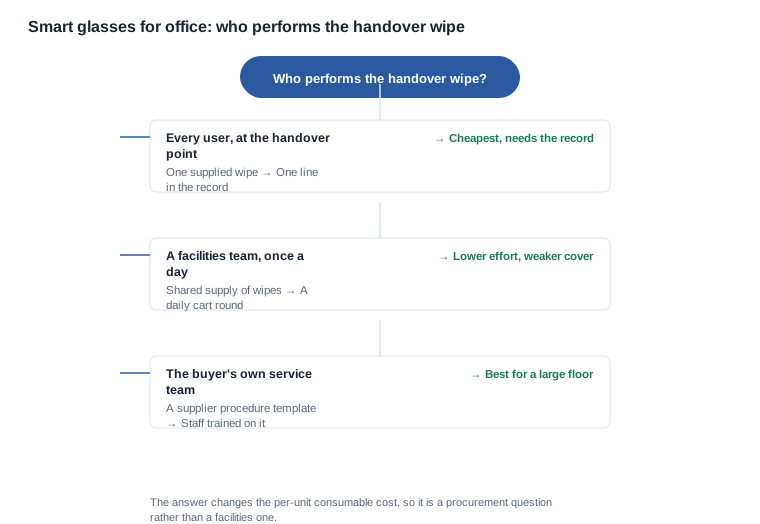
The decision tree above puts the owner first, because the owner determines the format. A user-performed handover needs an item that is dispensed one at a time and a record line to go with it. A facilities round needs a supply that can be issued in quantity and a schedule that is audited. A service team needs a procedure template and training, and it needs the supplier to have tested the procedure against a surface rather than described it.
The replacement interval is the number that is normally missing. The cost of a single-use item per device per week is a number the buyer can calculate, but only after the interval has been decided, and the interval is a function of the floor size, the device count and the number of wipes each device needs per day. Deciding it from a floor survey rather than from a rule of thumb is cheap, and it is the difference between a consumable line that is right and one that is either wasteful or short.
A shared device in an office is also an asset, and the asset count is the other half of the cost. A device that goes missing is a device that is bought again, which reads as a repeat sale in the accounts and is a loss in reality. A monthly count that reconciles to the register, and a refurbishment tray rather than a repair bin, are what make the loss rate visible. Neither of them is a maintenance task; both of them belong to the same procedure document.
The device register is the document that makes the floor auditable, and it has to be requested as a configuration attribute. The catalogue publishes no serial number scheme, no device identity attribute and no device-management specification for any model, so forty units arrive as forty identical objects with nothing on them that distinguishes one from another. An office buyer should therefore ask for the identity attribute in writing, test it on the sample set, and confirm how it would appear on a purchase order and on the refurbishment paperwork. The register also carries the designation of each model, which is what makes a lost device traceable rather than merely lost.
Personal allocation and hot-desk pooling are different products with the same hardware. A device assigned to one person is looked after by that person, and the procedure can live in the pouch with the unit; a pooled device passes between users, and the procedure has to live at the charging point. The published runtimes decide which of the two a floor can afford, because a pooled device on a roughly six-hour model has to be swapped at the midpoint of a long shift while a pooled device on a roughly eight-hour model can sit through it. The refresh cycle then decides the rest: a device that is in constant circulation reaches the refurbishment bench sooner than one that is not, and that is a cost the buyer should model before the pool size is fixed.
A tender route changes what has to be settled before the order. Where a procurement process compares quotations against a written requirement list, the supplier's ability to state which requirements it meets and which it does not is itself a commercial advantage, and the requirement list has to include the surface specification rather than leaving it open. Leaving the surface specification out of a requirement list is the most expensive omission available in this scenario, because it converts a documentation gap into a dispute at the point where the procedure is written.

Smart glasses for office: the surfaces where a shared device fails first
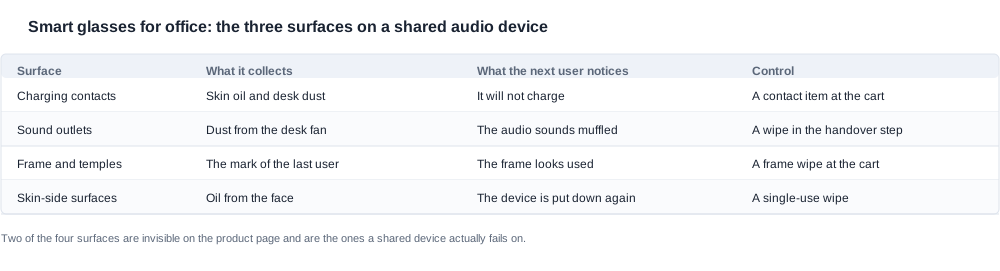
Four surfaces matter on a shared audio device, and only one of them is the lens. The table below states what each one collects, what the next user notices and which control addresses it.
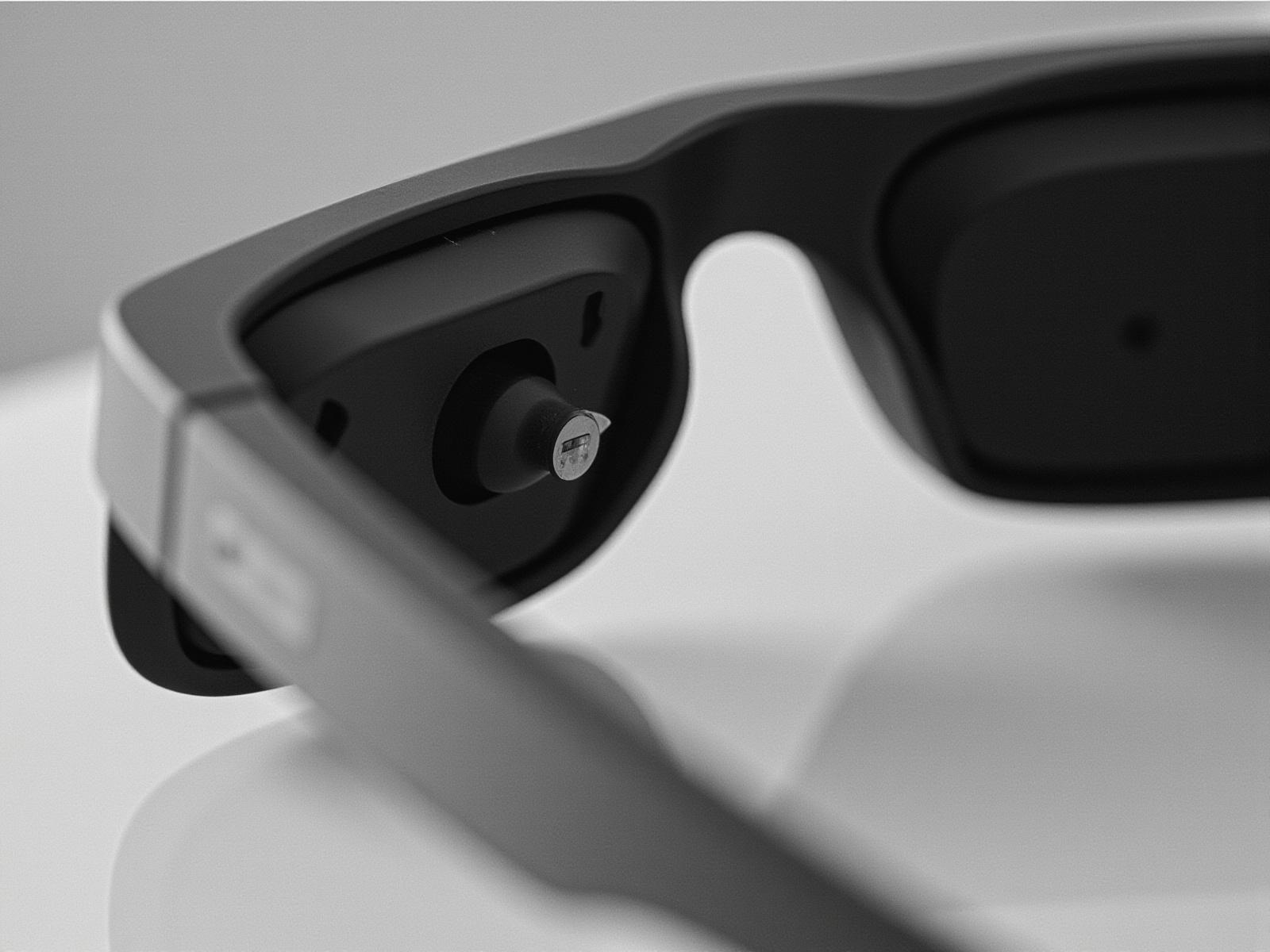
The charging contacts are the surface that generates the faults. The interface published for the audio tier is magnetic on the LC-105 pair, the G07 and the YK12 and Type-C on the D11 and the D12, and a shared device collects skin oil and desk dust fastest on an exposed contact pad. A device that will not charge is reported as a fault, and the fault is real, and it is also a routine failure. A contact item at the charging point converts a returns category into a five-second action.
The sound outlets are the surface nobody thinks about. A shared device sits in a room with a desk fan and an open shelf, and the outlets collect dust that nobody notices until the audio sounds muffled. The symptom is indistinguishable from a hardware fault to the user, and it is one of the few cases where a routine step produces an audible improvement rather than an invisible one. That is worth mentioning in the procedure, because a step whose effect nobody can hear is a step that gets skipped.
The frame is the surface the next user actually sees. The mark of the previous user is on the frame and the temples, and it is the thing that creates the "this looks used" reaction that turns into a request for a different device. It is also the surface where the published material matters most, because the frame material and the surface treatment are not published for any model. A desk solvent wipe is the most common office consumable and the most damaging one on an undescribed surface, so the prohibition list has to name it.
The skin-side surfaces are the fourth, and they are the reason the single-use format exists. Whatever the frame is made of, it is in contact with skin for the length of a working day, on a device that changes hands.
Smart glasses for office: what to request and what to write down
Five requests close the file for an office deployment.
- The frame and lens material and the surface treatment, per model, in writing. Ask specifically about the prohibited cleaning agents in an office environment, and ask about solvent wipes and aerosol products by name, because they are the products an office already owns.
- The audio path tested after a servicing step. Ask whether the sound outlets need attention, how often, and with what item. The answer is usually not in the documentation and has to come from the supplier's own test.
- The consumable compatibility statement. If the supplier has one, it removes the largest ambiguity in the procedure. If it does not, the procedure has to be restrictive and the restriction has to be stated.
- A handover condition list with a visual reference and a stated judgement location. It is what the record line refers to and what the refurbishment tray is measured against.
- The designation table, the certificate register and the battery transport file for the shipped configuration. The catalogue's export page is images rather than text, so there is no certification scope to read off it; the catalogue publishes no per-model certification row, and its document text carries no CE, FCC or RoHS marking, so certificate numbers have to be supplied and checked in the issuing body's public register, at certification checklist. The transit file is at battery transport, and it has to cover the configuration as shipped, including any case.
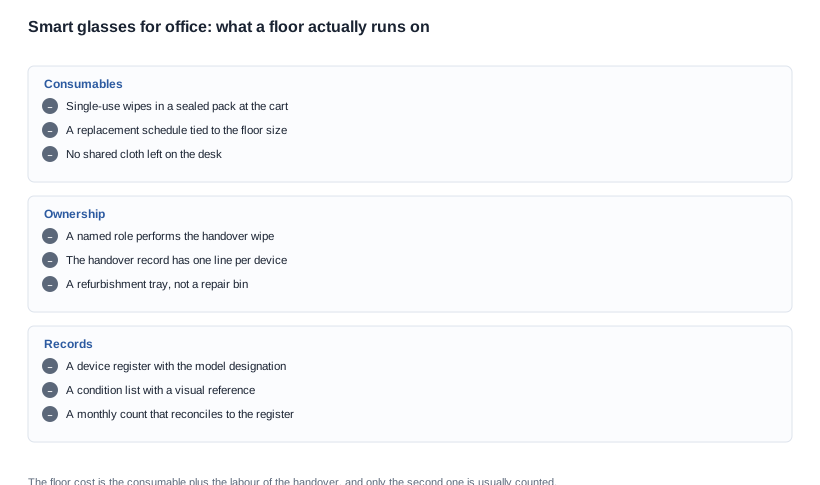
The document set an office order should carry. The frame and lens material statement per model, the prohibited-agents list, the procedure artwork, the handover condition list, the consumable list with the per-unit cost and the replacement interval, the device register with the model designation, the refurbishment checklist and its price, the certificate register and the agreed incoming inspection criteria. Clause language is published at contract terms, and the commercial structure of a first order is published at pricing. The kit list for this scenario is at the office gear checklist and the packing decision is at packing smart glasses for office.
Worked as a scenario rather than a client order, the passage below is illustrative. Assume a company with a hot-desk pool of forty audio units on a serviced floor, buying one model with a magnetic interface and a single 100 mAh cell, in a market where a workplace consumable has to be procured centrally. The first decision is the owner: the handover wipe is performed by the user, because the floor is not staffed, and that decision fixes the consumable format as a single-use item dispensed from a sealed pack at the charging point. The second is the interval, derived from a floor survey rather than a rule of thumb, so the consumable rate is a number rather than an estimate. The third is the procedure, which names the moment as the handover, the role as the outgoing user, and the record as one line per device. The fourth is the prohibited agents, with solvent wipes named explicitly, because they are what the office already owns. The fifth is the asset half, with a monthly reconciliation to the register and a refurbishment tray rather than a repair bin. The outcome is a floor whose device state is documented rather than assumed, and a per-unit consumable cost that is known before the order.
Smart glasses for office: where the floor-level cost sits
The office cost has three parts and only one of them is in the quotation. The unit price, the consumable cost and the labour of the handover. The third is usually invisible, and it is usually the largest, because a handover step performed by every user is a step that somebody has to be reminded to do.
The terms that move inside the order. The consumable model and its per-unit cost, which is the cheapest hygiene improvement available in a shared environment. Whether the procedure is printed on the insert, on a card at the charging point, or both — a card at the charging point is read at the moment of the handover, which is the moment it is needed. Whether the supplier will provide a procedure template for the buyer's own service team, and whether that template has been tested against a surface. Whether the replacement interval is agreed with the supplier rather than assumed. Whether the refurbishment checklist is the supplier's or the buyer's, and whether a refurbishment partner is trained on it. Minimum order quantity tiers. Colour, temple configuration, logo, lens tint and packaging. Splitting a first run into two deliveries against a staged payment, which suits a staged floor rollout.
The terms that do not move. The frame material and the surface treatment, and therefore what the procedure can safely recommend. The cell configuration and the charging interface, and therefore the rotation and the charging point design. The certification cost and lead time. Tooling, spread across the first order and kept on a line of its own instead of being folded into the unit price.
Our position and the boundary of it. We publish the audio tier's Bluetooth version, charge times, cell configurations, rated runtimes, charging interfaces and structural feature rows exactly as the catalogue states them, and we publish the absence of frame material, surface treatment, lens material, a per-model weight, a runtime test condition and any cleaning compatibility statement with the same prominence. We will not publish a maintenance recommendation for a surface whose material and treatment we have not been given, and we will not state that a product in our range is tested to IP54.
What to send us next. Send the size of the floor, whether the device is shared or personal, the interface you have decided on, the channel, the price band and the markets, and we will return which published rows apply, what the procedure and the consumables should be for the handover design you have chosen, and which questions have to be settled before the packaging is signed. The product range is at Bluetooth audio glasses, the lens-side treatment is at cleaning lenses for office, and the scenario entry point is smart glasses for office.
Related reading
- The point where the scenario starts — smart glasses for office
- The models the range covers — Bluetooth audio glasses
- The kit list — office gear checklist
- The lens-side treatment — cleaning lenses for office
Tell us the floor size and whether the device is shared, and we will say what the procedure and the consumables should be.


