
Open ear audio glasses: a number with its condition attached
Acoustic performance in open ear audio glasses cannot be read from a datasheet, because almost nothing in this category is published. Our catalogue gives Bluetooth version, battery capacity, charge time, runtime and charging interface — and no driver size, no frequency response, no leakage figure and no microphone specification for any model. Open ear audio glasses smart glasses how to measure is therefore entirely a question of protocol: what you measure, under what conditions, what the resulting number means, and what it is legitimate to do with it afterwards.
The single most important decision is what the measurement is for. A measurement used to rank two candidate samples is one thing; a measurement used to detect drift between production lots, months later, is another. Both need a fixed protocol. Only the second needs the recordings kept.
The short answer: fix the protocol before the samples arrive, because a protocol designed after the first result is a description rather than a protocol. Every number in the set is meaningless without its condition attached — the distance, the environment, the playback level, the noise type, the airflow condition and the measurement geometry. Score every sample on the same rows, blind, with two people scoring independently, and re-test any row the two disagree on. A buyer-run measurement is a comparison, not a specification, and it must never be published as one.
Choosing an audio platform for a channel, and the protocol nobody hands you
A buyer here is usually choosing an audio platform for a channel — sport, industrial, education, or everyday open-ear listening — and is holding two or three samples, a target price and a supplier's catalogue entry. What they are missing is any acoustic data, and the reason is that open-ear performance is a property of the finished product rather than of a component: the transducer position, the frame geometry against the head, the port design and the firmware processing all sit between the datasheet and what the customer hears.
This is why the protocol has to be built by the buyer rather than requested from the factory. A supplier can hand you a component datasheet; nobody can hand you a measurement of your product in your environment.
Three decisions shape the whole protocol, and all three are commercial rather than acoustic. The first is the environment: a quiet office, a workshop and a street are three different markets for the same device, and the product that wins in one of them is usually not the product that wins in the others. The second is the load: a platform bought for music and a platform bought for calls are measured on different rows, and a protocol that mixes them produces a result nobody can act on. The third is whether the programme needs drift detection at all, because that is what decides whether the recordings and a reference unit are worth keeping.
The failure each of these prevents is a return rate. A customer who buys an open-ear product for a noisy street and finds the leakage carries into the conversation will not describe the problem acoustically. They will describe it as "the sound is bad" or "people can hear it", and both descriptions are untriageable, which is why the measurement has to be made before the listing is written rather than after the reviews arrive.
Where the cost of an open-ear platform sits
An open-ear product is a mechanical enclosure that happens to carry electronics, and the acoustics are a consequence of the enclosure rather than of the electronics. That single fact explains most of the price structure in this category and most of the reason two platforms with the same Bluetooth version cost different amounts.
The transducer and its position. Where the element sits relative to the ear, and the gap it is held at, decide both the output level and the leakage. Two products with identical electronics and different transducer positions are acoustically different products, and the datasheet will not tell you.
The port and grille design. A port that lets the outside world in as well as the music out is a leakage path, and a grille that protects it is a restricted path. This is an acoustic design decision made in tooling, which is why it is fixed once the tool is cut and why changing it later is a new programme rather than a revision.
The frame geometry against the head. A frame that sits differently on different people produces a different result for each of them, and the tolerance on that sit is a manufacturing tolerance that a buyer can inspect only if it is written down as a number.
The firmware processing. Every stage of processing has an artefact, and the artefact is audible in the specific place where processing is applied: gating in silence, pumping in steady noise, a sense of removed material in speech. This is why a technique name is not a result.
The microphone chain. A separate subsystem with its own noise handling, its own placement and its own failure mode, and in this category it is the half of the acoustic proposition most often skipped by a buyer who came for the listening side.
The negotiating room is in the places where the buyer controls the scope: the number of configurations, the pack contents, the case configuration, the artwork round count, the per-market label set, and the timing of the first delivery. It is not in the acoustic design, and a supplier who will not move the transducer position, the port design or the processing is telling you the acoustic behaviour is fixed — which is a fact to plan around rather than a position to argue with.
The rows that carry a decision, and their thresholds
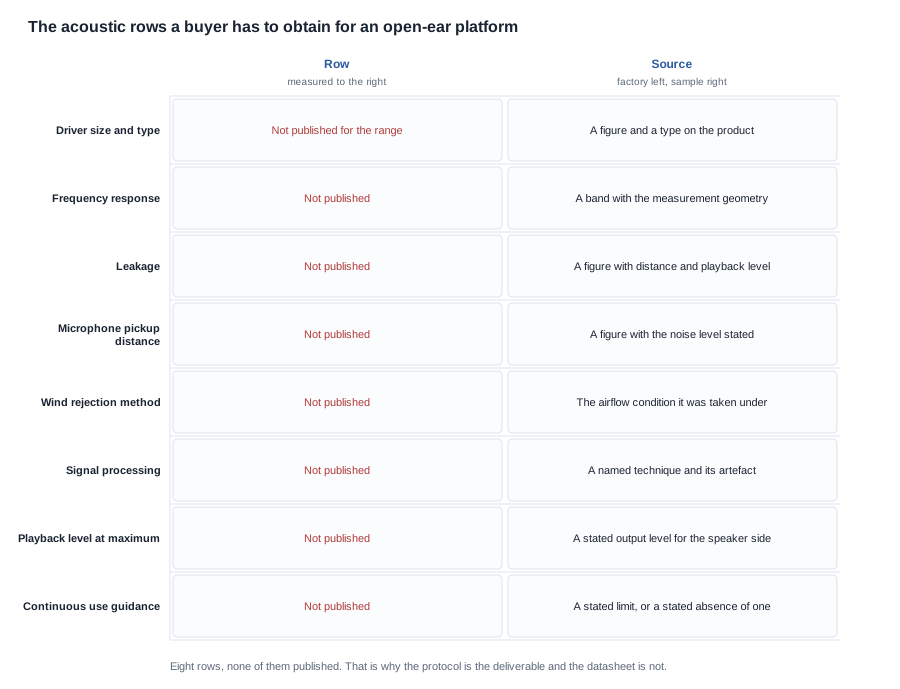
The eight rows below are the ones a buyer ends up needing, and all eight are unpublished for our range. The pass line column is what to ask for in writing; the soft answer column is what tells you the supplier is relaying a component specification rather than describing a product.
Driver size and type. Ask for the figure and the type, on the product rather than on the component. "Large dynamic driver" is a soft answer, because it is a claim about a component and not a measurement of an assembly.
Frequency response, with geometry. A band plus the measurement geometry, because a response without a reference point cannot be compared with anything. A curve with no stated geometry is the most common soft answer in this row.
Leakage, with distance and level. A figure with the distance, the environment and the playback level attached. "Low leakage" is a soft answer, and leakage is the row with a commercial consequence beyond sound quality: how much transmitted sound reaches the environment determines whether the wearer can hear their surroundings, and whether everyone nearby is exposed. In a professional context the second is an occupational question, not a marketing one.
Microphone pickup distance. A figure with the ambient noise level stated, and the noise type held constant rather than merely the level, because traffic, a fan and a café are three different problems and a product that performs in an office may not perform on a street.
Wind rejection method. The airflow condition the figure was taken under. A temple-mounted transducer sits directly in the airflow and wind noise is low-frequency, which is the range basic filtering handles worst, so the figure is only comparable when the condition is stated.
Signal processing applied. A named technique and its expected artefacts. "AI sound enhancement" is a soft answer and is the single most common phrase in this category that carries no information at all.
Playback level at maximum. A stated output level for the speaker side, because a product that is quiet on the far end is a product for a quiet room whatever the transducer does.
Continuous use guidance. A stated continuous-use limit, or a stated absence of one. Published battery figures describe how long the electronics run, not how long a person will wear the thing, and the gap between the two is a return-rate driver.
One warning applies to all eight rows: they are not directly comparable between suppliers. Two suppliers measuring the same quantity will use different distances, different source material, different levels and different definitions of intelligibility. Before building a table, decide which column is your own measurement and which is a supplier's number, and never mix the two in one row without a note.
The protocol: blind scoring, kept recordings and the golden sample
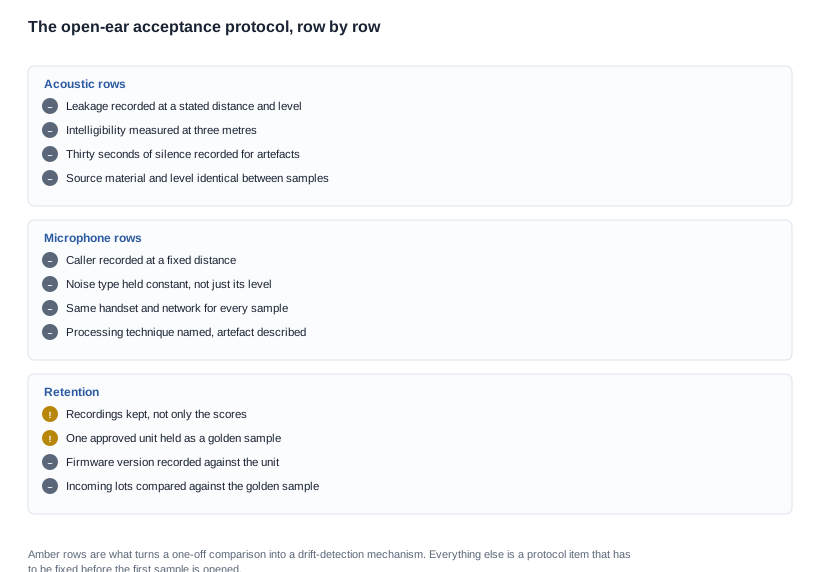
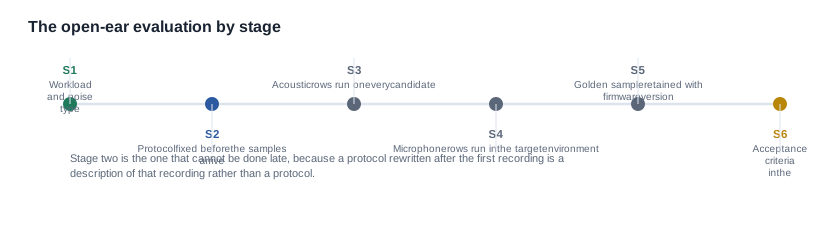
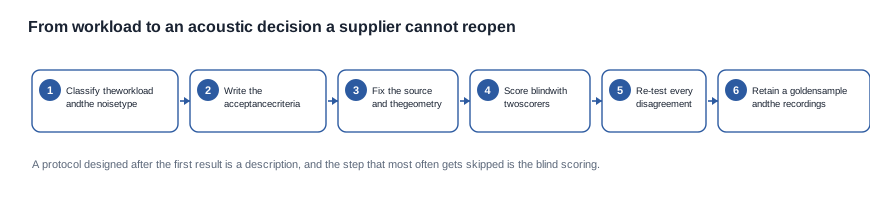
1. Fix the protocol before the samples arrive. The measurement rows, the conditions for each, the source material, the distance, the environment, the scoring method and the number of scorers. A protocol designed after the first result is not a protocol.
2. Score blind, with two people scoring independently. Rank every sample on the same rows, without knowing which is which. Treat any row the two disagree on as the one to re-test — it is usually the row that predicts returns, and it is usually a row where the judgement is subjective enough that the disagreement is information rather than noise.
3. Keep the recordings, not just the scores. They become the reference against which later deliveries are compared, because performance drifts between production lots more often than specification sheets suggest, and the usual cause is a component supplier change that nobody recorded.
4. Retain one approved unit as a golden sample, with its firmware version recorded. Without it you cannot detect drift, because a drift is only visible against a fixed reference. In a category where the acoustic result is a property of a mechanical assembly, the reference has to be a physical unit, not a specification.
5. State the protocol in your own records. A programme that has measured and documented can manage its limits; one that assumed discovers them through returns. The protocol document is the thing you hand to a customer service team when a complaint arrives, and it is also the thing you hand to a supplier when they dispute a result.
6. Check the configuration against the documentation on receipt. The model designation on the unit should match the model designation on the paperwork. In this category a sub-tier change can alter the acoustic result without altering the electronics, and the sub-tier is exactly the thing that is not printed on the box.
7. Repeat the protocol on a later production batch, not only on the pre-production sample. The lot that arrives after the first production run is the lot that tells you whether the result holds.
8. Label every buyer-run result as buyer-run, in every internal and external use, with the protocol attached to the number. A measurement that loses its conditions becomes a claim, and a claim made from one unit under buyer-chosen conditions is one you will have to defend with that single unit.
Five ways an open-ear measurement is misread, and the terms that stay fixed
A leakage figure is quoted with no distance and it is used to make a privacy claim. Root cause: the figure was accepted without a condition. Prevention: treat an unconditioned figure as no figure, and publish a claim only with the distance, the environment and the playback level attached.
The product that scored best at one metre fails at three. Root cause: the test distance was inside the range where every product passes. Prevention: set the intelligibility test at three metres against a fixed source, and keep the source level identical between samples. One metre passes on almost anything; three is roughly conversational distance in a real call.
A delivery arrives and the microphone is clearly worse than the approved sample. Root cause: no golden sample and no kept recordings, so there was no reference to compare against. Prevention: retain the recordings and an approved unit with its firmware version recorded, and compare every incoming lot against them.
Gating is discovered by customers rather than by the programme. Root cause: the silence-artefact row was not in the protocol. Prevention: include thirty seconds of silence on a table in every protocol, and treat pumping as a failure regardless of how the other rows scored.
The buyer publishes its own measurement as a product specification. Root cause: the result was quoted without the conditions or the sample count. Prevention: keep the protocol attached to the number and never let it travel without it.
An open-ear programme spends money on samples before it spends money on units, because a single-unit acoustic result cannot support a golden sample. The terms worth negotiating time on:
- Minimum order quantity, and the volume of evaluation units, which in this category is often two or more per model because a single-unit result cannot support a golden sample.
- The pack contents and the charging case configuration, which is a per-market decision with an artwork consequence.
- Packaging specification and the artwork round count.
- Delivery splitting against a sample-approval milestone.
- The cash-flow terms: an initial deposit, a balance on inspection held until shipment, and a retention released with the documentation package.
- The warranty period with a stated response, and the return terms for a channel where the acoustic experience is the product.
Two cost lines in an open-ear programme can be quoted but not negotiated. Certification cost and certification lead time follow the process and the testing body rather than your order size. Tooling is often amortised across the first order, so ask what volume the charge is spread across and what happens to the tool when the programme ends. Below both sits the signal chain — the transducer, the frame geometry, the port design and the firmware processing. A supplier who will not change any of them is telling you the acoustic behaviour is fixed.
The file to request before the deposit is: the driver specification, with the type; the frequency response, with the measurement geometry; the leakage figure, with its distance, environment and playback level; the microphone pickup figure, with the ambient level and the noise type; the certificate numbers with the issuing body and validity dates; and the model designation written on the quotation.
The contract is where a measurement stops being a claim and becomes a commitment, so the clauses that belong in it are these: the model designation as a line item, with the certificate numbers attached; the acceptance criteria for the sample, referencing the protocol above; a clause requiring notice before any change of transducer, firmware, DSP tuning or frame geometry, because a substitution is the classic way an approved acoustic design changes without anybody deciding to change it; and a clause on who bears the cost when the sample does not meet the acceptance criteria.
A site-supervision platform evaluated, and what our catalogue does not say
This is a worked case rather than a customer case. It offers a view of the order. Assume a brand-side buyer choosing an open-ear platform for a site-supervision channel, where the end user works outdoors on a construction site, keeps the device on for a full shift, and takes calls in moving air.
Step one: the workload. The product is bought for calls and for environmental awareness, not for music, and the environment is a construction site rather than an office. That single sentence removes music reproduction from the shortlist, makes the microphone chain load-bearing instead of secondary, and makes the wind row mandatory rather than optional.
Step two: the rows. Both candidates are asked for the same eight rows in the same format. One answers the leakage figure with a distance and a level, names the processing and describes its artefact, and gives a microphone pickup figure with the ambient level. The other offers a driver size and a "clear and balanced" description. The asymmetry is a fact about documentation, and the buyer proceeds on a test rather than on the paperwork, because the comparison has to be made on the same footing.
Step three: the protocol. The same source material, at the same level, at three metres, in a quiet room and then outdoors. Two scorers, blind, independently. A thirty-second silence recording on a table. The result is that the ranking holds in the quiet room and does not hold outdoors, and the row the two scorers disagree on most is the wind row, which is therefore the row that gets re-tested with a stated airflow condition.
Step four: the golden sample. The approved unit is retained with its firmware version recorded, and the recordings are kept. The reason is not tidiness: the buyer expects a component substitution at some point in the programme, and the golden sample is the only thing that will make it visible when it happens.
Step five: the commercial structure. The buyer negotiates the evaluation units as a separate line, splits the first delivery against the sample-approval milestone, writes the acceptance criteria and a change-notice clause into the purchase order, and publishes nothing about leakage or microphone performance beyond what the protocol produced.
Our own position is that we will not publish a driver size, a frequency response or a leakage figure, because we hold none, and we would rather a buyer ran a fixed protocol on samples than trusted a number whose method they had never seen. Our catalogue gives Bluetooth version, battery capacity, charge time, runtime and charging interface for this family, and we publish no microphone specification for any model in it. We will not present a technique name as a result, and we will not let a buyer-run measurement be presented as a specification.
We will also say plainly what a buyer measurement is and is not. It is not a specification. It is a comparison, and its value is ranking samples and detecting drift over time — for both of which a consistent protocol matters far more than a technically rigorous one. The mechanism is under open-ear audio technology, the microphone side of the protocol is covered in microphone quality control and noise control, and the sample route is at sample evaluation.
What to do next. Send the workload, the environment and the two or three candidates, and we will write the protocol with you: the rows, the conditions, the source material, the scoring method and the number of scorers. If you send samples we will run the same protocol alongside you, and report what we measure, including where the result is worse than expected.
Related reading
Send samples and we will run a fixed acoustic protocol with you.


