

Photochromic smart glasses: four rows, and the fourth is commercial
Measuring a light-responsive lens is a four-row exercise, and every one of the four rows is meaningless without the condition it was taken under. Photochromic smart glasses smart glasses how to measure is therefore mostly a question of discipline: request the figures with their conditions, and if they cannot be obtained, establish a baseline on a sample with a fixed protocol and label it as your measurement rather than as a specification.
The four rows are transmission, switching behaviour in both directions, uniformity across the lens, and the behaviour at a flat battery. The first three are performance. The fourth is a commercial question, and it is the one a buyer is most likely to skip.
The short answer: request every figure with the condition it was taken under — the state for a transmission figure, the light level and temperature for a switching time, the grid and the measurement points for a uniformity figure — and do not let an unqualified figure become a product claim by repetition. If the figures cannot be obtained, run a fixed buyer-side protocol and label every result as your own measurement. The single most valuable thing a buyer can do in this category is write the flat-battery behaviour down, because it decides what the customer sees when the cell runs out, and most suppliers have never been asked.
The buyer launching an outdoor line, and the two-track plan it forces
A buyer in this category is usually launching an outdoor or sport product with a light-responsive lens, and holds samples, a product page draft and a supplier's datasheet that may or may not contain a lens figure. The lens data usually sits with the lens maker rather than the assembly factory, so the most likely outcome of a request is a relay of a component specification or a silence.
That is a normal commercial fact, not a warning sign. The realistic plan is a two-track one: ask for the manufacturer's figures with conditions, and in parallel build a buyer-side protocol so that the comparison between candidates does not depend on a document that may never arrive. The second track is not a fallback; in this category it is usually the one that produces the decision, because the lens behaves differently in the assembled product than it does in a component coupon.
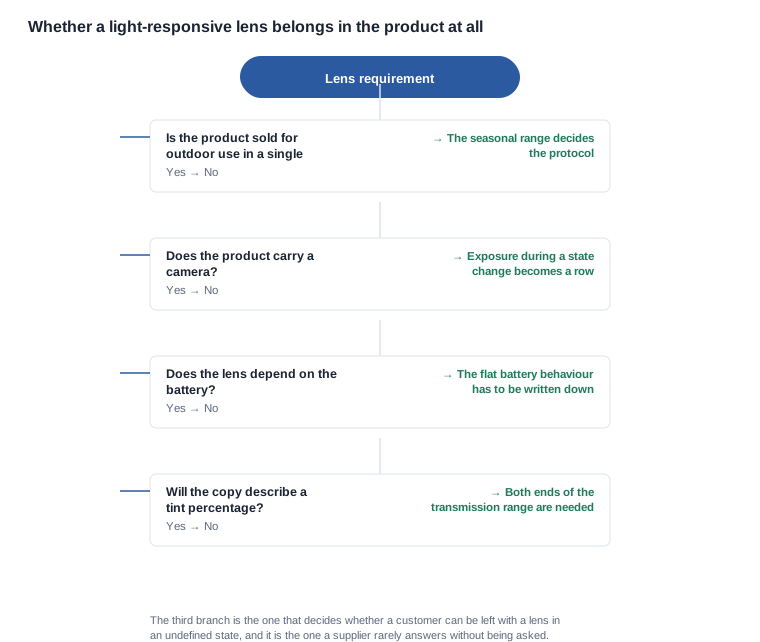
There are three things the buyer is trying to avoid, and each of them is a listing problem rather than a product problem. The first is a lens that behaves differently in the customer's environment than in the demonstration, because a parked car in summer and a winter morning are different conditions, and a lens characterised at room temperature in a laboratory has not been characterised for either. The second is a claim the customer can falsify on a windowsill: if the lens does not darken in direct sun, the marketing is visibly false in daylight, in front of other people, and the return arrives with a photograph attached. The third is a product whose behaviour is undefined when the battery is empty, which is a real possibility here because this is an electrochromic entry with a published 100 mAh cell, and the catalogue does not say whether the lens depends on power.
The reason these three matter commercially is that they are all decided before the artwork. A product page sentence, a care instruction and a customer service script are three places where the lens behaviour has to be described consistently, and a change to any of them after the packaging is printed is a reprint rather than an email.

What a photochromic platform costs, and why the lens sets the schedule
A light-responsive lens is not a tinted plastic insert. It is an active element, a driving circuit, a control signal, a colour state that has to be coordinated with the rest of the product, and in some architectures a dependency on the cell. Each of those is a design decision that lands in tooling, in firmware and in the cost of the lens itself.
The lens is the most expensive single component in this category, and the one with the longest lead time. It is typically specified and procured separately from the electronics, and a buyer who treats it as a colour option discovers the lead time at the point where the electronics are already in production. The commercial question worth asking is not the price of the lens but the point in the programme at which the lens has to be committed, because everything downstream of that point — the packaging artwork, the listing copy, the launch date — inherits it.
The uniformity tolerance is a tooling decision, not a quality decision. If the centre of the lens and the edge darken by different amounts, the customer sees it in a photograph of their own face, and the fix is a change to the lens or to its mounting, not an adjustment on the line. The cost of tightening the tolerance after tooling is orders of magnitude higher than writing it into the specification before the first article, which makes the tolerance one of the few rows in this category that genuinely has a deadline attached to it.
The state coordination is a firmware problem that also has a schedule. A lens that takes time to darken and time to clear has states in between, and the camera exposure, the display behaviour and the user interface all have to do something sensible during those transitions. The buyer who does not ask about the camera interaction will find out about it during outdoor footage reviews.
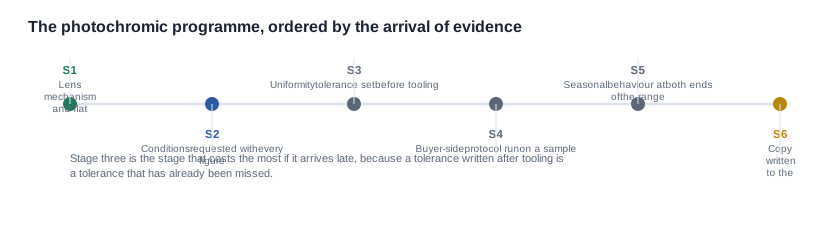
The season sets the testing window, and that is a commercial fact as much as a technical one. A summer product shipped into a market with a winter season will meet a temperature range nobody characterised. The temperature range over which the figures hold is a row to request, and if it is not published, the buyer has to run the sample test at both ends of the range the product will actually see — which means scheduling the test across two periods rather than one.

The four rows, their thresholds, and the conditions that make them comparable
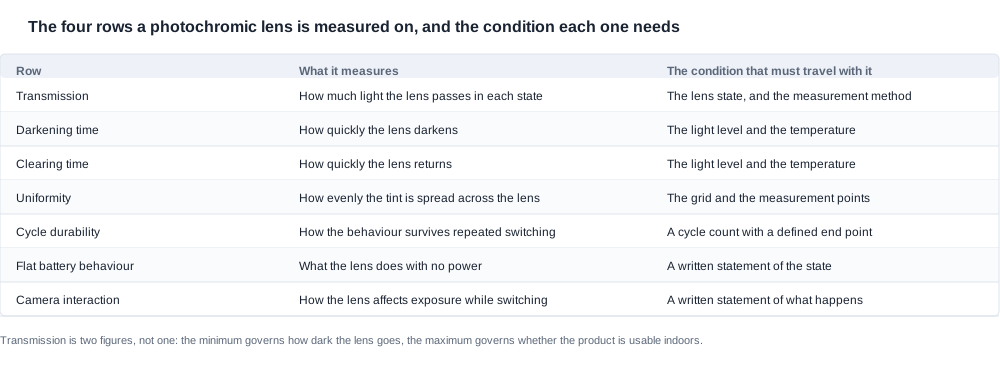
Send the table to every supplier in the same form. The right-hand column is the useful one: it separates a supplier who has measured the finished product from one relaying a component sheet.
Transmission is two figures, not one. The minimum governs how dark the lens goes and therefore whether the copy can describe sun protection. The maximum governs whether the product is usable indoors without the customer wanting to take it off. A supplier who publishes only a "tint percentage" has given you one half of the range and left the half that decides your positioning unstated. The pass line is a figure with the lens state named and the measurement method described, because a transmission figure without a method cannot be reproduced.
Switching time is the number your customer will feel, and it is two numbers. Darkening and clearing are separate behaviours with separate timings, and a lens that darkens quickly and clears slowly is a good morning product and a bad evening one. Ask for the light level the figure was taken at, because a switching time measured under an artificial source is not comparable with one measured in daylight. Ask for the temperature as well, because the behaviour of an active element is temperature-dependent and the same product behaves differently in a warm car and on a cold morning.
Uniformity is a grid measurement, and the grid is part of the result. If the centre of the lens and the edge darken by different amounts, the customer sees it in a photograph of their own face. The pass line is a maximum difference between zones, with the grid and the measurement points stated, and the tolerance written into the RFQ rather than agreed after the first article. A supplier who says the lens is "even" and cannot name the grid is describing an impression.
Cycle durability without an end point is not a test. What transmission value constitutes failure? Without that answer a durability claim cannot be verified, and a warranty built on it has no measurable end. The pass line is a cycle count with a defined end point and a pass criterion.
The temperature range of the behaviour is a row, not a nicety. The pass line is the range over which the figures hold. Not offered is a common answer, and it means the behaviour outside the laboratory range is undefined.
The flat-battery behaviour is a product behaviour and it belongs in the instructions and in the file. It goes in the manual, in the customer service script and in the listing copy. A supplier who has not thought about this will not have a written answer, and the absence of an answer is itself the finding.
The camera interaction is a written statement, not a preference. What happens to the exposure while the lens changes state is a behaviour the firmware decides. It goes in the acceptance criteria and it gets tested on the sample, in sunlight, while recording.
One warning applies to all of these rows: they are not directly comparable between suppliers. Two lens makers will measure transmission with different instruments, switching time against different light sources, and uniformity on different grids. Before you build a table, decide which column is your own measurement and which is a supplier's number, and never mix the two in one row without a note.
Running a buyer-side protocol when the lens data does not arrive
1. Request the measurements from the manufacturer, with the conditions stated for each. A supplier who cannot supply conditions has not measured, or has measured something that is not comparable to what you would measure.
2. If they cannot be obtained, establish a baseline on a sample with a fixed protocol. Transmission at a stated state, switching behaviour in both directions under a stated light source, and a grid measurement for uniformity. Write the protocol down before the first reading, because a protocol written afterwards is a description.
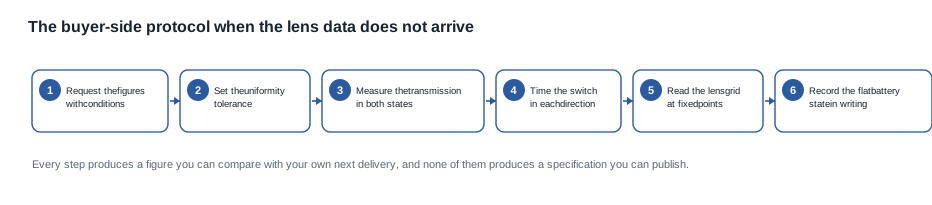
3. Record what your protocol was. You need your own figures to be comparable to each other over time and across deliveries, and that only works if the protocol is fixed and written down.
4. Do not present your measured figures as a manufacturer specification. They are your measurement of one unit under your conditions. A buyer-run result is a comparison, not a claim, and the distinction has to survive every internal use of the number, including a product page draft that is circulated for approval.
5. Check the certificate numbers against the issuing body's register, and against the exact model. A powered lens with a cell is a different conformity file from a passive lens, and a document held on a sibling model is not a document held on yours.
6. Run one acceptance test on the sample before the first article. Set the lens in direct sun, record video while it darkens, then let it clear indoors, and write down what you observed before you discuss it. A supplier disputing a written observation is arguing with evidence; a supplier who has never seen the test is arguing from theory.
7. Repeat the whole protocol on a later production batch. The lot that arrives after the first production run is the lot that tells you whether the lens behaviour holds, and in this category it is the only test that would catch a lens substitution.
Five ways a photochromic programme fails, and the terms that stay fixed
The customer reports that the glasses "do not work" and no defect is found. Root cause: the customer expected a passive lens and read the powered lens's behaviour as a fault. This is a listing problem before it is a product problem. Prevention: fix the claim wording before the product page is written, and describe the mechanism rather than the outcome.
The lens darkens evenly at the centre and unevenly at the edge, and the supplier says it is within tolerance. Root cause: no uniformity tolerance was written into the specification, so "within tolerance" means within the supplier's internal default. Prevention: set the tolerance in the RFQ and put it in the acceptance criteria for the sample.
The product ships and the lens takes noticeably longer to clear than it took to darken, and nobody wrote the limitation down. Root cause: a single switching figure was quoted for two different behaviours. Prevention: ask for the two figures separately, and if only one is available, treat the product as one-directional in the copy.
A summer product arrives in a market where the winter behaviour was never characterised. Root cause: the temperature range was never asked about, because the sales season was the summer. Prevention: ask for the temperature range, and if it is not published, run the sample test at both ends of the range the product will see.
The camera exposure is wrong in outdoor footage and the supplier calls it a software bug. Root cause: the lens-camera interaction was never in the specification, so it was never tested. Prevention: put the interaction in the acceptance criteria and test it on the sample, in sunlight, while recording.
The lens colourway count is the line that decides the shape of a photochromic programme, because a light-responsive lens is normally supplied in a small number of tints and a wider palette means a wider set of lens commitments. The terms worth negotiating time on:
- Minimum order quantity, and the lens colourway count.
- The pack contents and the care instructions, which are a per-market decision with an artwork consequence.
- Packaging specification and the artwork round count.
- Delivery splitting against a sample-approval milestone, which is often granted more easily than a price concession.
- Payment staging and holdback: a deposit before production starts, a balance at the inspection point before shipment, and a holdback released once the documents arrive.
- The warranty period with a stated response, and the returns policy, where a lens that behaves differently from the copy generates returns that are really copy failures.
Two costs in a photochromic programme are quoted but not negotiated. Certification cost and certification lead time follow the process and the testing body rather than your order size. Tooling is often amortised across the first order; a buyer is entitled to know the volume the charge is spread across and what the position is on the tool if the programme is discontinued. In this category there is a third item that is not negotiable either: the lens itself. A supplier who will not change the lens, the coating or the tint range is telling you the product is fixed, and the lead time for that lens belongs in your plan from the first week.
The file to request before the deposit is: the certificate numbers with the issuing body and the validity dates; the declaration of conformity for the exact model designation; a written statement of the lens mechanism and of the behaviour at a flat battery; the measurement conditions behind the runtime figure; and the lens figures with their conditions, or a written statement that they are not published.
The clauses a photochromic programme needs are these: the model designation as a line item, with the certificate numbers attached; the acceptance criteria for the sample, referencing the four measurement rows; a clause requiring notice before any change of lens, coating or tint range, because a lens substitution changes the conformity file; and a clause on who bears the cost when the sample does not meet the acceptance criteria.
A seasonal launch measured, and the position we can and cannot take
This is a worked case rather than a live order. The reason for it is the order. Assume a brand-side buyer launching a lens-equipped outdoor line for a northern European market, with a summer selling season, a retail partner who wants a tint claim on the box, and a supplier who has answered the flat-battery question with "the lens fades when the device is off".
Step one: the requirement. The product is used outdoors in daylight and carried indoors, and the listing is going to describe the tint. That settles the transmission row as decisive, makes the maximum transmission as important as the minimum, and puts the indoor usability question in the specification rather than leaving it to a review. The buyer asks for both figures and for the state each was taken in.
Step two: the request. The manufacturer returns one transmission figure with no state and a single switching time for both directions. The buyer treats that as two separate gaps rather than as a partial answer, and asks for the clearing time and the light level separately, and for the uniformity grid.
Step three: the protocol. On a sample, the buyer measures transmission in both states with the instrument and the method written down, times the darkening and the clearing under a stated source, and reads the lens on a fixed grid. The result is that the clearing time is materially longer than the darkening time, which the supplier's single figure had concealed. The buyer also records the camera interaction while filming outdoors, which is the row nobody had asked for.
Step four: the season. Because the selling season is summer, the buyer runs the same protocol again at the cold end of the range before the launch, and finds that the darkening time changes with temperature. The temperature range therefore goes into the acceptance criteria, and the copy says the lens darkens faster in warm conditions rather than making a single claim about speed.
Step five: the commercial structure. The buyer keeps the tint claim narrow, describes the mechanism rather than the outcome, writes the flat-battery behaviour into the manual and the customer service script, puts a notice obligation on any lens or coating change, and splits the first delivery against the sample-approval milestone.
The result is a listing a customer can test on a windowsill and find true, which is the only kind of lens claim worth making.
Our own position is that we publish what we hold and mark the rest as open. This is the situation for our electrochromic entry: we publish Bluetooth 5.4, a 100 mAh battery, a charge time of two hours or less, about seven hours runtime, magnetic charging, and electrochromic lenses — and no lens measurement of any kind, and no model designation. We will not estimate a switching time from a typical value, because a typical value is a number no test in your programme produced, and a plausible-looking figure on a product page becomes a claim the customer will test on a windowsill.
We will also say plainly what a buyer-side measurement is worth. It is a comparison, and its value is ranking candidates and detecting drift between deliveries. It is not a specification, and it does not become one by being repeated in a listing.
If you tell us the environment, the use case and the destination markets, we will say which of the four rows is decisive for that combination, which of them our documentation answers, and which have to come from a supplier or from a test on your own units. The mechanism is described under photochromic lens technology, and the comparison method is in how to compare photochromic smart glasses.
What to do next. Write down the environment the lens will live in, and the season it will sell in. Request the four rows with their conditions, from every candidate in the same format. If the figures do not arrive, run the protocol and label the result as your own measurement. Put the uniformity tolerance in the RFQ, the flat-battery behaviour in the manual, and the change-notice clause in the purchase order.
Where the measurement method comes from
- Photochromic lens technology
- How to choose photochromic smart glasses
- Photochromic smart glasses range
Tell us the environment and the use case and we will say which of the four measurements is decisive.


