

The mistakes around AI features are not random. They are placed, and the place they appear tells you which document to go back to. A claim that outruns its evidence usually entered through a supplier deck, sat in a brief nobody challenged, and was printed on a product page three weeks later — and a buyer who audits the product page is looking at the wrong document.
Smart glasses ai features smart glasses common mistakes is therefore organised as a document audit rather than a list of warnings. Eleven mistakes, grouped by the document that carries them, each with the control that stops it. The claim screen that turns a supplier answer into a publishable sentence comes after, and the audit sequence that catches the mistakes before artwork costs money.
The short answer: publish what the manufacturer has stated and nothing beyond it, write every claim after the build rather than before it, and name the person who owns the wording. Nearly all of the eleven mistakes disappear when those three things happen.
Our published position is narrow and deliberate. We name an AI voice assistant as a listed key technology across the camera and audio tiers, and we mark everything we cannot evidence as open rather than approximating it. That rule is the reason this article exists, because a rule you can apply beats a list of mistakes you have to recognise.
Smart glasses AI features: where the mistakes enter
An AI feature claim does not appear on a product page on its own. It enters at the earliest point where somebody writes down what they want the product to do, and from that moment it is copied forward: from the brief to the supplier response, from the supplier response to the listing, from the listing to the box.
That direction of travel matters, because the cheapest place to remove a bad claim is where it enters, and the most expensive place is where it leaves. A claim removed while the brief is being written costs a paragraph. The same claim removed after the artwork is approved costs a reprint, a new listing, a stock write-down and a customer conversation.
Three things make the copying happen without anyone deciding to copy. First, an AI feature is a capability with a number attached somewhere, and the number is available to whoever wrote the brief — it does not have to be verified to be repeated. Second, there is usually no single person accountable for the claim, so it belongs to the brief, then to the marketing team, then to the artwork, and nobody owns it at any point. Third, the failures are asymmetric in a way that makes them invisible: a claim that is too narrow costs a slightly less impressive product page, while a claim that is too wide costs a listing review, a return, or a complaint that arrives months after the product shipped.
None of this is a supplier failing to be honest. It is the normal behaviour of a claim system with no gate in it. What follows is the gate, applied to the four documents where the eleven mistakes actually live.

The eleven mistakes, grouped by the document that carries them
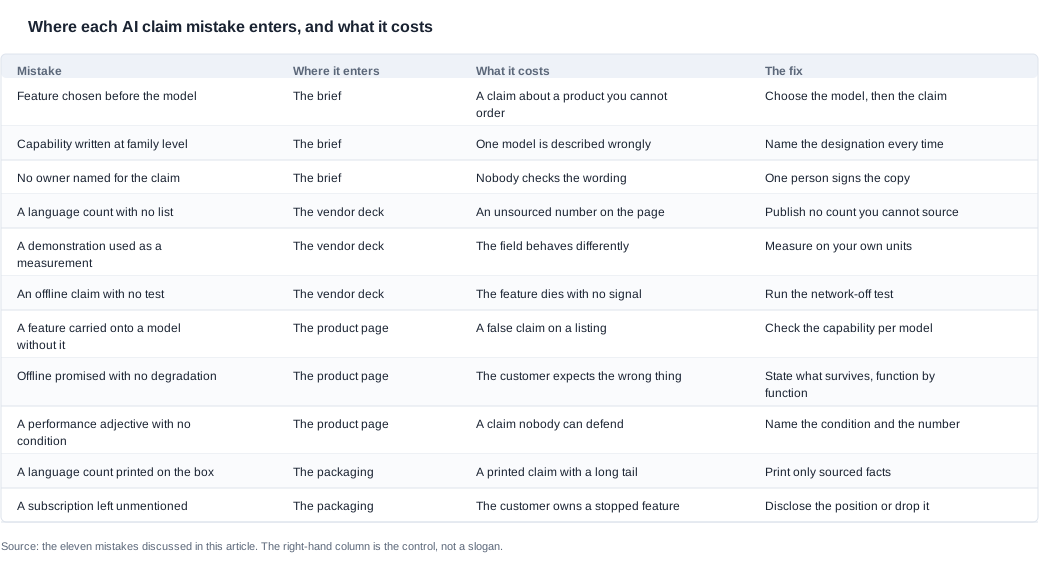
The eleven mistakes below are not eleven unrelated warnings. Each one belongs to a specific document in the chain, and each document has its own failure mode: the brief fails by being vague, the supplier response fails by being promotional, the product page fails by being compressed, and the packaging fails by being permanent.
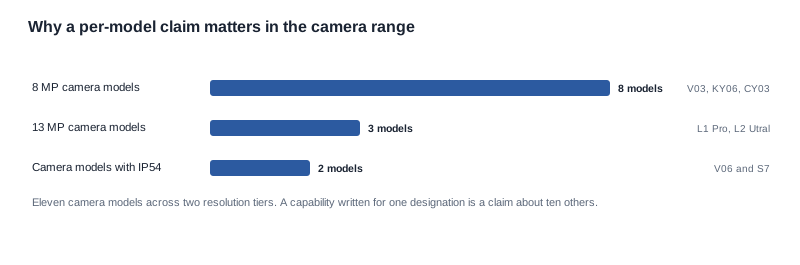
The scale of the per-model problem is worth seeing before the details. The camera tier in this range is eleven models across two resolution tiers, and only two of them carry an IP rating, so a capability written once for "the camera range" is potentially wrong for nine models out of eleven.
The three that enter through the brief
The brief is where the claim is born, and it is the only document where removing a claim is free. Three mistakes dominate it.
Choosing the feature before the model. If the brief opens with "we need a voice assistant" rather than with a model designation, every claim written afterwards describes a product nobody has ordered. The camera tier in our range is eleven models — eight at 8 MP and three at 13 MP — and the voice assistant is a published key technology across that tier, but a claim written at family level is a claim about ten models you may never sell. The control is trivial and absolute: put the model designation in the first line of the brief, and treat any sentence that does not name a designation as unfinished.
Writing the capability at family level. This is the same error with a different trigger: the brief describes the "camera family" or the "audio range" as though a capability were uniform inside it. In the audio tier, AI translation is published on the K01 and not on the other models in the same family. In the camera tier, IP54 is published on the V06 and the S7 and on no other camera model. A capability written at family level will eventually be read on a model page that does not carry it.
Naming nobody as the owner of the claim. When the wording has no owner, it is owned by whoever is closest to the deadline, which is usually the artwork studio. The control is a name and a date: one person signs the final wording, and the supplier's capability list is attached to the brief as the reference they are signing against.
The three that enter through the supplier response
The supplier response is the document most likely to contain a number with no method behind it, because a response is written to win the order.
A language count with no list behind it. "Supports 50 languages" is a marketing figure unless it is a named list with a stated direction and a stated assessment method. A count with no list is the claim most likely to be challenged by a customer in a specific language, because that is the only language they care about. We will not publish a language count for any model in this range, and the reason is not scepticism about the number — it is that we do not hold the list it refers to.
A demonstration offered as a measurement. A prepared phrase in a quiet room, on a known-good network, on a unit configured for the occasion, tells you about the demonstration. It does not tell you about the false activation rate in a place with a machine running, or about the command success rate on a phrase list your customers actually use. A demonstration is the cheapest evidence in this category, and it is also the easiest to mistake for a specification.
An offline claim that was never tested. If the assistant depends on a service, the product with no signal is a different product, and a listing that promises offline use is describing the other one. The offline behaviour in our range is not published for any model, so a supplier answer that arrives without a tested list of surviving functions has not answered the question.
The three that reach the product page
By the time a claim reaches the product page it has usually been through two copies, and the page is where the compression happens: a sentence written for a general audience, on a page that has to work for every model in the range.
A feature carried onto a model that does not have it. This is the most expensive mistake on this list, because it is invisible until a customer with the other model reads the page. It usually arrives through a family landing page written once and reused across eleven camera models.
Offline promised with no degradation stated. "Works offline" tells a buyer nothing about what they lose. A defensible sentence enumerates the functions that survive with no signal, and the enumeration is more persuasive than the adjective because it is checkable.
A performance adjective with no condition attached. "Fast", "accurate" and "seamless" are not claims until a condition is attached to them — which network, which language, which phrase list, which environment. A measured figure with its condition written next to it is defensible; the same figure without the condition is not.
The two that get printed on the packaging
Packaging is the only one of the four documents that cannot be quietly corrected, because it is printed, shipped and then sitting on a shelf for months.
A language count printed on the box. A number on packaging is a commitment with a long tail. It has to be correct in every market where the box is sold, and it has to stay correct after the service behind it changes.
A subscription left unmentioned. If a plan is required, the box has to say so, and the product has to say what happens when the plan ends. Leaving it out moves a support cost onto your own team and a surprise onto the customer. We publish no subscription position for any model in our range, which is a different problem from the one a brand creates by omitting it.
The claim screen: what a defensible sentence looks like
The claim screen is the control that all eleven mistakes ultimately fail against. It is a simple rule: every claim about an AI feature has to resolve to a document you can attach to the order. A claim that resolves to an adjective, a number without a method, or a demonstration is not yet a claim.
The right-hand column below is the version of the claim you can actually publish once the left-hand column is answered.
| Mistake | What it produces | The supportable version, and the evidence |
|---|---|---|
| The feature was chosen before the model | A claim about a product you cannot order | The model designation on every line of the brief |
| The capability was written at family level | One model in a family described wrongly | The capability list, per model designation |
| Nobody owns the wording | The artwork signs the claim | One named owner, and a reference document |
| A language count with no list | An unsourced number on a product page | A named list we can source, or no count at all |
| A demonstration used as a measurement | The field behaves differently from the demo | Measurements on your own units, in your environment |
| An offline claim with no test | The feature dies where there is no signal | The list of functions that survive, tested on a sample |
| A feature carried onto the wrong model | A false claim on a listing | The per-model check, before publication |
| Offline promised with no degradation | The customer expects the wrong thing | The surviving functions, written into the copy |
| An adjective with no condition | A claim nobody can defend | The condition and the number, side by side |
| A number printed on the box | A printed commitment with a long tail | Sourced facts only, printed |
| A subscription left unmentioned | A customer owns a stopped feature | The position stated, or the claim dropped |
Three thresholds are worth stating separately, because they are the ones that come up in every audit.
The capability list is the only source of a capability. A model that does not publish a capability list has no claimable capability, and the honest listing says so plainly rather than describing the family.
Offline capability is an enumerated list, never a yes. The question is "which functions remain with no signal", and the answer has to be a list you can put in the manual. "It still works offline" is the answer that generates the complaints.
A demonstration is a best case, and a best case is not a specification. It is the cheapest evidence available — a written script, an afternoon, two units of the same build — and it is worth far more than a week of reading, provided you write down what you observed.

The four mistakes that cost a re-print
Two of the eleven mistakes are expensive because they are wrong. Four are expensive because they are right at the wrong time, and because the correction comes after the packaging is on the shelf.
The feature that changes after the artwork is approved. A voice assistant is, in most designs, a behaviour that lives outside the frame, and it can change when the service changes, when the model is updated, or when the firmware is revised. If the product page says "ask it anything" and the behaviour afterwards becomes narrower, the listing is wrong and there is no process to notice. The control is a notice period and a copy review trigger in the agreement, so that a change arrives as a scheduled event rather than as a customer complaint.
The offline degradation that is discovered in a customer review. Nothing in a return rate tells you which function failed. A cluster of returns that all mention the same thing without naming the cause is usually a degradation nobody wrote down. The control is the enumerated offline list, tested on the sample and shipped in the manual.
The model that appears on a listing it should not. This one is invisible until it is not. A page written for one designation, reused across the family, produces a claim on a model page that the model does not support. The control is a per-model check that takes minutes and is repeated every time a page is created.
The subscription that appears after the customer has paid. If a plan exists, the support load for a lapsed plan is a different job from hardware support, and a customer who discovers it late treats it as a defect rather than a term. The control is the lapse behaviour, written into the brief and into the agreement, so that it is a disclosed position rather than a discovery.

Catching the mistakes before they reach artwork
An audit is only worth running if it produces a decision, so this one produces a mark on every claim: sourced, unsourced, or contradicted. The three marks map onto three different actions, and only the first one lets you publish.

Step one: collect every claim, wherever it currently lives. The brief, the product page draft, the packaging artwork, the marketplace listing and the support script. In practice the claims that nobody remembers are the ones in the artwork, so pull the artwork rather than asking for a summary.
Step two: match each claim to the document that supports it. A claim supported by nothing is not a weak claim, it is a different kind of object. It belongs in the "unsourced" column, and the only two available actions are to test it or to drop it.
Step three: mark each claim. Sourced means a document exists and is attached. Unsourced means it might be true and has to be tested. Contradicted means a document says something different, and a contradicted claim is the dangerous one because it reads as supported.
Step four: test the unsourced claims. Two units of the same build, the network on and the network off, a written script of the commands you intend to publish, and the conditions you intend to publish them under. The measurement sheet you produce is the document you will need later, when someone asks why the wording changed.
Step five: write the copy from the claims that survived. Not from the claims you wanted, and not from the claims that were true in a demonstration. The rewrite that follows a test is the only version of a claim that will still be true when the customer buys the product.
There are three further failure modes worth naming separately, because they are the ones that arrive after a launch rather than before it.
A capability listed for one model appears on another model's page. The cause is always a copy written at family level. The prevention is the per-model check, repeated at every page creation rather than once at launch.
A yield problem appears at scale. A feature that works on the sample unit and fails on the third unit of the lot is a consistency problem, and consistency is invisible in a single-unit test. The prevention is two or three units per build, and a repeat on a later lot before the claim goes on the page.
The count on the page has no owner, so nobody corrects it. A number without an owner does not get updated when the service changes. The prevention is the same one-line rule as the brief: one named person, and a copy review trigger.
The audit checklist, and the criteria behind it
Before you order — and before you sign artwork — there is a short list of questions to ask that will settle most of the eleven mistakes, and the criteria behind each one are deliberately simple.
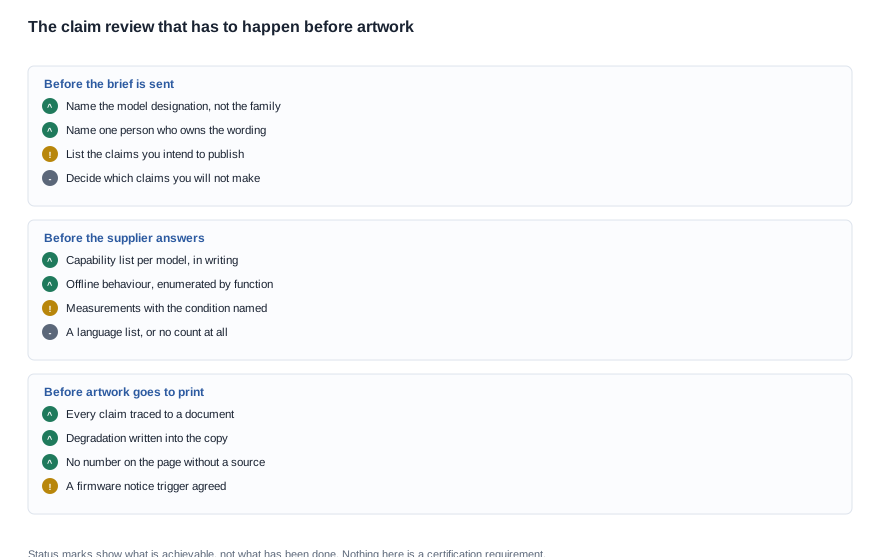
- The questions to ask the supplier: the capability list per model designation, in writing; the functions that survive with no network, enumerated; the measurement conditions behind any number you have been given; and the data path, the operating entity and the jurisdiction.
- The criteria for a published claim: it names a model designation, it attaches a condition to any figure, and it resolves to a document that will be attached to the purchase order.
- The criteria for a measurable claim: there is a written script, a pass condition per line, at least two units of the same build, and a network-off run in the same pass.
- The red flags that mean stop: a language count with no list behind it, an offline claim with no enumeration, a demonstration offered in place of a measurement, a capability described for a family rather than a model, and a wording with no named owner.
- The total cost of the gap: every unsourced claim carries the cost of a reprint, a listing correction and a support load that is difficult to size and easy to underestimate.
Those criteria are not a procurement framework. They are the minimum set that stops a claim from being published without a source, and each one costs nothing to adopt.
The pitfalls in this category are consistent enough to be worth naming as a group, because they share a root cause: a claim is easy to write and hard to disprove, so it travels. The checklist above is the counterweight — not a rule against making claims, but a rule about how a claim becomes one you can defend.
What we can evidence, and what to send us
The short answer: we will name the AI capabilities our documentation supports and mark the rest as open, and we would rather a buyer removes a claim than publishes one it cannot defend. That is not a defensive posture; it is the cheapest operating rule in this category, because a claim you can defend costs nothing to maintain and a claim you cannot costs a reprint every time the underlying service changes.
What we publish: an AI voice assistant as a listed key technology across the camera tier and the audio tier, and the smart noise reduction technique for the Bluetooth audio family. Our independent site describes AI translation on the K01, which is an audio model, so we treat that as an observation from our own marketing material rather than as a published specification. That distinction is small and it is the whole argument: an observation is not the same as a specification, and a buyer who restates our observation carries exactly the exposure we carry.
What we do not publish, and will not estimate for any model in this range: the architecture, the provider, the model list, the language list, the latency, the accuracy, the false activation rate, the offline behaviour, the subscription status, the data path and the retention period. We also publish no verified device list, and we will not produce one retrospectively from memory, because a compatibility list is only useful if it is accurate at the moment it is read.
The same rule applies to our own pages. If we cannot source a claim from the manufacturer, we mark it open rather than approximating it.
What we can do is take your draft listing, the packaging artwork and the marketplace copy, and mark every AI claim as sourced, unsourced or contradicted — and then tell you which ones have to come out or be rewritten. Send them as they are, in whatever state they are in, along with the models and the quantities you are considering, and we will tell you what to negotiate for and what we can actually close. The background is under AI features, the measurement method is in how to measure AI features, the supplier questions are in AI supplier verification, and the cost side is in AI cost factors. The camera range itself is at AI camera glasses.
Where the eleven mistakes come from
Send us your draft listing and we will mark each AI claim as sourced, unsourced or contradicted.


