

Confirming the reported Bluetooth version takes about a minute, and the version is also the least informative measurement available on a Bluetooth device. Four measurements that take about an hour answer the question a buyer actually has, which is whether the product will hold a connection in a customer's hand. Smart glasses bluetooth version smart glasses how to measure is therefore a two-stage procedure: a five-minute screen that catches a documentation error, and a one-hour protocol that settles the purchase. Our published data: Bluetooth 5.3 on the K01 and the K02 in the audio tier, and 5.4 on the A07 and the LC-105-2, the D17 and the ZH12, the YK12 and the G07, and the YKC02 and the LC-105-1, the sport and camera models, the light-responsive entry and the bone conduction entry.
Smart glasses Bluetooth version: a screen, not a purchase decision
The answer that fits on a quotation
Use the version as a screening filter and a documentation cross-check, and never as the reason for the order. The purchase decision is made by the set of phone platforms and operating systems the supplier has actually qualified, tested in the environments your channel sells into. If a supplier cannot produce that qualification list, the version number is the only thing they have, and it is the one thing that cannot be a pass or a fail line in an incoming inspection.
Who is reading this and what they are defending
A procurement manager is comparing two candidates whose catalogues both print a version, and needs to know which single question to ask so that the comparison stops being about the printed row.
A product manager is building a proposition for a channel with a known platform mix, and needs to know whether the version on the sheet corresponds to a platform population their channel actually contains.
A channel buyer is writing the listing and needs to know which connection claims are publishable and which would create a support burden.
Why the version cannot carry the decision
A version number tells you which feature set the controller claims to implement. It does not tell you which profiles were actually qualified, which codec is negotiated first, how the radio behaves at the edge of range, how the device behaves when the phone's radio is busy, or whether the pairing flow survives a factory reset that the customer performs in month three. Each of those is a reason a product is returned, and none of them is visible in the version.
There is a second reason the version is a weak comparison basis, and it is a procurement reason rather than a technical one. A version is a number with no tolerance. You cannot write "Bluetooth 5.3 or better" into an incoming inspection criterion and reject a lot on it, because there is no failure mode you can observe. Every other row in the radio set — a connection that does not establish, a reconnection that requires re-pairing, audio that drops out while the phone is streaming — produces an observable failure that an inspector can see and a clause can refuse.
The thresholds that turn a connection behaviour into a pass or a fail
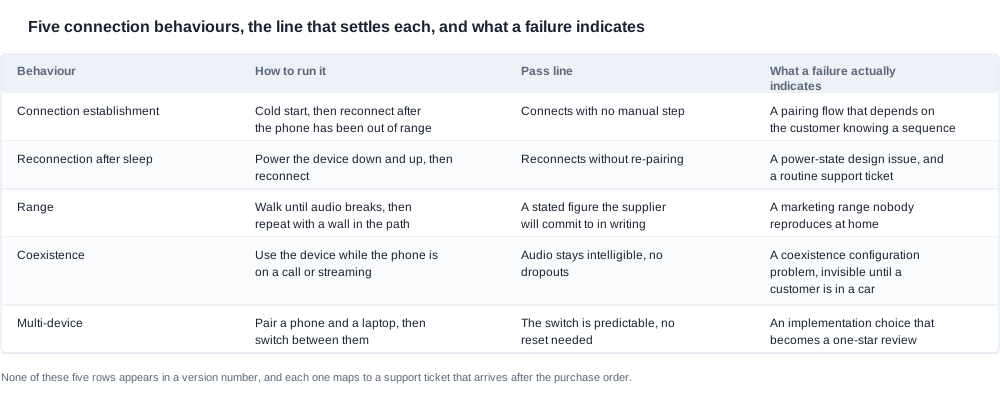
The five behaviours and their pass lines
| Measurement | How to run it | Pass line | What a failure actually indicates |
|---|---|---|---|
| Connection establishment | Cold start, then reconnect after the phone has been out of range for a minute | Connects without a manual intervention | A pairing flow that depends on the customer knowing a sequence |
| Reconnection after device sleep | Power the device down and up, then reconnect | Reconnects to the paired phone without re-pairing | A power-state design issue, and a routine support ticket |
| Range with line of sight | Walk away until audio breaks, then note the distance, then repeat with a wall in the path | A stated figure that the supplier will commit to in writing | A marketing range that will not be reproduced in a customer home |
| Behaviour with a busy radio | Use the device while the phone is on a call or streaming | Audio remains intelligible, with no dropouts at the audio level | A coexistence configuration problem, which is invisible until a customer is in a car |
| Multi-device | Pair to a phone and a laptop, then switch between them | The switch is predictable and does not require a reset | An implementation choice that becomes a one-star review |
Each of the five maps to a specific support ticket that arrives after the purchase order, and each one can be written into the incoming inspection criteria as a pass or a fail line. That is the whole argument for spending an hour on the radio rather than reading a version.
The four variables that have to be recorded with every result
A measurement without its conditions is not a result, and in this category the conditions are where the comparability lives.
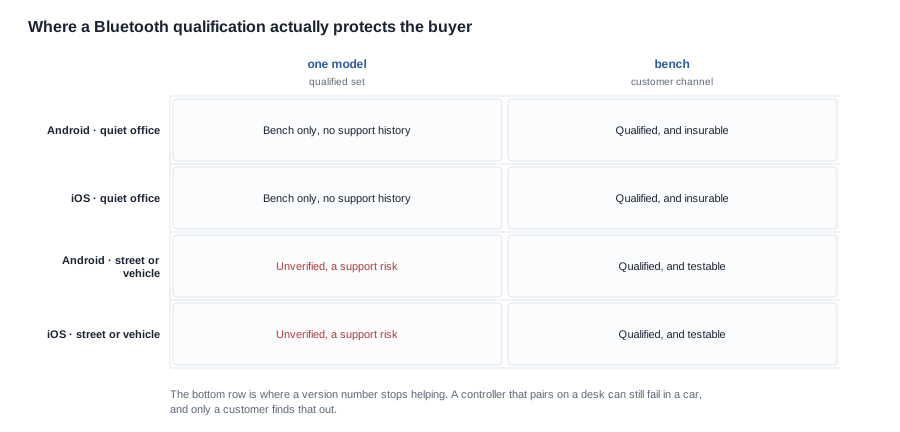
The phone model and its radio state. The same device behaves differently beside a laptop with an active Wi-Fi link, and the phone you test with is the phone you will be judged by. If your channel's customers are concentrated on one platform, that platform is the one that belongs in the protocol, and a test set that excludes it tells you nothing about your channel.
Distance and obstruction. Line of sight and through-wall are different tests and should never be reported under the same heading. A range figure without the obstruction named is not a range figure.
The firmware and application version on both sides. A controller change can alter pairing behaviour without any change to the version number, which is precisely why a version-only history is not a traceability record.
The environment. An office, a vehicle, a retail floor and a street are four different test environments, and the customer will use the product in all four. A result that carries the environment is worth writing into a clause; a result that does not is an anecdote.
The platform population is a commercial fact, not a radio fact
The most useful input to this whole exercise is not in the radio at all. It is the channel's own platform mix — which mobile platform the customers of that channel actually use, and in what proportion — and it is available from the seller's own analytics long before anyone orders a sample. A buyer who arrives at the comparison table without it will end up qualifying against a test bench, and the bench is not the channel.
This matters commercially as well as technically. A qualification list naming the platform population of your channel is a document that can be written into the purchase order as a named scope, and a scope written into the order is a scope the supplier has priced. A buyer who asks for "all platforms" instead is asking for the widest possible scope, which is both the most expensive thing to deliver and the least useful thing to receive, because it does not tell you whether your channel is covered.
A warning about comparing range figures
Range figures in this category are quoted in metres, in feet, in open air, on a bench, with the device paired and idle on the far side of the room. None of those qualifiers travels with the number into a catalogue, and a comparison table built on two unqualified range figures is a comparison of the two suppliers' imagination. If a supplier gives you a range figure with no obstruction and no environment, the correct treatment is to treat it as a marketing figure and to run your own line-of-sight and through-wall readings on the sample.
Running the version check and the behavioural protocol on a sample
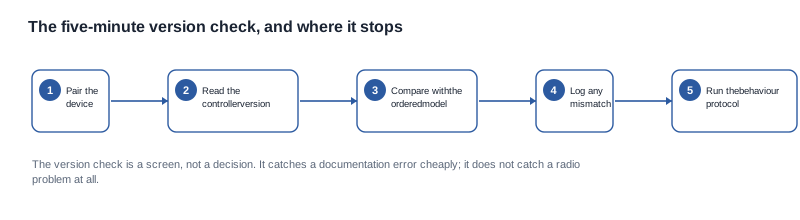
The one-minute check
- Pair the device with a phone and open the system's Bluetooth detail page. The reported controller version is usually visible in the device information panel, alongside the host device's own version.
- Read the version from the device, not from the box or the listing. A version printed on packaging is a marketing claim; a version read from the paired device is the controller's own report.
- Compare it against the documentation for the model you are ordering. 5.3 on the K01 and the K02, 5.4 on the D17 and the ZH12, the G07 and the LC-105-2, the LC-105-1 and the YKC02, and the A07 and the YK12, the sport and camera models, the light-responsive entry and the bone conduction entry.
- If the two disagree, stop there and write it down. A mismatch between the device, the datasheet and the purchase order is a traceability finding, and it is much cheaper to find it on a sample than on a pallet. The supplier-side verification procedure is at Bluetooth version supplier verification, and the row-by-row reading of the specification is at Bluetooth version spec sheet explained.
The behavioural protocol
Run the five behaviours in the table above, in that order, on two units of each candidate, and record the four variables with every reading. The order matters because each step assumes the previous one passed: a product that will not connect on a cold start tells you nothing useful about its reconnection behaviour, and a product that will not reconnect tells you nothing about its coexistence behaviour.
Two units is the minimum that produces a usable result, because a single unit cannot distinguish a design characteristic from a production inconsistency. That distinction is worth a great deal when a defect rate is disputed later, because one of the two answers means a specification change and the other means a supplier conversation.
Write the protocol down before the first run, not after the first surprise. A pass line expressed as a count — the far end hears the phrase on three attempts out of three — can be reproduced by an inspector. A pass line expressed as a judgement cannot.
What the protocol will not tell you
It cannot tell you what the product will do in a customer's building, because a radio in a factory with steel racking behaves differently from one on a desk. It cannot tell you the audio quality of the microphone in a noisy environment, which is a separate measurement and is covered at noise control and microphone pickup. It cannot tell you whether the pairing experience in the application is coherent, because that is a software question rather than a radio question. And it cannot tell you whether the product will be paired to a phone model that was not in the test set, which is the question a buyer should ask next, because a test against one phone is a test against one phone.

Where a Bluetooth programme loses the customer after the order
A product connects on the bench and fails in a customer's car. The symptom is a cluster of returns whose description mentions interruptions during calls. The root cause is that coexistence was never tested with a busy radio, and the phone's own activity is the variable that breaks the link. The prevention is to put the coexistence row into the sample protocol and into the incoming inspection criteria, and to name the environment in which the line was measured.
A customer has to re-pair after the device sleeps. The symptom is a support ticket that reads as the product forgetting the phone. The root cause is a power-state design issue rather than a radio issue, and it is invisible on a datasheet. The prevention is the reconnection row, run on both units, written as a pass line.
The product connects to the phone but not to the second device a customer owns. The symptom is a one-star review about switching between a phone and a laptop. The root cause is a multi-device policy that was never specified. The prevention is the multi-device row, and it costs five minutes.
The listing promises a range the customer never reproduces. The symptom is a return cluster from households rather than from any particular use case. The root cause is that a marketing range was published as a specification. The prevention is to publish nothing about range unless you have measured it yourself, and to publish the conditions with it if you have.
A firmware update changes the pairing behaviour and the returns begin. The symptom is a return rate that climbs with a controller release rather than with the size of a shipment. The root cause is that the radio stack never entered the change-control list. The prevention is a notice obligation on any change to the controller firmware or the pairing application.
The product works with the phone it was qualified on and fails with the phone a customer upgraded to. The symptom is a complaint that mentions a new handset, arriving after a platform release rather than after a shipment. The root cause is that the qualification list was a snapshot of the platform population on one date and was never scheduled for re-checking. The prevention is to write a re-qualification obligation into the order, tied to a named interval or to a platform release that touches the qualified set, so that the cost of catching it falls on the party that can act on it.

What the radio evidence is worth in negotiation
Negotiable, and this is where the effort belongs. The qualification list — which phone models and which operating system versions were tested — is a document request, and a supplier who can produce it has a documentation habit. Whether the supplier will run the five-row behavioural protocol on units pulled from the production line rather than on the pre-production samples it keeps on a shelf is worth a real conversation, because the production line is where a lot-to-lot radio difference appears and a pre-production sample will not show it. Whether the protocol is included in incoming inspection for the first shipment only or for every shipment is a negotiation, and a single-shipment-only inspection is the cheaper option that leaves the second shipment uncovered. The minimum order quantity tiers, the accessory and charging set minimums, the packaging specification and the payment nodes against inspection are all standard negotiating positions.
The radio conformity work is fixed by the laboratory and by the shipped configuration, not by the order. A Bluetooth qualification has to be booked into a test laboratory's queue, and the date that comes back from that queue is the laboratory's to give rather than yours to press for. The antenna and tooling setup is a one-off charge that a first order usually carries, so the questions worth asking are over what volume it is written off against, whether the antenna tooling stays with the supplier or moves to the programme, and what happens to it if a second source is brought in. Also not negotiable is the radio implementation itself: a supplier who will not change the controller, the antenna design or the firmware tuning is telling you the connection behaviour is fixed, and the programme should be built around that fact.
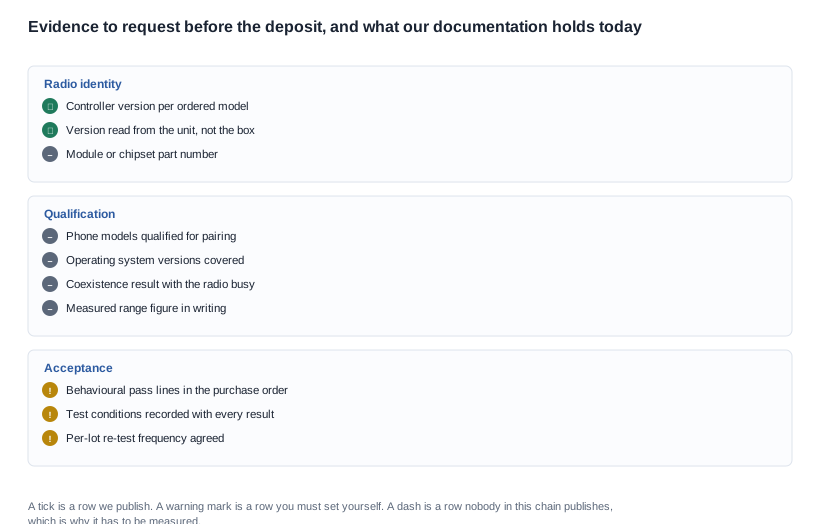
Documents to request before a deposit. The controller version statement per model. The qualification list of tested phone and operating system combinations. The coexistence test result. The radio qualification documentation for the shipped configuration. The agreed incoming inspection criteria including the pass lines above. The certificate register and how to check it is at certification checklist, the clause language is at contract terms, and the range covered here is at Bluetooth audio glasses.
A worked scenario: two candidates for a call-led channel
A brand product manager buying a call-led line has to write the platform population down before the version numbers are compared, and the four steps below are the order in which that comparison is actually decided.
Assume a brand product manager building a call-led line for a channel whose customers are concentrated on one mobile platform, comparing two suppliers whose catalogue rows are otherwise identical. Both suppliers quote a recent Bluetooth version. The binding constraint is not the version; it is that the previous line in this channel generated support contacts about calls breaking up in vehicles, and the channel will not fund a second line with the same problem.
Step one is the platform question. The manager writes down the platform population of the channel rather than the platform population of the test bench, because the qualification list is only meaningful against a population. The supplier that can name the phone models and operating system versions it qualified against, and the supplier that cannot, are now distinguishable in a way two version numbers never were.
Step two is the behavioural protocol. Both candidates go through the five behaviours on two units. The first candidate passes the cold start, the reconnection and the multi-device rows, and shows intermittent dropouts when the phone is on a call. The second candidate passes all five but reproduces the dropout at a lower threshold on the second unit. The difference between a design characteristic and a production inconsistency has now been identified on a sample, which is the cheapest place to identify it.
Step three is the commercial response. The supplier with the inconsistent behaviour is asked to state the production control it applies to that configuration and to accept the coexistence row into the incoming inspection criteria for every shipment rather than the first. The supplier that can state a control and accept the clause is kept; the one that answers the consistency question with a marketing description of its radio tuning is set aside, and the manager is explicit that the reason is the absence of a control rather than the presence of a defect.
Step four is the claim. The listing says what was measured and nothing more: the platform set that was qualified, and the fact that the connection is stable in the environments tested. It says nothing about range, because no range figure was measured under conditions the manager could defend.
The decision was made by the qualification list and the protocol, and the version number played no part in it beyond confirming that the documentation matched the hardware.
What our version rows cover and what they do not
The Bluetooth version is published per model exactly as the catalogue states it, and no measured range, no qualified phone list and no coexistence result appear anywhere in our documentation; none of them is estimated from typical values. The version is a screening filter; the five behavioural measurements are the decision, and they are the ones that can be written into a purchase order as acceptance criteria. A buyer who relies on the version alone will get a product that connects on the bench and behaves differently in a customer's car, and the discovery will happen at the wrong point in the project.
We will also say the other half plainly. A version row that matches the device tells you the documentation is honest about that row, and nothing about the rows it does not cover. And we will not present a supplier's typical value for range or coexistence as though it were ours.
Three requests to send this week
Write down your channel's platform population before you compare suppliers. Two lines: the platform mix and the environments the product is sold into. Those two lines turn the qualification list from a document into a decision.
Send the five-row behavioural request and the four record variables in one message. Version statement, qualification list, coexistence result, radio documentation for the shipped configuration, and the incoming inspection criteria. Ask for the results to be recorded with the conditions attached.
Send us the models you are evaluating and the platform population of your channel, and we will tell you which published version rows apply, which of the five measurements our documentation can answer today, and which have to be run on a sample and written into the inspection criteria before a purchase order is signed.
Related reading
- The technical background — Bluetooth connectivity and versions
- The supplier-side check — Bluetooth version supplier verification
- The specification rows — Bluetooth version spec sheet explained
- The range covered — Bluetooth audio glasses
Tell us the models, the phone platforms and the environments, and we will say which published rows apply and which measurements still have to be run.


