

Verifying a supplier's Bluetooth capability is a narrow activity with a specific output, and it is worth separating it from the much larger activity of verifying a supplier. You are not auditing the factory, the incoming inspection system or the production capacity in this step. You are establishing four things: that the radio configuration the supplier describes can be evidenced by something outside the supplier's own sales conversation, that the firmware owner is a named party rather than an assumption, that the radio behaviour of the unit can be observed on your own sample, and that the version is fixed for the production window you are about to commit to.
The published position in our own range makes the shape of that problem obvious. Fourteen rows print a Bluetooth version — V5.3 on the K01 and the K02, V5.4 on the D11, the D12, the LC-105-1, the LC-105-2, the G07, the YK12, the YKC02, the D17, the ZH12, the A07, the AR glasses entry and the AI electrochromic entry — and fourteen rows print nothing. That distribution does not distinguish one supplier's product from another's, because it tracks nothing else in the catalogue either. Verification effort spent comparing version strings is effort spent on the one row that cannot be verified usefully.
Smart glasses bluetooth version: verifying the capability rather than the supplier
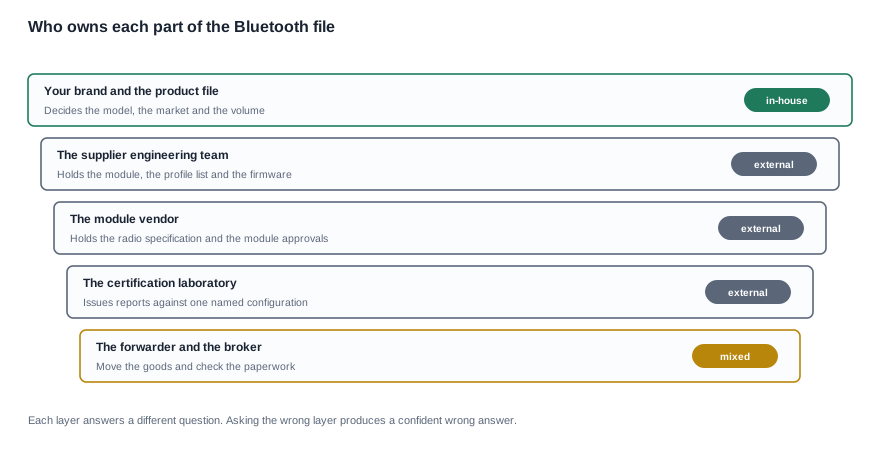
The layers above divide the file by ownership, and asking the wrong layer is the most common reason a capability question comes back with a confident and useless answer. Your own brand owns the product file: which model, which market, which volume, which acceptance criteria. The supplier's engineering team owns the module, the profile list and the firmware. The module vendor owns the radio specification and the module's own approvals. The certification laboratory owns the reports it issues, which are always issued against one named configuration. The forwarder and the broker own the paperwork that has to travel with the goods, and they are the layer that will ask for documents nobody else requested.
Ask each layer its own question and the answers are consistent with each other. Ask the forwarder for the radio specification and you will get a shipping document; ask the supplier for the conformity scope and you will get a family statement.
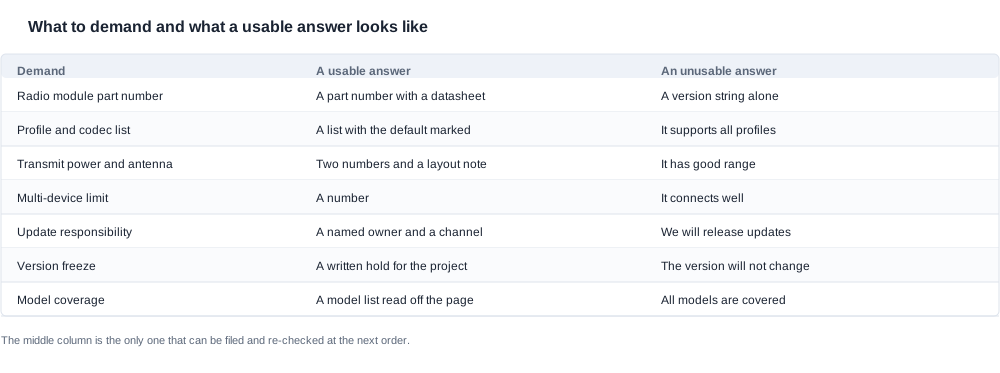
Five items have to come out of a capability verification, and each one has a form of answer that can be filed and a form that cannot:
- The radio module or chipset part number, with a datasheet that a third party could use. A version string alone is not evidence of anything, because it is the string the supplier chose to publish.
- The supported profile and codec lists, with the negotiated default marked. "It supports all profiles" is the answer that leaves the actual behaviour undetermined, which is the behaviour that determines how a call sounds in a noisy place.
- The transmit power and the antenna configuration. Two numbers and a note about the antenna arrangement, not a sentence about range.
- The simultaneous-connection limit, as a number. For a product issued to staff, this is the number that decides whether the unit is usable at all.
- The version position for the project, in writing, with an owner.
The test that applies to all five is checkability. Could somebody who has never spoken to the supplier take the answer and verify it? A module part number can be checked against the module vendor's own documentation. A profile list can be checked on a unit. A version position can be checked against the next delivery. A sales answer cannot be checked by anyone at all, which is why it should never reach a specification sheet.
Naming precision is the other half of this, and it is not a formality in this category. A document has to name the model designation that appears on your order, because that designation is what identifies the configuration the document was issued against. The catalogue page for the L2 Utral, for example, carries a second designation line, Utral Pro Max, that is not explained anywhere in the catalogue — so the question of whether that is a variant, a related product or a packaging label is one that the documents have to answer and the product name cannot. Ask for the model list printed on the conformity documents and the qualification listing, and read it against the models you are actually buying. A family name is not model coverage, and the two are treated as identical by buyers more often than by suppliers.
It is worth being explicit about what this capability verification is not, because the boundary is what keeps it affordable. It is not a factory audit, which examines the production system, the incoming inspection routine and the traceability of components. It is not a quality audit of the sample programme, which examines whether the unit you receive is representative of the units you will receive. It is a documentation-and-sample exercise with a narrow question: can this radio configuration be evidenced, and can it be held for the window you are buying into. Run as a separate activity from the factory audit, it takes days rather than weeks, and it produces a document set rather than a report. Run as part of the audit, it usually produces a paragraph, and a paragraph is not evidence.

The firmware update responsibility that has to be pinned down
Firmware ownership is a verification item rather than a courtesy, and the reason is that it determines who carries the cost of everything the radio does in the field. The radio behaviour of a shipped product is not set by the module alone; it is set by the firmware on the unit. A unit whose firmware owner is undefined has an undefined behaviour after the point of shipment, and the undefined behaviour will be handled by whoever receives the afters, which in a brand-owned channel is you.
Six things have to come out of the conversation, and they are six because each one has been the missing element in a different failed project:
- The named owner of firmware updates for the model. A team, a role or an individual — anything that identifies a party who can be asked a question in two years.
- The channel the updates travel through: over the air, through a service tool, or through the distributor on a returned unit.
- The cadence, whether it is scheduled, on-demand or only in response to a defect.
- The policy on radio-affecting changes, which is the one that matters most. A change to the radio inside a product that has already shipped is not a firmware update. It is a new product carrying the same model code, and the difference has to be stated in the agreement rather than assumed.
- The notification route — who tells the buyer, how far in advance, and what form the notice takes. A notice that arrives after the change has shipped is not a notice, it is a statement of fact.
- The versioning scheme, and whether a firmware version is tied to a hardware revision. If it is not tied, then a result measured on one unit is attributable to a software state, not to a model, and every test result has to carry that state.
The question that gets a useful answer is specific: name the party that would approve a radio-affecting change to this model, and state the notice period you would receive. A supplier that answers this has a process. A supplier that answers in general terms — that updates will be released as needed, or that the product will be kept current — has no process, and the difference is worth knowing before the first production order rather than after the first field issue.
There is a useful way to test any answer. Ask the same question twice, in writing, at different times and to different people, and compare the two replies. An answer that changes between the two tells you something about the process rather than about the product, and a process whose answers change is a process where the firmware owner is not actually a single party. Most suppliers find this surprising, and it is the reason to do it before a contract rather than during a support escalation. Two replies that agree are evidence of a process; two replies that disagree are evidence about the question.
For the eleven camera models — the L2 Utral and the V03 Pro, the KY06 and the L1 Pro, the MT6 and the CY03, the V03 and the CY05, the S7 and the MT5, and the V06 — this conversation matters more than elsewhere, because those rows publish no radio version at all. With no version on the sheet, the firmware owner is the only thing standing between you and an open-ended radio behaviour that nobody has committed to fixing.
Four checks that need a sample and three that need only a document
The order of the checks matters more than their number. Run the document checks first, because they are fast, they are free, and they can disqualify a supplier before anyone spends a week with a sample. Run the sample checks second, because they answer the questions the documents cannot.
Three checks need only a document:
- The module part number against a datasheet. Confirm that the part named is a radio part and that its specification includes the Bluetooth version being claimed. A part number for a combined audio and radio solution is fine; a part number for a host processor is not, and it is a common confusion.
- The model list on the conformity documents and the qualification. Read the designations against the models on your order and mark what is named, what is covered only by a family statement, and what is not covered at all. The Bluetooth SIG compliance material sets out how the qualification is structured and why it is not the same instrument as a regulatory approval.
- The update duty statement. The six items above, in writing, with the owner named.
Four checks need the sample:
- Two-device handover. Connect two phones, then a third. Count how many connections hold and record which one wins when the active device changes. This is the check that produces the multi-device limit, which no row in the catalogue publishes.
- A crowded 2.4 GHz room. Run the same connection with a router, a laptop and a phone active. This is the check that separates a radio that works from a radio that works in an empty room.
- Re-link after a power cycle. Both ends, then the unit. A unit that needs a manual reset on the device is telling you something about its firmware, and it is telling you it in a way that no document would have.
- Sustained load on a camera model. Record continuously for as long as the use case requires and note where it stops. On the camera tier this is the only practical route to a radio behaviour figure, because the catalogue prints no version for those rows.
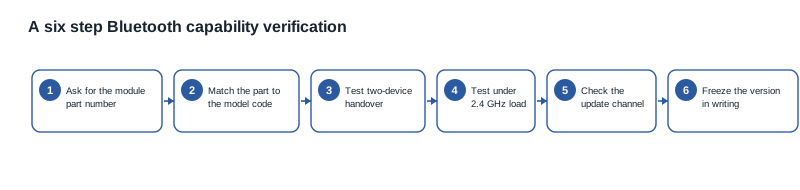
Two recording rules make the difference between a verification and an opinion. Log the model designation, the hardware revision and the firmware version of the unit under test, because a result attached to a model name rather than to a revision cannot be reproduced later. And log the host devices and their software builds, because radio behaviour is negotiated between two stacks and the same unit behaves differently against different builds.
When a check fails, the order of the next three steps matters. Reproduce it on a second unit, because a single unit fails for reasons that have nothing to do with the design. Then establish whether it is a design limit or a defect, by asking the supplier to reproduce it on their own unit. Then write it into the acceptance criteria rather than rejecting the supplier, unless it fails a criterion you declared before the test. A declared criterion produces a defensible outcome; an undeclared one produces an argument.
A supplier who is unwilling to run the sample checks at all has given you an answer, even if it is not the one you wanted. The usual reasons are legitimate — sample shipping costs, the risk of a unit being returned in a damaged state, a concern about the results being published — and the usual resolution is to narrow the request rather than abandon it. Ask for the two-device handover on a sample that is already being shipped for another purpose. Ask the supplier to run the checks and report the results rather than to hand the unit over. Ask for a written description of the coexistence behaviour and the re-link behaviour instead of an observation. Each of these keeps the information moving and, in practice, each produces a usable answer where a refusal produces none.
What matters is that the refusal is recorded as a refusal and not as a pass. The most common way a capability verification fails quietly is that a check was never run, the result column stayed empty, and the empty column was read downstream as an absence of problems.

Writing a Bluetooth version freeze into the supply agreement
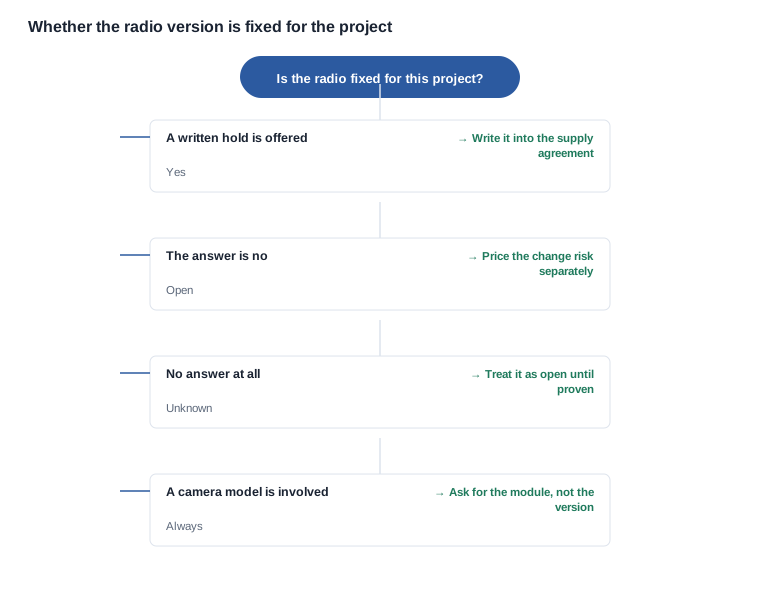
A version freeze is the clause that converts the version from a catalogue entry into a contractual position, and it has more content than most buyers assume. Six elements belong in it: the agreed module part number and the agreed version; the configuration they apply to, including the antenna arrangement and any case that forms part of the product; the term the freeze covers; the notice period for any change; the cost responsibility if a change forces a re-run of the conformity assessment; and what happens to stock that has already been produced against the old configuration.
The weak version of this clause is the sentence in a quotation that says the version will not change. It fails because it has no owner, no term and no consequence, and because a sentence in a quotation is not an agreement. It is worth knowing that the freeze itself is usually the easiest part of this conversation for a supplier to accept, since most radio modules do not change during a production window. What is worth negotiating is the notice period and the cost of a forced re-qualification, because those are the two things a supplier would otherwise carry informally and a buyer would otherwise carry formally.
Three things cannot be frozen, and it is better to say so in the agreement than to discover it later. The behaviour of the host device cannot be frozen, because the phone's own radio stack updates on a schedule your product does not control. The module vendor's silicon lifecycle cannot be frozen, because an end-of-life notice is the vendor's to issue and arrives on the vendor's timetable. And the firmware feature set cannot be frozen indefinitely, because a product that never changes is a product whose behaviour becomes a liability as the market moves around it.
What you can freeze is the thing that actually causes a conformity problem, which is the radio configuration of the delivered unit, for the term of the production window, with notice and consequence attached.
The negotiation space around the freeze is narrower than buyers expect, and it is worth knowing where the boundaries are before the conversation rather than during it. The supplier will normally accept a freeze, because a module that changed mid-window would be their problem as well. The supplier will resist a re-qualification cost that falls on them, because a re-qualification triggered by their own change is an unusual thing to accept, and this is where the commercial pressure sits. The supplier will resist a long notice period, because a long notice period on a change they are entitled to make is an encroachment on their own product planning. The buyer should be prepared to trade the length of the freeze against the length of the notice period rather than to hold both at their maximum, and should be clear that the notice period is the item that cannot be given away.
The short answer: the Bluetooth version is one of the easiest things in the catalogue to state and one of the least useful to state usefully, and we will not dress it up as a quality signal, because in the published data it tracks no other product difference. We publish the version for each row where the catalogue states it, and we will not estimate one for the fourteen rows that are silent.
We will not publish a module part number, an output power, a profile list or a measured radio behaviour for any model, because none of them is published to us. Verification begins with the product and only then with the paperwork, and the version is not the place to begin. Ask for the radio file in the order a certification body will read it rather than the order it is convenient to send: the module identification and the antenna configuration come first, because everything downstream is a statement about a specific module in a specific configuration.
The wider treatment of radio behaviour sits under bluetooth connectivity, the Bluetooth version procurement checklist collects the same items into one working list, and what buyers most often ask about the Bluetooth version covers the questions that most often arrive without an answer attached.
Ask for the profile list, the codec list, the transmit power and the model coverage, and we will tell you which we can answer directly. Send the models, the destination market and the production window, and we will come back with the published rows for each model, the rows that are silent, and a draft of the freeze clause written against the configuration you intend to buy.


