
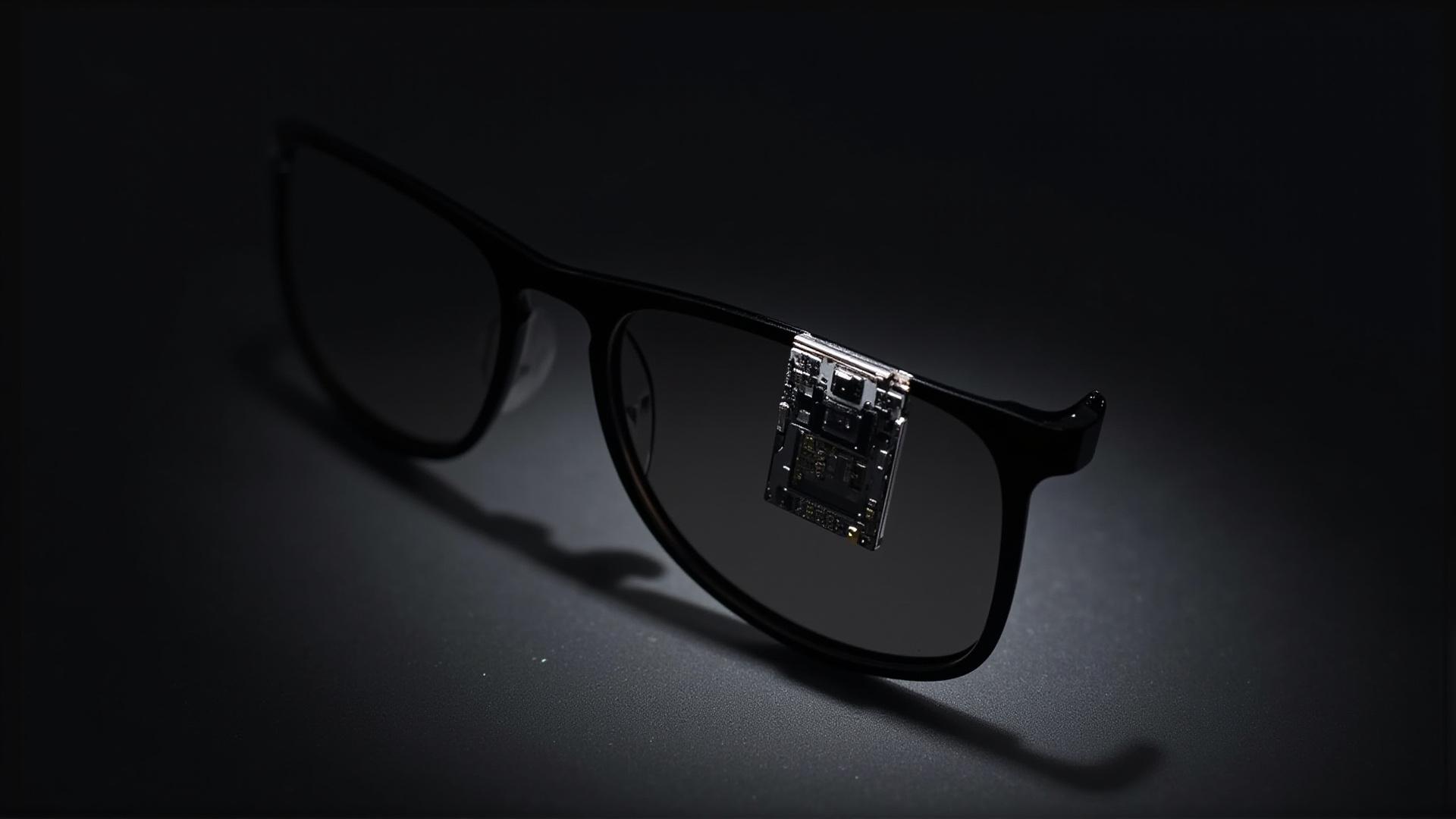
A camera in smart glasses is a subsystem that has to work while the frame is flexing and while the scene is whatever the person happens to turn towards. Smart glasses camera technology smart glasses how to measure is therefore a session rather than a specification check: eight measurements, all of which are cheap to take and none of which can be substituted by a datasheet figure. The single most common error is not a bad measurement but a non-comparable one — a shot taken from a different position, in different light, on a different day — and the second most common is discovering, after the comparison, that the supplier resells a module it did not design.
Our catalogue publishes the resolution tiers and the electrical rows and nothing else on the imaging side. The 8 MP group is the V03 Pro and the MT5, the V06 and the V03, and the CY03 and the KY06, and the CY05 and the MT6. The 13 MP group is the L2 Utral and the S7, and the L1 Pro, with the Utral listed in our catalogue with a note that the word appears to be a typographical rendering of "Ultra" — a reminder that a designation is a procurement artefact and has to be written down character by character. We publish no sensor model, no field of view, no video resolution or frame rate, no aperture, no stabilisation figure, no storage capacity or overwrite behaviour, no low light data and no transfer time for any camera model.
Smart glasses camera technology: a bought subsystem, and who owns it
Where the camera decision actually sits
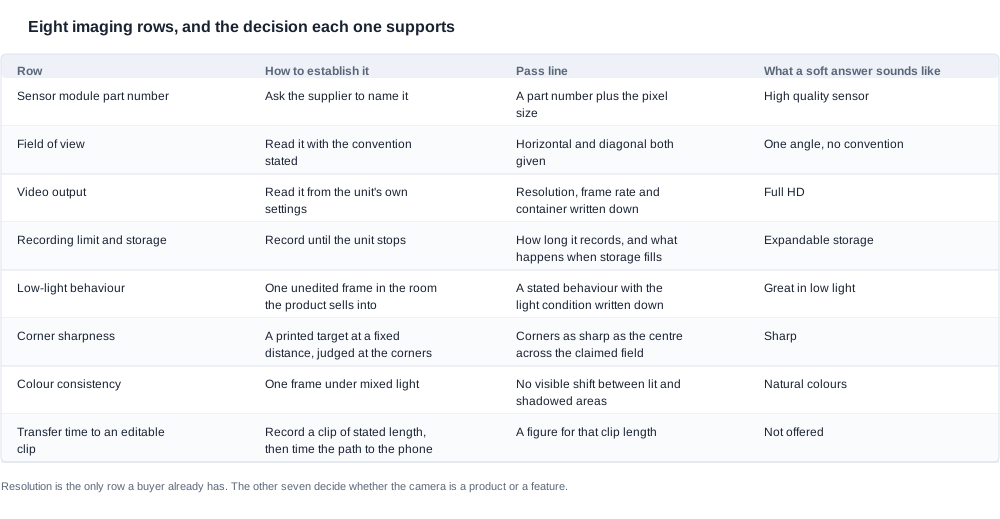
Before you compare any pictures, establish who controls the imaging module, because the module part number is the row that determines everything else and it is the row a reseller cannot give you. The three measurements that decide a purchase between two products are the field of view, the low-light behaviour and the transfer time; everything else is a filter. Fix the test geometry first — a marked stand position, a printed chart at a measured distance, identical lighting, the unit worn rather than held — and the comparison is defensible; change any one of those and it is not.
Who is running the session, and what they are holding
A buyer running a camera measurement is usually deciding between two candidate models for a first-person content line, and holds samples, a target price and a channel. What they do not hold is any imaging data, and the reason is structural rather than accidental.
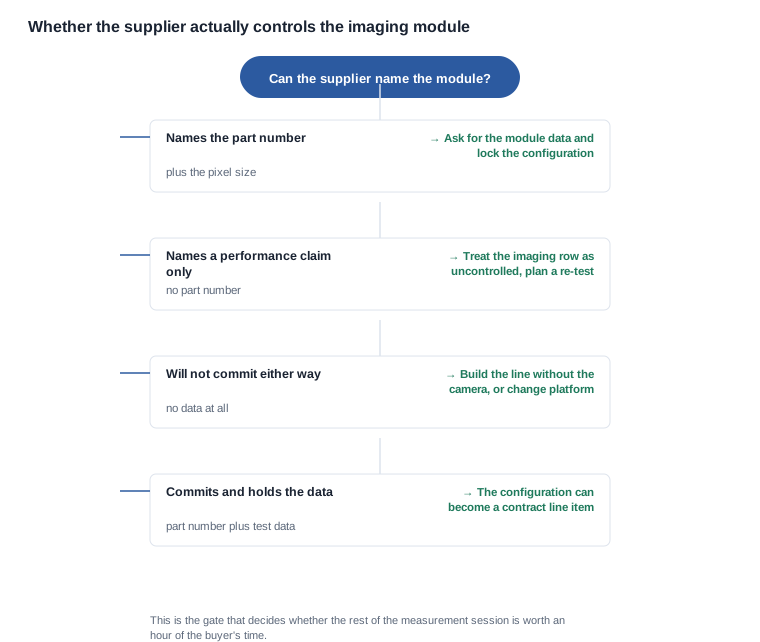
The imaging data belongs to the module maker. The assembly factory usually receives a module it did not design, integrates it, programmes it, and resells it. A factory can be entirely candid about this and still be unable to answer a question about sensor behaviour, because the answer belongs to someone further up the chain. This is not an obstruction; it is a description of where the knowledge sits, and a buyer who treats it as an obstruction will spend a month chasing something that was never held.
The practical response is to ask for the module part number rather than a performance claim, and to treat a supplier who cannot name the module as a supplier who cannot control the part that determines the picture.
What the camera buyer is trying to avoid
A comparison that is really a demonstration. A camera close to a subject produces a dramatic image nobody will reproduce. A manufacturer who publishes that image is describing a demonstration and not a product, and a buyer who accepts those images as evidence is being sold a frame rate.
A centre crop hiding the truth. A lens can be sharp in the middle and soft at the edges, and the softness appears in the corners of a wide frame, which is where first-person video spends a lot of its time.
A camera that records but cannot be used. The transfer time is the row that separates a camera that works from a product a customer can actually use, and it is the one a creator notices in the first minute.
A conclusion that does not survive the production run. A measurement session ranks the units in your hand. It says nothing about the population the supplier ships, and that gap needs a production-side control rather than a bigger sample.
A tier decided on pixels. An 8 MP sensor with large pixels can beat a 13 MP sensor with small ones. Resolution narrows the list; it does not rank it.
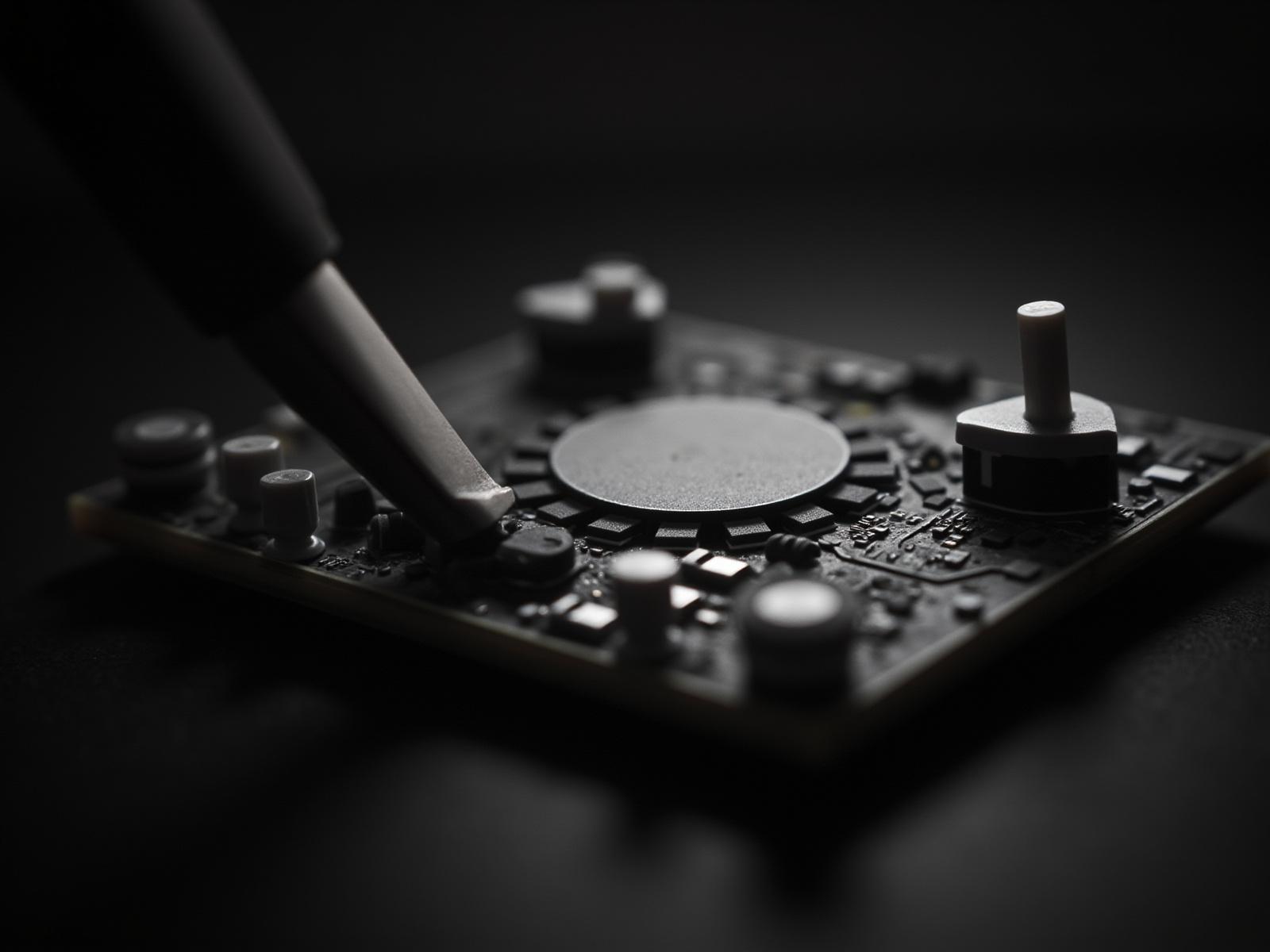
The eight imaging thresholds that decide whether the picture is usable
Send the table to every supplier before the samples are tested, in the same form. The right-hand column separates a supplier who controls the module from one who is relaying a brochure.
| What to ask the supplier for | The pass line | What a soft answer sounds like |
|---|---|---|
| Sensor module part number | A part number, plus the pixel size | "High quality sensor" |
| Field of view, with the convention | Horizontal and diagonal both stated | A single angle with no convention |
| Video output specification | Resolution, frame rate and container format written down | "Full HD" or "4K" |
| Recording limit and storage behaviour | How long it records, and what happens when storage is full | "Expandable storage" |
| Low light performance | A figure or a stated behaviour, with the test condition | "Great in low light" |
| Stabilisation method | On-sensor, electronic or none, named | "Stable footage" |
| Transfer time to the phone | A figure for the stated clip length | Not offered |
| Model designation | A published designation for the exact configuration | A series name only |
| Certification scope | Certificate numbers naming the exact model designation | A family-level document |
Resolution is a filter, not a comparison
Resolution is the pixel count and you already have it, because it is in the catalogue tier. Its only use is to narrow a list, because it says nothing about the size of the pixels and therefore nothing about how much light each one gathers. That is why a lower tier can produce the better picture in a dim environment, and why the low-light test decides the tier rather than the spec sheet.
The field of view decides whether first-person video is usable at all
A field of view that is too narrow films the wearer's nose. One that is too wide makes the middle of the frame small and pushes the detail to the edges, where the lens is least sharp. The frame's own geometry also occludes part of the scene, so the usable field of view is always smaller than the sensor's, and a supplier quoting the sensor's figure rather than the product's is quoting a number for a different object.
The convention matters as much as the number. Horizontal and diagonal are different quantities, and a single angle with no convention is unusable in a comparison table.
Sharpness has to be judged at the corners
Photograph a printed target against a wall from a fixed distance and look at the corners, not the centre. Corner softness is the normal behaviour of a wide lens, and it only becomes visible when somebody checks for it. A first-person video spends a disproportionate share of its time at the edges of the frame, so a judgement made on the centre of the image is a judgement about the least important part of the picture.
Low light is the most common complaint in this category and the most often untested
A single unedited photograph in a dim room, taken with the unit worn rather than held, tells you more about the product than any specification — including whether the product needs a light source, which is a product decision rather than a technical one. The condition has to be written down: the same room with the lights on and the same room with the lights off are two different tests, and the second one is not a dimmed version of the first.
Colour consistency decides whether the product is usable in an edit
Photograph a scene with mixed light and check whether the result needs correcting downstream. A product that produces a consistent colour between the lit and shadowed areas is usable in an edit; one that shifts between them is not, and no specification in the catalogue will tell you which one you have.
The recording limit and the storage behaviour decide whether it is a video product
What does it record, at what resolution and frame rate, and for how long before it stops? A product whose storage fills and stops recording is a different product from one that overwrites oldest-first. Both are legitimate designs, and they serve different channels: one suits a creator who downloads daily, the other suits a security or field-review use case. The row has to be established before the channel is chosen, not after.
Running a measurement session that survives a supplier argument
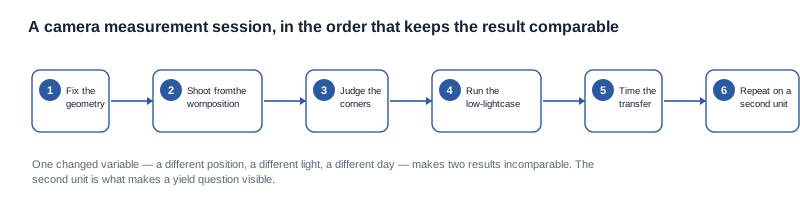
1. Fix the geometry before you shoot anything. A marked stand position on the floor, a printed resolution chart on a wall at a measured distance, identical lighting for every shot, and the unit worn rather than handheld. Write the distances down, because the comparison is worthless without them.
2. Insist on unedited output from a unit worn at arm's length. A wide-angle demonstration shot is not a product image, and asking for the unedited file is the test of whether the supplier is comfortable with the claim.
3. Add a second unit of each product. Two units make the yield question visible, and a feature that works on one sample and fails on another is a production problem rather than a product problem. That distinction changes who you talk to and what you ask for.
4. Test in the environment the product will be sold into. A dim room or a night street, not a darkened indoor space, because the difference between them is the difference between a usable product and a paperweight.
5. Time the transfer from recording to editable. Record a clip of stated length, then time how long it takes to appear on the phone and become editable. This is the row a creator notices first and the one a specification never mentions, because it is a property of the transfer path rather than of the camera.
6. Check the certificate numbers against the issuing body's register and against the exact model. A camera change is a product change, and a document held on a sibling model is not a document held on yours.
7. Write the observations down before you discuss them. A supplier disputing a written observation is arguing with evidence; a supplier who has never seen the test is arguing from theory. The second is much harder to resolve, and it takes far longer.

Six ways an imaging programme fails after the sample looks good
The product is chosen on megapixels and returns as "not good enough". The symptom is a return cluster whose description mentions picture quality without naming a condition. The root cause is that the only published camera figure was treated as the quality measure. The prevention is to use resolution as a filter and to decide on the low-light test.
The comparison uses the manufacturer's own photographs. The symptom is a decision that cannot be reproduced by the buyer's own team. The root cause is that a demonstration image was accepted as evidence. The prevention is to insist on unedited output from a unit worn at arm's length, shot under a fixed geometry.
The footage is sharp in the centre and soft in the corners, and nobody looked at the corners. The symptom is a creator's complaint that the edges of the frame look wrong. The root cause is that a centre crop was used to judge sharpness. The prevention is to judge the corners, because that is where first-person video spends its time.
The product records well and the customer says it is unusable. The symptom is a complaint about the product being slow, raised by someone whose camera is not the problem. The root cause is that the transfer time was never measured. The prevention is to time the recording-to-editable path on the sample and to put the figure into the product documentation.
The sample is excellent and the production batch is not. The symptom is a return rate that starts climbing a few weeks after launch, with no change visible in the product. The root cause is that one unit was tested and no production-side control exists. The prevention is to ask for a reference unit, a defined test frequency and a third-party report on the finished product, and to compare incoming lots against a retained golden sample.
A camera is added to an audio product and the runtime collapses. The symptom is a battery complaint that appears only on the camera variant, and it reaches the buyer as a quality issue rather than a design issue. The root cause is that the camera's share of the load was never budgeted into the power plan. The prevention is to require the runtime condition and the camera's share of the load, and to treat the result as a constraint on the use case rather than as a specification detail.
What the module relationship is worth commercially
Negotiable, and this is where the effort belongs. The module part number is the first negotiation: a supplier who commits to a part number has committed to a configuration, and a configuration can be written into the purchase order as a line item that triggers a notice obligation when it changes. The willingness to supply a retained reference unit, and the test frequency the supplier applies to production units against it, are both negotiable and are worth more than a unit price concession because they are what makes an incoming lot judgeable. Minimum order quantity tiers, packaging and insert design including market labels, the delivery split against a sample-approval milestone, and payment nodes against inspection are the standard positions.
The imaging cost is set by the module and the tuning bench, not by the negotiation. A sample-and-tune cycle on a lens and an imaging module is priced per configuration and scheduled by the people who hold the rig, so the sensible questions are how many cycles a configuration needs, who owns the calibration file at the end of them, and whether a re-tune is charged again when the second batch arrives. Tooling for the optical path is a one-off setup that the first order usually carries. Once the module, the firmware pipeline and the calibration procedure are fixed, the imaging behaviour stops being a negotiation variable and becomes a specification you design the listing around. A supplier who will not move any of those three has drawn the boundary of the camera programme in advance, and the shortlist has to be built on the right side of that boundary rather than argued across it.
Documents to request before the deposit. The sensor module part number. The certificate numbers with the issuing body and the validity dates. The declaration of conformity for the exact model designation. A written statement of the video format and the storage behaviour. The measurement conditions behind the runtime figure. The sample protocol is set out at sample evaluation.
Clauses to write into the contract. The sensor module part number and the camera resolution as line items, with a clause requiring notice before any change of module. The acceptance criteria for the sample, referencing the eight measurements and the fixed geometry. The documents named in the purchase order, with the exact model designation attached. A reference unit and test frequency for incoming lots. And a clause on who bears the cost when a lot fails the acceptance criteria.
A worked scenario: a content line qualifying two camera tiers
This is a hypothetical scenario, and it is here to show the decision sequence rather than to report an outcome.
Assume a mid-size brand opening a first-person content line, comparing a candidate in the 8 MP tier against a candidate in the 13 MP tier. The binding constraint is the channel: creators who publish daily and who will abandon a product that takes too long to hand over a clip.
Step one is the ownership question. The brand asks both suppliers for the module part number and the pixel size. One answers with a part number and offers to supply the module's own data. The other answers with a resolution tier and a marketing paragraph. The second candidate is not excluded here — it is flagged, and the flag tells the brand that the imaging row on the second candidate will have to be established entirely by the brand's own session.
Step two is the geometry. The brand fixes a stand position, a printed chart at a measured distance, a lighting condition and the worn position, and writes all four into the protocol before either unit is powered on.
Step three is the three decision rows. The field of view decides that the 8 MP candidate frames the scene without the wearer's nose in it, while the 13 MP candidate's usable field is narrower than its quoted figure because of the frame geometry. The low-light test in a dim room decides that the 13 MP candidate produces the more usable picture at low light despite the higher tier — the exact outcome a resolution-only comparison would have missed. The transfer time decides separately, and it is the row that changes the channel decision: one candidate hands a clip over in a time the creator will accept, the other does not, and that has nothing to do with image quality.
Step four is the yield check. The brand adds a second unit of each. The 8 MP candidate behaves consistently on both; the 13 MP candidate does not, and the difference shows up in low light.
Step five is the commercial response. The brand keeps the candidate that wins on the three decision rows, takes the tier difference as settled, and negotiates the reference unit and the incoming test frequency rather than the unit price. It also asks for a notice obligation on the module, because the manufacturer of the 13 MP candidate is not the party that chose the module.
The result is a programme where the tier was a filter, the low light decided the picture, and the transfer time decided the channel. Nothing in that sequence depended on the published resolution figure.
What we publish on the imaging side and where the rows stop
The camera is the part of this product a buyer should test rather than read, and a supplier who resists a measurement session has a reason. We will supply units with a known firmware build, and we will work through the eight measurements with you and hand you the recordings and the results, so that what you publish is something you have seen rather than something you were told.
We will also tell you where our own documentation is empty, so that you do not mistake an open row for a weakness of the product. The catalogue carries the resolution tier and the electrical rows and stops there: for none of the eleven camera models does it print a sensor model, a field of view, a frame rate, an aperture figure, a stabilisation number, a storage capacity, an overwrite rule, a low-light result or a transfer time, and none of those is estimated from typical values. We will not tell you that 13 MP produces a better picture than 8 MP, because that is not a statement the evidence supports, and a tier comparison that stops at the pixel count is the comparison that keeps producing the wrong shortlist.
What a measurement session can conclude is which of two products is better for a specific use case, under specific conditions, on specific units. What it cannot conclude is how the product will perform across the population the supplier ships — that needs a reference unit, a defined test frequency and a third-party report on the finished product. The imaging rows are under camera and imaging, and the specification side is in camera spec sheet explained.
Three things to do before the sample order
Ask every supplier for the module part number, in writing, before the samples ship. The answer is the fastest available test of whether the imaging row is under anybody's control.
Write the geometry down before you shoot. Four lines: the stand position, the chart distance, the lighting condition and the worn position. Without them, the session produces opinions.
Send us the two candidates and the environment the product will be sold into, and we will set up the measurement session with you. We will tell you which of the eight rows our documentation can answer today and which have to come from your own units.
Related reading
- The imaging rows and what they mean — camera and imaging
- The specification side — camera spec sheet explained
- The protocol for a sample test — sample evaluation
Tell us the use case and the two products, and we will set up the measurement session with you.


