
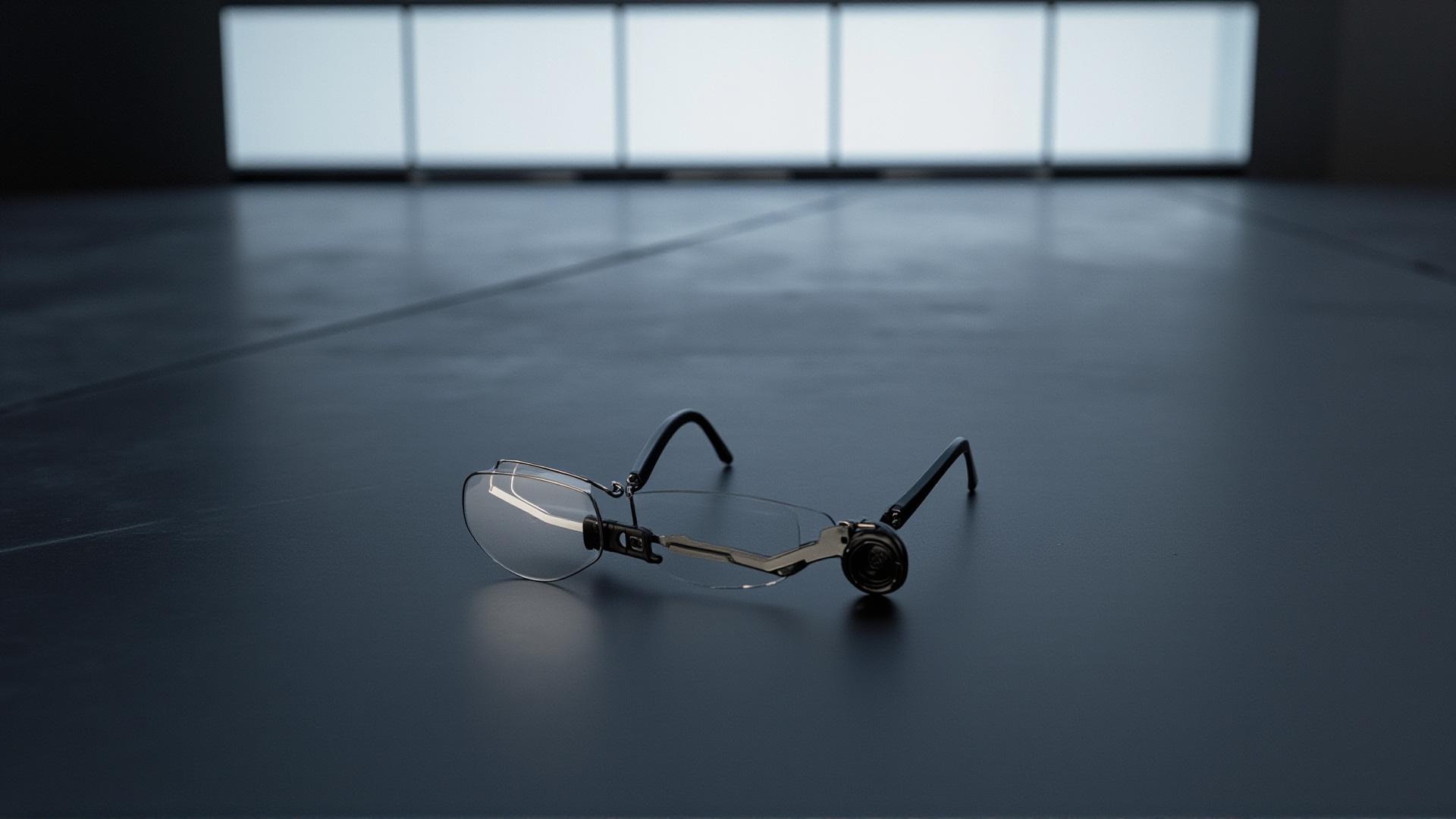
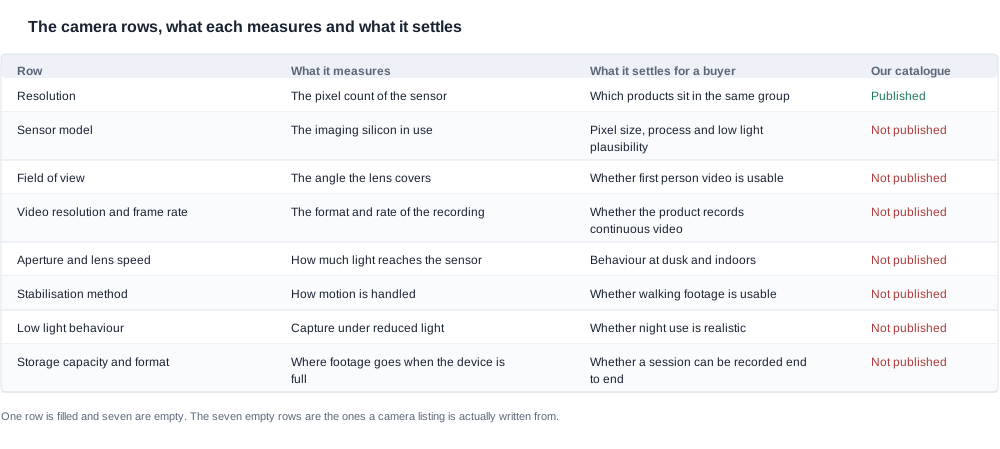
For a camera product the specification sheet is where smart glasses camera technology smart glasses spec sheet explained matters most, and where our own documentation is thinnest. Our catalogue publishes one camera row per model — the megapixel count — and publishes nothing else about the camera: no sensor model, no field of view, no video specification, no frame rate, no stabilisation, no low-light behaviour, no storage detail. This article is about what each of those missing rows would mean, so that you know which ones to go after and what a good answer contains.
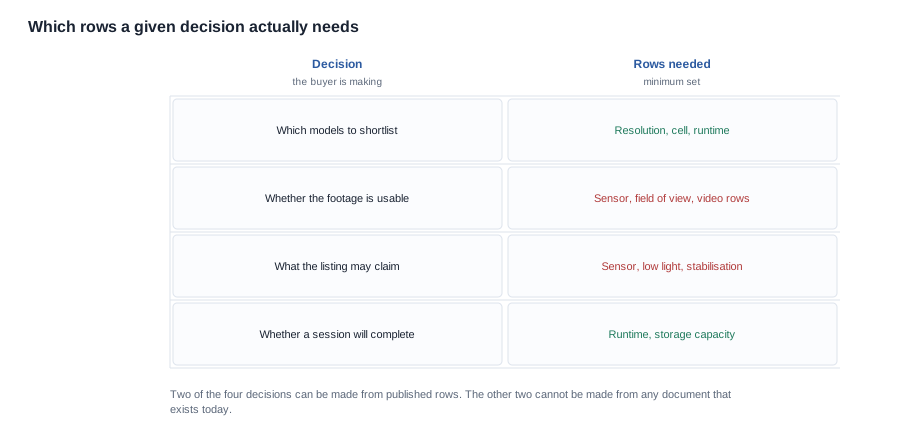
The practical way to use a spec sheet is to read it as a set of decisions rather than as a set of features. Every row on a camera sheet exists because somebody had to decide something with it: which models can be grouped, which claim can be printed, which promise can be kept. A row that decides nothing is decoration, and a missing row is a decision nobody has made yet.
Smart glasses camera technology: the one row we publish and its limits
Our camera models state 8 MP or 13 MP, and across the eleven camera platforms in the range eight sit at 8 MP — the CY03 and the MT5, the V03 and the MT6, and the KY06 and the CY05, and the V06 and the V03 Pro — while three sit at 13 MP: the L2 Utral and the S7, and the L1 Pro.
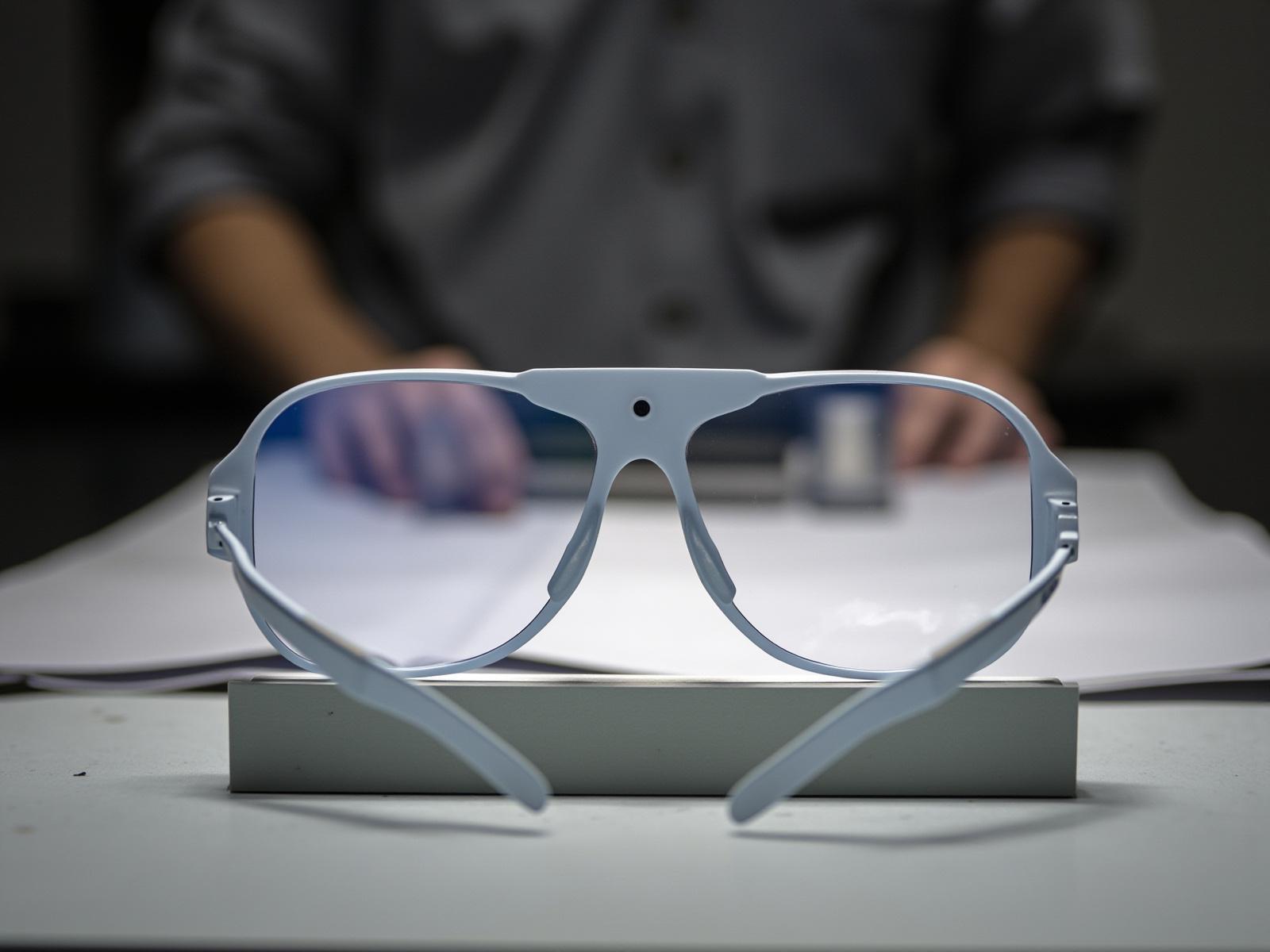
That single row is enough to group products and it is not enough to compare them. A megapixel count says how many pixels the sensor records. It does not say how large those pixels are, and it does not say how much light each one gathers, because both of those are properties of the sensor rather than of the count. It does not say how wide the lens sees, because the lens is a separate component with its own specification. It does not say how the camera behaves at dusk, because that depends on the pixel size, the lens speed and the processing pipeline together.
An 8 MP sensor with large pixels can produce a better image than a 13 MP sensor with small ones. We do not publish a sensor for either tier, so we cannot tell you which case applies, and we will not present the 13 MP tier as an imaging advantage over the 8 MP tier — the published data does not support that comparison in either direction.
What a megapixel count does and does not tell you
There are three legitimate uses for the row, and they are worth separating because most misunderstandings come from using it outside them.
It is legitimate to group the range. Two platforms at the same count belong to the same product family for listing purposes, which is exactly how a buyer should treat them.
It is legitimate to check a listing against a specification. When a supplier quotes a platform at a count that does not match ours, one of the two is wrong, and the question is a cheap one to ask.
It is legitimate to set a minimum requirement in a requirement document — "at least 13 MP" — which is a statement about a number rather than about an image.
What it cannot do is support a claim of the form "higher resolution means better quality". That claim is true in a narrow and specific sense, and false in the sense a customer will apply it. It is true in the sense that more pixels can carry more detail. It is false in the sense that a 13 MP sensor with small pixels gathers less light per pixel than an 8 MP sensor with large ones, so in poor light the higher-count platform can produce the noisier image. For a buyer who is writing listing copy, this distinction is the whole difference between a defensible statement and a refund request.
Reading the optical rows: field of view, aperture and the lens
The optical rows are where a camera sheet either becomes usable or becomes decorative, because they are the rows that describe what the camera actually sees.
Field of view decides whether the product is a first-person camera at all. A narrow field of view produces a tunnel-like recording in which the person has to turn their head to find something, which is unusable for the continuous point-of-view capture that camera platforms are usually bought for. A very wide field of view produces the opposite problem, with distortion at the edges that is visible and disliked. The row is meaningful only as a number, in degrees, and it needs two qualifiers to be usable: whether the figure is horizontal, vertical or diagonal, and the distance from the lens at which it was measured, because the effective view from the eye position is not the same as the view from the lens centre.
Aperture and lens speed decide how much light reaches the sensor and how that changes across the frame. A specification sheet that gives a field of view without any aperture information is describing a lens without describing its light gathering, which is the equivalent of describing a lens without describing its focus.
The lens construction matters less than most buyers expect and more than suppliers assume. Focal length in millimetres, whether the lens is fixed or focusable, and whether the lens is behind a cover that can scratch — each of these is a row that, when missing, turns into a question at the sample stage.
Why the field of view row needs a distance attached
The distance qualifier is not pedantry. A lens's field of view is measured from a point, and every camera module in this category is mounted some distance in front of the eye. The effective angle the person experiences, and the angle the camera actually records, are related to that distance and to the geometry of the frame. A figure quoted from the lens centre and the same figure quoted from the eye position are different numbers for the same lens, and a buyer who compares them against a competitor's figure is comparing two different measurements.
The same logic applies to any optical figure a supplier offers. The rule is simple enough to put in a request: every optical number arrives with the condition it was measured under, or it does not arrive at all. The condition is the part that turns a number into something a second engineer can reproduce.
The three-column format that makes a camera sheet usable
A camera sheet becomes a working document the moment every row carries three things: the value, the condition it was measured under, and the source it came from. Most sheets carry only the value, and a sheet carrying only values cannot be used to make a purchase decision, because every comparison drawn from it is a comparison of two unstated conditions.
The condition column is what makes a number portable. A field of view of 105 degrees with the working distance stated can be re-derived by somebody else on a different unit; the same number without the distance cannot be checked at all, and it cannot even be compared against a competitor's figure, because nobody can tell whether the two numbers were taken from the same reference point.
The source column is what tells a buyer how much weight to put on the row. There are three sources worth distinguishing and one that is worthless. A value the supplier measured on a unit from the same production run is the strongest, and it can be re-verified on the buyer's own incoming units. A value transcribed from the manufacturer's documentation for this configuration is acceptable if the document is produced with it. A value copied from a comparable product in the same family is weak, because a family-level number may describe a configuration the buyer is not ordering. A value that arrived without any source at all is not a specification and should not be copied into a purchase order.
Writing the sheet in three columns is not more work for the supplier than writing it in one. It is simply a different discipline, and it is the discipline that separates a spec sheet that can settle an argument from one that starts one.
Reading the recording rows: format, frame rate and storage
The recording rows answer a different question from the optical ones. The optical rows describe what the camera sees; the recording rows describe what it keeps, and they are the rows that decide whether a product can be sold into a particular market.
Video resolution and frame rate together decide what kind of product this is. A platform that records continuous video at a usable rate is a different commercial object from one that captures stills with a video-shaped expectation attached. A sheet that lists a photo resolution without a video resolution leaves the buyer to assume the video exists, and the assumption is the one that produces the complaint.
Stabilisation method sits awkwardly on a spec sheet because it describes a behaviour rather than a component. Optical, electronic, hybrid and software stabilisation are different engineering decisions with different failure modes, and a sheet that says only "stabilised" has described none of them.
Storage capacity and format, and what happens when the device fills, is the row buyers most often discover is missing at the worst moment. Whether footage overwrites silently, whether the device stops recording when storage is full, whether it drops frames, and whether the file format needs a specific application to be readable — these are all commercial questions. A platform whose storage behaviour is unknown cannot be given a customer support script, because nobody knows what the customer is going to see.
Capture latency is the row that decides whether a platform can be used for anything requiring a remote shutter, and it is also the row most likely to be missing entirely.
The electrical rows on the same sheet, read together with the camera rows
A camera platform is bought as one product, and the rows on the sheet have to be read against each other rather than one at a time. The electrical rows in our catalogue are complete, and they are the ones most often quoted on their own.
Every camera platform in the range publishes a cell capacity, a runtime and a charge time; seven of the eleven also publish a charging interface. The cells run from 220 mAh on the MT5 and the V03, and the V03 Pro, through 260 mAh on the KY06 and the S7, and the V06, and 265 mAh on the MT6, to 290 mAh on the L2 Utral and the CY05, and the L1 Pro and the CY03. The published runtimes run from roughly five to eight hours on the V03 Pro and the V03, and the S7 and the V06, through six to eight hours on the KY06 and the MT5, to about seven hours on the four 290 mAh platforms and on the 265 mAh MT6. The charge time is two hours or less everywhere, and the interface is magnetic on the MT5 and the V03, and the KY06 and the V06, and the S7, Type-C on the V03 Pro and the L2 Utral, and not published at all on the MT6 and the CY05, and the L1 Pro and the CY03.
Read on their own, those rows are reassuring. Read against the camera rows, they raise a question that no single row answers: a camera recording continuously consumes more power than a camera capturing a still, and the published runtime does not state whether it was measured recording or idle. A buyer planning around "about seven hours" for a continuous recording session has made an assumption the catalogue does not make for them.
The same applies to storage. A platform with a large cell and a long runtime still fills its storage, and the rate at which it fills depends on the video format and frame rate — two rows we do not publish. The practical consequence is that the runtime row and the storage row have to be settled together, and neither of them is enough on its own to promise an uninterrupted session. Any listing that pairs a long runtime with a claim about long sessions is making a compound claim from two rows that do not support it.
Specifying a row so that it can be checked later
The difference between a useful specification row and an unusable one is almost always the condition attached to it. A row that can be checked by a second party, later, without asking the original author, is a specification. A row that cannot is an assertion, and it will be treated as one.
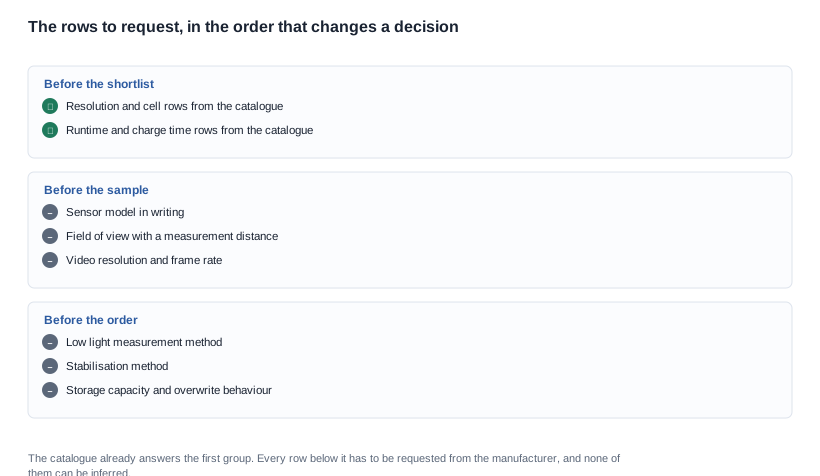
The condition a camera row needs has four parts, and all four are cheap to ask for. What was measured, so the reader knows whether the figure came from a test or from a document. Under what conditions, so a second measurement can be reproduced. With what method, so the two measurements can be compared. To what threshold, so that a disagreement has an outcome rather than an argument.
Applied to the rows that matter, that produces a request like this: the field of view is quoted horizontally at a stated working distance under the stated lighting, measured against a method the supplier will identify, and accepted if it is within the tolerance band agreed in the order. That is a paragraph, and it turns an argument about image quality into a measurement both parties can repeat.
It is also worth keeping one answer sheet per supplier rather than a folder of documents, with the date, the source and the condition recorded against every figure. The sheet is what stops a supplier's specification from drifting across three versions of the product over eighteen months, and it is what lets a buyer tell, at the moment of a dispute, whether the figure in the dispute is the one that was agreed.
It is also worth asking for the source of each row, because there are three possible sources and they carry different weight. A figure the supplier measured on a unit of the same build is the strongest. A figure taken from the manufacturer's documentation for this configuration is acceptable, but the documentation itself has to be produced. A figure from a comparable product in the same family is not acceptable at all, and it is the source most likely to be used when nobody asked where the number came from.
Which rows are worth the cost of a sample test
Sampling a specification sheet is a decision about where to spend attention. Some rows can be closed with a document in an afternoon; some genuinely require a sample and a fixture; and some cannot be closed by either and have to be negotiated as a scope limit.
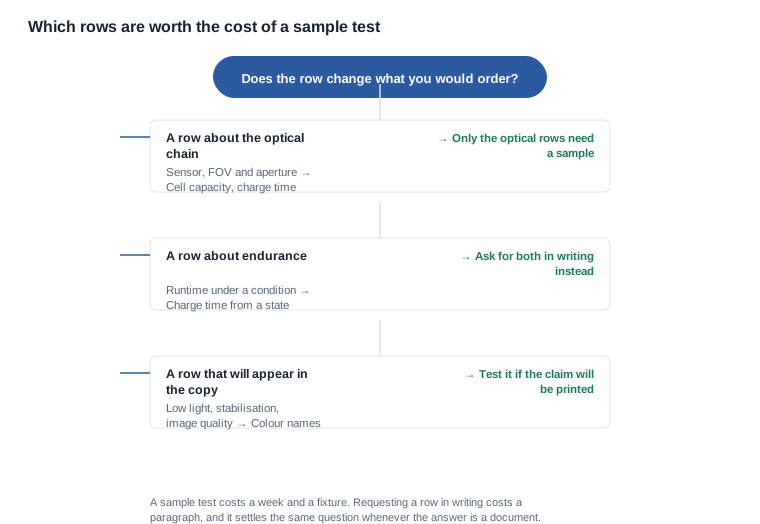
The practical rule is that a row is worth a sample test when it changes what you would order. If the answer does not change the order, the sample test is cost without consequence, and a document request will do as well. This is a narrower test than it sounds, because many camera rows are used to decide marketing copy rather than to decide the product, and copy decisions are often better settled by a supplier who is willing to state the limits of what they can evidence.
A row that cannot be closed by either route needs a decision rather than an investigation. The three options are to scope it out of the product, to price the risk of leaving it open, or to hold the platform until the supplier closes it. Scoping it out is the cheapest and the most common: the platform is specified without the row, the listing avoids the claim, and the buyer has a product whose copy is defensible. Pricing the risk works when the row is unlikely to matter commercially, and the honest way to do it is to write down what would have to be true for it to matter. Holding the platform is the right answer when the row is central to the proposition, and it is the option most often avoided because it feels like an escalation rather than a process step.
There is a second consideration, which is time. A sample test has to happen while the supplier is still willing to be tested, which in practice means before the order and while the evaluation is still open. A row that is difficult to close will get harder to close after the order, and a buyer who leaves four rows open when the order is signed has not saved time — they have simply moved the argument to a point where the supplier has less reason to concede.
What we publish, and what we leave open on purpose
We publish megapixel count, battery capacity, stated runtime, charge time and, where the catalogue states it, the charging interface for our camera models, along with the case capacity for the five platforms that publish one, and the IP54 ingress marking on the V06 and the S7. We do not publish the other camera rows listed above.
We would rather state that plainly than fill a camera spec sheet with typical values, because a content creation buyer who builds a listing from those values will produce reviews saying the footage is not what the page promised. A row that is marked open can be requested, negotiated and tested. A row that is filled with a plausible number cannot be distinguished from a row that is correct, and it will be copied into a listing and defended as though it were measured.
The wider treatment of imaging in this category is on the camera imaging page, and the model-level view of one platform is in L1 Pro smart glasses specifications. Where the same discipline is applied to two platforms of the same kind, you can see it in LC-105-2 against K01 on specification, and the electrical rows on the same sheet are set out in the smart glasses battery life checklist for procurement teams.
Related reading
- Where a camera platform sits in the range — camera imaging
- The charge and runtime rows on the same sheet — battery life checklist
Send us the model and the content proposition and we will tell you which camera rows we can source and which we cannot.


