

Smart glasses for cycling: where a pack's trip profile comes from
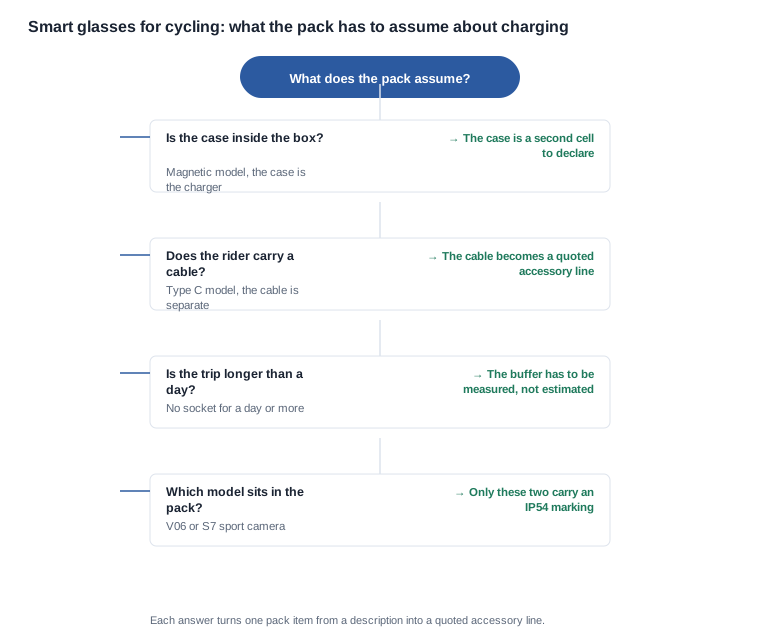
The short answer. Packing smart glasses for a cycling channel is not a question about which accessories photograph well. It is a question about one number a buyer has to fix before anything else: how long the rider is away from a socket. A commute pack carries a charging cable and nothing more. A day-loop pack carries the cable plus a case. A multi-day tour carries a buffer that has to be measured on a sample, because the published cell figure is not a measurement of anything a rider will do. Fix the trip profile first, and the pack stops being an opinion about accessories and starts being a bill of materials the factory can quote, the freight forwarder can weigh and the returns desk can measure.
Who is specifying the pack, and what are they defending. The reader is a brand owner, a channel buyer, a product manager or a procurement manager for a dealer network. Whichever title is on the order, the artefact is the same: a set of accessory lines that ship with the device. What is being defended differs by title. A brand owner is defending the per-unit cost of a pack that a competitor also ships, and they need to know which of those lines are visible to the customer and which are invisible. A channel buyer is defending the reorder, and a pack that cannot be reordered line by line is a pack that forces a full re-order of the device. A procurement manager for a dealer network is defending the warranty line, because a pack item that fails in a dealer's hand is indistinguishable from a device failure in the returns data. The task in front of all of them is the same kind of task: turn a description into a specification that a supplier can quote without a clarification email.
Why two packs for the same product cost very different amounts. The published electrical rows across this range are close together, so the reason two quotes diverge is rarely the battery. It is the charging architecture, because the interface decides whether the case is a pouch or the charger, and the case is the single most expensive line in any pack. Our catalogue splits the charging interface three ways across the twenty-eight models: seventeen are magnetic, seven publish a Type C interface, and four publish neither a charging method nor a charging port row at all. The four in that last group are the L1 Pro and the CY05, and the MT6 and the CY03, and each of them does publish a charging-case capacity. A buyer who reads a magnetic interface into one of those four is guessing. A buyer who knows the four are unsettled knows that the case is in the box and the method is an open question, which is a very different position to negotiate from.
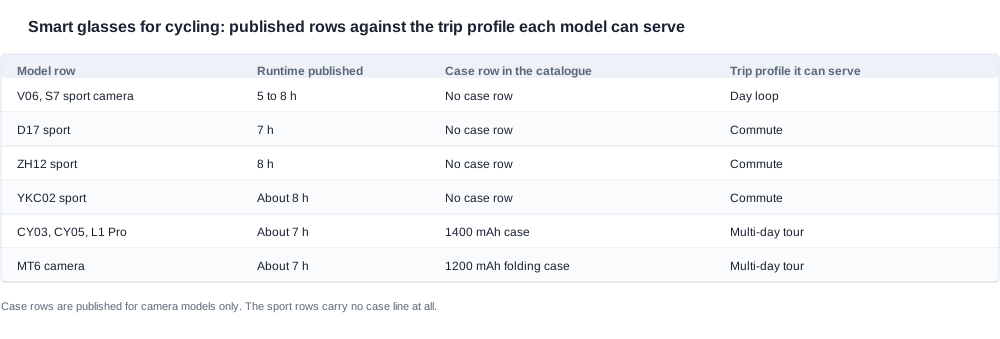
What the published runtime rows mean for each trip profile
The trip profile is the organising device, and there are only three that matter for a cycling channel. A commute is a single continuous absence of up to a couple of hours, usually ending at a desk or a wall socket. A day loop is a morning-to-evening absence where the device is carried but rarely topped up. A multi-day tour is one or more nights without a dependable socket, and it is the only profile in which a buffer has to exist as a quoted line.
The commute profile is the easiest and the most frequently over-specified. A rider who leaves the house and returns in the same evening recharges at the same place every day, so the pack needs a charging path and nothing else. The published charge times support that: twenty-six of the twenty-eight models publish a charge time of two hours or less, and only the D17 and the ZH12 publish roughly one hour. The D17 and the ZH12 are the two sport models that also publish a Type C interface, and they are the models a buyer should examine first for a commute pack, because a one-hour charge is short enough to complete at a kitchen table and a magnetic charge is short enough to complete in a coat pocket. The mistake here is a pack that includes a case for a profile where a case has no job.
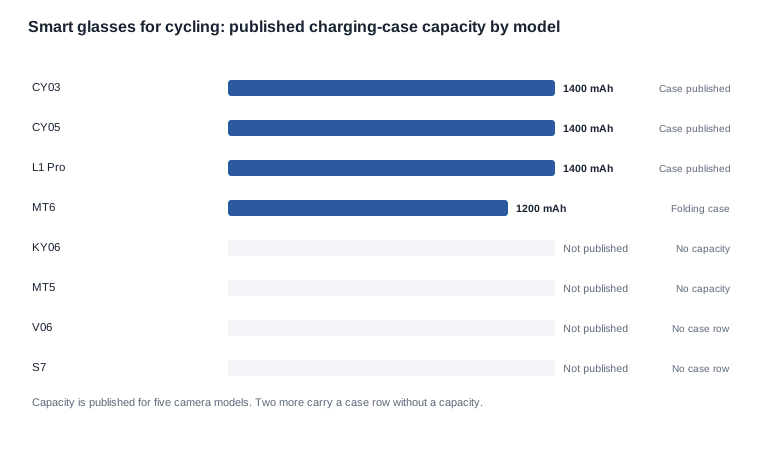
The day-loop profile is where the case enters, and where the catalogue splits. The case is not one row in this catalogue; it is three different answers. Five camera models publish a case capacity: 1400 mAh for the CY05 and the L1 Pro, and the CY03, 900 or 1400 mAh for the L2 Utral depending on configuration, and 1200 mAh for the MT6 in a folding case. Two more, the KY06 and the MT5, publish a case but no capacity for it. Four camera models, the V06 and the V03 Pro, and the V03 and the S7, publish no case row at all, which is an unpublished position rather than a published absence, and the question of whether a case is in the carton has to be put to the supplier for each of them. The sport models that matter most for a day loop, the D17, the ZH12 and the YKC02, publish no case row either. A buyer who writes "with case" into an accessory bill of materials for a sport model has invented a line, and the factory will price it as a custom request.
The multi-day tour profile is the one where arithmetic fails. The published runtimes cluster between five and eight hours across the range: the V06 and the V03, and the V03 Pro and the S7 publish five to eight hours; the KY06 and the MT5 publish six to eight; the L1 Pro and the CY05, and the L2 Utral and the CY03, and the MT6 publish about seven; the D17 publishes about seven and the ZH12 about eight; the YKC02 publishes about eight. A tour is planned against that number multiplied by the number of days, and the multiplication is where the risk hides, for three reasons that a buyer has to write into the specification.
- The runtime is a rating, not a measurement with a condition. No published runtime in this range carries a test condition — no volume level, no signal condition, no ambient temperature, no statement of whether the camera is capturing while the rating is measured. A tour rider is recording. A rating measured without recording and a tour with recording are different numbers, and the difference is exactly the amount of buffer the pack has to carry.
- The charge time has no starting state and no end criterion. The catalogue publishes that a model reaches its charge state in two hours or less, but it does not publish the state the device started from, nor the point at which charging is considered finished. A charge time without a starting state cannot be turned into a usable window, and a buyer who quotes it as a window will over-promise to the customer.
- The case is a second product with its own unpublished rows. No case in this range publishes its own charge time, its own charging input, or whether it can pass charge through to the device while it is plugged in. The buffer that closes a tour gap is therefore an assumption in every current quotation.
The rows that cannot be compared to each other, and why a pack specification has to avoid them. The catalogue publishes cell capacity in two forms — a single cell such as the 100 mAh on the D11, the D12 and the ZH12, and a doubled cell such as the 90 mAh times two on the K01 and the K02, the 55 mAh times two on the LC-105 pair, the G07 and the YK12, and the 70 mAh times two on the YKC02. A tour buffer written as "180 mAh" is a derived total, not a published figure, and it must be labelled as derived wherever it appears. The runtime figures for the 55 mAh doubled-cell group cluster at six to eight hours, and the two models in that group that publish the lower figure, the G07 and the YK12, are the two that publish ultra-slim or slim detachable temples, so a reader who assumes a uniform eight hours for the group is wrong twice over. And the camera models publish no Bluetooth version at all, so a pack that promises a connected accessory chain across the camera and audio families is promising something the catalogue does not support.
The verification steps that turn a pack description into a quoted accessory line
A pack list is easy to write and hard to quote, because a description does not carry a minimum order quantity, a per-unit cost or a lead time. The verification work is not measurement in the laboratory sense; it is a sequence of written requests, each with a completion standard, and each one turning one pack item from a phrase into a line the factory can price.
- Request the accessory bill of materials per configuration, in writing. The completion standard is a document that names the items, the quantity per device and the configuration it applies to. A verbal answer to "what comes in the box" is not a bill of materials, and neither is a photograph of a box.
- Establish the case position for the exact model in the order. The completion standard is one of three answers: a published capacity, a case row without a capacity, or no case row in the catalogue at all. The MT6 and the L2 Utral need their configuration stated as well, because the case capacity is a choice rather than a fixed line on those two.
- Ask for the charging input, the charge-time starting point and the indicator behaviour, per model. None of these three is published for any model in the range, and the completion standard is a written answer per model, not a generic answer for the family. The generic answer is the one that gets quoted into a pack that then does not work.
- Ask whether the case charges the device while the case is plugged in. The completion standard is a yes or a no with the test method described. This single answer decides whether a multi-day pack can carry one cable instead of two, which is a real per-unit cost difference at volume.
- Ask for the case's own charge time, in the configuration being ordered. The completion standard is a number with a starting state, because the device's published charge time has neither.
- Ask for the battery transport documentation covering the configuration, including the case. The completion standard is a file reference that names the configuration. The requirement is set out at battery transport, and the question is narrow: does the file cover the configuration I am ordering, with the case in it.
- Measure the buffer on a sample, in the mode the rider will use. The completion standard is a number of hours of recorded use per charge, measured on a sample at the volume the channel sells, with the case charged to the same state each time. This is the cheapest measurement in the category and the only one that replaces arithmetic with evidence.
- Confirm the model designation on the unit against the paperwork and verify every certificate number in the issuing body's public register. The register procedure is at certification checklist. A pack adds three or four more objects that can arrive in the wrong condition, and the designation is what makes a loss traceable.
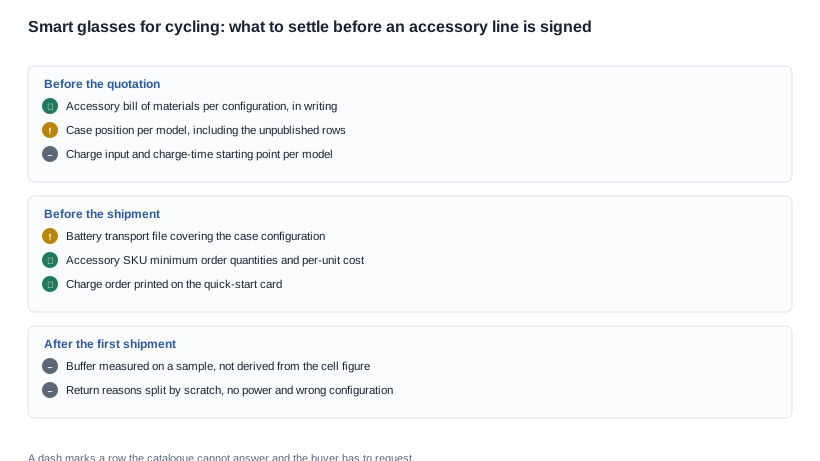
The documents that have to exist before a deposit is paid. The accessory bill of materials per configuration, the case specification for that configuration, the battery transport file covering it, the written answers on charging input, charge-time starting point, indicator behaviour and case pass-through, the measured buffer figure, the accessory minimum order quantities and per-unit costs, the agreed incoming inspection criteria, and the model designation table. The clause language sits at contract terms and the commercial structure of a first order sits at pricing. The published charging rows that sit underneath all of this are collected at charging solutions, and the model families themselves are listed at sport smart glasses.
Where a cycling pack goes wrong between the quotation and the rider
The pack was inherited from a channel that sells a different architecture. Every inherited line is a per-unit cost that was justified by somebody else's interface. The symptom is a bill of materials a buyer cannot explain line by line, which is also a bill of materials the factory cannot price line by line, and the cost lands twice: once in the unit price and once in the clarification emails.
The case was assumed to be in the box for a model that publishes no case row. This is the single most common failure in this category, and it is worst on the sport models, because the sport family is the natural choice for a cycling channel and publishes no case line at all. The rider then has a magnetic model with no way to charge it. A factory that quietly adds the case has changed the configuration, the price and the freight weight; a factory that does not add it ships a return.
The buffer was derived from a cell figure rather than measured. The arithmetic appears defensible and is not, because the runtime it divides has no test condition, and the case has no published charge time, so the number in the specification is not tied to anything a rider will observe. When the first shipment arrives, the observed buffer is different from the quoted one, and the pack reads as a manufacturing defect rather than an estimate that was never replaced by a measurement.
The charge order was never written down. A rider with a device and a case, told only that both need charging, will charge the device. The case then has no charge for the whole trip and the buffer is empty at the moment it is needed. The charge order is a single line on the quick-start card and it costs nothing.
The mounting hardware was treated as part of the product. The mount is an accessory, and the constraints on it are specific: a fixture that puts the device in front of a helmet vent, in the airflow, or on a bar that carries vibration, will produce complaints about wind noise and about the recording stopping. The requirements for recording while riding are covered at is it safe to record while cycling, and the fixture belongs on the accessory line with its own connector type and its own spare-parts route.
A waterproof claim was written onto the insert. Only two models in the entire catalogue carry an ingress marking, the V06 and the S7, and both are sport camera models. The marking covers splashing water and a dust protection level; it does not cover immersion or a sustained downpour, and no third-party test report is published behind it. The digit reading is at IP ratings. An insert that says "waterproof" on any other model is a claim the documentation cannot carry, and a rider in a downpour is the customer who tests it.
The commercial room inside a cycling accessory bill of materials
A pack is priced in two places, and only one of them is visible on the product page. The first is the accessory bill of materials, which is the per-unit cost of everything in the box, and the second is the accessory order line, which is the minimum order quantity, the tooling and the lead time that sit behind each item. A buyer who negotiates only the first has left most of the room on the table.
The largest lever is whether the case is in the box or a separate orderable line. The catalogue publishes two case capacities that are configuration choices rather than fixed lines, the 900 mAh and 1400 mAh on the L2 Utral and the 1200 mAh folding case on the MT6, and a case that is optional rather than included changes the artwork, the freight weight and the transit file together. Making it a separate line also makes it a separate order, which is usually what a channel with three or four models actually wants.
The second lever is the number of orderable SKUs, not the number of items. A pack with five items where two are consumables and three are orderable accessories is a three-SKU order, and three SKUs carry three minimum order quantities, three lead times and three replenishment paths. Every additional SKU is a per-unit cost the factory holds and a line the buyer has to reorder. The test to apply before adding an item is simple: does it need to be replaced independently, or does it only need to be present once per device?
The third lever is the split between the per-unit consumable cost and the per-order accessory cost. A consumable that is printed on an insert and costs a few cents per device changes the unit price and nothing else. An accessory that is boxed changes the artwork, the carton, the freight weight and the stock. A quotation that mixes them into one line hides both the unit economics and the reorder path, which is why the bill of materials should separate them explicitly.
What genuinely cannot be moved, and why it is worth separating out in the quotation. The charging interface of each model is a published row, and so are the cell configuration, the charge time and the case architecture. Those four are fixed before the commercial conversation starts, and no payment schedule changes them. The battery transport documentation for a configuration is also fixed, because it follows the process and the testing body rather than the order size. Tooling and mould cost is a third category, and it is the one most often bundled with something else: ask which line the quotation is charging you for, because tooling is normally amortised across an order while certification cost follows the product family, and a single blended line hides a cost that repeats on every future order and one that does not.
The commercial terms worth putting in the agreement. The published rows for the configuration ordered, per model. The case position, its capacity and its charge time. The charging input, the charge-time starting point and the indicator behaviour. The measured buffer figure and the method it was measured with. The accessory order lines with their minimum order quantities and per-unit costs. The incoming inspection criteria and the point in the flow at which they are applied, which is the point at which the payment node sits. The warranty period with a stated response, and the treatment of a device returned with a missing pack item, which is the single most common warranty dispute in a channel that ships accessories. The first-order terms are set out at MOQ, lead time and payment terms, and a sample order is a better way to settle the buffer question than another round of emails — the procedure is at samples.
What we publish for a cycling pack, and what has to be measured first
We publish the rows a buyer can order from, and we will not fill the gaps with industry averages. For this range that means the resolution class, the cell capacities, the charge times, the rated runtimes, the charging interface per model, the structural features that are published, and the case capacities on the models where they are published. For the cycling pack specifically, that means the trip profile mapping in the table above is offered as a configuration guide, not as a promise about a specific accessory list.
What we do not publish, and will not estimate, is the charge-time starting point, the indicator behaviour, the case charge time, the case pass-through behaviour, the charge input, the runtime test condition, the per-model frame weight beyond the single 158 g whole-unit figure for the MT6, the lens material, the coating, the field of view or the video specification. We will also not state that any model is tested to an ingress rating, because no test report is published behind the two markings that exist, and we will not extend the ingress position to models that publish none. On certification, the catalogue carries a company-level export certification page and no per-model certification row, and the text of the catalogue contains no reference to CE, FCC or RoHS at all, so the certification scope of a model is material a buyer has to request in writing rather than a fact we can quote. The checklist for that request is at certification checklist.
What to send us. Send the trip profiles the channel actually sells to, the models you are comparing, the target price band, the volume and the destination markets, and we will return the accessory lines each configuration should carry, the published rows that cover them, the documentation that has to be settled before the order, and the three figures that a buyer has to measure on a sample before the specification can be called complete. The channel context for this scenario is at smart glasses for cycling, the sport models are at sport smart glasses, and the charging decisions are at charging solutions. A quotation request with those five items attached is at request a quote.
Related reading
- Where the channel sits — smart glasses for cycling
- The model families — sport smart glasses and AI camera glasses
- The published charging rows — charging solutions and battery life
- The commercial terms — MOQ and contract terms
Tell us the trip profiles, the models and the volume, and we will return the accessory lines each configuration should carry.


