

"Is it safe to record while cycling" has no single answer, and the reason it has no single answer is that the question bundles four different ones: whether the device survives the conditions of the ride, whether the recording is legally and ethically permissible where it is made, whether the people caught in the frame have been told, and whether the product as configured can actually do what a buyer will claim it can do. The catalogue speaks to the fourth of those, and it speaks in the narrowest possible way. It publishes a resolution class for eleven camera models, two ingress markings across the whole range, a charge ceiling for every model and a runtime band for every model — and it publishes nothing at all about frame rate, video format, storage capacity, file format, recording indicator behaviour, or the test conditions behind any of the runtime figures.
The practical consequence for a procurement team is that the safety question cannot be settled by reading a product page, and cannot be settled by any supplier's answer to a general question either. It has to be decomposed into conditions, each condition attached to a specific published row or to a specific document request. That is what this article does, and the structure follows the conditions rather than the marketing categories.
is it safe to record while cycling: the boundary, not the verdict
The first thing to establish is what the range actually publishes about a camera. Eleven models carry a resolution class, split across two bands, and that class is the entire camera specification. There is no frame rate on any of the eleven, no field of view, no video format, no stabilisation statement, no low-light performance figure, no sensor model and no storage capacity or file format. A buyer planning a riding use case therefore knows the still-image resolution class of the device and knows nothing about the moving image, which is the part that matters on a bicycle.
The second row group is ingress protection, and it is where the catalogue is most useful and most easily misread. Two models carry an IP54 marking: the V06 and the S7. Both of them are camera models, and they are the only camera models in the range with any published ingress marking at all. The other nine camera models publish no ingress row whatsoever, and the remaining entries across the whole range are likewise unmarked. The marking carries no third-party report number, so the marking is a catalogue statement and not a certified test result. Read strictly, the published position is that two models have a stated ingress rating and everything else has nothing said about it — which is not the same as saying that everything else has no protection.
The third row group is power, and here the catalogue is detailed but not convertible. Every one of the twenty-eight models publishes a charge time, and for twenty-six of them that figure is a ceiling of two hours or less rather than a measured value, while the D17 and the ZH12 publish about one hour. No model publishes the starting state of charge, so no model publishes a charge figure that can be turned into an interruption window. For the ride itself, the runtime arrives as a band rather than as a figure. The five-to-eight-hour band belongs to the S7 and the V03 Pro, and the V03 and the V06; the six-to-eight-hour band to the KY06 and the MT5; and the about-seven-hour band to the MT6 and the CY05, the CY03 and the L2 Utral, and the L1 Pro. None of those three bands states a laboratory, a load, an ambient temperature, a method or a sample count, so none of them can be converted into hours of riding without an assumption the catalogue does not support.
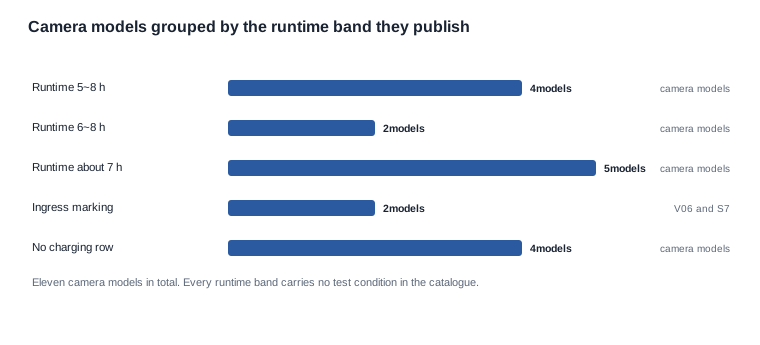
The shortlist for a riding programme can be cut from the catalogue before any request is sent, and it is worth seeing how because it narrows the field at no cost. Two published criteria do most of the work. The first is the ingress marking, which separates the V06 and the S7 from the other nine camera models on a published fact rather than on a claim. The second is the charging method, which separates the magnetic group of five — the S7 and the V03, and the KY06 and the V06, and the MT5 — from the Type-C pair of the V03 Pro and the L2 Utral, and from the four camera models that publish no charging method row at all. Neither cut is a recommendation. A filter is not a verdict, and a buyer who applies both cuts still has a long list rather than a short one. What the filter does is tell a buyer which models justify a sample order and which ones need a document request before they do, which is a cheaper way to spend a procurement budget.
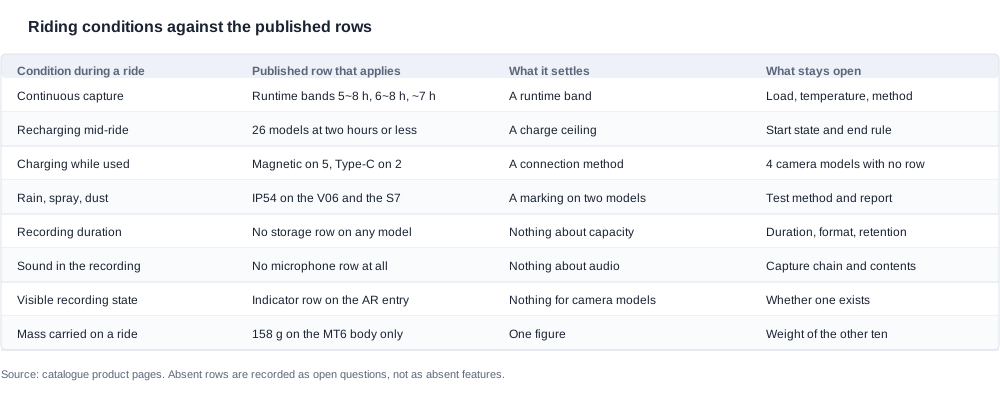
The published rows that bear on a riding session
| Condition during a ride | Published row that applies | What it settles | What stays open |
|---|---|---|---|
| Continuous capture on the move | Runtime bands of 5~8 h, 6~8 h or ~7 h | A published runtime band | Load, temperature, method, sample count |
| Recharging between sections | 26 models at two hours or less | A charge ceiling | Start state and completion criterion |
| Charging while the device is used | Magnetic on 5 camera models, Type-C on 2 | A connection method | The 4 camera models with no charging row |
| Rain, spray and dust | IP54 on the V06 and the S7 | An ingress marking on two models | Test method, scope, third-party report |
| How long a recording can run | No storage row on any model | Nothing about capacity | Duration, format, retention |
| Whether the sound is captured | No microphone row on any model | Nothing about the audio | Capture chain and file contents |
| Whether recording is visible | Indicator row only on the AR entry | Nothing for camera models | Whether an indicator exists |
| Mass carried on a ride | 158 g on the MT6 body only | One published figure | Weight of the other ten camera models |
Three of the eight rows deserve a note because they are where buyers most often go wrong. The charging row is not a small point: among the eleven camera models, five publish magnetic charging — the KY06 and the S7, and the V06 and the V03, and the MT5 — two publish Type-C — the V03 Pro and the L2 Utral — and four publish no charging method row at all, which are the MT6 and the CY03, and the CY05 and the L1 Pro. Those four do publish a charging-case capacity, 1400 mAh for the first three and a 1200 mAh folding case for the MT6, so what is missing is the connection method rather than the case. A buyer who wants to charge during a ride cannot evaluate those four at all, and a buyer who wants to charge between sections cannot compute the interruption for any model, because no model publishes the state of charge at which the figure applies.
The storage row is the one with the widest consequences. No model in the range publishes a storage capacity, a file format or a recording limit. A riding use case is, in practice, a question about how long a recording can run before the device stops, and that question has no answer anywhere in the catalogue. It also has no answer in the usual place, because the answer would normally come from a specification sheet rather than from a product page, and no specification sheet is published for this range either.
The indicator row deserves attention because it is the row a buyer is most likely to need and least likely to find. The only published indicator row in the whole range is on the AR entry, which also publishes a button control row. No camera model publishes an indicator row, so a buyer cannot determine from the catalogue whether recording is announced visibly, audibly, or not at all. For a use case in public, that is not a cosmetic question.
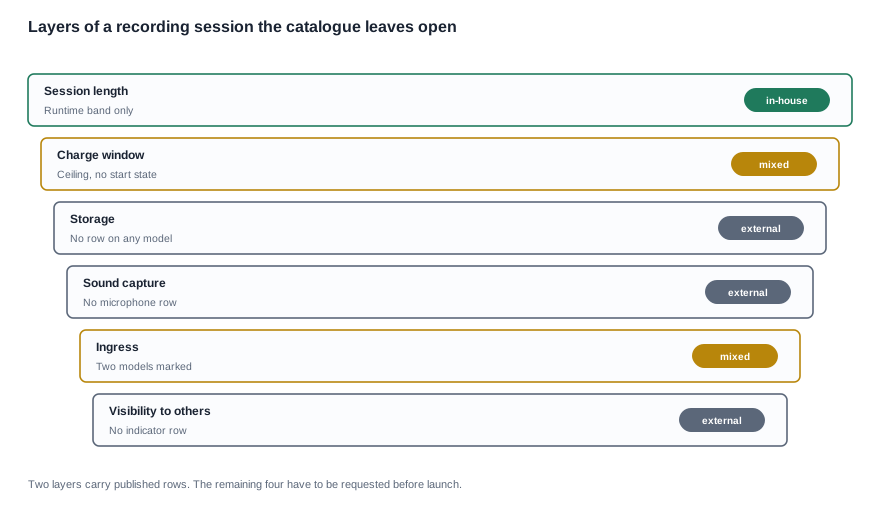
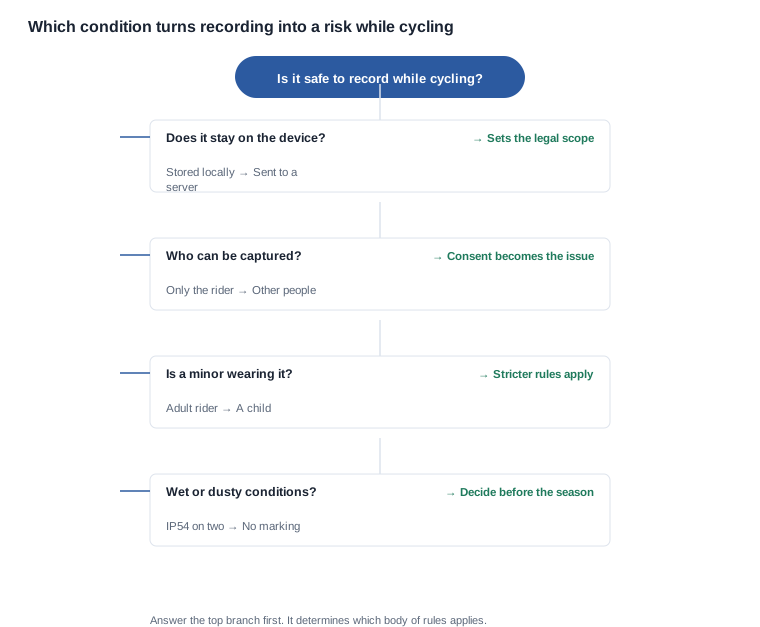
Six conditions that decide whether recording becomes a problem
The conditions below are the ones that actually change the answer, and each is written as a conditional so that a buyer can apply them to a specific market, a specific product and a specific policy. Where the catalogue has a row, the row is named; where it has none, the question to ask is named instead.
If the recording stays on the device and is never transmitted, then the question becomes a retention question rather than a transmission question. The data protection exposure is smaller, but it is not zero, because the device can be lost, sold on, or handed to a third party, and because the retention period is not published anywhere. What a buyer should settle is the deletion behaviour, the default retention setting, and whether storage is encrypted. None of the three appears in the catalogue, and each is a document request.
If the recording is transmitted or shared, then the applicable rules are those of the jurisdictions involved rather than those of the device. This is the point where a catalogue answer would be actively misleading, and it is the reason this article does not attempt one. The rules that apply to capture, storage and publication differ by market, they are frequently amended, and they attach to the controller of the data rather than to the manufacturer. What a procurement team can do is identify which markets the order will ship to and have each one checked by counsel who work in it, rather than relying on a general statement of legality. The camera and data protection note covers the framework this sits inside; the market-by-market legal work is not ours to do and does not belong on a product page.
If people other than the rider can be captured, then consent becomes the operative question, and no technical feature resolves it. The catalogue publishes nothing that helps here either: there is no indicator row on any camera model, so a rider cannot be certain the device is recording, and there is no field of view, so nobody can be certain what the device can see. A buyer who sells into a market with a strong expectation of notice is effectively choosing how the recording state is communicated, and that choice has to be made in writing.
If a child or a minor wears the device, then a separate and stricter set of conditions applies, and the catalogue makes the point indirectly. Three models in the range are children's models, and their published rows are worth stating precisely rather than loosely. The A05 and the A06 carry identical feature rows that describe a unit fitted in the lens, a fogging unit, prompts distinguishing correct from incorrect posture and distance, and states for lens clarity and lens fogging, while the A07 publishes a cell, a runtime, a charge time, a charging method and a Bluetooth version. None of the three publishes a camera specification, and none of them is intended for the recording use case in question. What they do show is how much care is required before a recording device is placed on a minor at all.
If the ride includes rain, spray or dust, then the ingress marking is the only published variable, and it exists on two models. The V06 and the S7 carry IP54; no other camera model carries any ingress marking. That is a genuine selection criterion for a wet-weather programme, and it is one that can be applied from the catalogue today without any further request. What it does not settle is the method behind the marking or whether a third-party report exists, and a buyer whose programme depends on it should ask for the report rather than the marking.
If the device is carried on a helmet rather than on the head, then the mass and the mounting both become safety variables, and the catalogue publishes mass exactly once. The MT6 is published at 158 g for the glasses body, with the cell and the camera inside and the folding charging case outside, and it is the only weight figure in the whole range. The other ten camera models publish no weight at all, and no model publishes the weight of a case or of a mount. A buyer with a helmet programme cannot compare masses across the range, and cannot assume that a model with a folding case behaves like a model without one. The helmet questions and the cycling range note cover the surrounding decisions.

How to frame a riding use case without overstating the evidence
A buyer who has read the catalogue carefully is in a slightly awkward position when writing the listing, because the honest page is thinner than the page a competitor will publish. The resolution is not to omit the use case but to write it in a different register — describing what is published rather than what is intended.
Concretely, a defensible listing for a cycling use case names the resolution class, because that is published for eleven models. It names the runtime band and the charge ceiling, because those are published for all twenty-eight, and it uses the ceiling wording correctly: two hours or less, never under two hours. It names the charging method where one is published, which means five of the eleven camera models in the magnetic group, two in the Type-C group and four with no row at all. It names the ingress marking for the V06 and the S7 and omits it everywhere else, rather than writing that the other models are not waterproof. And it says nothing about frame rate, video format, storage duration or stabilisation, because the catalogue says nothing about them and a listing that goes further is making a claim the buyer cannot substantiate.
That framing has a second-order benefit that is worth naming for a procurement team. A listing built only from published rows is a listing that can be defended when a channel partner asks for substantiation, and it survives the transition from a direct-to-consumer page to a marketplace listing where the platform's own reviewers read it. The claims that cause problems in this category are not the ones that are slightly overstated; they are the ones that assert a capability the catalogue cannot support at all.
The commercial framing of all this is a total cost question rather than a threshold question, and the two are easy to confuse. A rider programme that is planned against published rows only will produce a launch that is defensible and narrower than the programme a competitor is running, and the difference will show up as a shorter feature list rather than as a smaller order. A programme that is planned against assumed capture characteristics will produce a launch that is broader and that carries a documentation cost which is invisible until the first market review. The how to choose decision here is not about which model to pick. It is about which set of claims the organisation is prepared to defend when a channel partner, a marketplace reviewer or an end customer asks the total cost of being wrong about one of them.
There is a related point about the wording of the recording question itself. Whether a device records continuously and how to start and stop it are separate subjects, and the recording behaviour questions and the continuous capture question cover them in their own terms. The relevant point here is narrower: a rider-facing page that describes capture has to describe the trigger, and the catalogue publishes a trigger row only on the two sport models that carry a remote photo line. A camera model has no published trigger row, so a listing that promises hands-free capture is making a product claim rather than a catalogue claim.
Three of the red flags in this category are worth naming because they turn up inside otherwise credible answers. The first is a frame rate offered without a resolution class attached, since a rate quoted for a different model says nothing about the model in the quotation. The second is a runtime offered without a test condition, because a figure produced under laboratory conditions cannot be carried across to a rider on a cold morning without an assumption the supplier has not made explicit. The third is an ingress marking presented as though it were a report, since a marking and a third-party test result are two different documents and only one of them can be filed in a compliance file. A supplier who volunteers any of the three is not concealing anything, but a buyer who has not asked for the attachment cannot tell the difference between a supplier who has tested and a supplier who has relabelled.
is it safe to record while cycling: what to settle before the listing goes live
What a buyer can actually rely on here is narrower than a list of specifications, and it is better read against the four conditions rather than against the product rows.
On the wet-weather branch, two camera models carry an ingress marking — the V06 and the S7 — and that marking is the single published fact that changes the answer. Everything else in the range says nothing about water, so a rider programme either has a published marking or it has a document request, and there is no third position.
On the power branch, every model in the range publishes a charge ceiling and a runtime band, and not one of them publishes the method that produced the figure or the state of charge at which charging is treated as complete. Seven of the eleven camera models publish a charging method; the four that publish a case capacity without publishing a method are the MT6 and the CY03, and the CY05 and the L1 Pro. That is the branch where a rider programme has to make an assumption, and the assumption has to be written down rather than absorbed.
On the capture branch, the published rows run out almost immediately. There is no frame rate, no field of view, no video format, no stabilisation statement, no storage capacity, no file format and no recording indicator behaviour for any camera model. The absence of an indicator row matters more than it looks: it means a buyer cannot tell from the catalogue whether a recording is announced at all.
On the consent branch, the catalogue is silent in a way no specification can fix. We do not publish a capture specification for any model beyond the resolution class, and the absence of one is a statement about the catalogue rather than about the hardware. The obligations that attach to the recording are a matter for the buyer's own counsel in each destination market, and a retention and deletion policy has to exist before launch rather than after the first complaint.
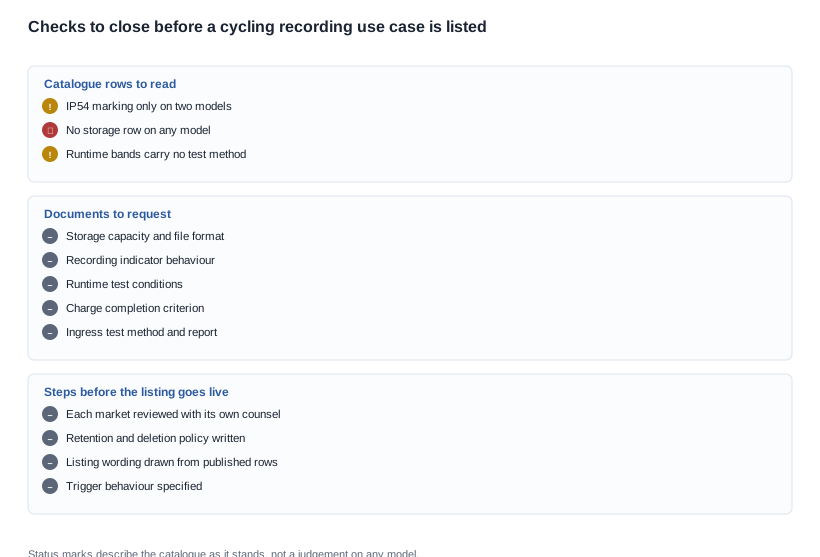
What to ask is therefore the set of document requests that close the eight rows in the table: storage capacity and file format, recording indicator behaviour, runtime test conditions, the charge completion criterion, the ingress test method and report, the mass of the body and of any case, and the trigger behaviour — each one attached to the condition it protects rather than to the model it happens to concern.
The boundary that should end up in the purchase order is worth stating in one sentence, because it is the sentence that prevents both failure directions. The device is sold for riding use on the published rows it has, the recording behaviour and the legal scope are specified by the buyer rather than inferred from the hardware, and any use case that depends on a capture characteristic the catalogue does not publish is either evidenced by a measurement request before the order or excluded from the launch.
For the wider decisions around this use case, the cycling range note sets out the category, can I use them with a helmet covers mounting and mass, can it record with sound covers the audio side of a recording, and the cycling applications page covers the use case as a whole.
Related reading
- Mounting, mass and the helmet question: using smart glasses with a helmet.
- The capture behaviour behind a riding use case: does the camera record continuously.
- Triggering a recording from the device: how to start and stop recording.
- Audio inside a recording: can it record with sound.
- Where camera data protection sits: what the camera data rules show.
Decompose the question into conditions, attach a published row or a document request to each one, and the safety answer stops being a verdict and becomes a specification.


