

How to pack smart glasses for running: when a daily cycle meets a small pocket
The short answer. A running kit has two constraints, and they pull in opposite directions. The first is volume: a runner carries a phone, a key and a card, and every additional object is an object that will not be carried, so a kit that is abandoned at the first run is a kit that was never bought. The second is the cycle: a running device is charged after every session rather than once a week, it is exposed to sweat on the charging contacts, and it is put away in a state nobody measured. That second constraint is the one a running channel has to solve and the one the catalogue cannot help with, because no cycle life rating, no operating temperature range and no runtime test condition is published for any model in the range. So the kit for a running product should be a consumable-only kit by default, with the durable objects kept out of the box, and the specification should be built around two requests the factory can answer: a cycle life figure or a stated test plan, and a packed weight and volume figure for the configuration. Both are cheap to request and both decide what the kit can be.
Who is specifying the kit, and what they are defending. The reader is a brand-side purchasing lead, a channel buyer or a product manager specifying a running product, either as a retail line or as a trail and club channel. The decision in front of them is what the box contains, and it is more constrained here than in any other channel, because the consumer has a veto: a kit that is too heavy to be carried produces exactly the same outcome as no kit at all, and a kit that is too light produces a scratched lens and a complaint about a soft image. What is being defended commercially is the repeat rate, and the failure mode that damages it is rarely the device. It is a kit the runner stopped using.
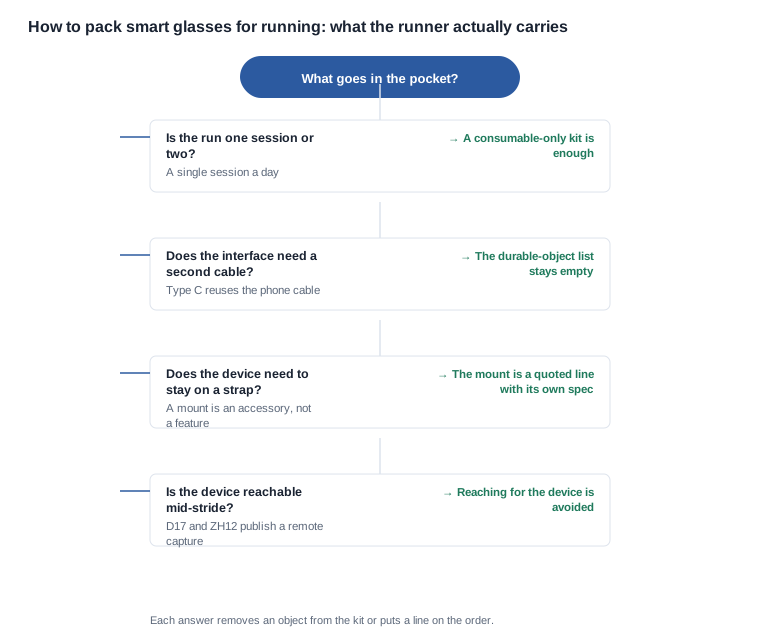
Why two running kits for the same device can cost very different amounts. The published rows for the sport family are close together, so the divergence between two quotations is rarely the battery. It is the charging architecture, because the interface decides whether a case is an accessory or the charger, and a case is the single object that would decide the volume question in a running pocket. Our catalogue splits the charging method three ways across the twenty-eight models: seventeen are magnetic, seven publish a Type C interface, and four publish neither a charging method nor a charging port row — the CY05 and the L1 Pro, and the MT6 and the CY03, each of which does publish a charging-case capacity. The models that suit a running line best on the charging side are the D17 and the ZH12, because they publish a Type C interface, roughly one hour of charging, and a remote capture control. The charging decisions are at charging solutions, and the product family is at sport smart glasses.
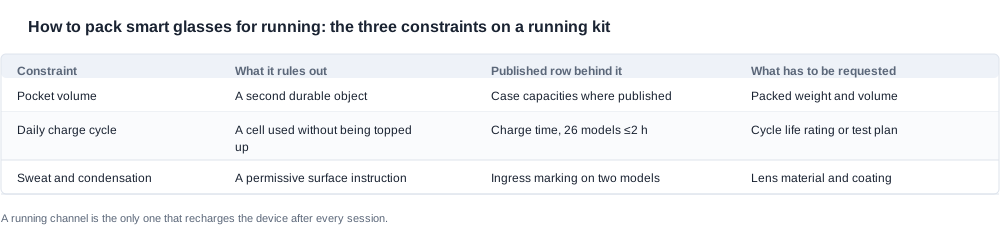
The three constraints a running kit has to satisfy
The first constraint is volume, and it rules out a second durable object. The case positions in the catalogue are these. Five camera models publish a capacity: the CY05 and the CY03, and the L1 Pro — each at 1400 mAh, the L2 Utral at 900 or 1400 mAh as a configuration choice, and the MT6 at 1200 mAh in a folding case. Two more, the KY06 and the MT5, publish a case without a capacity. Four, the V03 and the V03 Pro, and the S7 and the V06, publish no case row at all, and no model in the range is published as having no case, so the pack-out has to be confirmed per model. The sport models that carry a running line publish no case row either. A runner who wants one is therefore choosing between a custom accessory and the session length, and a buyer who puts a case in the box for a model that publishes none is shipping a custom accessory at a price the channel did not plan for. The honest default is a consumable-only kit, with the case offered as a separate purchase for the runner who does two sessions in a day.
The second constraint is the daily charge cycle, and no published row covers it. A device that is charged after every session is on a different duty cycle from a device that is charged once a week, and the charge times in the catalogue describe a single charge rather than a life. Twenty-six of the twenty-eight models publish a charge time of two hours or less, and the D17 and the ZH12 publish roughly one hour, which is the number a post-run gap is planned around. The D17 publishes 115 mAh and about seven hours of runtime, and the ZH12 publishes 100 mAh and about eight hours; the YKC02 publishes two 70 mAh cells and about eight hours; the V06 and the S7 publish 260 mAh and five to eight hours. What is not published anywhere is a cycle life rating, an operating temperature range, a runtime test condition, the charge-time starting point or the indicator behaviour. A channel whose whole promise is a daily cycle is therefore buying an unquantified duty, and the specification has to ask for a test plan rather than accept the silence.
The third constraint is sweat and condensation, and the instruction has to be restrictive. The lens material, the coating and the surface treatment are not published for any model in the range, and neither is a frame weight — with one exception, the 158 g whole-unit figure for the MT6, which is a camera model and not a running model. Two models in the entire catalogue carry an ingress marking, the V06 and the S7, and both are sport camera models; the marking covers splashing water and a dust protection level, it does not cover immersion or a sustained downpour, and no third-party test report is published behind it. The digit reading is at IP ratings. A kit that includes a "waterproof" card on any other model is making a claim the documentation cannot carry, and a runner in a downpour is the customer who tests it. The consumable-led procedure is at field work lens handling.
What the storage position does, and why it is free. A running device is put down on a bench, a car roof and a café table, and a lens placed face-down on a rough surface is damaged with no agent involved. The answer is a defined place rather than an object: a pocket position, or the top of a bag, and that is an instruction rather than a kit line. It is the cheapest damage reduction available in this category and the one that is most often left to the copy rather than to the artwork.
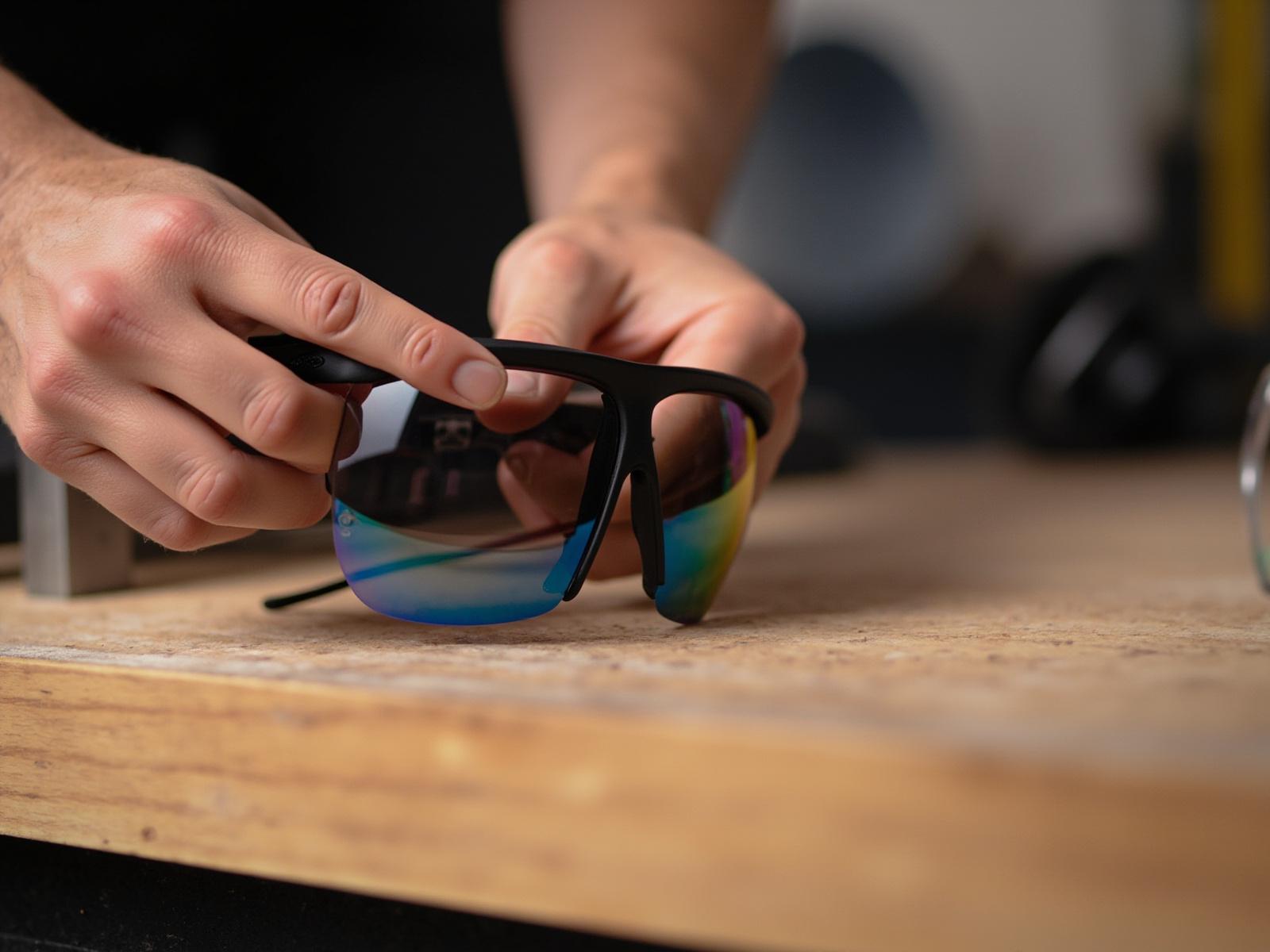
The mount, the strap, and the one feature that removes the need to reach
A mount is an accessory, and in a running channel it is the accessory that decides whether the camera is usable. The catalogue publishes no mount for any model, no mount interface, and no field of view, and a device that is strapped on has to hold a stable angle through repeated impact cycles, which is a requirement on the fixture and not on the device. A buyer who treats the mount as a product feature has quietly made two decisions: that the fixture is a product, and that its failure is a product failure. The commercial version of that mistake is a return that arrives with a "the recording stopped" description and a supplier that cannot reproduce it, because the fixture that failed is not a part the supplier sold.
The mount therefore has to be a quoted line with its own specification. The request is for the interface type, the adjustment range, the strap material, the weight it adds, and the spare-parts route, and the completion standard is a written answer per model rather than a general statement that mounts are available. The weight is the part that matters commercially, because it is the number that makes the running kit fail its own volume constraint, and no published weight exists for any running model.
Two published features change the mount question, and they are worth having. The V06 and the S7 publish a removable inner frame, and the G07 publishes ultra-slim detachable temples with the YK12 publishing slim detachable temples, and a detachable temple is a sizing system rather than a cosmetic feature: one outer frame can serve different face shapes, which matters for a channel that has to serve a range of head sizes from one SKU. The second feature is more specific to this channel: the D17 and the ZH12 publish a remote capture control, so the runner does not have to reach for the device mid-stride to trigger a capture. For a running product that is a genuine design advantage and it is published on exactly two models in the range, which makes the model choice in this channel narrower and cheaper to argue for.
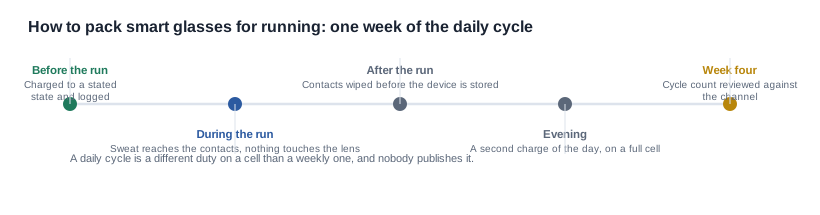
The consumables are what the running kit should actually contain. A lens wipe and a contact wipe cost a fraction of the unit price, they take no room, and they address the two failures this channel actually produces: grit that gets ground into a lens, and sweat on a charging contact that stops a unit from taking a charge. Neither has a published quantity per session, and a single-use rather than washable choice is a decision the buyer makes and the factory prints. The quantity to negotiate is the quantity per device per month and the restock interval, because a running customer buys the device once and then a consumable every few weeks.

The file that makes a running kit quotable
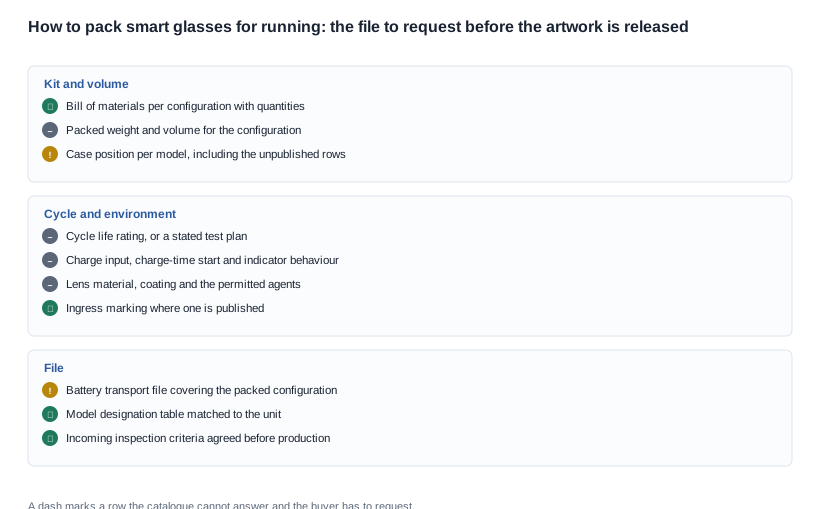
A running kit is decided by a small number of documents, and each request below has a completion standard. The standard matters most on the two rows that are genuinely open, because those are the rows a listing would otherwise be written from.
- The bill of materials per configuration with quantities. The completion standard is a document that separates the consumables from the orderable accessories, and that states the case position per model rather than assuming one.
- The packed weight and volume for the configuration. The completion standard is two numbers, measured on the assembled configuration including the packaging the customer carries, because the volume constraint in this channel is a physical one and a buyer who quotes a volume has to mean the same volume as the factory.
- The cycle life rating, or a stated test plan. The completion standard is either a figure with its test condition, or a written plan naming the cycle regime, the end point and the sample size. A bare "good cycle life" is not usable, and a channel selling a daily cycle needs the regime to match the daily one.
- The charge input, the charge-time starting point and the indicator behaviour. The completion standard is a written answer per model, because the daily cycle is planned against the window and the indicator is what tells a runner at a gym bag that the unit is charged.
- The lens material, the coating and the permitted agents. The completion standard is a statement per model, because it is the statement that makes the permitted-treatment line on the insert specific rather than generic.
- The mount interface, the adjustment range and the weight it adds. The completion standard is a written answer with a weight figure, because the mount is the accessory most likely to break the volume constraint the channel is built on.
- The battery transport file for the exact configuration. The completion standard is a document reference naming the model, the case configuration and the cell count. The requirement is at battery transport.
- The model designation table and the incoming inspection criteria. The completion standard is that the designation on the unit resolves to the paperwork, applied to a stated sample of the production lot. The register procedure is at certification checklist.
- The packaging artwork proof, with the storage instruction on it. The completion standard is a proof showing the defined place, because the storage position is an instruction and an instruction that is not printed is not shipped.
Where a running kit fails on the fourth week
The kit that was too heavy and was left behind. The first run carried it and the second did not, so the whole kit stopped travelling and the protection stopped with it. The control is the packed weight figure, agreed before the order, and a kit that fits inside a pocket the runner already has.
The contact that was charged with sweat on it. A unit that has been on a run and goes straight onto a charge collects salt on the contact, and the failure is gradual enough that it surfaces as a dead device rather than as a charging fault. The control is the contact wipe and the instruction to use it before the charge, which is the order the insert has to get right.
The lens that was put down on a bench. No agent was involved; grit on a rough surface did it. The control is the defined place, printed on the artwork rather than left to the listing copy.
The case that was included and never carried. A case in the box on a model that publishes no case row is a custom accessory, and a custom accessory that a runner does not carry is a per-unit cost with no return. The control is the consumable-only default and a case offered as a separate purchase.
The claim the card could not carry. A "waterproof" card on a model with no ingress marking, or on one of the two models that do, without the marking's own wording. The control is the marking row, quoted as published, with no test report claimed behind it.
The mount that failed and was reported as a device fault. The fixture was treated as part of the product, so the return arrived with a recording complaint that the supplier could not reproduce. The control is the mount as a quoted line with a spare-parts route, and a written note on the insert that the mount is an accessory.
The commercial terms of a running line, and what to send us next
The consumables are the whole of the running kit's cost, and they are the part of it that has to be negotiated. The lens wipe and the contact wipe cost a fraction of the unit price, take no room, and address the two failures this channel produces. The quantity to negotiate is the quantity per device per month and the restock interval, and whether the item is washable or single-use is a real decision with a real unit-price effect across a channel that reorders monthly.
Whether the case is in the box or sold separately is the main decision for a running kit, and it changes the price point rather than the volume. A case in the box raises the unit price and the pack weight at the same time, and on the models that publish no case row it also raises the lead time because it becomes a custom accessory. A separate case preserves the consumable-only default and lets the runner who does two sessions a day buy one. The trade-off is worth putting to the channel's own data rather than deciding on instinct, because the answer depends on how many sessions a customer actually does.
Whether the supplier will fund a baseline measurement on the production batch is worth asking, because that document answers every complaint in year two. A batch-level measurement of the packed weight, the charge behaviour and the state of the contacts after a session is the reference against which a customer complaint can be judged, and without it every complaint becomes an argument. The same document is also what makes a cycle life claim defensible later, in either direction.
What cannot be moved, because it is fixed before the commercial conversation starts. The cell configuration, the charging interface, the charge time, the runtime ceiling and the case architecture of any given model are published rows. Certification cost and its lead time follow the process and the testing body rather than the order size. Tooling and mould cost is a third category and the one most often bundled: tooling is normally amortised across an order while certification cost follows the product family, and a blended line hides a cost that repeats on every future order next to one that does not. Ask which line the quotation is charging.
The terms worth putting in the order. The published rows for each model in the set. The bill of materials per configuration. The packed weight and volume for the configuration. The cycle life figure or test plan. The mount specification and its spare-parts route. The lens material, coating and permitted-agents statement. The battery transport file for the exact configuration. The incoming inspection criteria and the point in the flow at which they are applied, which is the point at which the payment node sits. The warranty period with a stated response, and the treatment of a unit returned with a missing accessory. The building blocks are at pricing, contract terms and MOQ.
What we publish, and where we stop. We publish the cell capacities, the resolution tiers, the structural features, the rated runtimes, the charge times, the colour availability and the charging interfaces exactly as the catalogue states them, and we publish the absence of the frame and lens material, a per-model frame weight, an operating temperature range, a cycle life rating, an ingress test report and a runtime test condition with the same prominence. We do not read a charging case as extra running time, and we do not attach an IP54 test claim to any product, because no test report is published behind that marking.
What to send us. Send the session pattern, the channel, the price band, the markets and the models, and we will tell you which kit items the configuration should include, which published rows apply, which two rows have to be requested in writing before the artwork is signed, and which claims the configuration can support without a test report behind them. The scenario entry point is smart glasses for running.
Related reading
- How the scenario opens — smart glasses for running
- The model family — sport smart glasses
- The handling procedure — field work lens handling
- The ingress standard — IP ratings
Tell us the session pattern and the channel, and we will say which kit items the configuration should include and which rows have to be requested first.


