

An ingress code is two characters, and the first thing a datasheet reader should do with it is check whether both characters are numbers. IP rating smart glasses smart glasses how to read a datasheet is about turning a code into evidence: decoding what each position means, identifying the rows a datasheet should carry next to the code, spotting the readings that deserve suspicion, and then turning the whole read into a protocol for one email to the supplier.
The format is IP followed by two characters. The first is the protection against solid foreign objects and the second is the protection against water. A letter X in either position means that part was not evaluated, and that is not a minor detail: an IPX7 product carries no dust opinion at all, and a product with an X in the second position has no water opinion.
IP rating smart glasses: two characters, one of them an absence
The short read that decides the datasheet row
IP rating smart glasses smart glasses how to read a datasheet is decided by whether the code is read as a number or as a document. A code tells you what was tested; only a report tells you what was tested, on which model, in which configuration, and who paid for it. The second thing to establish, before the document request, is where the marking came from — because an ingress code on a datasheet is usually an inherited claim, and an inherited claim has an owner you have not yet spoken to.
Who is reading the row, and what they are holding
A buyer reading an ingress row is usually deciding whether a product can go into an outdoor, sport, industrial or beach channel, and holds the supplier's sheet, a channel plan, a target price and a set of samples. What they do not hold is the report, and that is normal rather than suspicious: an ingress test is a per-configuration activity whose report lives with whoever commissioned it — often the factory, sometimes the original brand that developed the platform, and occasionally nobody at all.
That means the buyer's realistic position is that the marking is inherited rather than owned, and the read is about finding out which. A sheet with an ingress code and no other information is a normal document. What it is not is a complete one.
There is a second audience, and it decides whether the marking is worth anything: the person who writes the listing. For them the practical question is what sentence the evidence supports, and the answer is almost always narrower than the sentence they want to write.
Where the marking usually comes from
Three provenance patterns appear in this category, and they have very different consequences.
The factory tested its own platform and holds the report. This is the good case. The report exists, it is resolvable, and the model list may include the configuration you are buying. Your work is to check the list.
The original brand commissioned the test and the factory inherited the marking. Here the report exists but sits with a party you may never approach, and the model list names a designation that is not yours. The rating may still describe the same enclosure, but the evidence is one step removed from the unit in your hand.
The marking is an annotation with no report behind it. This is common, and it is not fraud — it is a catalogue entry copied forward. But it means the code is a statement rather than a document, and a statement is all you have.

The thresholds that decide whether a code is worth anything
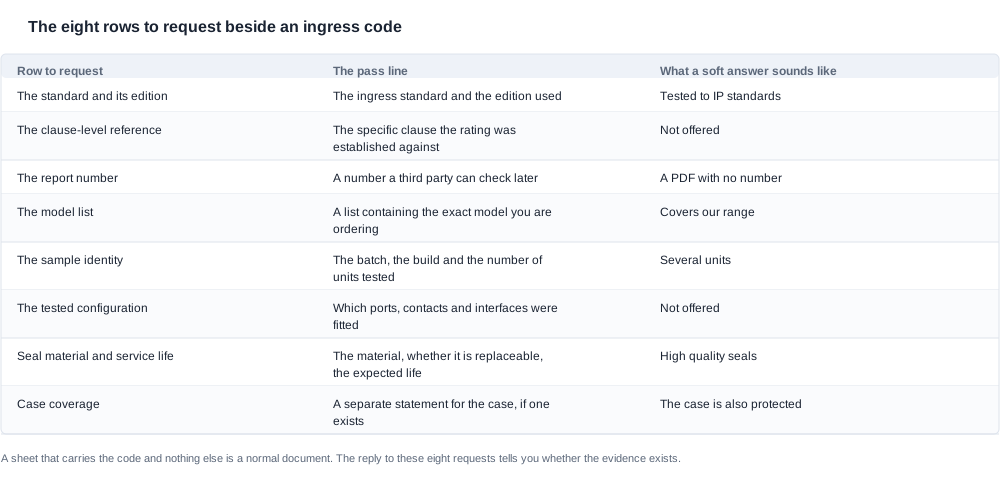
The rows below are the ones a datasheet should carry next to the code. Ask for them in a single email, in the form given, and the reply either produces the evidence or tells you it does not exist.
| Row to request | The pass line | What a soft answer sounds like |
|---|---|---|
| The standard and its edition | The ingress standard and the edition used | "Tested to IP standards" |
| The clause-level reference | The specific clause the rating was established against | Not offered |
| The report number | A number that can be checked later by a third party | A PDF with no number |
| The model list | A list containing the exact model you are ordering | "Covers our range" |
| The sample identity | The batch, the build and the number of units tested | "Several units" |
| The tested configuration | Which ports, contacts and interfaces were fitted | Not offered |
| Seal material and service life | The material, whether it is replaceable, and the expected life | "High quality seals" |
| Case coverage | A separate statement on the case, if one exists | "The case is also protected" |
The first digit runs from 0 to 6, with 6 meaning dust-tight
This half is mechanical, and it transfers reasonably between products with the same enclosure. That is why a solid rating is usually safe to carry across a family and a water rating usually is not.
The second digit runs from 0 to 9, and the levels are not a scale
The code that appears most in this category is IP54, which means protection against limited dust ingress on the first digit and protection against splashing water from any direction on the second. That is a modest claim, and a legitimate one, provided the copy does not stretch it.
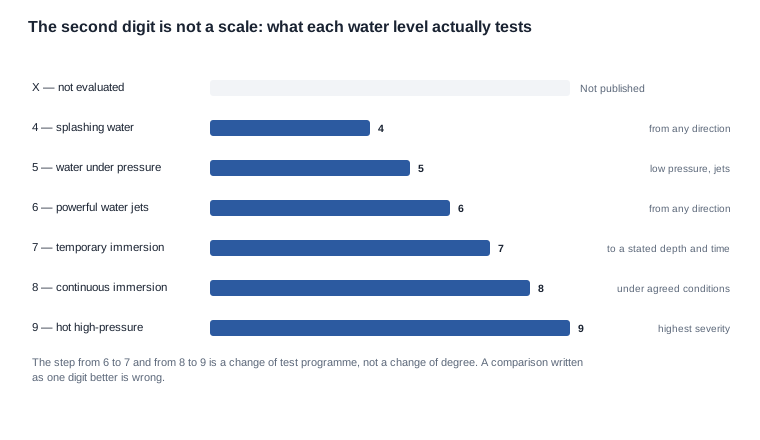
The water levels are not a linear scale, and this is the reading that causes the most commercial damage. A 4 is protection against splashing water from any direction. A 5 is water under low pressure. A 6 is powerful water jets. A 7 is temporary immersion to a stated depth for a stated duration. An 8 is continuous immersion under agreed conditions. A 9 is high-pressure, high-temperature jets. A 6 and a 7 are far further apart in test severity than a 4 and a 5, so "one digit better" is not a proportional improvement, and a comparison written in those terms is simply wrong.
A letter X is an absence, not a zero
An IPX7 product carries no dust opinion at all. A buyer who reads an X as a low score has missed the more useful fact: the part of the rating that was never evaluated is a part of the product nobody has a claim about. That cuts both ways commercially — there is nothing to defend, and nothing to publish either.
The tested configuration decides whether the marking covers your unit
Which ports, contacts and interfaces were fitted during the test. A unit with a different port, a different contact arrangement or a different interface is a different configuration, and a rating transfers only if the enclosure is the same. This is the row that catches a substitution, because a mismatch usually means a component changed after the test.
The report number is the only part of the document that can be checked later
A rating with no number is a statement rather than a document, and the difference matters the first time a broker, a marketplace or your own compliance team asks. It is also the part that makes a claim auditable, which is what your compliance reviewer will want and what a marketplace listing review will look for.
The physical condition of the received unit is the row that catches a substitution
Check the seal line, the interface, the button seals and the microphone ports against the tested configuration. A unit reworked between the test and the production run is a unit the marking does not describe, and this is a check that costs five minutes on receipt.
Turning the row into a document, one request at a time
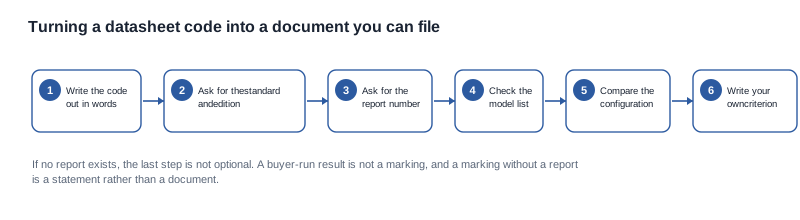
1. Decode the code and write down what it actually covers, in words. Do not carry the code forward as shorthand. "Limited dust ingress and splashing water from any direction" is a claim you can check; "IP54" is a reference.
2. Ask the provenance question first: who holds the report? The supplier, the factory, or the original brand. The answer tells you whether the model list is likely to name your configuration, and it decides whether you are asking for a document or asking for a summary of somebody else's document.
3. Ask for the report number, with the standard and the edition. A number is the only part of a compliance document that a third party can check later, and it is the first thing a marketplace or a broker will ask for.
4. Check that the model list contains your exact model designation. A family-level report is not coverage, and a report on the factory's own catalogue number is not a report on your branded unit. Do the comparison character by character.
5. Establish the tested configuration and compare it with the unit in your hand. The ports, the contacts, the interfaces, and the physical condition of the seals. This is the check that catches a substitution, and a mismatch is a stop condition rather than a query.
6. Establish your own criterion if no report exists. The absence of a marking is not evidence of a weak product; it is the absence of a claim to evaluate. If your use case requires it, write what you need — a specific environment, a duration, a behaviour after exposure — and test it on a sample, recording the protocol and labelling the result as a buyer-run measurement.
7. Do not convert your own result into a marking. A test you ran does not produce an IP code, and a code in your listing without a report behind it is a claim you cannot defend.
The questions to ask a supplier, in one block
The eight rows above are a document request. They become a decision only when they are paired with four questions that force an answer rather than a recital.
Which object was tested, and in which configuration? A frame with a capped charging contact and a frame with an exposed contact are different objects to a test laboratory, and the difference is invisible in a two-character code.
Who holds the report, and can a third party resolve the number? This is the provenance question, and it is the one that tells you whether the marking is a document you can file or an annotation somebody copied.
Does the model list contain the exact designation you are ordering? Not the family, not the platform, not a similar name. The exact string, character by character, because this is where a branded unit most often falls outside the coverage.
What happens to the marking when the variant changes? A per-colour, per-logo or per-cap change to the enclosure, the seal or the interface can take the unit outside the tested configuration, and the answer tells you whether a notice obligation is required in the contract.
A supplier who answers all four has a documentation habit, and a supplier who answers only the first has a catalogue entry.
A note on the case
A case is a separate object with its own electronics, its own contacts and its own opening. A rating on the glasses says nothing about the case, and the most common version of this error is a listing that says "the case is also protected" because the glasses are. Ask which object was tested; if the answer is that the case was not tested, then the case is not covered, and it should not be described as though it were.

Where an ingress claim is misread
A splash rating is published as "waterproof" and the product is returned after rain. The symptom is a cluster of returns from one channel with a description that says the product is broken. The root cause is that the code was carried forward as shorthand instead of being written out. The prevention is to write the coverage in words and to use only those words in the copy.
A product is quoted with an ingress code and the report names a different model. On the ground the symptom is a marketplace rejection, a warranty claim, or a customs query with nothing behind it. The root cause is that equivalence was assumed from similarity of name. The prevention is to check the model list and to make the exact designation a condition of the purchase order.
The unit received has a different port from the tested configuration. The symptom is a leak in a specific channel and a pattern that looks random. The root cause is a component substitution after the test. The prevention is to check the physical configuration against the report on receipt, and to put a substitution clause in the contract.
The case is claimed as protected because the glasses are. The symptom is a customer whose case fails while the glasses are fine, and a listing that says otherwise. The root cause is that the claim was written at the product level rather than at the object level. The prevention is to ask which object was tested.
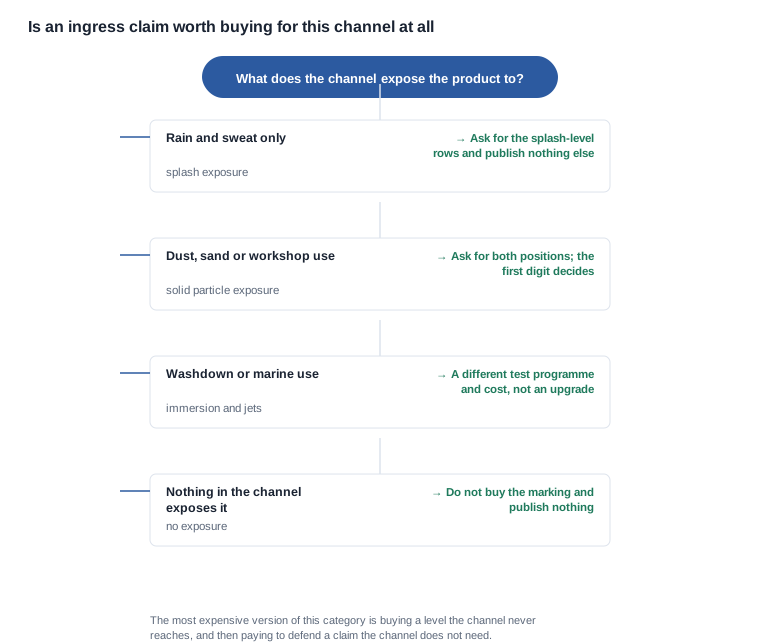
A channel buys a level it never reaches. The symptom is a programme that paid for an immersion or jet rating and then sold the product into an ordinary retail channel, where the marking does nothing for the price that was paid. The root cause is that the exposure was never written down before the quotation. The prevention is to write the exposure first, one line per channel, and to buy the marking that matches it.
The marking is quoted as a lifetime guarantee. The symptom is a customer expectation that no seal can meet, usually after two or three years. The root cause is that the sheet's wording was not read closely. The prevention is to state the scope explicitly — a rating describes the product as it left the factory, and seals age.

What the ingress evidence is worth commercially
Negotiable, and this is where the effort belongs. The set of configurations you commit to, because a re-validation cost is per configuration and compounds with the range rather than with the order. The per-colour minimum for each. The artwork round count. The per-market label scope. The market list itself, because a channel served only from markets where approvals already exist is worth a materially better price than one that requires new testing. The retention held against the documentation package, because it protects you on the failure that costs most in this category, which is a product that arrives with a marking nobody can evidence.
The ingress test and the seal are settled before the negotiation opens. An ingress claim is bought as a test report on a named configuration, so the cost that matters is the retest every new variant creates rather than a number on a quotation. Ask what a configuration change triggers — a new colour, a different port, a revised logo on the housing can each pull the variant out of the covered configuration list — and ask whether the sealing tooling is owned by the supplier or by the programme. Once the seal material, the seal geometry and the port design are settled, the ingress performance of the product is a fixed characteristic rather than a variable, and every configuration added afterwards is another configuration with a retest attached to it. A supplier who will not move those three has drawn the boundary of the ingress claim in advance, and the configuration list has to be built inside it.
Documents to request before the deposit. The report number, with the standard and the edition. The model list the report names. The configuration that was tested, set out by its port layout, its contact set and its interfaces. The sample identity. The seal material and expected service life. A separate statement on the case. The certificate numbers for the rest of the conformity file.
Clauses to write into the contract. The report number and the exact model designation attached to the purchase order. A clause requiring notice before any change of seal, port, contact or interface, since each of those invalidates the configuration. A clause requiring per-variant confirmation that a changed variant remains within the covered configuration list. The acceptance criteria from the buyer-run protocol. And a clause that puts the cost of a shipment whose seals were damaged in transit back on the supplier.
A worked scenario: a channel buyer deciding whether to pay for an ingress claim
A distributor weighing whether an ingress claim is worth paying for has to write the exposure down before anyone opens a quotation, and the five steps below are the order in which that line gets written.
Assume a distributor considering a sport line for two channels: an outdoor retail channel exposed to rain and sweat, and a general channel with no meaningful exposure. The supplier's sheet carries an ingress code with no other information.
Step one is the exposure, written before the price. One line per channel: what the product meets, for how long, and what happens afterwards. The outdoor channel is a splash-and-sweat exposure. The general channel has no exposure worth naming. That single pair of lines is what stops the programme buying a level the general channel will never use.
Step two is the provenance question. The distributor asks who holds the report. The answer is that the marking is an annotation on the platform with no report number behind it, which changes the whole basis of the decision: there is no evidence to inherit, so any claim has to be created.
Step three is the request. The eight-row request goes out. The reply either produces a report with a model list, or it does not. If it does not, the distributor has a decision rather than a delay: a buyer-run protocol against the outdoor channel's own exposure, written before the first sample is signed off.
Step four is the claim. Rather than re-testing at a level the channel never reaches, the distributor takes the narrow option. The copy describes protection against splashing water from any direction, publishes the exclusions next to it, and the general channel is listed with no ingress claim at all, because a claim in a channel with no exposure is a liability with no benefit.
Step five is the commercial response. The distributor negotiates the per-configuration minimum against a committed combination count rather than a unit count, and adds a per-variant confirmation obligation to the contract so that a later colour or logo does not silently invalidate the configuration.
The decisive decision was the exposure line, written before anyone opened a quotation.
What our ingress annotations say and what they do not
An ingress marking is published exactly as the catalogue states it, and a splash-protected product is not described as waterproof. In our catalogue the IP54 marking appears on the V06 and the S7, as an annotation, with no third-party test report number behind it, and no other model in the range carries a published rating. No charging case in the range carries a published rating either. We do not publish the standard, the test condition, the report number or the tested configuration for any of them, because the company has not confirmed them to us, and we will not fill those fields with a plausible-looking value.
We will also say plainly what a missing marking means in each direction. It is not evidence that a model cannot handle the environment; it is the absence of a claim. And when a marking is present without a report, it is a statement rather than a document, and the difference matters the first time somebody asks.
What we can do is tell you which of the eight rows a given supplier's claim leaves open, and which of the three readings above it raises. The background is under IP ratings and durability, the verification method is in how to measure and verify an IP rating, and the range is sport smart glasses.
Three steps for the ingress row
Write the exposure down, one line per channel, before you write the requirement. If a line is "occasionally, in the rain", you have a splash case. If it is "under a pressure washer", you do not, and the codes are not comparable.
Send the eight-row request as a list, not a question, and ask the provenance question first. Who holds the report, and for which model designations. A supplier who answers all nine has a documentation habit; one who answers two is telling you something you need before the deposit.
Send us a supplier's ingress claim and we will tell you which rows it leaves open. Give us the channel, the exposure and the model, and we will say which published rows apply and what has to be established before the marking can go in a listing.
Where the reading method comes from
Send us a supplier's ingress claim and we will tell you which rows it leaves open.


