

Photochromic: six published rows and the question left open
Photochromic smart glasses how to read a datasheet produces two lists, and the second list is the one that decides a purchase. The first list is what a supplier publishes. The second is the set of rows a lens buyer needs in order to defend a claim on a product page six months after launch. For our electrochromic entry, the published list is six rows long — Bluetooth 5.4, a 100 mAh cell, charging in two hours or less, roughly seven hours of runtime, magnetic charging and electrochromic lenses — and the second list is six rows long as well. That symmetry is the lesson of this article: a datasheet can look complete and still be half empty, and the half that is empty is usually the half that decides whether the product can be sold with a claim attached to it.
The decision this read supports is narrow and commercial. Before you compare two suppliers, decide which of them you are actually dealing with: a lens maker, an assembly factory that bought a lens from a lens maker, or a brand that designed the product and outsourced assembly. The answer changes what you may ask, who can answer, and what evidence you can realistically hold on delivery day. A buyer who assumes they are buying from a lens maker will spend a month waiting for a lens data set that was never going to arrive, because the lens maker has no contract with them.
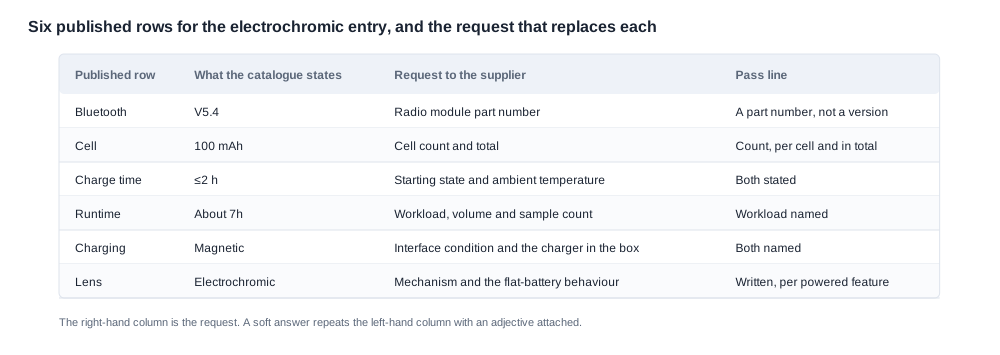
The three buyers who read this kind of sheet, and what each is defending
A brand-side product manager is usually opening a sheet to decide whether a lens option belongs in a new outdoor or sport line, and they are defending a proposition: what the product does that a plain pair of glasses does not. Their exposure is the listing, and the listing has to survive a customer who buys the product on the strength of the lens sentence.
A channel buyer or distributor is comparing two or three suppliers whose catalogues all print the same six rows, and they are defending a margin. Their exposure is the landed cost and the return rate, and a lens that behaves differently from the description they wrote is a returns problem rather than a marketing problem.
A specifier in a product team, sometimes the same person under a different title, is deciding whether the electrochromic architecture is acceptable at all for a use case, and they are defending the engineering decision to whoever signs the specification. Their exposure is the sample test failing on a row nobody asked for.
All three are reading the same sheet and needing three different things from it, which is why a single "here is our datasheet" email closes none of them. The sheet has to be turned into a request, the request into answers, and the answers into acceptance criteria. Each of those is a different document, and each of them is something a procurement manager can own.
What the buyer is trying to avoid, expressed as four red flags
Reading "electrochromic" as "photochromic" without noticing the difference. The two words are used interchangeably in retail listings, and they describe different supply chains with different behaviour. A powered lens that changes state on a control command is a different product from a passive mineral lens that reacts to ultraviolet light, and a customer who bought expecting mineral-lens behaviour will read a powered lens's behaviour as a fault. This is the first red flag because it is a language problem, and language problems are decided in the copy, not in the factory.
Quoting a runtime without its condition. The roughly seven hours is a result without a stated condition, and the condition is the load: what was active, at what volume, over how many units, on which rig. Two products with identical cells can differ by an hour or more because their load profiles differ, and the sheet that omits the condition is the sheet that makes the comparison wrong.
Copying a switching time from a neighbouring model. A supplier who publishes a figure for a sibling product has told you something about their data discipline, not about your product. This red flag is common in private-label work, where a range is assembled from a shared platform and a plausible number migrates from one spec sheet to another.
Treating the absence of a model designation as a formality. If no model designation is published for the entry, then no compliance document, technical file or declaration of conformity can name your unit. That single gap turns a documentation request into a legal exposure, and it is a much harder gap to close after tooling than before it.

Why electrochromic and photochromic are two different supply chains, not two adjectives
The word on the sheet is a technology name, and technology names hide the supply chain. A passive mineral or resin photochromic lens is a piece of glass with a coating that responds to ultraviolet light; the performance lives in the coating chemistry and the certification travels with the lens maker, because the lens maker controls the material. An electrochromic lens is an electrically driven stack that changes its transmission when a voltage is applied; the performance lives in the stack, in the drive electronics, in the control firmware and in the coating, and the certification travels with whoever assembled the finished device.
That difference is not academic for a buyer, because it decides where the risk sits. With a passive lens, the lens maker holds the optical performance data and will usually share it, because it is their product. With an electrochromic lens, the finished unit is a system, and the interesting data — the switching behaviour, the uniformity, the behaviour at a flat battery — is only measurable on the assembled device, because the frame, the drive electronics, the firmware and the ambient conditions all participate in the result.
Where the money sits in a lens option
Four cost layers, and only one of them appears on the unit price.
The lens itself. A powered lens is a bought-in component, and the price is set by the module maker rather than by the assembly factory. The negotiation room here is thin, because the factory is a pass-through. What is not thin is the specification: the tint range, the coating and the switching behaviour are all set by what the module maker offers, and they are set once, for everybody.
The drive electronics and the firmware. Someone has to deliver current to the lens, sense the state, and expose a control. That is design work, and it is where the intellectual property and the differentiation live. A supplier who is willing to change this layer is telling you the product is not fixed.
The integration work. Mounting the lens in a frame, routing the contacts, managing the heat from the drive circuit, and making the assembly repeatable. This is where the tolerance question lives, because a powered lens has a visible state and a visible tolerance, and an uneven result is a visible defect on a product that sits on a customer's face in daylight.
The validation and documentation. Test on the finished assembly, because a lens validated on a bench is not the lens in the frame. Then the conformity file, the model list, the labelling per market, and the re-validation cost for every colour and logo variant that touches the lens stack.
The practical consequence for a procurement manager is that the quoted unit price is the smallest and least informative of these four numbers. A buyer comparing two lens options on unit price is comparing the one number that is identical across suppliers and ignoring the three that differ.
The decision tree a lens claim actually sits in
Before any of the numbers, there is a branching question, and a buyer who answers it early saves weeks. The chart below is the branch structure we use internally when a supplier sends a lens claim and a product manager has to decide what to do with it. Each branch ends in an action that can be written into a purchase order, which is the only place an action is worth taking.
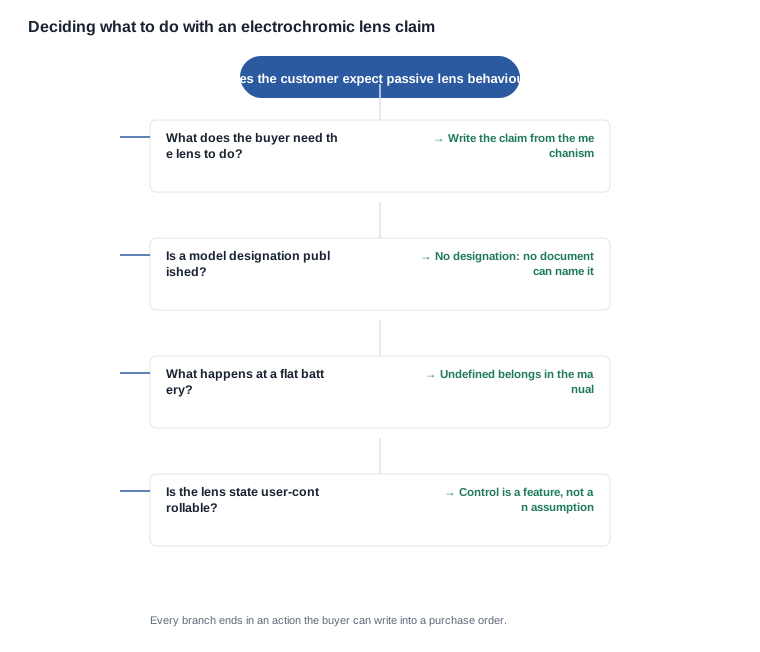
Note the first branch. "Does the customer expect passive lens behaviour" is not a technical question and it is not a nicety; it is the branch that determines whether the product will generate returns, and it is answered by the copy, not by the factory. A brand that has decided the lens is a feature worth paying for will write the mechanism into the listing and will be judged on it. A brand that wants the lens to be invisible will find that the same behaviour is read as a fault, and no amount of engineering fixes a mismatch between the claim and the expectation.
Cell capacity across published entries, and why the row is not a ranking
The published electrical rows in our range make the point that a capacity figure is an architecture statement rather than a performance statement. The electrochromic entry publishes a 100 mAh cell, magnetic charging, a charge time of two hours or less and roughly seven hours of runtime. The bone conduction entry publishes 200 mAh, Type-C, two hours or less and roughly seven hours. The D11 and D12 entries publish 100 mAh, Type-C, two hours or less and roughly seven hours, and the ZH12 sport entry publishes 100 mAh, Type-C, a charge time of around one hour and roughly eight hours.
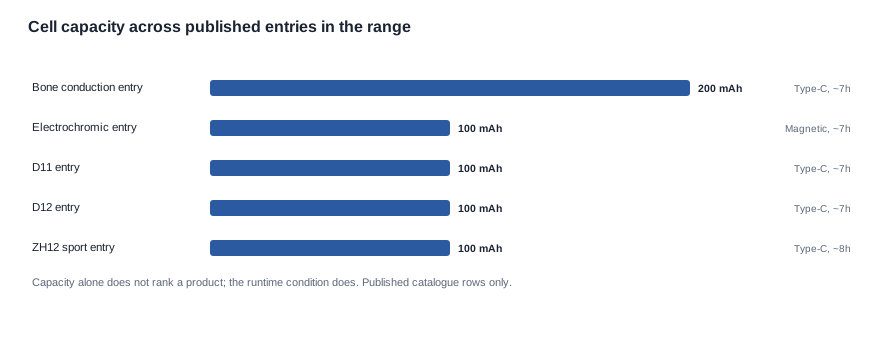
Four of those five entries share a 100 mAh cell and three of them share a runtime of roughly seven hours, while the sport entry gains an hour of runtime from a faster charge. The point is not that one entry is better. The point is that the cell figure carries almost no information about the lens, because a lens product's power draw is set by the lens drive, the radio activity and the ambient conditions, and none of those is in the sheet.
The six rows a supplier has to commit to in writing
This is the section to work from, and the table below is the request to send. Send it in the same form to every supplier, because a comparison where the questions differ is not a comparison. For each row there is a pass line, and the pass line is what you write into the purchase order when the answer comes back.
| Row | What the published sheet gives you | What to request instead | The pass line |
|---|---|---|---|
| 1. Lens mechanism | A technology name, and a fact about mechanism | The mechanism confirmed in writing, with the flat-battery behaviour | A named mechanism and a written behaviour at flat |
| 2. Switching time, both directions | Nothing | A figure with the light condition, and the direction stated separately | A number per direction, with the stimulus named |
| 3. Transmission range | Nothing | The transmission at the lightest and darkest states, with the measurement method | Two figures and a method a third party can repeat |
| 4. Uniformity tolerance | Nothing | The tolerance across the lens area, and the measurement grid | A band and a grid, agreed before the first article |
| 5. Temperature behaviour | Nothing | The range over which the stated performance holds | A range, or a written statement that it is not published |
| 6. Cycle durability | Nothing | A cycle count with a defined failure criterion | A quantity and an end point, not a quantity alone |
The thresholds in plain language, and what a soft answer sounds like
A switching time without a direction is half a specification. Darkening fast and clearing slow is a good morning product and a bad evening one, and a single number hides which one you have. A supplier who answers "under one second" without a direction has told you about the easy half. The pass line is two numbers.
The transmission range decides whether a sunglasses positioning was available at all. If the darkest state does not reach a sunglass-equivalent transmission, the product cannot be positioned as sunglasses, and the marketing has to be built on adaptation rather than on darkening. A buyer who discovers this after the packaging artwork is approved pays for it twice.
A uniformity tolerance is the cheapest thing you will ever buy. It costs nothing to agree and it is worth a great deal later, because a tolerance set after the first article is a tolerance already missed, and tightening an optical or cosmetic characteristic after tooling is orders of magnitude more expensive than specifying it before. The measurement grid matters as much as the band: a grid at the centre only describes the centre.
Temperature behaviour is a market question, not a laboratory question. A parked vehicle in summer and a winter morning are different conditions, and an electrochromic lens is an active component with a temperature envelope. If the envelope is not published, the honest position is that the product has not been characterised for the climate it will be sold into, and that is a finding rather than a detail.
A cycle count without an end point is a quantity, not a test. A durability warranty needs a measurable end. Without one, a return-rate conversation becomes an argument about definitions, and the argument is settled by whoever has the better records.
Why these six rows are not directly comparable between suppliers
This is the warning that matters most, because a lens comparison is exactly the comparison where buyers reach for a chart. Three things break a like-for-like comparison, and all three are silent.
The stimulus is not the same. A switching time measured under a controlled illuminance, a switching time measured behind a window, and a switching time measured in a customer's car are three different measurements with three different values. A supplier who publishes a figure without the stimulus has published a number that cannot be placed next to another number.
The state definition is not the same. "Transmitted" can be measured at a drive voltage, at a nominal tint, or at an end-of-life state. Without the definition, two transmission figures describe two different things.
The sample count is not the same. A figure from one unit is a demonstration, and a figure from a production batch is a specification. A supplier who runs twenty units and reports the mean has told you something a supplier who runs one unit has not.
None of this is a reason not to compare. It is a reason to compare only the rows where the definitions match, and to say plainly in the chart and in the listing that the rest are not comparable. The alternative — a chart of six numbers where three of them mean different things — is a document that will be read by a customer, and by a competitor, and eventually by your own legal team.

Turning a lens claim into a repeatable sample protocol
The verification path has five steps, and each one assumes the step before it passed. A failure at any point tells you what the next point would have told you, which is why the order matters more than the effort.
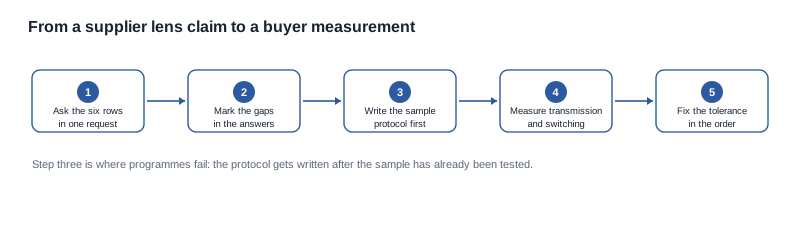
Step one: ask the six rows in a single message, per model, before the sample is shipped. One email, six numbered rows, one reply per row. The reply structure is what matters: a supplier who answers all six rows has a documentation habit, and a supplier who answers two has told you something you need to know before you commit a deposit. The cost of this step is one email, and it is the cheapest step in the whole sequence.
Step two: classify every answer as closed, conditional or open. Closed means the answer is a figure with its condition attached. Conditional means the figure is real but depends on something you have not accepted yet, such as a prototype, a different configuration or a future firmware build. Open means no figure exists. A conditional answer is not a closed answer, and treating it as one is how a sample test fails on a row that the supplier believes was agreed.
Step three: write the sample protocol before the sample is tested, not after. The protocol names the environment, the stimulus, the number of units, the measurement grid, the acceptance band and the pass condition for each of the six rows. A protocol written afterwards is a description of what the sample happened to do, and it cannot be used to reject a lot.
Step four: measure the transmission, the switching behaviour in both directions and the uniformity on your own units. Label the result as your measurement, not as a supplier figure, and state the units, the date and the build. This is the step that turns a supplier's claim into a fact you can put in a purchase order.
Step five: put the acceptance criteria into the order. A criterion that lives in an email is not binding. A criterion in the purchase order is an acceptance standard, and a lot that fails it is a lot you can refuse. Include the cost allocation for a failing lot, because that clause is what makes the refusal real.
The photochromic rows to be answered in writing before payment
The model designation written on the quotation. The lens mechanism confirmed in writing, with the behaviour at a flat battery stated per powered feature. The transmission range and the switching figures with their conditions. The uniformity tolerance and the measurement grid. The temperature envelope, or a written statement that it is not published. The cycle durability figure with its failure criterion, or a written statement that it is not published. The certificate numbers for the rest of the conformity file, with the issuing body and the validity dates. The battery transport documentation for the cell configuration, since the electrochromic entry's published cell is 100 mAh and a cell substitution invalidates that file.
Where a lens programme loses money, and where the terms can still move
Five failure modes, each with a prevention
The customer reports that the glasses "do not work" and no defect is found. The symptom is a cluster of returns carrying a description that says the product is broken. The root cause is that the customer expected passive lens behaviour and read a powered lens's behaviour as a fault. The prevention is to fix the claim wording before the product page is written, and to state the mechanism in plain words on the listing.
A switching time is copied from a neighbouring product. The symptom is a specification that no unit meets, discovered in a customer dispute. The root cause is that an empty field was filled with a plausible value. The prevention is to leave the field empty, mark it as not published, and use the buyer-side measurement instead.
The lens darkens unevenly across the frame and the supplier says it is within tolerance. The symptom is a first-article rejection that arrives late, or a customer complaint about a visual quality nobody had defined. The root cause is that no uniformity tolerance was written into the specification. The prevention is to set the band and the grid in the request, and to repeat the grid measurement on the production batch.
The product ships and nobody wrote down what the lens does at a flat battery. The symptom is a customer whose lens stopped changing state and who believes the product is defective. The root cause is that the question was never asked, because the sheet had a cell capacity and a runtime and appeared complete. The prevention is to ask it in writing, and to put the answer in the quick start guide, the care instruction and the customer service script, in that order.
A summer product arrives in a market where the winter behaviour was never characterised. The symptom is a seasonal return cluster in the first cold month of sales. The root cause is that the temperature envelope was never asked for, because the sales season was the summer. The prevention is to request the envelope, and if it is not published, to run the sample test at both ends of the range the product will actually see.
The commercial terms, separated into what moves and what does not
On an electrochromic line the negotiating room sits in the configuration count rather than in the unit price, because the tint range and the logo treatment are what multiply the cost of a variant. The minimum order quantity is negotiable, and it moves more on a configuration-heavy product than on a simple one, because the real unit of commitment is the configuration count rather than the unit count. The tint range, the coating and the logo treatment are configuration variables, and a supplier who prices the configuration count is negotiable in a way a supplier who prices the unit is not. Packaging and insert design, including the market labels and the language of the documentation pack, is a low-cost negotiation that carries no tooling implication. Delivery splitting against a sample-approval milestone is often granted more easily than a price concession, because it moves risk onto the schedule where it belongs. The payment dates are a standard area: a deposit as part of the purchase order, a balance on the pass that comes with the inspection, and a retention on the paperwork protects you on the failure that costs most, which is a product that arrives with a marking nobody can evidence. And the re-validation cost per lens variant, together with the trigger that causes it, is a term worth settling before the first variant is ordered rather than after the second one is already in production.
The electrochromic lens itself is not a commercial variable, and a buyer should establish that before the quotation rather than discover it after the tooling release. The lens itself is not a commercial variable: a supplier who will not change the lens, the coating or the tint range is telling you the optical product is fixed, and the programme has to be built around that fact rather than against it. Certification cost and certification time follow the process and the testing body; the elapsed time is a queue at a laboratory, not a function of your order size. A tooling cost is a one-off item usually amortised across the first order, so the questions worth asking are over what volume it is amortised and what happens to the tooling if the programme is discontinued.
Four clauses belong in an electrochromic purchase order, and the first of them is the model designation. The model designation as a line item, with the certificate numbers attached. The acceptance criteria for the sample, referencing the six rows. A clause requiring notice before any change of lens, coating, tint range or drive firmware, because a substitution changes the conformity file and the visible behaviour at the same time. A clause requiring per-variant confirmation that a changed variant remains inside the accepted configuration list. And a clause stating who bears the cost when a lot fails the acceptance criteria.
An outdoor brand qualifying an electrochromic line
The scenario and the decision sequence
This is a hypothetical scenario, written to show the decision sequence rather than to report an outcome. No customer, project or order is being described.
Assume a mid-size European outdoor brand with two colourways, currently selling a fixed-tint sport product into three markets, and considering an electrochromic option for a year-two range. The binding constraint is not the lens price. It is that the brand's own marketplace listing was suspended for six months over a claim it could not evidence, and the brand does not want to repeat that.
Step one, the channel gate. The brand writes down the exposure per market before it writes the requirement: rain and sweat in two markets, a cold and wet winter in the third, no immersion and no marine environment anywhere. That line is the whole requirement, and it keeps the programme from buying a level it will not use.
Step two, the supply-chain question. The brand asks each candidate supplier the six rows, and the answers tell it who it is dealing with. One supplier returns lens-level data and names the module maker; the other returns device-level data and names a prototype build. The brand now knows that one conversation is with a component supplier and the other is with an assembler, and it routes them differently.
Step three, the flat-battery behaviour. The brand asks what the lens does at the end of the charge. The answer is a written statement that the lens holds its last state and stops accepting commands. That is a product behaviour, and it goes into the quick start guide, the care instruction and the support script, and it also becomes a line in the listing, because a customer whose lens stops changing state on a train platform will otherwise think the product has failed.
Step four, the tolerance. Before the first article, the brand and the supplier agree a uniformity band and a grid, and the measurement is repeated on the production batch rather than only on the sample. The brand writes the band into the purchase order, which means a lot that fails it can be refused without a dispute about what was agreed.
Step five, the commercial structure. The brand negotiates the per-configuration minimum against a committed combination count rather than a unit count, because two colourways and a lens option are multiple configurations, not one product in two colours. It moves artwork approval earlier than usual, because the lens state appears on the packaging and the copy has to match what the unit does.
Step six, the claim. The copy says the lens adapts to light conditions and does not quote a switching time, because the brand could not evidence one to its own standard. The listing states what the lens does rather than how fast it does it. That is a narrower claim than the brand wanted, and it is a claim it can hold.
The result is a programme with one named precondition and a defensible listing, rather than a programme with four unowned risks and a second suspension waiting to happen. Every decisive step happened before the sample order, and none of them was about the mechanism name.
What our entry can evidence, and what we will not estimate
We publish the rows we hold and mark the rest as open, because a buyer who checks a claim should be able to check ours first. For this entry the published rows are six: Bluetooth 5.4, a 100 mAh cell, charging in two hours or less, roughly seven hours of runtime, magnetic charging and electrochromic lenses. Those are accurate as we hold them, and they are the whole of what we can say about the product.
We publish no model designation, no switching time, no transmission range, no temperature behaviour, no uniformity tolerance, no cycle durability figure and no coating description for this entry, and we will not estimate any of them. A plausible-looking switching time on a product page becomes a claim a customer will test on a windowsill, and a claim that fails is a return rather than a specification.
We will also say the uncomfortable half plainly, before anyone places an order. In this category the deciding variables are the regulatory position and the channel, not the lens specification, because the lens specification does not exist yet for this entry. A buyer who wants a lens data set from us today is asking for something we do not have, and we would rather say so in week one than in week twelve.
What we can do is read the supplier's answers against the six rows, tell you which of the rows is decisive for your use case, and tell you which have to come from a supplier commitment or from a measurement on your own units. The specification rows are in photochromic key specifications, the measurement protocol is in how to measure photochromic smart glasses, and the range is photochromic smart glasses.
Three requests to make before the deposit
Write the exposure before you write the requirement. One line per channel: what the lens meets, for how long, and what the customer is expected to do about it. If the line ends with "and the customer takes them off indoors", the transmission range is decisive. If it ends with "and nothing changes when the battery dies", the flat-battery behaviour is decisive.
Send the six-row request as a list, not as a question. The mechanism confirmed in writing, the switching figures with their direction and stimulus, the transmission range with its method, the uniformity band with its grid, the temperature envelope, and the cycle count with its end point. A supplier who answers all six has a documentation habit; one who answers two is telling you something you need to know before the deposit.
Send us the use case and we will tell you which row is decisive. Give us the environment, the target markets, the channel and the claim you intend to make, and we will say which of the six absent rows decides that combination and which have to come from a supplier or a test on your own units. We will also say plainly where our own documentation does not reach.
Where the reading method comes from
- Photochromic lens technology
- How to measure photochromic smart glasses
- Photochromic smart glasses range
Tell us the use case and we will say which of the six absent rows is decisive.


