

There are very few specifications in this category that a buyer can quote, and the ones that can be quoted turn out to describe the product's electronic architecture rather than its performance. That is not a criticism of the catalogue — it is the honest state of the data, and a buyer who knows which rows are quotable and which are merely stated can avoid a great deal of wasted effort. Photochromic smart glasses key specifications is about the difference between a quotable row and a stated one, and about what has to be established where nothing is published.
Our published position in the electrochromic entry is the clearest case in the range: Bluetooth 5.4, a 100 mAh battery, charging in two hours or less, roughly seven hours of runtime, magnetic charging, and electrochromic lenses. There is no model designation published, and no switching time, no transmission range, no temperature behaviour, no uniformity figure, no cycle durability and no coating detail. There is also no second light-responsive platform with published lens data to compare against, because the V03 Pro is published with a photochromic lens configuration and carries no lens figure of its own, so the rows that are missing have to be measured rather than sourced.
This matters more than a thin data sheet usually does. In a category where a datasheet row is the thing a customer reads and the thing a regulator is given, a row that appears in the specification becomes a commitment. The discipline that protects a buyer is knowing which rows they can carry and which rows they have to earn, and that discipline is what this article sets out.
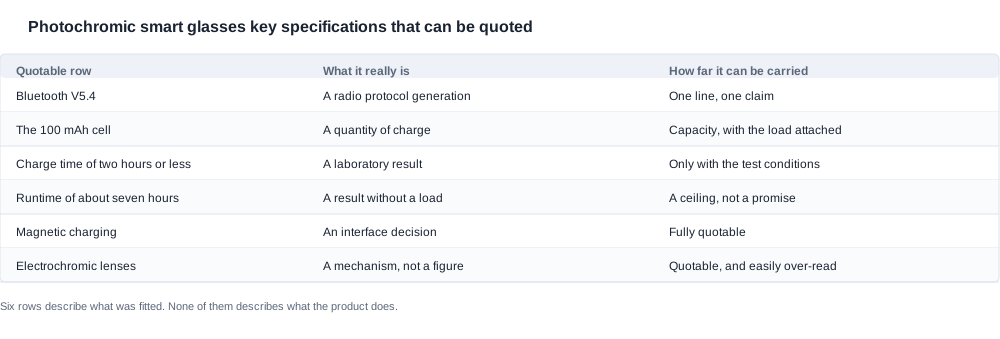
The photochromic smart glasses key specifications split between quotable and absent
Why a thin data set is not automatically a weak product
Buyers sometimes read a short specification as a warning sign, and in most categories they would be right. Here it is a different signal. The thinness of the published rows in a light-responsive lens reflects the immaturity of the category rather than the weakness of a particular product, and the practical consequence for a buyer is that the data has to come from somewhere other than the catalogue. The question "is this product under-specified" is less useful than the question "which rows do I have, and which rows do I have to go and get".
That reframing is worth the effort, because it changes what a buyer asks a supplier. A buyer who asks "what is the switching time" is asking for a number the supplier may not have characterised at all. A buyer who asks "what is the switching time, measured from which light level to which light level, at what temperature" is asking for a measurement the supplier either has or can produce, and the answer tells the buyer something about the product's readiness for a controlled programme either way.
The difference between a configuration fact and a performance figure
Every row in this category falls into one of two kinds, and the distinction is the whole of the specification problem.
A configuration fact records what was fitted. The cell capacity, the charging interface, the radio generation, the charge time, the rated runtime and the lens mechanism are all configuration facts. They are fixed at the point the bill of materials is set, they do not change with the conditions the buyer sells into, and they can be verified by reading a document rather than by running an experiment.
A performance figure records what the product does. The switching time, the transmission range, the uniformity, the temperature behaviour, the cycle life, the camera exposure shift during a state change — these are all performance figures. They depend on conditions, on the measurement method, and on the unit under test, which means they can only be compared when the conditions travel with the number.
The failure mode of a thin specification is that the two kinds get mixed. A runtime of roughly seven hours is a performance figure that reads like a configuration fact because it has a number and a unit. So does a charge time of two hours or less. Both are quoted in catalogues everywhere, both are technically results rather than configurations, and both become meaningless the moment a customer compares them with a different figure measured under different conditions.
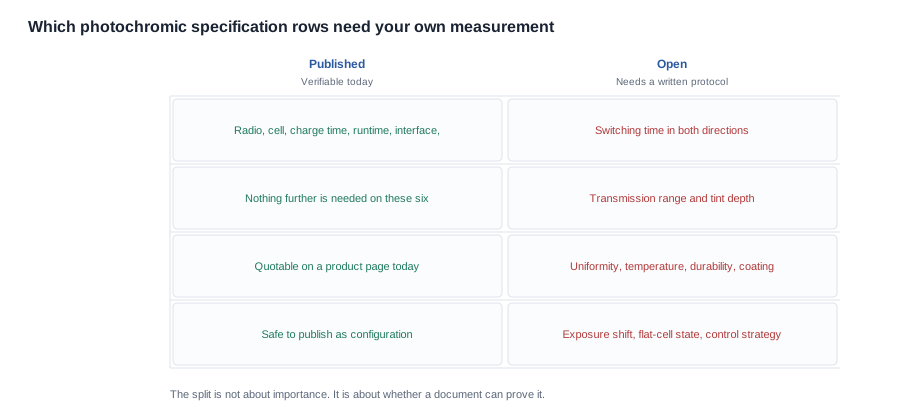

The six rows that describe the configuration rather than the performance
The six published rows fit on one line each, and the third column is the part buyers get wrong most often.
| Quotable row | What it actually is | How far it can be carried |
|---|---|---|
| Bluetooth V5.4 | A radio protocol generation | One line and one claim, and nothing about the lens |
| The 100 mAh cell | A quantity of charge | A capacity, with the load attached if a runtime is published |
| Charge time of two hours or less | A laboratory result | Only as "two hours or less under the manufacturer's test conditions" |
| Runtime of about seven hours | A result without a stated load | A ceiling, with the workload attached |
| Magnetic charging | An interface decision | Fully quotable, and it also raises an ingress question |
| Electrochromic lenses | A mechanism, not a figure | Quotable, and the row most likely to be over-read |
The radio generation, and what it settles
Bluetooth 5.4 is a protocol generation. It tells the buyer that the radio controller is a current generation, and in our published data it is the only row that distinguishes this platform from other products in the range. It settles the question of whether the brand can use the Bluetooth mark in its own marketing, and it establishes that the radio is covered by a qualification the brand can point at.
It settles almost nothing else. A protocol generation does not tell the buyer anything about the lens, about the radio's behaviour in a crowded environment, or about the difference between two products that both publish 5.4. In our own range several products publish 5.4, so the row distinguishes this platform from a subset of the range and not from the rest of it. The correct way to use it in a specification is as one line, supporting one claim, and not as a proxy for product quality.
The cell capacity, the charge time and the rated runtime
These three rows are the ones most often over-read, so they are worth taking one at a time.
The 100 mAh cell is a quantity of charge. It does not tell the buyer the runtime, because runtime depends on the load: on what the product is doing, on whether the radio is connected, on whether the lens is in a driven state. A buyer who publishes "100 mAh battery, seven hours" has published two numbers that do not describe each other. The correct form is the capacity with the load attached, or the runtime with the workload attached, and ideally both with a single stated condition connecting them.
The charge time of two hours or less is a laboratory result. It has no starting state, no temperature and no charger, and the charger matters more than buyers expect: a magnetic interface with a weak source behaves differently from the same interface with a compliant one. Publish it as "two hours or less under the manufacturer's test conditions" or do not publish it as a number at all.
The roughly seven hours of runtime is the most quoted and least transferable figure in the category, for the same reason. It is a rated result and the rating implies a workload the buyer has not been told. The defensible way to carry it is as a ceiling under favourable conditions, with the workload named.
The charging interface and the mechanism name
Magnetic charging is fully quotable, and it carries further than its length suggests. It tells the customer what cable and cradle they need, and it tells the buyer that the enclosure has a deliberate opening in it, which is an ingress question and therefore a question for the product's environmental claim. The interface also affects the packaging, the shipping weight and the number of items in the box, all of which are costed.
Electrochromic lenses is a technology name, and it is a fact about mechanism rather than about performance. This is the row most likely to be over-read by a customer who arrives expecting the behaviour of a glass photochromic lens, because the retail vocabulary collapses the two. Write it as what it is: the lens changes under an applied electrical state, and the product decides when and how far.
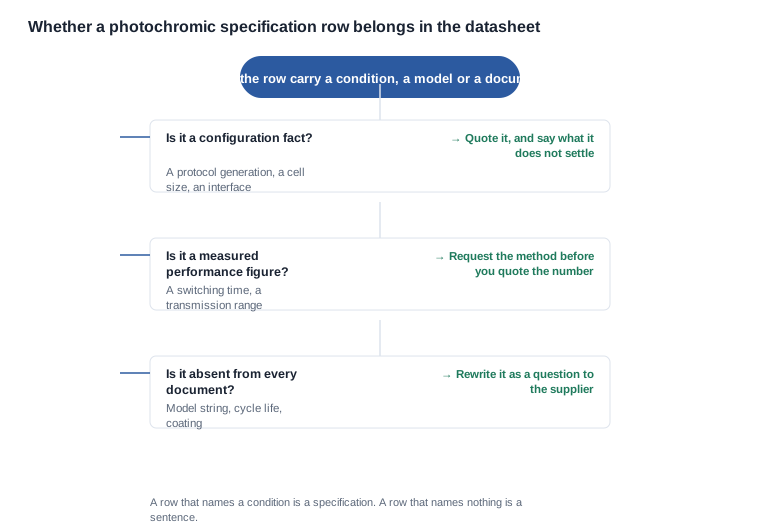

The rows you have to establish yourself before the first order
The switching times, and the four conditions that make them mean something
Two switching times are needed, one per direction, because the two behaviours are different and a product that darkens quickly and clears slowly is a different commercial product from one that does the opposite. A single figure for a single direction is not a specification of a changing lens.
Each figure needs four conditions attached before it can be compared with anything: the direction of travel, the initiating light level, the ending light level, and the temperature. There is a specific trap here that catches experienced buyers. A lens that reaches a moderate darkness in ninety seconds under strong sun may take several minutes to reach its full state under weak winter light, and the second scenario is the one a customer in February is standing in. Whichever direction the supplier chose to quote, the other direction is the one your customer will notice.
The transmission range and the uniformity tolerance
The transmission range is a pair of numbers, one in the clear state and one in the darkened state, and the pair together describes the range the lens actually works across. A lens that moves from ninety per cent transmission to twenty per cent and one that moves from ninety to forty-five are different products carrying the same story. The threshold to hold is a range with the units and the method stated, and the measurement has to include the clear state, because a seller quoting only the darkened figure has quoted the part that looks best on a beach.
The uniformity tolerance decides whether a good lens is rejected at first article. A centre reading is easy and nearly useless, because users notice edge-to-centre variation before they notice an average. The threshold is a maximum difference between zones, measured on a stated grid, agreed before the first article rather than discovered at it. A tolerance set afterwards is a tolerance that has already been missed.
The temperature range, the cycle life and the coating
The temperature range decides whether the product works in the customer's climate, and it is almost always quoted wider than it is useful. The useful question is not the range but the slow end of it, because a lens that reacts slowly in cold conditions produces a different complaint from one that fails outright.
The cycle life decides whether a durability warranty has a measurable end. A cycle count without a failure criterion is a quantity rather than a test. The criterion has to be written by the buyer — at what transmission level is the lens considered failed — and it has to be applied by both parties, otherwise the first warranty claim is unanswerable.
The coating is the row most often treated as a cosmetic detail, and it decides three practical things at once: how the lens is cleaned, how it marks, and how the camera's exposure behaves through it. A camera product with a tinted lens and a reflective coating is a product where the image quality is partly a function of the coating, and the buyer who has not asked about it will discover the interaction during a product shoot rather than during acceptance.

Turning a published row into a claim your customer can check
Writing the claim so that the customer can falsify it
The practical output of a specification is a set of claims a customer can test, and the test of a claim is simple: can a customer holding the product check it? "Adapts to light conditions" survives that test, because a customer can put the product in the sun and see whether the lens changes. "Switches in under thirty seconds" does not survive it, because the customer cannot know the light level, the temperature or the direction, so any result appears to confirm the claim and any failure appears to contradict it. The number is not the problem; the absence of the conditions is.
This is also why the narrow claim is the commercially stronger one. A buyer who publishes no depth figure can still sell the feature, because the feature is visible. A buyer who publishes a depth figure that turns out to be a best case has created a return stream and a review score problem, and neither is recoverable by a product-page edit.
The two light-responsive routes and why the cell size differs
Our range offers two light-responsive routes, and they are different products rather than two configurations of one product, which is why comparing them by cell size is instructive rather than trivial.
The V03 Pro is a camera platform with a photochromic lens listed as a configuration. It publishes an 8 MP camera, a 220 mAh cell, charging in two hours or less, a rated runtime of five to eight hours, Type-C charging, flexible temples and three published colour options. The dedicated electrochromic entry publishes Bluetooth 5.4, a 100 mAh cell, charging in two hours or less, roughly seven hours of runtime, magnetic charging and the fact that the lenses are electrochromic — and no model designation at all.
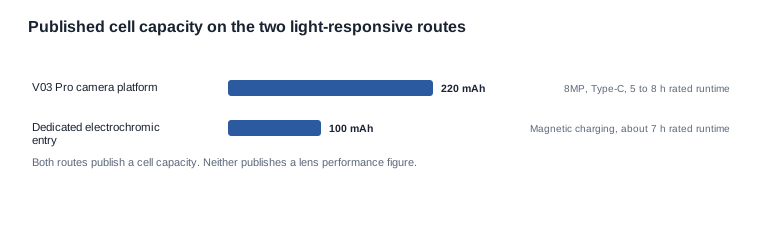
The 220 mAh against 100 mAh difference is not a quality statement. The camera platform carries a sensor, a storage path and a capture mode alongside its radio, and the dedicated entry is a lens-and-audio product. What the comparison does establish is the shape of the decision: a brand that needs imaging and a lens in the same frame has a specification available today, including a model string, and a brand that wants the lens to be the product has a thinner set of published rows and no designation to put on a certificate.
The fixed list, and the pitfalls to avoid before you order
A specification is only as good as the questions that shaped it, and for a light-responsive configuration those questions are a short, fixed list. Buyers who work through it before the sample order avoid the two expensive outcomes: a programme that discovers a missing model designation after the artwork is approved, and a product page that publishes a figure the supplier never characterised.
- What is the model designation, exactly, and what appears on the documents that ship with the goods? If the answer is a series name rather than a string, the paperwork cannot be written and the packaging cannot be printed.
- Which of the four lens numbers exist, and which do not? The honest answer names what is missing as explicitly as what is present, and a supplier who will state a figure with its conditions is a supplier you can build a specification on.
- Is the mechanism fixed for the platform, or can the lens be specified? The answer determines whether the trade-off is a specification decision or a product decision.
- What does the lens do on a flat cell? This is the behaviour a customer meets first, and it belongs in the instructions, the manual and the support script before it belongs anywhere else.
- Which rows are reissued when a component changes? A supplier with a maintained file answers this in one sentence; a supplier without one takes a week to answer it.
- Is the lens material documentation split at module level, and who holds it? The module maker is often a third party the buyer has never spoken to.
- What is the charge interface in the box, and does the enclosure have an opening for it? The interface is a packaging and an ingress question, not only a cable question.
- What do you publish, and what do you refuse to estimate? A supplier that answers this clearly is telling you how its documentation will behave under pressure.
The value of the list is not the individual questions. It is that a supplier who answers all eight has a documentation habit, and a supplier who answers two is telling you something you need to know before the deposit rather than after it.
What we publish for the light-responsive platform, and what stays open
The six rows we hold for the electrochromic entry
We publish the mechanism and the electrical rows, and we publish them in the order that makes their limits visible. For the dedicated electrochromic entry: Bluetooth 5.4, a 100 mAh cell, charging in two hours or less, roughly seven hours of runtime, magnetic charging, and the fact that the lenses are electrochromic. For the V03 Pro configuration we publish the camera resolution, the cell, the charge time, the runtime, the charging interface, the temple type and the colour options, and we publish no lens performance figure for that configuration either.
Across the range, one weight is published — 158 g for the MT6 glasses unit, excluding its foldable charging case — and no model in the range publishes a weight with a light-responsive lens fitted. For a product whose listing leads on comfort and on all-day wear, that is a gap we would rather name than fill.
The rows we will not estimate
We will not supply a switching time, a transmission range, a uniformity tolerance, a temperature range, a cycle count or a coating description for the electrochromic entry, because none is published to us and a plausible-looking number in a lens product becomes a claim on a product page within a fortnight. We will not manufacture a model designation either. The absence of a designation on this entry is an operational fact, not a formatting gap, and it means the certification, packaging and customs questions have to be resolved before a programme is scheduled rather than after.
The boundary we hold: we publish the rows we hold and mark the rest as Not published, because a reader who knows a row is missing can act on it while a reader who does not will assume it does not matter.
There are trade-offs here that are worth naming rather than glossing. The cheap route is to publish the configuration rows and stay silent on performance; the cost of that route is a feature that cannot be described with a number, which is a weaker listing but a safe one. The expensive route is to commission the four measurements and publish them; the cost of that route is a figure that then has to be held, defended and kept current, which is work that does not stop when the launch does. Buyers who want to know how to choose between the two should decide which of those two ongoing costs they are prepared to carry, because the specification is a one-off document and the claim is a permanent liability.
On the commercial side, the specification and the acceptance criteria are negotiable documents and a supplier willing to sign the buyer's protocol is agreeing to be measured against the buyer's own threshold. The number of configurations committed to, the artwork round count, the packaging and insert design, the market labels and the structure of the payment nodes are all ordinary negotiation points. What is not negotiable is the cost and the elapsed time of a conformity route, the amortisation of tooling, or the mechanism of the lens itself — if your requirement needs a wearer-controlled tint, no price adjustment turns an electrochromic lens into a passive one.
What we can do is tell you which of the missing rows is decisive for your channel, and run the measurement protocol with you so that the figure in your specification is one you own. The background is under photochromic lens technology, the measurement protocol is in how to measure photochromic smart glasses, the mechanism is in how the lens actually works, and the range is photochromic smart glasses.
Tell us the environment and the use case and we will say which row is decisive, and we will run the measurement that closes it.
Where the key rows come from
Tell us the environment and the use case and we will say which row is decisive.


