

Smart glasses AI features: a marketing category printed as a specification
Reading a datasheet for AI features is a reading exercise with one specific hazard. The words on the page describe a marketing category rather than a technical specification, and that category has acquired a vocabulary that sounds precise and is not. "AI assistant", "AI translation", "real-time translation" and "AI-powered" are all in circulation across this category, and not one of them tells you anything you can verify. What is actually inside a product is a set of specific capabilities running somewhere specific, under specific conditions, and none of those three is printed on the sheet.
Smart glasses ai features smart glasses how to read a datasheet is therefore a method for extracting verifiable meaning from language that does not contain it, and this article is written for the buyer who has to turn that language into something they can put in a purchase agreement rather than something they can put in a product page.
Our own published position shows the problem cleanly. The catalogue row for the camera tier names an AI voice assistant among the key technologies. The K01 entry notes AI translation, with the evidence level recorded as observed from our own site copy rather than as a published specification. Beyond those two statements, the published position is that which models are supported, whether processing runs on the device or in a service, whether a subscription is required, and where data is stored are all not published. Two sentences in a whole catalogue, and both of them are about categories.
What this read has to produce
Three outputs, and each of them is a different document with a different owner.
A capability list, written per model and per capability. One line per model, one line per capability, written so that a customer could read the line and know whether the capability applies to them. "Translates spoken English into Chinese" is a capability line. "AI translation" is a category label. The first can be tested and the second cannot.
A processing position, stated per capability rather than per product. Per capability, written down, because it determines latency, the connectivity requirement, the operating cost per unit, the privacy position and the behaviour when the network is unavailable. This is the single most consequential answer in the whole area and it is almost never printed.
A dependency list, with version floors rather than product names. The account, the application, the minimum firmware version, the network requirement and the subscription terms. A feature that needs a specific application version is a feature that breaks for existing customers the first time the application updates, and that is a support cost rather than a technical cost.
The three roles, and the decision each one owns
A product manager is deciding whether an AI feature can carry the proposition at all, and their exposure is the listing. The question they are really answering is whether the feature is the reason somebody buys this product rather than a line in the comparison table, and that question cannot be answered from a category name.
A procurement manager is putting the feature into the purchase agreement, and their exposure is the difference between a description and an obligation. A description can be argued with; an obligation can be used to reject a lot. The whole point of this read is to convert the first into the second.
A compliance or legal reviewer is deciding what may be said about data handling, and their exposure is a jurisdiction question rather than a device question. For any product with a microphone and a camera, the question that will arrive from a European or North American customer is where the audio goes, not what the microphone does.
Three readers, one sheet, three decisions. That is why a single datasheet closes none of them, and why the four questions below are the ones that have to survive all three readings.

What an AI capability actually costs inside a smart glasses programme
An AI feature in this category is not a chip. It is a chain, and every link in the chain has a cost, a failure mode and an owner. Four layers, and the buyer needs to know which layer they are paying for in each quotation.
The silicon and the firmware. The processor that runs the model, the memory it needs, the firmware that schedules it. In a device that also has to run a radio, a camera and an audio path, the AI workload competes for thermal budget and battery, and the way a supplier resolves that competition is a design decision with a cost attached to it. This layer is fixed once the hardware is chosen, which makes it the layer with the least negotiating room and the most influence on whether an advertised feature can actually run at the advertised setting.
The service. The cloud inference endpoint, the account system, the entitlement store, the network traffic and the support team behind it. This is the layer that creates a recurring cost per active unit, and it is the layer that determines whether the feature survives a trial period, a lapsed payment or a withdrawn service. If your business model depends on a service, you are buying a dependency and you should price it as one.
The integration. The application on the phone, the pairing, the firmware build that carries the feature, the account migration when a customer changes handset, the language pack and the update path. This is where the majority of the real cost of an AI-enabled programme sits, and it is invisible in any spec sheet because it is spread across several suppliers.
The evidence. The data processing position, the retention period, the processor list, the market-specific position, the deletion route. This layer is the one that stops the programme being published, and it is the layer with the longest lead time, because it belongs to the brand's own schedule rather than the factory's.
Why the catalogue vocabulary grew faster than the evidence
The category vocabulary is recent, and the procurement consequence is that suppliers have a vocabulary long before they have a data set. "Real-time" is a good example: it is a claim about latency, and latency is a function of where the computation runs, the network condition and the queueing in the service. A product can satisfy "real-time" in a laboratory and fail it on a congested mobile network, and the sheet will say the same thing in both cases.
The second example is "on-device". It is used for everything from a wake-word detector that runs locally to a translation feature that runs in a data centre, and a buyer who reads it as a privacy guarantee has been misled by a word rather than by a supplier. The privacy position and the processing position are two different facts, and only one of them is implied by the phrase.
The third is "AI-powered", which carries no information at all. It is worth noting that the absence of information is not a supplier defect in every case. In this category the honest position of many manufacturers is that the feature set is not yet stable enough to publish, and a buyer who forces a number out of a supplier who does not have one ends up with a number nobody can defend.
The schedule is where the cost actually lands
Cost is not only money. In an AI-enabled programme the expensive resource is calendar time, and it is time the brand spends rather than the factory. The capability list, the processing position, the data answer, the copy, the packaging artwork and the listing all sit on the brand's schedule, and the artwork sits at the end of it. A feature decided in week three becomes a reprint in week twelve.
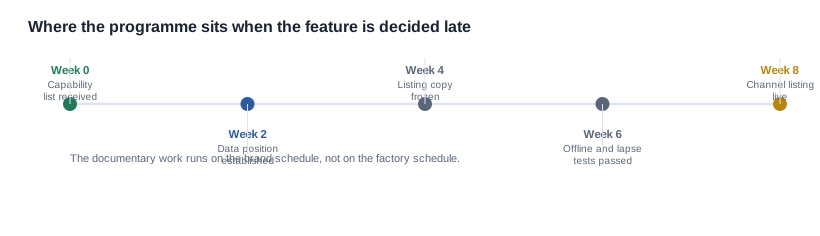
The practical rule for a procurement manager is that the AI questions are a gate, not a task. Either the four answers arrive before the copy is written, or the feature is described in words that do not commit you to anything. A programme that describes a capability in general terms and then discovers in month five that the feature needs a network does not have a marketing problem; it has a planning problem that could have been caught by one email in week one.
The four questions that turn an AI phrase into an obligation
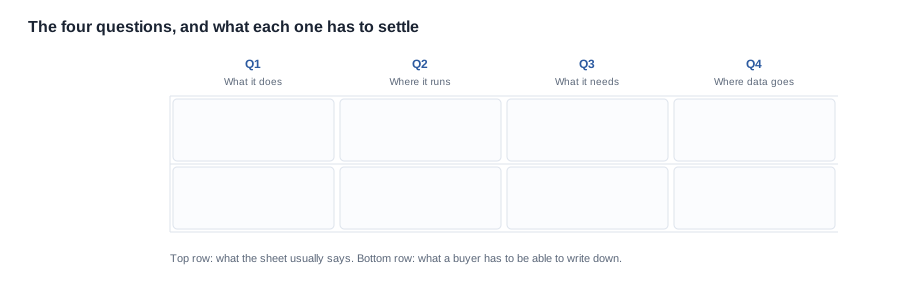
These are the four questions. They work in this order, because each one narrows what the next one means, and because a supplier who answers the first immediately usually has a method behind the rest.
1. What does the capability actually do? Not what it is called. "AI translation" is a label; "translates spoken English into Chinese, live, from the microphone" is a specification, and it can be tested. The threshold you need is the language pairs, the direction of translation, the input format, and whether it handles a live conversation or a prepared clip. A supplier who cannot name the language pairs does not have a capability list.
2. Where does it run? On the device, in the cloud, or split between them. This is the row that determines everything else, and it is the one most often missing.
3. What does it need in order to work? An account, an application on the phone, a minimum application version, a firmware build, a network connection, a subscription. A feature that requires a specific application version is a feature that breaks for existing customers on an update, and it is a feature that breaks silently, which is worse.
4. Where does the data go? Which jurisdiction the audio and the resulting data are processed and stored in, how long they are retained, how a customer asks for deletion, and who else processes the data. For a product with a microphone and a camera, this is the question a European or North American customer will ask, and it is answered about the service, not about the device.
The four thresholds that close each question
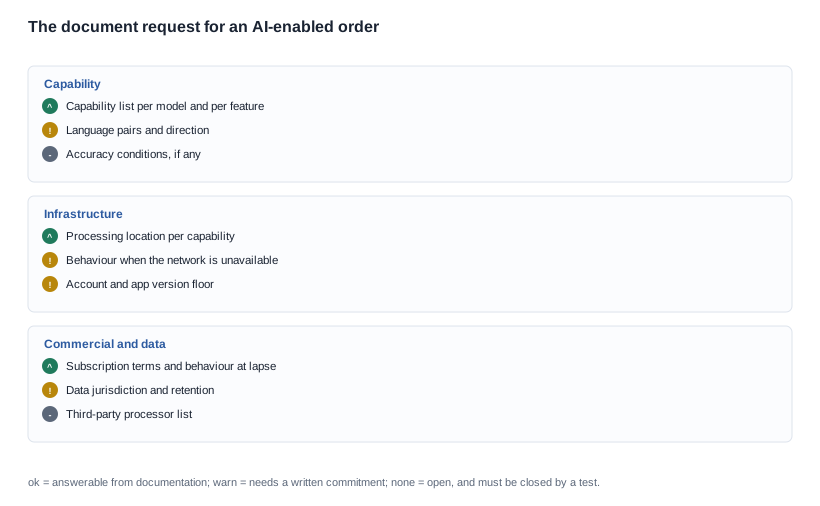
A question is closed when its answer is written down, attributed to a model and a version, and can be failed by a test. Until then it is an aspiration. The table above is the request to send, grouped by the question it closes, and the marking is a useful discipline in itself: answerable from documentation, needs a written commitment, or open and therefore needing a test.
The thresholds that matter most for a buyer are these. A capability line must be testable by a person who was not in the conversation. A processing position must be per capability, not per product, because a device with a local wake word and a cloud translation has two positions. A dependency list must carry version floors, not just names, because a version floor is what tells your customer service team whether an old handset is a fault. A data position must name a jurisdiction and a retention period, because a promise to "protect privacy" has no meaning without either.
The phrases to distrust, and what replaces each one
| The phrase on the sheet | What it does not tell you | The question that replaces it |
|---|---|---|
| "AI voice assistant" | Which capabilities, on what hardware, in which conditions | What does it do, and what does it need to work? |
| "AI translation" | The language pairs, the direction, whether it is live | What does it do, and where does it run? |
| "Real-time translation" | Whether the latency is acceptable, and what happens offline | Where does it run, and what happens without a network? |
| "AI-powered" | Anything at all | What does it do? |
| "On-device AI" | Whether all of it is local, or only the wake word | Where does it run, per capability? |
| "Privacy-first" | The jurisdiction, the retention and the deletion route | Where does the data go? |
| "Works with your phone" | Which application version, and which handset models | What does it need in order to work? |
The value of this list is that it converts a category vocabulary into a procurement request without requiring you to know the technology. You do not need to know how a translation model works to know that a supplier who will not name the language pairs has not got a capability list.
Why the processing location is the row that decides the programme
It is worth spending a paragraph on the second question, because everything else hangs off it.
If the capability runs on the device, then your customer gets it without a network, your marginal cost per unit is close to zero, your data position is largely your own, and the feature survives a poor signal. It also means the feature competes with the radio and the camera for the same battery, which is why the published runtime for a camera product has to be read as a combined budget rather than as an audio figure.
If the capability runs in the cloud, then your customer needs a network, your marginal cost per unit is non-zero and continues after the sale, your data position belongs to a service operator rather than to you, and the feature fails in a dead zone, a basement or a lift. None of that is bad. All of it has to be priced and disclosed, and a buyer who discovers it after the copy is written pays for it in reprint costs.
The split case is the most common and the most awkward, because it is usually the local part that the customer experiences as "instant" and the remote part that produces the quality. Asking for the processing location per capability is therefore not pedantry; it is the question that tells you what the customer will actually experience in the environment you sell into.

A sample protocol that an AI feature can actually pass
Documentation closes the questions. A test closes the claims. Four steps, each with a single pass condition written down before the sample is tested, and each one cheap.
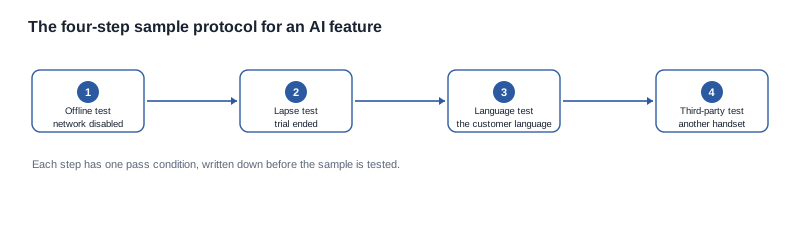
Step one, the offline test. Disable the network on the handset and try the capability. The pass condition should be written in advance: the feature either continues to work, or it fails in a defined way that a customer can understand. What is not acceptable is a silent wait that ends in an error nobody described. A supplier who has not considered the offline case has not shipped one, and their answer tells you the feature is a network feature.
Step two, the lapse test. If there is a trial, let it end and see what happens. A feature that stops at the end of a trial is a product fact the customer will discover on their own, and it belongs in the listing. The pass condition is that the behaviour after lapse is defined: continues working, degrades to a reduced feature set, or stops, and each of those is a different commercial arrangement.
Step three, the language test. Test the language the customer actually needs, with the accent and the conditions they will use, not the language in the demonstration. A language list shorter than the marketing implies is the single most common source of dissatisfaction in this category, and it is entirely preventable with a fifteen-minute test on one sample.
Step four, the third-party test. Run the same task on a handset you do not control and on an application version you do not control. This is the test that finds the dependency, and it is the test that decides whether the feature works in the field or only in the brand's own ecosystem.
The evidence pack to request before the deposit
The capability list per model and per capability, with version attribution. The processing location per capability, in writing. The dependency list, including the minimum application version and the minimum firmware build, and what happens below that floor. The subscription terms, if there is one, and the behaviour at lapse. The data position per market: jurisdiction, retention period, deletion route and the list of processors. The certificate numbers for the rest of the conformity file, with the issuing body and the validity dates. The model designation written on the quotation.
Ask for all of it in one message, before the samples ship, and ask for it per model rather than per range. A range-level answer is a marketing answer, and a per-model answer is an engineering one.

Where an AI claim turns into a returns cluster
Six failure modes, and the prevention for each
The feature name was published as a capability. The symptom is a customer who expects a function the product does not have, and the return reason will be "not as described" rather than anything technical. The root cause is that a category label was read as a specification. The prevention is the four questions, asked before a word of copy is written.
The processing location was never established. The symptom is a feature that fails in a dead zone, or a compliance query that nobody on your side can answer. The root cause is that the most consequential answer on the sheet was never asked for. The prevention is question two, and it belongs in the request rather than in the follow-up.
The subscription was not disclosed. The symptom is a feature that stops working on a particular day, and a support ticket that says the customer bought something that no longer exists. The root cause is that the commercial terms were treated as somebody else's department. The prevention is question three, and stating the terms in the listing.
The data position was assumed. The symptom is a regulated customer asking where their audio goes and receiving no answer, followed by a procurement questionnaire you cannot complete. The root cause is that nobody asked. The prevention is question four, answered per market rather than once globally.
The language list was assumed from the marketing. The symptom is a return from a customer whose language is not supported, which reads as a quality problem rather than a scope problem. The root cause is that the capability list was never supplied. The prevention is question one plus the language test.
The application dependency was ignored. The symptom is a customer on an older application loses the feature after an update, and there is no way to explain it because nobody wrote down the version floor. The root cause is that the dependency was treated as a technical detail rather than a compatibility statement. The prevention is question three, with the floor published in the documentation and in the support script.
The commercial terms, and the one clause that matters most
An AI-enabled line earns its margin on a specific configuration, so the volume tier and the accessory set are where the negotiation time belongs. The unit price and the volume tiers, because a feature-heavy configuration is often the thing you are trying to make the margin on. The accessory set and its minimum order quantities, which is a packaging decision as much as a cost one. The packaging specification and the market label set, which is a low-cost negotiation with no tooling implication. Delivery splitting against a sample-approval milestone, which is often granted more easily than a price concession because it moves risk onto the schedule. The warranty period with a stated response time, and the return terms. And the terms of a pilot order, which in this category is usually the most valuable thing a supplier can offer, because a pilot is the only way to find out whether the offline case and the lapse case behave as the answers claimed.
Certification cost and lead time for an AI-enabled product follow the process and the testing body, which is why they belong in the schedule rather than in the negotiation. Certification cost and lead time, which follow the process and the testing body rather than the size of your order. Tooling, which is often amortised across the first order while certification cost is per product family, and it is worth asking which of the two you are actually being quoted, because the two are frequently bundled into a single line that hides which is which. The processing location, if the hardware is fixed, is also not a commercial variable: a supplier who will not move the silicon is telling you the feature's cost profile is fixed.
One clause does more work than any other in an AI-enabled purchase order, and it is the obligation clause that attaches the capability list to the order. The capability list, the processing location, the subscription terms and the behaviour at lapse, attached to the purchase order as line items with a model designation. Without that clause, an AI feature is a description of an intention, and a programme built on an intention is a programme that will be re-discussed every time a customer complains.
A short list of AI claims should be left out of the purchase order entirely, and they are the ones nobody confirmed in writing. Any AI claim, language count, offline capability, accuracy figure or data position that has not been confirmed in writing, and any implication that the feature works without a network or without the service.
A distributor qualifying a translation line, and what we publish
The scenario and the four questions
This is a hypothetical scenario, written to show the decision sequence rather than to report an outcome. No customer, project or order is being described.
Assume a European distributor who imports a first-person camera line under its own brand, sells into two markets, and is asked by a retail customer for a translation capability to include in the listing. The binding constraint is not price and not capability. It is that the distributor cannot complete the retail customer's data-handling questionnaire, because nobody has told the distributor where the audio is processed.
Step one, the four questions. The distributor sends the four questions to each of the two candidate suppliers, per model. One supplier answers all four and attaches a capability list with language pairs. The other answers with a marketing sheet and a promise to confirm. The distributor now knows which conversation is with an engineering team and which is with a sales team, and it drops the second from the shortlist.
Step two, the processing position. The first supplier confirms the capability runs in a service, in a named jurisdiction, with a stated retention period. The distributor now knows three things it can act on: the feature needs a network, the data position is a service question rather than a device question, and the capability cannot be described as offline.
Step three, the offline and lapse tests. The sample is tested with the network disabled, and the result is a defined failure rather than a hang. The trial is allowed to lapse and the behaviour after lapse is defined. Both results go into the listing, and both are narrower than the supplier's marketing. The distributor is comfortable, because the claim is now narrower than the evidence rather than wider.
Step four, the questionnaire. The distributor forwards the retail customer's data questionnaire to the supplier, and the answer returns with a jurisdiction, a retention period and a processor list. This is the step that would have failed in week twelve, when the artwork was already printed and the customer questionnaire was already in the customer's procurement system. It is now a three-day task.
Step five, the commercial structure. The distributor negotiates a pilot order rather than a full commitment, and writes the capability list, the processing location and the lapse behaviour into the pilot purchase order as acceptance criteria. The pilot is also the test of the one thing the documentation cannot tell them, which is how the feature performs on a customer's actual language with a customer's actual accent.
Step six, the claim. The listing says the glasses translate spoken English into Chinese, live, and states that the feature requires the paired application and a network connection. It does not say "AI-powered", it does not promise an offline mode, and it does not quote an accuracy figure, because no accuracy figure was ever established.
The result is a line the distributor can sell, a questionnaire it can complete, and a pilot it can run. The decisive steps were the four questions, and none of them required the distributor to understand the technology.
What our catalogue states, and what remains open
The AI vocabulary in this category describes a marketing category rather than a technical specification, and a buyer who asks the four questions will choose and write better than one who reads the feature line. We will not publish a capability list, a processing location, a subscription term, a data position or an accuracy figure for a model where the manufacturer has not provided one, and we will not present the K01's translation capability as a documented specification when our own record of it comes from our site copy.
We will also be direct about what a thin catalogue row can and cannot do. It can tell you that a camera tier exists and that an AI voice assistant is named among its technologies. It cannot tell you which capabilities that assistant has, whether it works without a network, what it costs to run, or what happens to the customer's data. A buyer who needs those answers needs them from the manufacturer, in writing, or from a test on a sample.
What we will do is give you the four questions, the phrases to distrust and the four-step protocol, and we will mark the answers as they come back so that you can see which questions are still open. The AI features overview page covers the general position, the What to ask a supplier about AI features page covers the request in detail, the AI camera glasses range page lists the models and their published rows, and the AI content creation solutions page covers the channel positioning.
The five actions to take now
- Send the four questions in one message, per model and per capability, before any sample is ordered.
- Put the capability list, the processing location and the subscription terms into the purchase order as line items.
- Run the offline test, the lapse test, the language test and the third-party test on the sample, each with a written pass condition.
- Ask for a pilot order rather than a commitment, and treat the pilot as the test of the dependency you cannot read in a datasheet.
- Write the copy from the four answers, and drop every feature the four questions do not cover.
Related reading
- The general position — AI features overview
- The request in detail — What to ask a supplier about AI features
- The range model by model — AI camera glasses range
Tell us the capability you want to build a proposition on, and we will tell you which of the four questions you have to close first.


