

Smart glasses AI features: the questions that decide if it is real
An AI feature in a smart glasses product is not a component. It is a dependency on somebody else's service, and the buyer inherits that dependency without ever having chosen it. The questions that decide an AI feature programme are therefore not about the device. They are about the service behind it: which models carry it, what it does when the network is gone, where the audio goes, who operates that service, how long the data is kept, who is accountable when the result is wrong, and what happens to a device whose service disappears.
That list is unusual in a hardware request for quotation, and it is unusual because the category is young enough that most suppliers are still describing the feature rather than specifying it. A supplier's own form asks for quantity, colour and packaging. The questions that decide whether an AI programme works are the ones nobody puts on the form, and they are also the ones a buyer is least equipped to ask, because they sound like questions for a software company rather than for a factory.
Our published position makes this list unusually easy to write, because we can state up front which answers exist and which do not. Twenty of the twenty-eight entries in our catalogue carry an AI function row. The AI voice assistant is listed as a key technology across the camera tier and the audio tier. AI translation is listed on the K01, which is an audio model with Bluetooth V5.3, a 90 mAh by 2 cell configuration, roughly eight hours of runtime and magnetic charging. Firmware customisation is listed for the camera tier. The implementation, the provider, the language coverage, the latency, the offline behaviour, the data path and the accuracy are not published for any model in the range.
That asymmetry is the whole argument of this article. The catalogue publishes the presence of a capability and publishes none of its behaviour. A buyer who reads a catalogue line that says a feature exists, and who then writes a listing about what the feature does, has built a claim on a row that was never a specification.
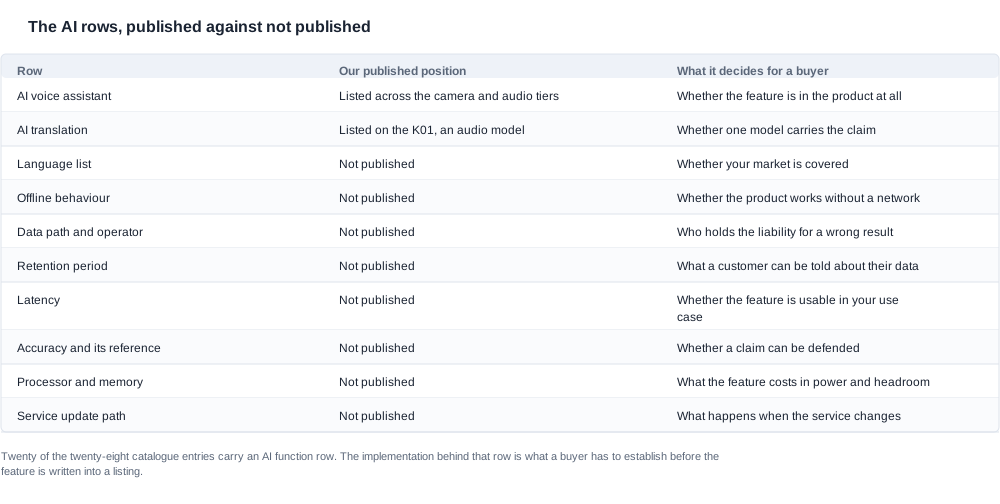
The twelve questions that separate a supplier who has done the work from one who has described it
Which exact models carry the feature, and in which configuration? A feature published on one model does not become a range capability by repetition. Our own published position is a useful illustration: AI translation appears on the K01, which is an audio model, and it would be easy to infer from repetition that it appears across the range. It does not, and a buyer who infers otherwise will write a listing for a product that does not have it.
What is the complete language list, in writing, with a count? A phrase such as "supports AI translation" is not a language list. A usable answer is a list with a number attached, and it should be the list that the service will actually be able to deliver in the first year rather than the list on the marketing page.
What does the product do with no network? A good answer specifies the behaviour rather than the intent. Does the feature fail silently, produce an error, fall back to a local command set, or attempt to queue the request? Our offline behaviour is not published for every model, and a buyer selling into sites with poor coverage needs this more than a buyer selling online.
Where does the audio go, and who operates that service? A good answer names the operator and the processing location. This is not a privacy formality; it determines which legal regime applies to the data, and in some markets that determines whether the product can be sold at all.
What is retained, and for how long? A retention period is a usable answer. "We do not store user data" is only usable if it is accompanied by a description of what happens to the derived transcript and any account record.
What latency should we expect, and how is it measured? A figure with a method is usable. Our latency is not published.
What is the accuracy, and against what reference? A figure without a reference is a marketing number, and a number against a reference set the supplier chose is still largely a marketing number. Ask which set, how large it was, and in which language.
What hardware runs it? There is no published AI processor, accelerator or memory figure for any model in our range, so the answer to this question is usually a chipset name and no performance claim. A chipset name is still worth having, because it tells you the generation and therefore whether a firmware update can plausibly improve the feature.
How is the feature updated, and what happens to a unit that has been offline for a month? A good answer describes both the update path and the failure behaviour, including whether a unit that misses several model releases still works.
What happens when the service is unavailable, or the operator changes? This is the continuity question, and it is the one most often unanswered because it is the one that requires someone to admit that the dependency exists.
Who is accountable when the feature produces a wrong result? A wrong translation in a customer-facing product is a support and liability question before it is a technology question, and it belongs to whoever operates the service. That answer has to be in the agreement, not in a conversation.
What does the feature cost per unit, per user, or per minute? Our unit prices, minimum order quantities and lead times are not published on this site and are confirmed per enquiry, and the service cost is a separate line that belongs to the service operator rather than to the factory. The cost factors discussion separates the two, and the separation is the point: a buyer who has modelled one and not the other has modelled half the cost.

Who inherits the AI feature risk when the supplier is not the operator
The reader here is a brand-side product owner working with a procurement manager, a product lead deciding whether an AI feature belongs in the product at all, or a compliance owner trying to establish who is responsible for a feature that is visible to customers. The situation is one of three: comparing quotations that all list an AI assistant, adding an AI feature to an existing hardware platform, or extending a programme whose AI service has already changed once.
The structural point is this. In a conventional hardware programme, the supplier who builds the product is the party a buyer contracts with, and the risk sits inside that relationship. In an AI programme, the party that determines the behaviour of the feature is often a fourth party who is not a party to the buyer's contract at all. The buyer signs with the factory, the factory integrates a service, and the service is operated by somebody else under terms the buyer has never seen. The liability for a wrong result sits with that somebody, and the customer relationship sits with the buyer.
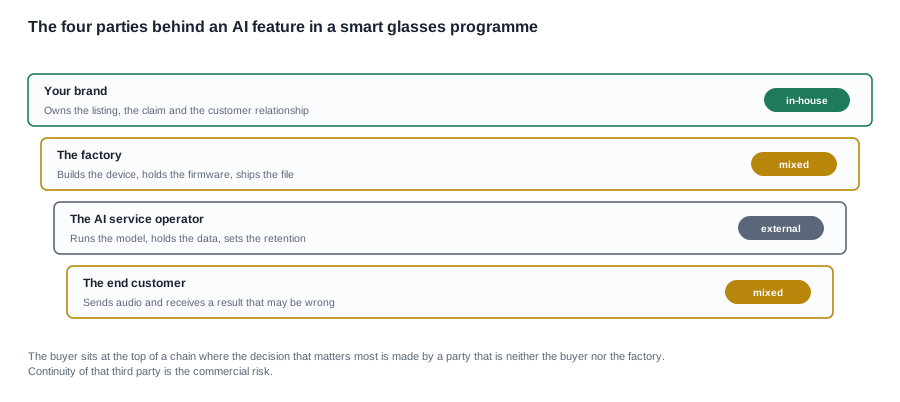
That structure produces three specific risks, and each of them is invisible in a unit price comparison.
The first is continuity risk. If the operator changes the pricing, raises its minimum order quantity, changes its data handling terms or withdraws the service, the buyer's product changes with no change to the hardware. A product that becomes substantially less useful because a third party changed its commercial terms is a product the buyer owns commercially but does not control.
The second is data path risk. The audio captured by a device in a customer's workplace or a customer's home may be processed in a jurisdiction the buyer did not plan for, retained for a period the buyer did not agree, and used to train something the buyer did not know about. None of that appears in a quotation, and all of it is answerable with three questions.
The third is the support burden. When a customer asks why a translation is wrong, the person on the other end of a support line is usually the buyer's customer service team, who did not build the feature and cannot fix it. A support script needs to distinguish a hardware failure from a service failure, and that distinction needs a technical answer the factory and the operator have to supply jointly.
There is a fourth risk that belongs to the brand rather than to the technology: the claim. A listing that says the product translates in real time, or understands voice commands, or recognises what the customer is looking at, is making a claim about a service. The supplier who wrote the feature row in the catalogue may not be the party who can support the claim, and the marketing team that wrote it will not have asked.
Where the cost of an AI feature sits in the quotation
The cost of an AI feature in this category is the hardest of any configuration to see, because the largest components of it do not appear on the factory's quotation at all. That is precisely why a buyer who compares two quotations that both list an AI assistant is comparing two incomplete numbers.
The first cost is the hardware headroom, and it is visible if it is asked about. There is no published AI processor, accelerator or memory figure for any model in our range, which means a buyer has to ask what the feature costs in silicon, in board area and in power. That last one connects directly to the published rows: the catalogue carries cell configurations from 40 mAh on the children's entries up to 290 mAh on the camera tier, with single cells on some entries and two cells on others, and rated runtimes that run from roughly six hours on the slim-temple audio models to roughly twenty hours on the children's models. A feature that draws meaningfully more power has to be inside a runtime figure that includes it, and a runtime figure quoted without it describes a different product.
The second cost is the integration cost, which appears in the schedule rather than the price. Integrating a service into firmware is not a software task, it is a product task: it involves the update path, the error states, the offline behaviour, the data handling and the support documentation. It also often involves a firmware version freeze, which delays the rest of the programme.
The third cost is the service cost itself, and it is the one a buyer most often forgets because it is not a factory cost. Per-unit, per-user and per-minute pricing all exist in this category, and they behave differently. A per-unit cost is a cost of goods and lands in the unit price. A per-user cost is a subscription and it lands in the channel relationship, which usually means the retailer or the employer pays it. A per-minute cost lands in the customer's usage, which means the customer's experience of the price depends on how much they use it. These three answer different commercial questions and the choice among them is a product decision, not a procurement one.
The fourth cost is the compliance cost, which is per market and per claim. The certification requirements covers the frameworks that come up, and the practical point for a buyer is that the more a listing says about what the feature does, the more documentation is needed before the product can ship into a market. A narrower claim costs less to document.
So the negotiating space sits in the configuration definition, the hardware headroom, the firmware freeze, the service commercial model and the claim scope. It is not in the price of the device, because the device price barely moves.

Establishing what an AI feature actually is
Verification here is mostly documentary and it is unusually sensitive, because the party with the answers is often not the party with the contract. The order below assumes each step passed the one before it.
Step one: ask which exact models carry the feature, in which configuration. Ask for the model designation, not for a feature name. A feature that exists on one model does not transfer to another, and this is the cheapest of the twelve questions to ask and the one most often skipped.
Step two: ask for the language list as a count and as a list. A count without a list is not usable, and a list without a count will change. Ask which of the languages are in the first release and which are planned, because a buyer planning a launch into a non-English market needs the first group, not the second.
Step three: ask what the product does with no network and with no service. These are two different states and they produce two different support scripts. A device that queues a request and replays it later has a data-retention question that follows from the answer.
Step four: ask who operates the service, where the audio is processed and how long it is kept. Ask for this in writing and ask for it in a form that can be shown to a customer's compliance team, because the answer is the only evidence available for a data-handling question.
Step five: ask who is accountable when the result is wrong, and what the remedy is. Put the answer in the order. A supplier who declines this question has told you where the risk sits, and the response to that is not to proceed, it is to price the support exposure and to narrow the claim.
Step six: ask what happens to a unit that has been offline, and what happens if the operator withdraws. The second question is the continuity question. There may not be a good answer. Asking it anyway converts an unknown into a known, and a known can be priced.

How AI programmes fail
The feature that was assumed to be on every model. A listing promised a feature that one model carried. The root cause is that a catalogue line was read as a range capability. The control is to require the model designation against every feature claim, and to check the artwork and the listing against that list.
The service that ended. The operator withdrew or changed its commercial terms, and the feature became unusable in the channel. The root cause is that the dependency was never documented and no continuity provision existed. The control is to ask the continuity question in the first round and to hold the answer in the agreement.
The claim that outran the data policy. A listing described a data-handling behaviour the operator does not implement. The root cause is that the claim was written from the feature name rather than from the service terms. The control is to make the claim wording a function of the data path, not of the feature row.
The offline behaviour discovered in the field. The product failed in exactly the environment it was sold for because the offline behaviour was never specified. The root cause is that the site coverage assumption was never written down. The control is to specify the offline state before the sample order and to test it by disabling the network on a sample unit.
The wrong result with nobody accountable. A customer reported a bad result and neither the factory nor the operator had an answer. The root cause is that accountability was never allocated. The control is a clause naming the accountable party and a remedy, agreed before the first shipment.
Nobody named against a bad result is a familiar gap, and it does not by itself disqualify the factory. It does justify a clause that names the accountable party before the first shipment moves.
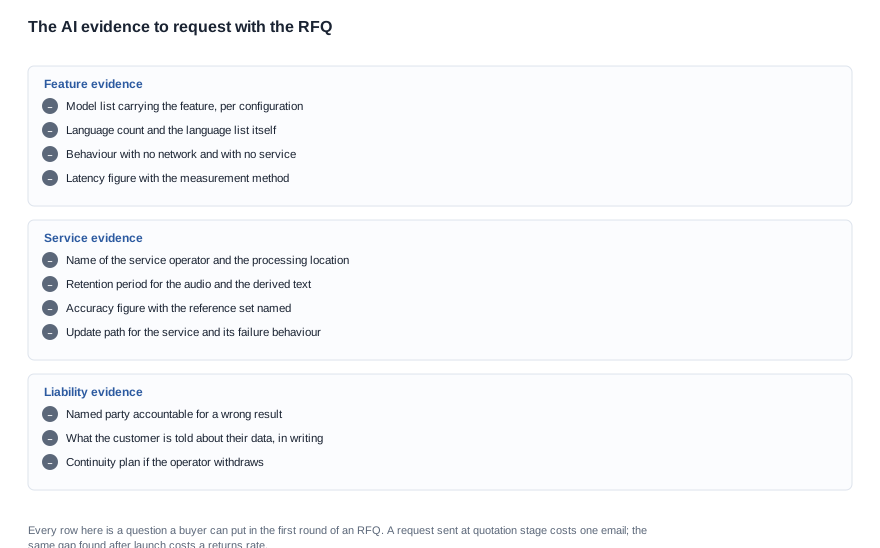

The terms an AI feature programme can move, and the ones it cannot
The commercial shape of an AI programme is unusual in that a large part of the cost is outside the factory's contract, and a buyer who negotiates only against the factory negotiates only the smaller half.
The claim scope is the live commercial number. Narrower claims cost less to document, require less evidence, and support a lower marketing spend. This is the one line where the buyer has genuine leverage over its own cost and over the factory's, because the artwork, the listing copy and the documentation set all follow from the claim.
The service commercial model is negotiable in structure. Per-unit, per-user and per-minute are three different commercial shapes, and a supplier who has only ever quoted per-unit will usually quote per-user if pressed. The choice is often worth more than the device price, because it determines who pays and how the channel experiences the price.
The firmware freeze and the update path are negotiable in timing. The number of firmware releases before production, the update delivery method, and the recovery behaviour are all workable points. A brand that needs its own firmware features on day one should say so at quotation stage, because adding a release later costs more than scheduling it early.
Evaluation units are worth more here than in a hardware programme, and they are usually the cheapest thing on the list. A feature whose behaviour comes from a service cannot be evaluated on a single unit, because the firmware build, the language set and the account configuration all vary between units and between testers. Under pressure on a first order, suppliers routinely concede sample cost, evaluation unit quantities and a first-article inspection allowance, and in this category the evaluation units are worth more than the other two combined.
The service price itself, the service continuity and the service data terms are not negotiable at the factory level. A factory that has contracted with an operator inherits those terms. What the buyer can negotiate is the allocation of the consequence: who handles a support contact when the service misbehaves, who credits a customer, and what happens to the product when the service is unavailable. That allocation has to be written into the agreement.
Certification cost and certification time are fixed. They are a per-market, per-configuration cost and a queue at the test laboratory. The claim scope influences the size of the documentation set but not the fundamental cost of the route.
The clauses worth having in the agreement are these. The model list carrying the feature, per configuration. The claim set, attached, with the language list and the accuracy reference. The offline behaviour. The data path, the processing location and the retention period. The service commercial model and its term. The accountability clause for a wrong result, with a remedy. The continuity provision, or a written statement that there is none. And the change-notification obligation covering the service, the firmware and the data handling.
A worked example: a brand adding an assistant to an existing platform
This is a worked case rather than a client project. The choice sequence appears here.
Assume a consumer brand with an existing camera platform in production across two markets, considering adding an AI voice assistant and a translation feature for a travel line. The constraint that matters is not the factory. It is that the brand's listing reviewer has a rule about claims it cannot evidence, and the brand has no engineering resource to verify a service's behaviour independently.
The first move is to write down what the feature is before asking anyone. The brand's team writes a one-page definition: the feature is present on named models only; it requires a network; it does not work offline; it produces a translation into a listed set of languages; the result is delivered to the device and is not guaranteed to be accurate; the audio is processed by a named operator in a named jurisdiction for a named period. That page is sent to two candidate suppliers and it does more work than a feature description would, because it forces the answers into a structure.
The second move is to establish which models carry the feature. One supplier confirms it across the whole platform. The other confirms it on a single model. The brand now has a decision it did not know it had: a feature on a single model is a different product with a different listing, a different packaging and a different claim, and a feature across a platform means a firmware change and a freeze. The brand takes the platform-wide answer and prices the freeze into the schedule.
The third move is the claim. The brand's initial copy says the product translates conversations in real time. The accuracy row is not published, so the copy is narrowed to a description of what the product does and the conditions it needs. The listing reviewer accepts it, and the copy that is approved is the copy that ships.
The fourth move is commercial, and it is the one the brand did not expect to matter. The supplier can quote the service per unit or per user. The brand's channel is a retailer, and a per-user subscription would have to be sold by the retailer, which the retailer has said it will not do. The brand therefore takes per-unit, which is more expensive per active user and is entirely predictable, and it negotiates the per-unit rate against a committed volume rather than against a pilot quantity.
The fifth move is the continuity question, which is asked directly and gets an honest answer: there is no continuity provision, because the factory has no one to give one. The brand records that as a known risk, narrows the claim further so that the feature is a convenience rather than a promise, and asks for a service credit against the first order, which is granted and which offsets part of the exposure.
The result is a feature that is described accurately, priced predictably, accounted for in the claim set, and launched with a risk that is written down rather than discovered.
What our catalogue publishes about AI features, and what it leaves open
We will answer these questions with a published figure or with a clear statement that it is not published, and we will not fill a gap with a typical value, a partner's marketing description or a benchmark taken from a different product. Our published position on the AI feature is short, and we would rather it were short and true than long and approximate.
These are the rows we do not publish, for any model in the range:
- The implementation, the provider and the model behind the AI function are not published.
- The language coverage and the language list are not published.
- The latency figure and its measurement method are not published.
- The offline behaviour is not published.
- The data path, the processing location and the retention period are not published.
- The accuracy figure and its reference set are not published.
- The processor, accelerator and memory figures for the AI path are not published.
- The service update path and its failure behaviour are not published.
These are the rows our published data does settle:
- The AI voice assistant is listed as a key technology across the camera tier and the audio tier.
- AI translation is listed on the K01, an audio model publishing Bluetooth V5.3, a 90 mAh by 2 cell configuration, roughly eight hours of runtime and magnetic charging.
- Firmware customisation is listed for the camera tier.
- Twenty of the twenty-eight catalogue entries carry an AI function row.
- The published power rows around it are a cell range from 40 mAh to 290 mAh, charge times of two hours or less on every entry except the D17 and the ZH12 at about one hour, and rated runtimes from roughly six hours to roughly twenty hours.
We will also be direct about a pattern: a supplier who answers every one of these questions with a confident number and no method has not answered them. The questions worth pressing hardest are the ones about the data path and the continuity, because those are the two the buyer carries after the purchase rather than during it.
The procurement checklist is the longer version of the same twelve questions, and it is worth sending in the first round rather than after the first quotation arrives.
The action to take this week
Write your own one-page definition of the feature before you contact any supplier. Name the models it applies to, the conditions it needs, what it produces and what it does not produce. Send that page with the request for quotation, and require the answers to be returned in the same structure, because a structured answer is comparable and a prose answer is not.
Then ask the five questions that decide the programme: the model list, the language count, the offline behaviour, the data path with the retention period, and who is accountable for a wrong result. Ask the continuity question as well, even if the answer is that there is no provision, because an unknown risk and a known risk are priced very differently.
Finally, narrow the claim to what the answers support, and put the accountability, the data path and the claim set into the purchase order as attachments. Send us the model, the quantity and the target market and we will mark which of the answers we can evidence and which we would have to decline.
Related reading
- The cost side of the same decision — cost factors
- The same questions in checklist form — checklist for procurement teams
- The frameworks that come up — certification requirements
Send the configuration, the quantity and the market, and we will say which parts of the AI feature are settled and which are yours.


