

Smart glasses camera technology: pixel counts filter candidates
A camera datasheet in this category is a short list with one number on it, and the skill is reading the empty rows as carefully as the filled ones. Smart glasses camera technology smart glasses how to read a datasheet is about nine rows to look for, what you can and cannot infer from what is published, and four tests that turn a thin sheet into a specification you can put in a purchase order.
Our catalogue for the camera tier publishes two resolution tiers, 8 MP and 13 MP, alongside cell configurations from 220 mAh to 290 mAh, charge times of two hours or less, runtimes of roughly five to eight hours, magnetic or Type-C charging, and case capacities from 900 mAh to 1400 mAh. On the camera itself, the published position is that the sensor model, the field of view, the video resolution, the stabilisation, the storage behaviour and the transfer time are all not published.
That is a thin sheet, and it is a typical one. The resolution tier is the only camera figure with a number on it, and it is the least informative number on the page.
What a camera read has to settle
Whether the candidate is in the right era. A resolution tier tells you the generation of the sensor and therefore the plausible low-light behaviour. That is a usable screen and it is not a ranking. An 8 MP sensor with large pixels can produce a better image than a 13 MP sensor with small ones, and no datasheet in this category will tell you which you have.
Whether the module is a controlled part or a resold one. The imaging module is frequently bought in, and the assembly factory often resells a module it did not design. Where that is the case, the sensor data belongs to the module maker, and the request has to be routed differently.
Whether the product can be specified at all. A camera without a field of view, without a video format and without a storage behaviour is a device that records something, and the purchase order cannot say what. The number of rows that are missing is itself the finding.
What to put in the listing. A camera claim that survives a customer test is a claim about behaviour the customer can see: how it moves, how it behaves at dusk, how long a clip takes to reach the phone.
The buyer choosing a module for a first-person line
A brand product manager building a first-person content line holds a supplier sheet, a target price, a channel and a set of samples. Their exposure is the listing and the content made with the product. What they are missing is the sensor identity, and the reason is structural rather than careless: the imaging module is bought in, and the module's data belongs to the module maker.
The practical response is to ask for the part number rather than for a performance claim. A supplier who can name the part number can usually obtain the field of view, the video specification and the low-light behaviour from the same source in one request, because those figures sit in the module maker's own document. A supplier who answers "high quality sensor" is telling you they do not have the part number either.
A channel buyer in this position is usually building a marketplace listing, and their exposure is a refund for "not as described". The specific complaint in this category is almost always about low light or about the video not playing smoothly, and neither of those is addressed by a resolution figure.
A procurement manager is usually asked to compare an 8 MP option with a 13 MP option on cost, and the decision they are being handed is the one the data cannot support. The real decision is which module, and the resolution tier is a proxy for it. The useful move is to make the comparison on the power budget, which is published, and then to settle the image question with a test.

Where the imaging module sits, and what that does to your position
The module supply chain, and who owns the data on it
Four parties sit between a brand and a camera specification, and knowing which one you are dealing with decides how long the answer takes and what it costs.
The module maker designs the sensor, the lens and the video pipeline, and publishes the data. If your factory designed the module, the data is theirs to give you and the request is a form-filling exercise. If the factory bought it in, the data belongs to the module maker and your factory is relaying it.
The assembly factory integrates the module into the frame, routes the power, manages the heat, and assembles the storage and the transfer path. The integration decisions are theirs, and they are the decisions that determine whether the published sensor capability survives into the finished product.
The firmware owner writes the capture, the encoding and the transfer code. The video format, the recording limit and the overwrite behaviour are all firmware decisions, and they are invisible in a hardware datasheet. This is the layer where the "storage fills and recording stops" behaviour comes from, and it is the layer that a supplier can change without changing a single component.
The brand owns the listing, the claim about the 8 MP and 13 MP tiers, and the customer relationship. The brand cannot influence the sensor and can influence everything above it, which is why the brand's leverage is in the claim language and the acceptance criteria rather than in the module selection.
The negotiating position follows directly. A brand that knows the module is bought in will not negotiate hard on the sensor and will negotiate hard on the integration, the firmware behaviour and the change control. A brand that assumes the opposite will spend a month asking for a number that will never move.
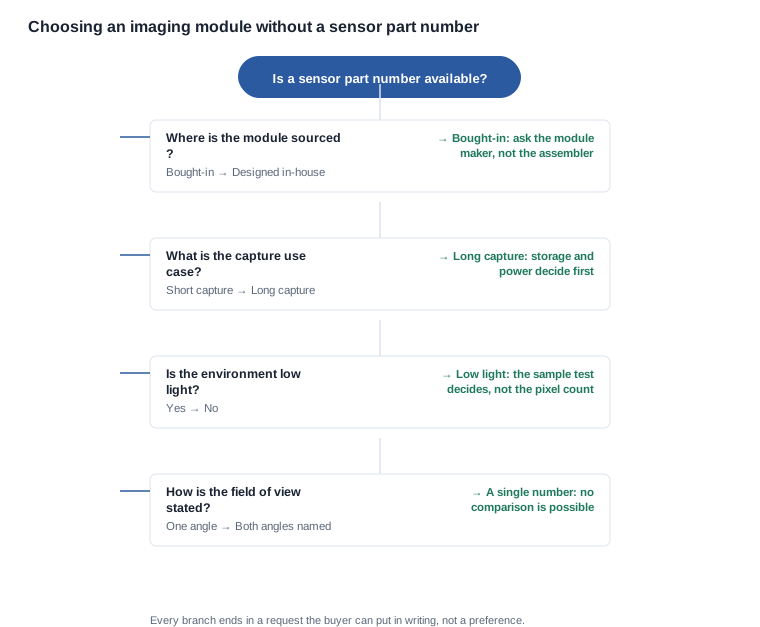
The branch structure above is the one we use when a supplier sends a sheet with no part number on it. Each branch ends in a request rather than a preference, which is what makes it usable in a procurement file: a branch that ends in "ask the module maker" is a routing instruction, and a branch that ends in "decide on the sample test" is a test you can schedule. The last branch is the one that catches people, because a single field of view with no convention is not a specification and cannot become one by being written more carefully.
The power budget the imaging subsystem has to live inside
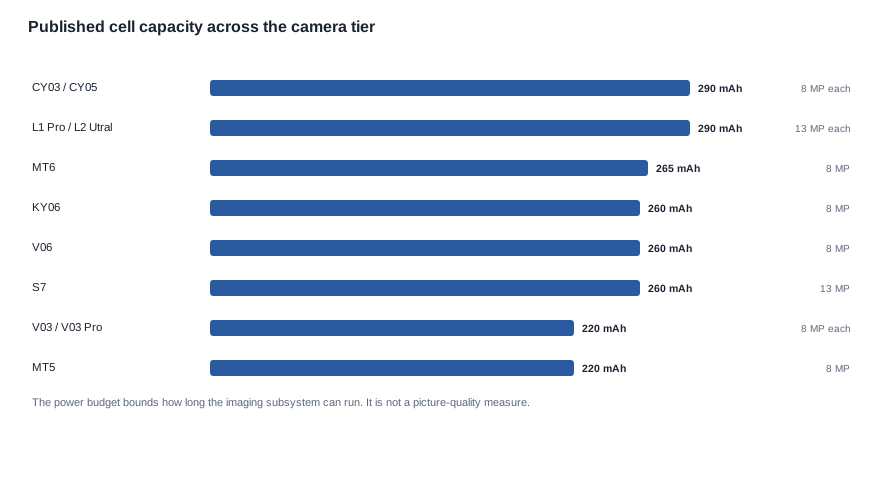
The cell configuration is published for every model in the tier, and it is the most useful camera-adjacent row available, because it bounds what the imaging subsystem can do. The CY03 and the CY05 publish 290 mAh; the L1 Pro and the L2 Utral, both 13 MP entries, publish 290 mAh as well; the MT6 publishes 265 mAh; the V06 and the KY06, and the S7 publish 260 mAh; and the MT5 and the V03, and the V03 Pro publish 220 mAh. The S7 is the 13 MP entry that does not sit at the top of that range, which is itself a reminder that the resolution tier and the cell tier are independent.
The published runtimes of roughly five to eight hours reflect the camera as the dominant load. A product that will be used for long capture sessions is constrained by that row rather than described by it, and a buyer who promises "a full day of capture" is promising something the published cell configuration does not support.
The practical reading is that the cell row tells you how long the camera can run, and the sensor row tells you how good it looks. Those are two different decisions, and they are made by two different parties. A buyer who understands that will stop trying to derive picture quality from a power figure.
The nine rows that turn a camera into a specification
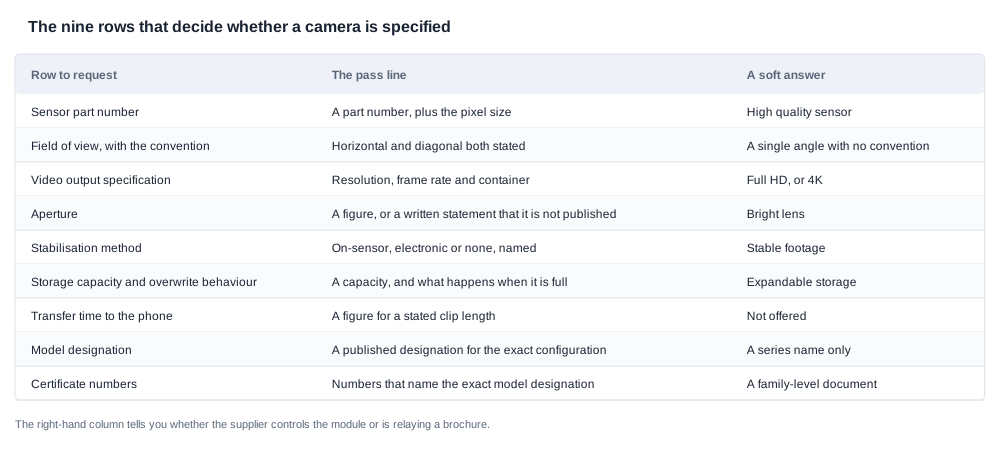
Send the table below to every supplier before the samples are tested. The right-hand column separates a supplier who controls the module from one who is relaying a brochure.
The thresholds behind the nine rows
Sensor part number, with the pixel size. This is the row that settles the era, the generation and the plausible low-light behaviour in one line. A part number can be looked up, which means it can be checked, which means a supplier's claim about it can be verified without a laboratory. The soft answer is a word: "high quality sensor", "HD camera", "professional grade".
Field of view, with the convention stated. Horizontal and diagonal, or vertical and diagonal, named. A single angle with no convention cannot be compared with anything, and a comparison made across conventions produces a confidently wrong answer. There is a second point here that is easy to miss: the frame's own geometry occludes part of the scene, so the usable field of view is always less than the sensor's, and the difference is the reason a wide-angle specification and a wide-angle photograph rarely agree.
Video output specification. Resolution, frame rate and container format, written down. "Full HD" and "4K" are marketing labels without a frame rate, and a frame rate is what separates usable footage from a slideshow. The recording limit belongs on the same row, because a product that stops after a fixed length is a different product from one that does not.
Aperture. A figure, or a written statement that it is not published. The word "bright" is not an aperture. Aperture drives the low-light behaviour, which is the characteristic customers complain about most in this category, so a missing aperture is a missing answer to the main complaint.
Stabilisation method. On-sensor, electronic or none, named. "Stable footage" is a claim about a result, and a result without a method cannot be tested and cannot be re-created by a different supplier.
Storage capacity and overwrite behaviour. A capacity, and what happens when it is full. The two common behaviours are stopping and overwriting oldest-first, and they are completely different products. This row is firmware, it is rarely in any datasheet, and it is the one that generates the complaint that reads as a manufacturing defect.
Transfer time to an editable file. A figure for a stated clip length. This is the row that separates a camera that works from a product a customer can use, and it is the one a creator notices immediately, because it is the wait between capturing and being able to edit.
Model designation. A published designation for the exact configuration. Without it, no certificate can name the unit, and the conformity file stays open.
Certificate numbers. Numbers that name the exact model designation. A family-level document is not coverage for a branded unit, and a document on the factory's own stock-keeping unit is not a document on yours.
The convention problem that makes camera comparisons wrong
Two comparisons break more often than the rest, and both are silent.
The field of view convention. A horizontal 90 degrees is a diagonal of roughly 110 degrees, so a chart that places a horizontal figure next to a diagonal figure is not a chart of the same thing. The fix is procedural rather than clever: ask for both angles with the convention named, and refuse any comparison in which one side has a single number.
The pixel count against the sensor size. A megapixel figure says how many pixels a sensor has and nothing about how large they are. Two sensors with the same count can differ substantially in low-light behaviour, and the one that differs is the one the customer notices. The resolution tier is therefore a screen, and the decision it screens on is which generation of module you are being offered.
A third, quieter one is the demonstration image. A camera close to a subject produces a dramatic frame that no customer will reproduce, and a manufacturer who publishes that image is describing a demonstration rather than the product. The test is simple and it is also the test of whether a supplier is comfortable with the claim: ask for an unedited file from a unit worn at arm's length.
A sample protocol that produces evidence rather than impressions
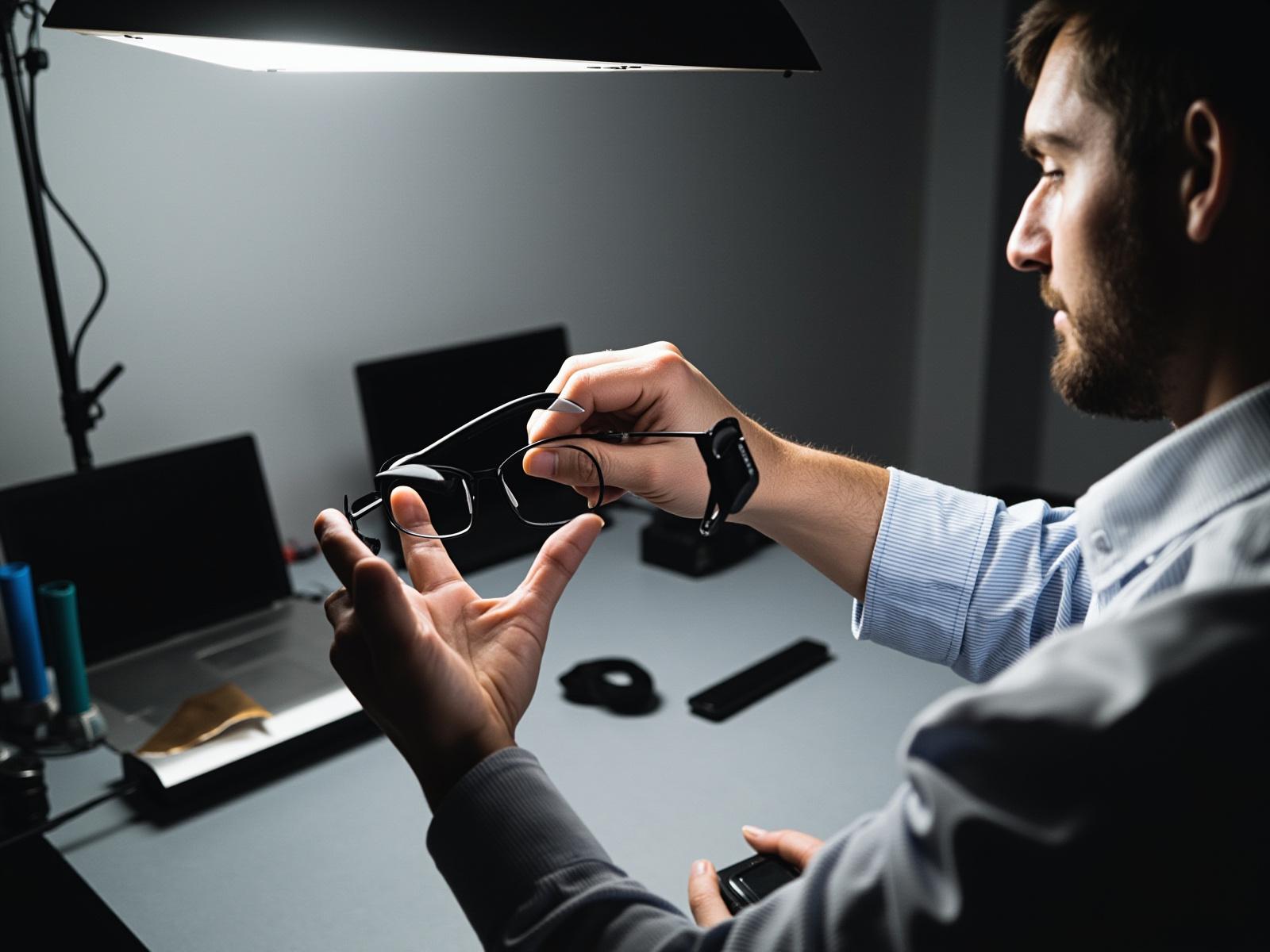
Four tests, each with a written pass condition, and each producing a file you keep.
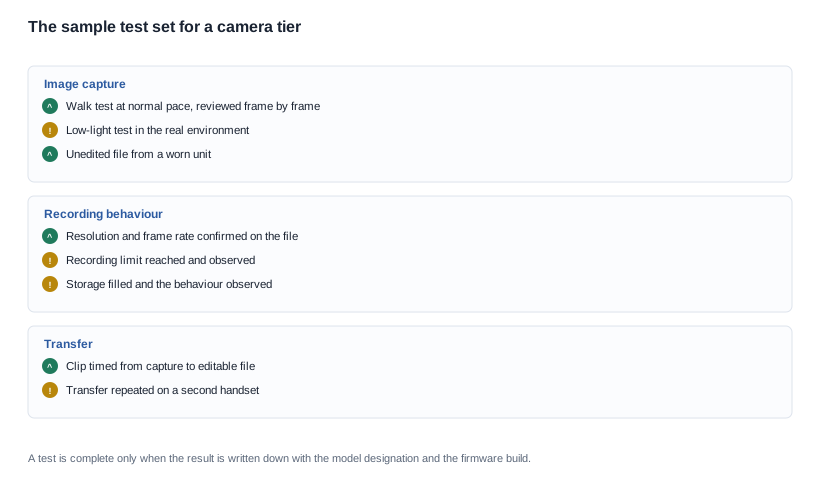
The walk test. Record while moving at a normal pace, then watch the footage back frame by frame rather than as a clip. This is the test that exposes a slow shutter, and a slow shutter is invisible in a still frame and obvious in playback. The pass condition should be written as a number of dropped or smeared frames per second of movement, or as a written judgement by a named reviewer, before the test rather than after.
The low-light test. In the actual environment the product will be used, comparing a 13 MP unit and an 8 MP unit side by side, with the same subject, the same distance and the same moment. This is the test that decides between the two resolution tiers, and it is the reason the resolution tier cannot be ranked on paper.
The storage test. Fill the storage deliberately and observe the behaviour. Does recording stop, does it overwrite oldest-first, does the device warn, and does the transfer path still work? The behaviour here is a firmware decision and it has to be in the acceptance criteria, because a lot that fails it is a lot you can refuse.
The transfer test. Time a stated clip from capture to an editable file on the phone. State the clip length, the phone model and the network condition, and repeat it on a second handset, because the transfer path is the one that most often depends on software the brand does not control.
A fifth check, which is not a test but a condition: insist on unedited output from a unit worn at arm's length. A wide-angle demonstration shot is not a product image.
The imaging paperwork to request before the deposit
The sensor module part number. The field of view with the convention, both angles. The video format, the frame rate, the recording limit and the container. The aperture, or a written statement that it is not published. The stabilisation method, named. The storage capacity and the overwrite behaviour, in writing. The transfer time for a stated clip length. The model designation written on the quotation, and the declaration of conformity for that exact designation. The certificate numbers with the issuing body and the validity dates. The measurement conditions behind the runtime figure, because the runtime and the camera are the same constraint.
Where an imaging programme breaks, and what the terms allow
Five failure modes, and the prevention that stops them
The product is chosen on megapixels and returns as "not good enough". The symptom is a cluster of returns carrying a description that names image quality rather than a defect. The root cause is that the only published camera figure was treated as the quality measure. The prevention is to shortlist on architecture and power budget, and to decide on the low-light test.
A field of view comparison is made across two conventions. The symptom is a product page or a channel brief that states a wider angle than the product actually delivers. The root cause is that one supplier quoted horizontal and another quoted diagonal, and both were plausible. The prevention is to ask for both angles and the convention for each, and to refuse a comparison in which one side has a single number.
A product is sold with a manufacturer's best shot and the customer's footage looks nothing like it. The symptom is a returns cluster with a quality complaint attached. The root cause is that a demonstration image was accepted as product evidence. The prevention is to insist on unedited output from a worn unit, and to keep the file.
The storage fills and the recording stops, and the customer thinks the product is faulty. The symptom is a warranty file with a cluster in it and no defect found. The root cause is that the storage behaviour was never in the specification, so it was whatever the firmware did. The prevention is to put the behaviour in the acceptance criteria and to confirm it by filling the storage on the sample.
A certificate arrives for a camera model that was not the one ordered. What it looks like from outside is a warranty claim, a customs query, or a platform rejection that stays open. The root cause is that the camera was changed late in the programme and the document was not re-issued. The prevention is to make the certificate number and the model list a condition of the purchase order, and to re-verify after any change to the imaging module.
The commercial levers on an imaging module
In a camera line the unit price is the least interesting number and the configuration count is the most negotiable, because three colours and two logo treatments are six configurations rather than one product. The minimum order quantity, and it is worth negotiating in configurations rather than units, because a camera line with three colours and two logo treatments is six configurations, not one product in three colours. The packaging specification and the insert set, including the market labels, the language of the quick start guide and the care instruction. The charger in the box, because a camera product without one generates a support call on day one. Delivery splitting against a sample-approval milestone, which is usually granted more easily than a price concession because it moves the risk onto the schedule. Payment node structure, with a balance on inspection before shipment and a retention held against the documentation package. And the accessory set, where a case is a line item with its own minimum and its own lead time, and negotiating it separately from the frame produces a better answer on both.
The imaging module is the one element in a camera package that cannot be negotiated, because a supplier who will not move the sensor or the video pipeline is telling you the picture is fixed. The imaging module itself: a supplier who will not change the module, the sensor or the video pipeline is telling you the picture is fixed, and the programme has to be built around that fact rather than against it. Certification cost and certification time, which follow the process and the testing body. Tooling, which is a one-off cost usually amortised across the first order, so the questions worth asking are over what volume it is amortised and what happens to the tooling and the fixtures if the programme is discontinued. And in a private-label arrangement, the module's own lifecycle, which is usually the factory's supplier relationship rather than yours, and which is worth asking about before you commit to a platform.
Five clauses belong in a camera purchase order, and the firmware branch clause is the one buyers forget, even though the video format and the storage behaviour both live inside it. The sensor module part number and the camera resolution as line items, with a clause requiring notice before any change of module. The acceptance criteria for the sample, referencing the four tests. The documents named in the purchase order, with the exact model designation attached. A clause on who bears the cost when the sample does not meet the acceptance criteria. And a clause that requires the firmware branch to be named, because the video format and the storage behaviour live in the firmware and a firmware change is a product change.
A creator brand selecting an 8 MP and a 13 MP option
The scenario and the module decision
This is a hypothetical scenario, written to show the decision sequence rather than to report an outcome. No customer, project or order is being described.
Assume a brand-side product manager launching a first-person content line with two configurations, one built on an 8 MP module and one on a 13 MP module, sourced from the same factory but potentially from different module suppliers. The binding constraint is not the cost difference between the two. It is that the brand's listing copy is written around a "13 megapixel" claim, and the brand cannot currently say what the 13 MP entry actually produces in a dusk scene.
Step one, the module reality. The manager asks the nine-row question of the factory. The answer comes back with a module part number for one configuration and a marketing phrase for the other, which tells the manager that the two configurations do not come from the same supply route. That is a more useful answer than a price comparison, and it arrives in week one.
Step two, the request that follows. The manager now knows which data has to come from the module maker and which has to come from the factory, and splits the request accordingly. The field of view, the aperture and the video format go to the module maker. The storage behaviour, the overwrite behaviour and the transfer time go to the factory, because those are firmware decisions the factory controls.
Step three, the power constraint. The manager looks at the published cell configurations and notices that the 13 MP entries in the range are not uniformly at the top of the cell range. The S7 is a 13 MP entry publishing 260 mAh while two of the 8 MP entries publish 290 mAh. The brand therefore cannot promise "more megapixels, longer runtime" as a package, and it writes the runtime claim from the published figure for whichever configuration it ships.
Step four, the low-light test. The manager runs the low-light test on the two samples, in the same place, at the same moment, and keeps the files. The result decides the configuration, and it does not agree with the pixel count, which is exactly why the test had to be run.
Step five, the claim. The listing drops the megapixel figure as a quality signal and replaces it with a behavioural description the brand can defend, and it publishes the storage behaviour and the transfer expectation, because those are the two things a customer complains about most and the two things the brand can now state accurately.
Step six, the commercial structure. The manager negotiates the minimum against a committed configuration count, separates the case minimum from the frame minimum, and adds a notice clause covering the module and the firmware branch.
The result is a product line that is specified rather than described, and a listing that does not make a claim the brand cannot hold. The decisive step was the low-light test, and the step that made the test possible was the module part number.
What our camera tier publishes, and what it does not
On the camera data, our position is a short one. We publish the two resolution tiers and the electrical rows attached to each model, and we stop there. We publish no sensor model, no field of view, no video resolution or frame rate, no aperture, no stabilisation figure, no storage capacity or overwrite behaviour, no low-light data and no transfer time for any camera model, and we will not estimate any of them from typical values.
We will also not tell you that 13 MP produces a better picture than 8 MP, because that is not a statement the evidence supports. A pixel count is a quantity, and no datasheet in this range will tell you which sensor you have. A buyer who shortlists on that number is choosing a filter, and filters are for excluding, not for ranking.
What we can do is tell you which of the nine rows is decisive for your use case, so you know which questions to put to the engineering team and which you can let go for now, and we can check a supplier's answers against the published rows for the model in front of you. The rows are in camera spec sheet explained, the supplier questions are in what to ask a supplier about the camera, the range is AI camera glasses, the background is under camera and imaging, and the sample handling route is in sample evaluation.
The requests to make before the sample order
Ask for the module part number before you ask for anything else. One line, and it unlocks the field of view, the aperture, the video format and the low-light behaviour from the same source.
Put the four sample tests in writing before the samples arrive, with a pass condition for each, and keep the files with the model designation and the firmware build attached.
Ask the factory for the rows it controls and the module maker for the rows it controls, and stop treating a non-answer from one of them as an absence of data. It is a routing problem, and routing problems are cheap when they are found early.
Where the reading method comes from
Tell us the use case and we will say which of the nine rows is decisive.


