
Most buyers who want to reduce smart glasses shipping costs start with the freight rate, and most of them are negotiating the one lever they do not control. Freight is priced on two things — the weight and the cube of what you ship — and both of those are decided long before a carrier sees the carton. The lever that actually moves the number is the shape of the shipment, and the second one is the configuration inside it.
There is a specific reason this matters more in smart glasses than in most categories. Glasses are the archetypal light-and-bulky product: the device is small, the retail box is small, and a master carton of small boxes still occupies a disproportionate share of a pallet's height. Add a charging case, a printed manual and a fabric pouch and the box stops being small. A volumetric charge applies when the shipment is light and bulky, which is precisely the case a consignment of this product falls into, so the cube of the box is usually the larger of the two drivers.
The realistic saving is rarely a percentage off the rate. It is a different shape of consignment, a different configuration ordered per market, and a set of commercial terms that move when the rate does not. This guide is organised around those three, and around the published catalogue data that tells you which of them is open before you ask a forwarder for a quote.
Smart glasses shipping: which freight lever is actually open to you
The buyer in front of this decision
The reader is a procurement manager working for the brand, a channel buyer or an importer who has a landed cost that is higher than the model allows. The freight conversation is rarely the first one. It usually arrives after the unit price has been agreed, after the minimum order quantity has been settled, and after somebody has run the arithmetic on what the product will cost on the shelf in the destination market. At that point the buyer is usually being asked to find the money in logistics.
What that buyer is managing is not a rate. It is a landed cost with four components — the unit price, the freight, the duty and the origin handling — and only two of them are open. A buyer who negotiates the freight rate for a quarter and leaves the configuration and the pack untouched will usually find that the rate was never the largest of the two variables.
There is a second thing this buyer is managing, which is schedule risk on the shipment itself. A large consignment of a product with a lithium cell is a single loss event, and splitting it is expensive in a way that is easy to underestimate. The right answer is a contract term, not a rule, and that distinction is the subject of the fourth section.
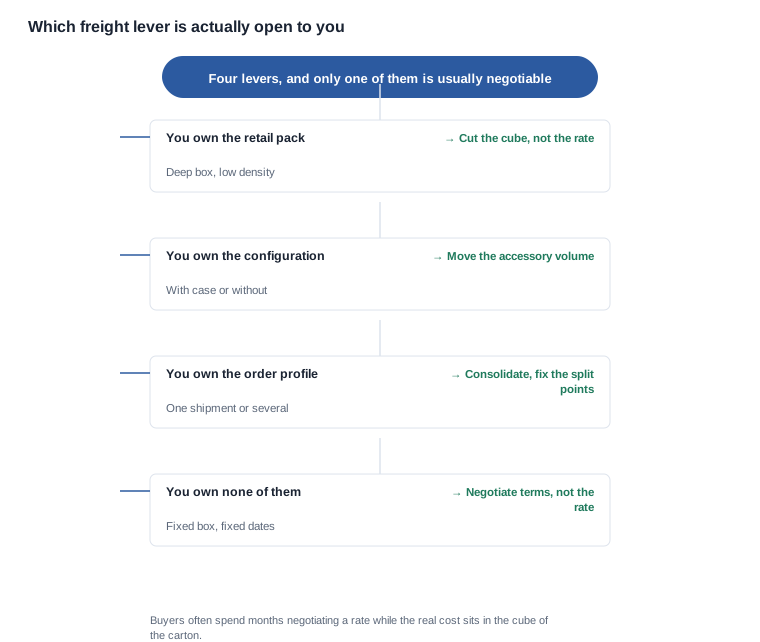
The four levers, in the order they should be tested
If you control the packaging, cut the cube first. The cheapest reduction in freight cost in this category is frequently a packaging decision rather than a logistics one: a shallower retail box, a smaller master carton, fewer units per carton so the boxes are not half empty, or an insert that no longer earns its place. A master carton that is not full is a volumetric charge paid on air.
If you control the configuration, cut the accessory volume. Accessories are the quietest cost in this category. A charging case is the largest single item in the box, and where a configuration offers a case option, the choice between options is a freight decision as much as a product decision. A buyer who orders a case-free configuration for one market and a case configuration for another is making a sensible freight decision without any negotiation at all.
If you control the order profile, consolidate instead of splitting. Splitting a large order into several smaller shipments feels safer, and it is usually the most expensive option available. Every additional shipment carries a minimum charge, a booking, an export declaration and a customs clearance.
If you control none of them, negotiate terms rather than rates. When the box is fixed, the configuration is fixed and the dates are fixed, the rate is largely determined by the market. What remains open is the commercial framing, and that is covered in the fifth section.
The test for which lever is open is a question, not a feeling: who decided the retail pack, who decided the case option, and who decided the split points? The answer tells you which conversation to have, and it takes about two minutes to establish internally.

What the published configuration already tells the forwarder
The catalogue rows that decide the shape of the shipment
Our catalogue publishes enough of the configuration to plan a shipment, and it does not publish the packed dimensions or the gross weights. That distinction is the one to hold on to, because it decides which questions belong to the supplier and which belong to the forwarder.
Published and usable:
- The cell capacity and the cell count, model by model. These are the inputs a forwarder needs for the lithium transport paperwork, and because they are published for every model, the battery data can be assembled from the order string rather than from a physical sample. The camera models run 220 mAh on the V03, the V03 Pro and the MT5, 260 mAh on the KY06, the V06 and the S7, 265 mAh on the MT6 and 290 mAh on the L1 Pro and the CY03, and the L2 Utral and the CY05. The audio models publish cell values in the same catalogue rows, including the two-cell configurations.
- The charging method, model by model. Magnetic charging on seventeen models, Type C on seven, and the method is not published at all for four camera models — the MT6 and the CY05, and the L1 Pro and the CY03. A forwarder asking about the connector is asking a question the order string can answer for three quarters of the range and cannot answer for the rest.
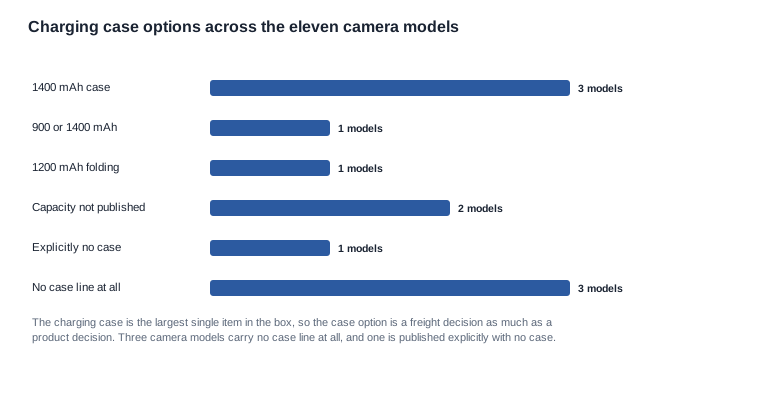
- The charging case option. This is the single largest volume driver in the box, and it is published per model. Three camera models carry a 1400 mAh case, one is published with either a 900 mAh or a 1400 mAh case, one carries a 1200 mAh folding case, two carry a case whose capacity is not published, and four camera models carry no case line at all — the S7 and the V06, and the V03 Pro and the V03.
- The charge time. Published for all twenty-eight models — up to two hours on twenty-six and about one hour on the D17 and the ZH12. It is a bench condition rather than a shipping input, and it is the number buyers most often mistake for a lead time.
Not published, and therefore a request rather than a lookup:
- Packed dimensions and gross weight, master carton and retail pack, for every model.
- Units per master carton, pallet plan and container plan.
- The retail pack contents item by item — manual, quick-start card, fabric bag, cable, insert.
- The shipping carton and its material specification, and the drop or transit test result behind it.
That list is short enough to put in a request, and it is the difference between a forwarder quote that can be compared with another forwarder quote and one that cannot. A request for "the shipping details" produces a description. A request for the master carton packed dimensions, the gross weight, the units per carton, the retail pack list and the case option, each named per configuration, produces a number.
What the case option does to the cube
The charging case is worth a separate paragraph, because it is the item most often overlooked when a buyer assumes a "glasses product" ships in a small box.
Among the eleven camera models in the catalogue, three carry a 1400 mAh case, the L2 Utral is published in two case sizes at 900 mAh and 1400 mAh, the MT6 carries a 1200 mAh folding case, the KY06 and the MT5 carry a case whose capacity is not published, while the V06 and the S7, and the V03 and the V03 Pro carry no case line at all in the catalogue. That is eleven accounted for, and it means the case is a per-model variable rather than a per-category constant.
Two commercial consequences follow. First, a buyer who compares two camera models on freight without checking the case option is comparing different products. Second, where a configuration offers a choice — the L2 Utral at two case sizes — the case option is a freight decision that can be made per market, and a supplier who can quote the same model in both configurations has given the buyer a freight lever that costs nothing to use.
There is a smaller version of the same point in the accessories. A printed manual, a quick-start card and a fabric pouch each add volume to every single unit in the consignment, and none of them is protected by any published requirement. Where a manual can be a card with a QR code, that is a packaging decision with a freight dividend that appears on every shipment for the life of the programme.
The two numbers that decide every freight quote
Dimensions, weight and the volumetric divisor
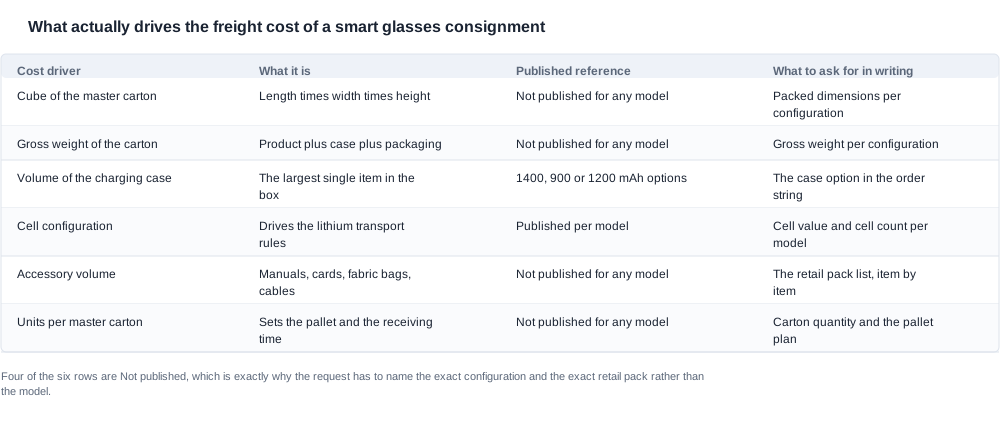
Whatever lever is pulled, two figures decide the shipment: the packed dimensions and the gross weight of the master carton, and the number of units per carton. Everything downstream derives from those two numbers — the freight quote, the pallet plan, the warehouse receiving time, the damage rate in transit, and the number of cartons a container will take.
The arithmetic is simple and buyers should be able to do it. Volumetric weight is length times width times height divided by a carrier-specific divisor, and the carrier charges the greater of actual weight and volumetric weight. For a light product in a box that is not dense, the volumetric figure is the one that is billed. The practical consequence is that shaving two centimetres off a box height can be worth more than a rate negotiation lasting a quarter, and that a carton holding fewer units than it could is a volumetric charge paid on empty space.
Ask for both numbers in writing, per configuration, at the point the retail packaging is frozen. A number given before the box is final is a number the buyer will be correcting later, and the correction arrives as a surcharge attached to a booking that cannot be moved.
There is a discipline here that costs nothing and is skipped constantly. The numbers have to be per configuration rather than per model, because the case option, the colour count and the accessory list all change the box. A buyer who asks for one set of dimensions for the whole range will get one set of dimensions, and it will be the set for the configuration with the largest case, because that is the one the factory packs most often.
The battery, and why the classification question is a scheduling question
Every model in this catalogue runs on a lithium cell, and the transport classification, the packing rules and the paperwork a forwarder needs all follow from the cell configuration and the state of charge at dispatch. The catalogue publishes the cell values and the cell counts, which is most of what is needed, but the classification decision and the packing instruction belong to the forwarder and the carrier, and they have to be settled before the booking rather than after the goods are on a truck.
Confirming the classification before the booking costs a day and saves a week. A consignment held at the border for a documentation question is a schedule event, and a schedule event on a launch is not something a freight negotiation can recover.
The two published durations that buyers most often mistake for shipping inputs are the charge time and the rated use. The charge time is published for every model and describes a bench condition; the rated use is published for every model and describes how long the product is used. Neither is a transit time, and neither is a clearance time. A schedule built from them is a schedule built on the wrong numbers.

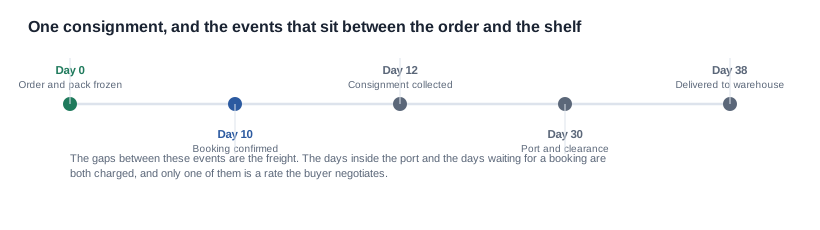
The six steps in that chart are the order a buyer should work in, and each one has a completion test: a number, a date, a document name or a named owner. A step without one of those is an intention rather than a control.

Consolidation, split deliveries and the cost of insurance
Why splitting is the most expensive option available
Splitting a large order into several smaller shipments feels safer, and the reasoning is not wrong: if one consignment is lost, the others arrive. The cost of that insurance is higher than most buyers expect, because each additional shipment carries a minimum charge, a booking, an export declaration, a customs clearance and its own transit, and each of those has a fixed component that does not scale down with the volume.
There is a second effect that is specific to retail. A part-shipment to a retail chain often lands in a different store network from the rest, because the receiving schedule is set by the retailer's own logistics plan. The units that arrive first are therefore not necessarily the units that sell first, and the merchandising that was planned around a full delivery has to be re-sequenced.
The counter-argument deserves a real answer rather than a dismissal. A single twenty-thousand-unit consignment is one large loss event, and a retailer may refuse a part-delivery outright. That is a real commercial risk, and the resolution is a term rather than a rule: agree the delivery schedule and the split points in advance, with the split defined by something objective — a destination, a channel, a date — rather than by a quantity that the factory happens to finish first.
The questions that turn a shipment into a contract term
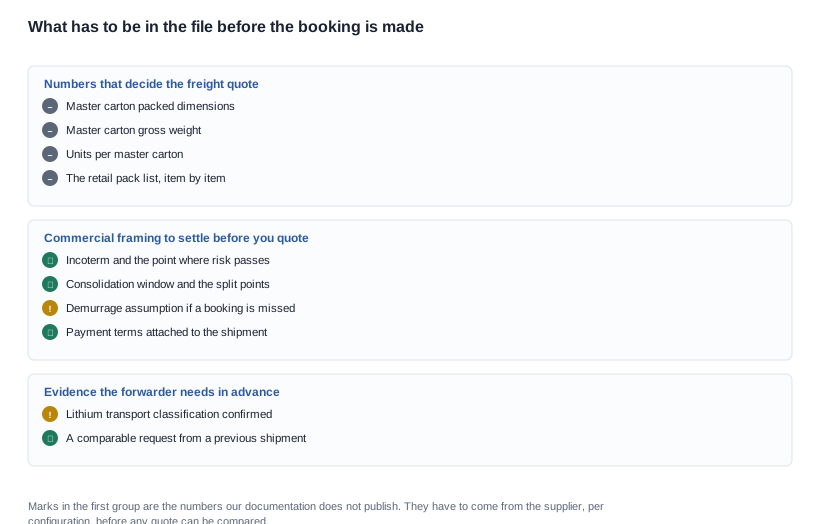
Four questions have to be answered in writing before the first booking, and each of them decides something that is otherwise decided by whoever is more anxious at the time.
- What is the consolidation window? How long does the factory hold a completed consignment before the carrier collects, and what happens if the window is missed? A missed booking at a congested port is a demurrage event, and demurrage is charged per container per day.
- What are the split points? A delivery schedule that names the destinations, the quantities and the dates, so that neither side is guessing at the moment the pallet is finished.
- What is the point at which risk passes? This is the incoterm question, and it belongs in the contract rather than in a forwarder's booking instruction, because the booking instruction is a logistics document and the risk transfer is a commercial one.
- What is the remedy when a documented link slips? A date with no consequence is a preference, not a commitment.
A buyer who has those four in writing has converted a shipping arrangement into a schedule commitment, and the difference shows up in the month when something goes wrong. The one thing worth not doing is asking for a guaranteed delivery date without asking which of the two the supplier is pricing — the premium or the penalty. A premium is a cost you chose; a penalty is a cost you incurred.
What the forwarder's quote needs to contain to be comparable
A freight quote is only comparable with another freight quote if both were made against the same request. That means the same master carton, the same units per carton, the same gross weight, the same destination, the same service level and the same trade terms. A quote made against a supplier's default carton is not a quote for your consignment, and a buyer who compares it with a quote made against the final retail pack will conclude that one forwarder is cheaper when the difference is entirely in what was priced.
The practical step is to write the request once, as a document, and send that same document to every forwarder being considered. Include the master carton dimensions, the gross weight, the units per carton, the destination, the service level, the trade term and the requested consolidation window. Ask for the chargeable weight, not only the actual weight, so that the volumetric arithmetic is visible. And ask for the quote to state the divisor used, because a divisor quoted once is a number the buyer can carry to the next carrier and use as leverage.

The commercial framing that moves when the rate does not
The terms worth asking for, and the ones that are not real
When the box, the configuration and the dates are all fixed, the freight rate is largely a function of the market. What remains open is the framing around it, and the framing is worth more than a small rate concession.
The terms that move:
- The incoterm and the point at which risk and cost pass. This changes the buyer's exposure more than the rate does, because it decides who carries a lost consignment and who carries the cost of a customs query.
- The consolidation window and the demurrage assumption. A defined window and a stated assumption about a missed booking are both free to agree and both expensive to discover.
- The units per carton and the pallet plan. A smaller carton is a slower receiving operation; a denser carton is a lower volumetric charge. The trade-off is between the warehouse and the carrier, and both parties should be in the room.
- Payment terms attached to the shipment, which in this category tend to follow the production terms rather than the logistics terms, and which are worth checking separately.
- The split points and the delivery schedule, covered above.
The terms that do not move:
- The rate itself, once the cargo, the route and the season are fixed.
- The minimum charge per shipment, which is a carrier tariff rather than a negotiating position.
- The cost of a compliant battery consignment. The transport rules are not a negotiating position, and a supplier that quotes a lower rate without the paperwork is quoting a rate that will not survive the first customs query.
- The cost of the packaging that protects the product. A box that is too light is not a saving; it is a damage rate that arrives three weeks later and lands in the returns reserve instead of in the freight line.
There is a cost that buyers consistently forget to price at all: the cost of the goods being unavailable while they sit in a port. A consignment that is delayed by three weeks is a consignment that misses a retail window, and for a channel buyer the damage is not the freight but the empty shelf. That is the number to put next to the freight quote when the conversation is about whether to pay for a faster service level.
The total landed cost, and where the decision actually sits
The freight quote is one line in a landed cost, and it is often the smallest of the lines a buyer can still influence. The full arithmetic is unit price plus freight plus duty plus origin handling plus the cost of capital over the transit plus the returns reserve plus the cost of a missed launch window. Each of those responds to a different lever, and the reason buyers focus on freight is that it is the only one that arrives on a carrier's invoice and can therefore be negotiated in a way that feels like a negotiation.
The useful discipline is to list the landed cost lines, decide which of them are still open, and then spend the negotiating effort on the open ones. In most of these programmes the open ones are the pack, the configuration and the split points, and the closed ones are the rate, the duty and the compliance cost. A buyer who discovers this in the first week of a programme has weeks to act on it. A buyer who discovers it at the end of the quarter has a surcharge.
A shipping scenario worked through, and where Cynrin stands
Three open levers, one closed, and the box being redesigned
What follows is a worked example rather than a description of a real engagement. No customer, order or shipment is claimed; the destination, the camera range, the split delivery and the gap in the landed cost are all assumed, so that the sequence of decisions can be examined without reference to any named project.
The scenario: a channel buyer is shipping a camera model range into a European retail programme. The unit price is agreed, the minimum order quantity is settled, and the landed cost is three points higher than the model allows. The retail pack is the buyer's own design, the case option has not been chosen, and the order is currently split across two destinations.
Step one is to establish which levers are open. The pack is the buyer's, so the cube is open. The configuration has not been decided, so the case option is open. The order profile is the buyer's, so the split points are open. Only the rate is closed. That is three open levers and one closed one, and it reframes the conversation: the buyer is not negotiating a rate, they are redesigning a box.
Step two is to request the numbers per configuration rather than per model. The catalogue publishes the case options, so the request names the case option alongside the carton, and the factory quotes the dimensions and the gross weight for each configuration that will actually ship. The order string stops saying "L2 Utral" and starts saying which case size, which is what makes the quote comparable across forwarders.
Step three is to change the pack on the two obvious lines. The master carton is filled to its designed density instead of being packed loosely, and the manual becomes a card, because both of those changes reduce volume on every unit in the consignment. Neither change touches the product.
Step four is to settle the split points in a contract term rather than in a conversation with the factory. The delivery schedule names the destinations, the quantities and the dates, and it says which consignment covers which store network, so the part-delivery that was going to land in the wrong set of stores does not happen.
Step five is to confirm the lithium transport classification before the booking, and to have the forwarder quote the chargeable weight with the divisor stated, so the volumetric arithmetic is visible rather than buried in a tariff the buyer has not read.
Step six is to move the remaining question out of freight and into the terms. The incoterm is agreed at the contract stage, the demurrage assumption is written down, and the launch-window cost is added to the landed cost model so that the decision about service level is made with the right number in front of it rather than with the freight rate alone.
Nothing in that sequence required a rate negotiation, and the whole sequence happened in the first three weeks rather than in the last month of the programme.
What the buyer controls on a shipment
Stated plainly: we publish the configuration details that determine what a buyer can control — the camera resolution tiers, the cell capacities, the charging methods, the presence and capacity of the charging case, the published charge times and runtime bands, the colour availability and the ingress marking on the two models that carry it — and we mark as Not published the packed dimensions, the gross weights, the pallet plans and the per-configuration freight weights. Our source material does not cover them, and an estimated carton is precisely how a buyer ends up paying a surcharge they believed they had avoided.
The rows we do not publish for logistics are these: master carton packed dimensions, master carton gross weight, units per carton, the pallet and container plan, the retail pack contents list, and the transit or drop test results. Where a number is needed for a forwarder's request, it has to come from the packing line for the specific configuration, and it has to be asked for at the point the retail pack is frozen.
What we will do is take a model list, a destination, an annual volume and a ship-by date, and tell you which of the four levers is open in your case, which are already closed by a decision you have made, and what the request to your forwarder needs to contain so that the quotes you collect can actually be compared. The logistics and shipping section covers where the packaging specification has to sit in the order sequence so that the freight quote is made against the final box rather than an assumed one.
The camera and audio range the configuration comes from is at AI camera glasses, the practical mistakes to avoid are at shipping mistakes that cost time, and the cross-border preparation is at logistics planning for OEM-ready platforms.
The action to take now. Send us the destination, the models, the configuration, the annual volume and the ship-by date, and we will tell you which levers are open, which of the published rows the freight request needs to carry, and what has to be settled in the contract before the first booking is made. The savings in this category come from the shape of the shipment, not from the rate on it.
Related reading