

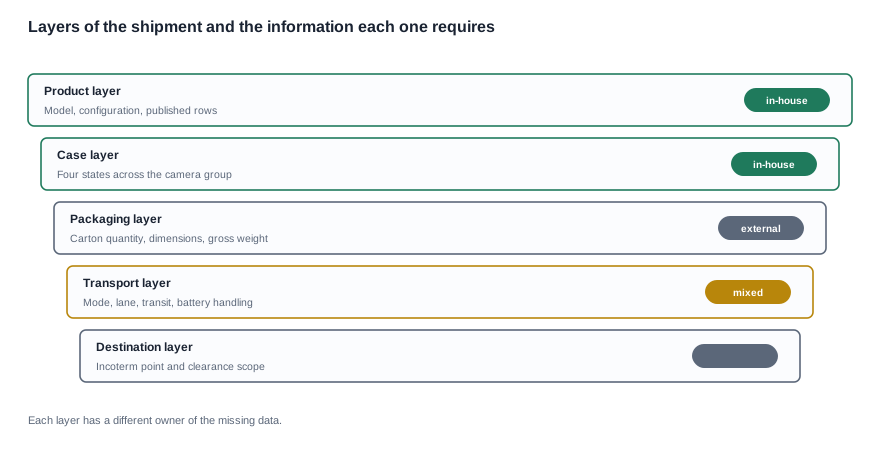
The most persistent mistake in logistics planning for this category is the assumption that a smart-glasses order is a box of identical units. On OEM ready platforms it usually is not, and the assumption is what makes freight quotes, carton counts and receiving plans wrong before the first pallet is opened. OEM ready platforms ship configurations where the glasses, the charging case, the packaging language, the artwork and the accessory set differ from model to model — and in some cases differ between units of the same model. Planning has to be done at the level of the multi-part box, not the unit.

The second misconception is equally expensive: that a published specification row tells you what will fit in a carton. It does not. The catalogue publishes cell capacities, runtimes, charge times and charging methods, and exactly one weight figure across twenty-eight models. Everything a freight quote depends on beyond that is either unpublished or is yours to ask for, and this article is about which is which and what to ask.
OEM ready platforms and the box that decides the carton
Start with the clearest case in the range, because it makes the structure visible. The camera group holds eleven models, and their charging-case position falls into four distinct states rather than a simple yes or no.
Five of the eleven publish a charging-case capacity: the CY05 and the L1 Pro, and the CY03 each publish a 1400 mAh case; the L2 Utral publishes a case row reading 900/1400mAh; the MT6 publishes a 1200 mAh folding case. Two more — the KY06 and the MT5 — show a case in their charging row and publish no capacity for it. Three — the V03 and the S7, and the V06 — publish no charging-case row at all, which is an absence of information and not a statement that they ship without a case. One, the V03 Pro, has no charging-case row.
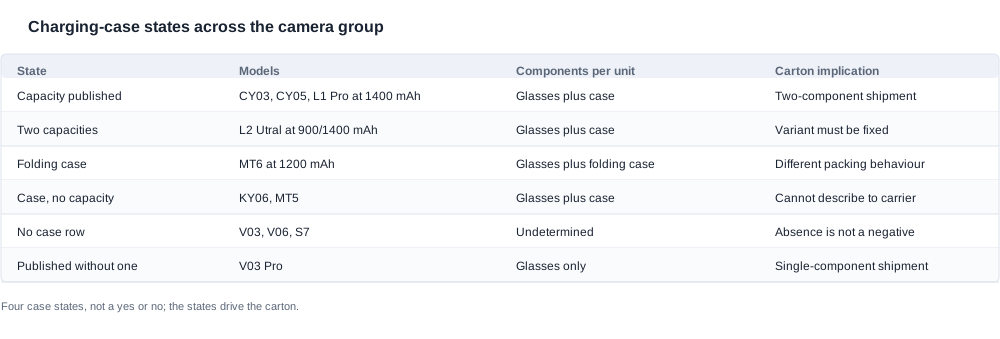
Four states means four carton implications, and this is the core of the misconception. A model with a 1400 mAh case is a two-component shipment per unit. A model with a folding case is a two-component shipment with a different packing behaviour. A model with a case of unpublished capacity is still a two-component shipment, but one whose second component you cannot yet describe to a carrier. A model with no case is a single-component shipment. A buyer who plans one carton for all of them will be wrong on at least three.
The published-versus-unpublished discipline applied to cartons
Two related cautions follow from the table. First, do not convert "no case row published" into "no case". The V06 and the V03, and the S7 are simply not described on that point, and treating absence as a negative is how a carton gets built for a product that arrives with a case in it. Second, do not convert a case capacity into a case weight. The 1400 mAh figure is a capacity, not a mass, and no case weight is published anywhere in the range.
What a carton plan actually needs
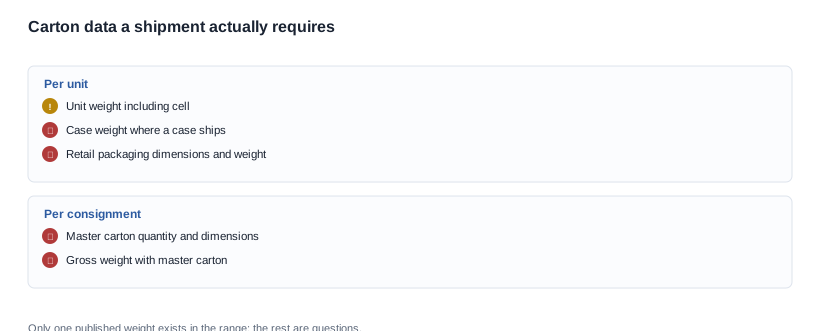
A carton plan requires five numbers per configuration, and only one of the five is published anywhere on this platform. The five are: the unit's own weight including its cell, the case weight where a case ships, the retail packaging dimensions and weight, the master-carton quantity and dimensions, and the gross weight with the master carton.
The single published figure is the MT6's 158 grams, and it needs careful handling: it is the weight of the glasses body including its 265 mAh cell and its camera, and it excludes the 1200 mAh folding case. It is not a frame weight, it is not a product weight and it is not a shipping weight. A buyer who uses it as a shipping weight will under-declare the goods by the entire mass of the case.
That single figure is still genuinely useful, and it is worth saying why: it is the only place in the range where a buyer can sanity-check a weight quoted by a carrier or by a supplier. Everywhere else, the weight is a question to ask.

The four unknowns that make freight quotations move
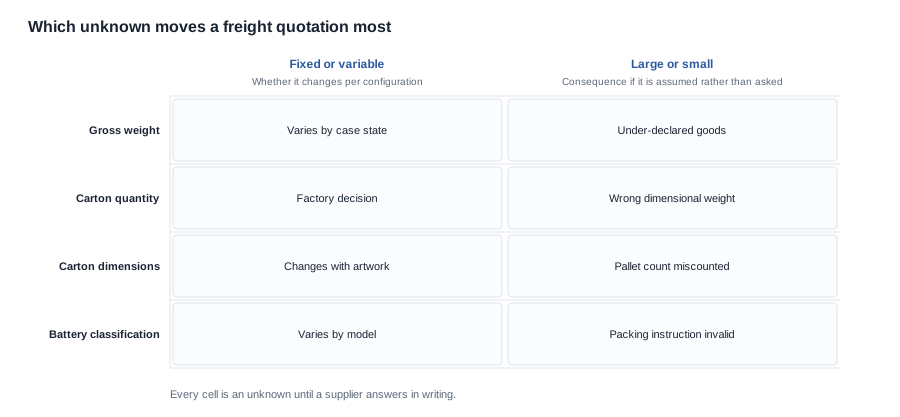
A freight quotation is a function of the numbers above, and when those numbers are unknown the quotation moves. Four of them move most often.
Gross weight per configuration. Different case states produce different weights for the same nominal product, so a single weight per model is not achievable across a range. Ask for gross weight per configuration including the retail packaging.
Carton quantity. Whether the master carton holds twenty units or six changes the dimensional weight, the pallet count and the handling charge. It is unpublished here and it is a routine question.
Carton dimensions. These are a factory packaging decision that changes with the artwork, the packaging language and the accessory set. A model that ships with a case and a multilingual carton is not dimensionally the same as one that ships bare.
Battery classification. The cell count and capacity determine the transport classification and the packing instruction, and the case states mean the count varies per model. The CY05 and the CY03, and the L1 Pro each travel with a 1400 mAh case in addition to their own cell; the MT6 travels with a 1200 mAh folding case; the KY06 and the MT5 travel with a case whose capacity is not published, which means the classification question cannot be answered from the catalogue at all.
Where the charge-time row fits, and where it does not
A word on a figure that gets misused in logistics planning. Every model in the range publishes a charge time, and twenty-six of the twenty-eight publish two hours or less as a ceiling, with the D17 and the ZH12 publishing roughly one hour. That is a charging specification inside the product's own cycle. It is not a case turnaround time, not a shelf-replenishment rate and not an indicator of how long a unit occupies any part of your warehouse.
The reason it matters for logistics is that a number like that invites a second inference, and the second inference is the wrong one. It is tempting to read a short charge time as a reason to ship with fewer units in the carton, on the assumption that units will be charging in transit. Nothing about a charge-time ceiling supports that, and the charging-method row is the one that actually determines how a unit is handled: seventeen of the twenty-eight entries publish magnetic charging, seven publish Type-C, and four — the MT6 and the CY05, and the CY03 and the L1 Pro — publish no charging-method row at all.
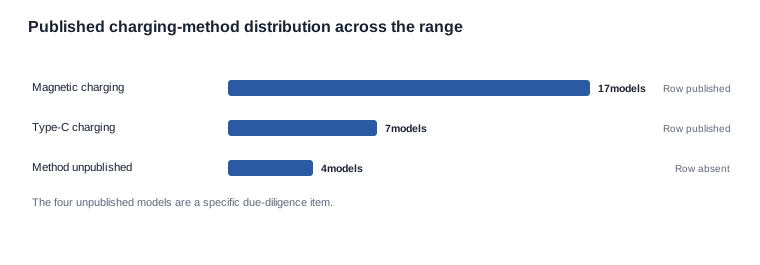
Those four unpublished models are a specific logistics due-diligence item. You cannot write a packing instruction or a warehouse procedure for a model whose charging method is not published, and you cannot infer it from a sibling model. Ask for it.
Route and incoterms as risk allocation
Freight planning is usually discussed as a choice between modes, and it is more usefully discussed as a choice about which party carries which risk across the point where the goods change hands. The incoterm does not change who pays for freight; it changes where responsibility for the goods passes, and that is what determines what you need to have in place before the shipment leaves.
For a brand owner running a private-label programme on this platform, three points deserve explicit attention.
Where risk passes relative to your inspection. If responsibility passes before you can inspect, the inspection you perform afterwards is a claim process rather than a receiving check. Deciding which model group needs pre-shipment inspection and which does not is a risk decision, and it should be made per configuration rather than per programme.
Who handles the destination paperwork. The export document set for this platform has to name the model it covers, and a mismatch between the model on the document and the model in the carton stops a consignment at the border. Building that set before the goods ship removes an entire category of delay from the receiving clock.
What happens to a carton that is short on arrival. Shortage and damage remedies depend on the contract and on the evidence you hold. A per-carton count recorded at receiving, cross-referenced to the packing list and the purchase order, is the minimum evidence position — and it is much easier to hold if the master-carton quantity and count are agreed in advance.
Consolidated versus direct shipment
Consolidation reduces the unit freight cost and increases the number of parties between you and the goods. Direct shipment costs more and reduces the number of handoffs. Neither is better in general; the question is which failure you can absorb more cheaply.
A buyer whose launch date is fixed and whose volume is modest is usually better served by accepting a higher freight cost in exchange for fewer handoffs and a shorter chain of custody. A buyer with stable volume, a flexible date and good receiving capability can usually take consolidation. The mistake is choosing on unit price alone, because the freight saving on a consolidated lane is frequently smaller than the cost of one delayed consignment.

What a freight quotation has to state
The gap between what a buyer needs and what a freight quotation provides is usually a set of missing conditions. Asking for them in advance costs one message.
- The configuration quoted, stated as model, colourway and case state.
- Gross weight per unit including retail packaging, and gross weight per master carton.
- Master-carton quantity and dimensions.
- Total cartons and total gross weight for the consignment.
- The battery count and capacity that travel per unit, which for some configurations includes an unpublished case.
- The shipping mode, the lane and the estimated transit time.
- The incoterm named explicitly, and the point at which responsibility passes.
- Whether the quotation assumes customs clearance and destination charges are included.
- Whether the quotation is valid for the stated configuration only, or is a range-wide figure.
- What changes the price — volume, carton quantity, mode or lane.
That last item is the one most often left out and most often regretted. A quotation that does not state what it assumes is not a price; it is an indication, and the difference between the two becomes visible at the worst moment.
Receiving: the part of logistics the buyer owns
Logistics planning frequently stops at the port. It should not, because the receiving clock is the one the buyer controls most directly and the one most often underestimated.
Three things determine whether receiving is fast. Whether the export documentation was complete before arrival. Whether the expected configuration was recorded on the packing list in a form the receiving team can check against — a model designation alone is not enough when four case states exist across a camera group. And whether the master-carton count was agreed in advance, so that a shortage is visible at the carton rather than discovered after put-away.
A standing checklist for the second shipment onward
The first consignment is improvised because everything is being established at once. The second is where a standing checklist pays for itself, because the questions are known and the answers can be requested as routine rather than as an exception.
The standing set is short: confirm the configuration against the purchase order before packing; confirm the case state per model on the packing list; confirm the gross weight basis before the cartons are sealed; confirm that the export document set names the model designation; and confirm the master-carton count so that a shortage is visible at the carton. Each of these takes minutes to ask and each prevents a category of dispute that is expensive to resolve afterwards.
Running the same checklist on every consignment also produces something more valuable than problem-solving: a comparison between quoted and actual figures, shipment after shipment. That comparison is the only reliable basis for renegotiating a lead time, a freight rate or a minimum order quantity, and it is far stronger than any argument a buyer can make from a single delivery that went well.

Auditing a supplier's shipment data before you accept it
Freight planning fails at the boundary between what a supplier says and what a buyer verifies. That boundary has a procedure, and running it before the first shipment is far cheaper than running it after a claim.
The audit has one rule: every number a carrier will use must come from a document, and every document must name the configuration it describes. A quotation that says "gross weight 0.6 kg" without saying whether that includes the case, the retail packaging and the carton tells you nothing usable, because on this range those four combinations produce four different figures for the same model.
Five checks that catch the usual errors
Check the model designation against the packing list. Not the marketing name — the designation the supplier publishes. Where a page carries more than one name, such as the L2 Utral's side-by-side Utral and Pro Max, the packing list has to name one of them consistently, because the receiving team checks cartons against that string and a mismatch stops the count.
Check that the case state is stated, not implied. Four case states exist across the camera group. A packing list that lists eleven camera models without a case column has not given the receiving team enough to count against, and a count made without that column is not evidence.
Check the weight basis. Ask whether the figure is per unit, per unit with retail packaging, per master carton or per consignment. All four are quoted in the industry and they are easy to confuse. The one published weight in this range — the MT6's 158 grams for the glasses body, excluding its folding case — is a reminder of how easily the basis gets lost in transit.
Check the battery declaration against the configuration. For a configuration that ships with a 1400 mAh case, the consignment carries more than one energy-containing component per unit. Where the case capacity is unpublished, as on the KY06 and the MT5, the declaration cannot be completed from the catalogue and has to be requested.
Check that the quotation states its own assumptions. A freight quotation without a stated basis is an indication rather than an offer, and the gap between the two appears at the moment the goods are ready.
What to do when the data stays unavailable
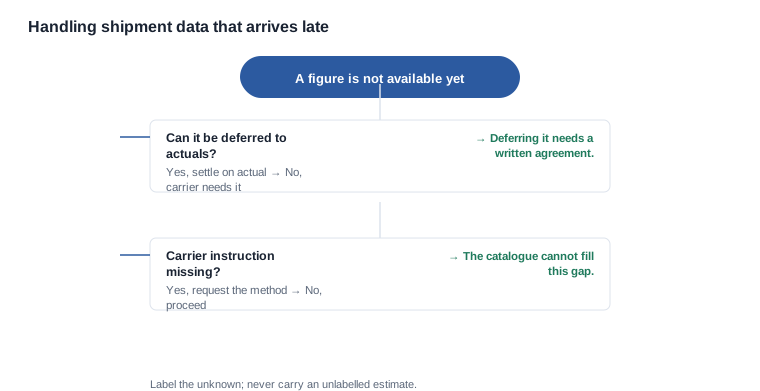
Sometimes a supplier genuinely cannot answer one of these before production. That is not a reason to abandon the shipment, but it is a reason to decide where the risk sits.
The workable approach is to name the unknown explicitly and attach a handling rule to it. If gross weight per configuration is not available before shipment, agree that the figure will be provided with the packing list and that freight will be settled on actuals. If the case capacity is not published, ask the supplier to state the packing instruction they will follow, and record that the carrier instruction and the catalogue do not agree — because that gap is the one that causes a refused consignment.
The mistake to avoid is filling the gap with an estimate and carrying it silently. An estimate that is labelled as an estimate is a managed unknown. The same estimate unlabelled becomes a fact that appears in your records, your insurance and your freight reconciliation, and nobody will remember that it was a guess.
Planning the first consignment as a rehearsal
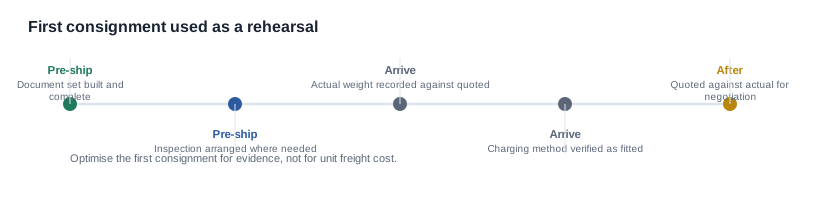
A first consignment is worth treating as a rehearsal for the rest, and that framing changes what you optimise for. A buyer planning for steady-state freight cost optimises for price. A buyer planning the first consignment should optimise for evidence.
That means accepting a slightly slower lane in exchange for a clean document set, accepting a pre-shipment inspection in exchange for a clear remedy position if something is wrong, and recording actual figures against every quoted one. The first consignment is the only occasion on which you can measure the difference between a quoted lead time and a real one, between a quoted gross weight and a real one, and between a stated charging method and the one actually fitted.
Keep those comparisons. They are the basis of every subsequent negotiation, and they are the difference between a buyer with data and a buyer with opinions. On a platform where the commercial terms are unpublished, the buyer who has measured the first shipment accurately is the one who can negotiate the second one properly.
One further criterion before you commit
Before accepting a shipment plan, apply one test: could a carrier, a customs broker and your receiving team all read the same documents and reach the same conclusion about what is in each carton? If not, the plan is not finished regardless of how accurate the individual figures are. This is the criteria that catches most of the remaining errors, because it tests the document set rather than any single number in it.
The ten questions, in the order they should be asked
- Gross weight per unit including retail packaging, per configuration.
- Gross weight of the case, where a case ships, per configuration.
- Master-carton quantity, dimensions and gross weight.
- The battery count and capacity travelling per unit.
- The charging method, for models whose page does not publish one.
- The accessory set included per configuration.
- Whether carton quantity or configuration changes price or lead time.
- The incoterm offered, and where responsibility passes under it.
- Whether packing and labelling are to one language or to a stated set.
- What the supplier considers a complete packing list.
None of these ten is published on this platform, and all ten are ordinary. We will not state a shipping weight, a carton specification or a freight cost that our documentation does not support; what we will do is tell you which of these answers depend on the configuration you choose and which are fixed for the range, so the shipment plan is built against facts rather than assumptions.
Send us the models, the configurations and the destination lane, and we will mark which of the ten are fixed by your choice of model and which have to come back as a written answer.
Related reading
- The clock that receiving sits inside — how lead time is actually built
- The paperwork that has to be ready at the border — the export documentation set to ship
- Carton and cash-cycle decisions — inventory planning that survives
- Terms that change with quantity — minimum order quantity for private label


