

Smart glasses shipping is where a procurement programme loses its schedule most often, and it is almost never because the factory did something careless. The seven mistakes below are the ones that reach a brand-side buyer as a surprise, and every one of them is a decision that was made in a conversation rather than written into the order. The freight rate is the least of them. What breaks a programme is a consolidation rule nobody agreed, a carton specified for a shelf instead of a route, a battery file assembled after the production slot, and a duty treatment that was never in the cost model. Each of those has a control, and each control costs nothing at quotation stage and a great deal after the container is sealed.
Smart glasses shipping mistakes that reach the buyer as a surprise
The short answer on the seven mistakes
The seven mistakes in this article are not exotic. They are the ones that a buyer could have prevented with a line in the purchase order and did not, because the conversation was about price and the freight was one line inside it. Two of them — the consolidation rule and the chargeable weight — cost money. The other five cost schedule, and schedule on a launch window costs more than freight ever does.
The one-line answer: every mistake below is a decision that was never written down. A quotation is not a specification. If the shipment rule, the packaging standard, the case capacity, the importer of record and the release conditions are not in the purchase order, then they are not fixed, and the party that defines them on the day is the party that does not have to explain them.
If you take one action from this article, take this one. Before the next order, write a configuration string — model, case capacity, interface, colour, carton, quantity, dated — and require the freight quotation to be issued in the same document as the product quotation, with the shipment rule and the solo-shipment rate written out. Almost every mistake in the list disappears when those two things are true.
The buying task behind the mistake list
The reader here is a buyer working for the brand, a channel buyer or an importer. Three situations bring them to this question, and each one is a different decision. The first is comparing two quotations that differ by more than the margin can carry, and the question is which of them is comparable. The second is opening a new programme and a new material number, and the question is what has to be in the specification before anything is quoted. The third is a programme that has already shipped once and did not go the way it was planned, and the question is which of the seven controls was missing.
What the reader is actually managing is a set of decisions that were made in a conversation and never written down. Each of the seven mistakes in this article is one of those decisions, and each of them is invisible at the moment it is taken — which is exactly why a programme that has already lost a week to one of them rarely connects that week back to the conversation that caused it.
The practical question a buyer is managing is therefore: which of the two or three suppliers in front of me can actually build, document and ship what I have written down? A supplier who has done the work will answer that question with a document. A supplier who has described the work will answer it with a sentence.
The seven mistakes, named
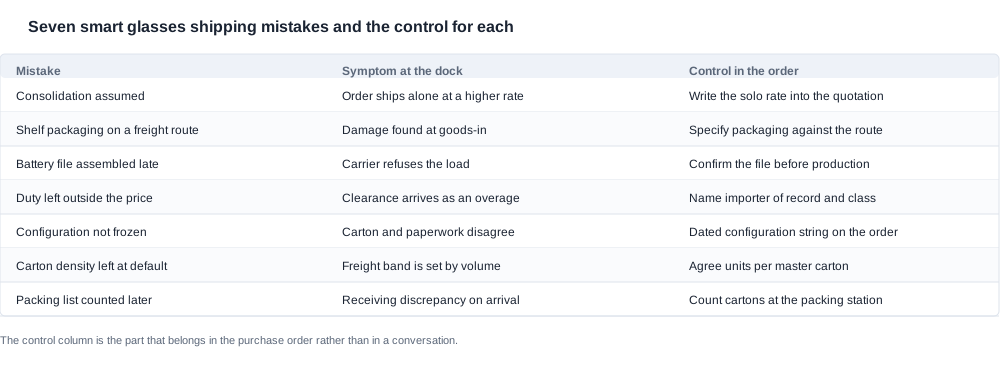
Here they are in one list, with the symptom each one produces and the control that prevents it. The controls are deliberately ordinary: they are things that can be written into a purchase order, not things that need a quality department.
| Mistake | Symptom at the dock | Control in the order |
|---|---|---|
| Consolidation assumed | Order ships alone at a higher rate | Write the solo rate into the quotation |
| Shelf packaging on a freight route | Damage found at goods-in | Specify packaging against the route |
| Battery file assembled late | Carrier refuses the load | Confirm the file before production |
| Duty left outside the price | Clearance arrives as an overage | Name importer of record and class |
| Configuration not frozen | Carton and paperwork disagree | Dated configuration string on the order |
| Carton density left at default | Freight band is set by volume | Agree units per master carton |
| Packing list counted later | Receiving discrepancy on arrival | Count cartons at the packing station |

Where each mistake is still cheap to correct
The value of the list above depends on one thing: each mistake has a stage at which it is still cheap to correct, and that stage is earlier than most buyers think. A mistake corrected at quotation stage costs a question. The same mistake corrected after the booking costs a week. The same mistake corrected after arrival costs a launch window.

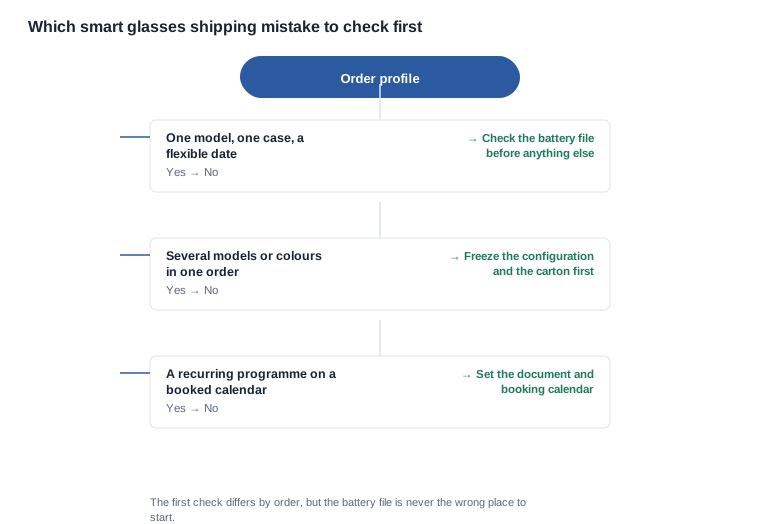
The order of the checks matters more than the number of them. A buyer who has three models in one order and a flexible date should be examining the carton and the configuration before the rate; a buyer with one model and a booked calendar should be examining the consolidation window and the release conditions. The decision path below is the way to work out which mistake is worth your attention first on a given order.
Stage by stage, who owns the fix
At quotation stage, the buyer owns the fix entirely, and the questions are cheap: what shipment rule does this price assume, what is the rate if the goods ship alone, is the packaging specified against this route, and who is the importer of record. None of these needs a sample and none of them needs a factory audit. A supplier that cannot answer all four in writing at quotation stage is telling you something you want to know before the deposit, not after it.
At specification stage, the buyer and the factory share ownership, because the case capacity and the colour determine the carton and the artwork. This is the point where the published configuration data is most useful. Our catalogue publishes case capacities of 900 mAh, 1200 mAh and 1400 mAh across the camera models — the L2 Utral is published at both 900 and 1400 mAh, the MT6 with a 1200 mAh foldable case, and the CY03, CY05 and L1 Pro with a 1400 mAh case. Three case capacities, and therefore three different cartons.
At documentation stage, the file is opened for the market route. This is the longest lead in the chain and the one that is most often started late, because the documentation route depends on the destination and the product category rather than on the colour. Every model in the range ships with a lithium cell, so the battery transport file applies to every consignment without exception.
At production and packing stage, the factory owns the fix, and the requirement is a station rather than an instruction. A configuration check at packing, a carton count that is counted rather than estimated, and a gross weight that is recorded on the packing list are three lines of work that any factory with a shipping procedure can do, and any factory without one will find difficult.
At booking and receipt stage, the controls are calendar items. The consolidation window is diarised, the release conditions are confirmed with the carrier in advance, and the packing list is reconciled against the cartons as they arrive.
The controls that belong in the order
What makes a control effective is that it is written down with an owner and a date, and the three documents that need it are the purchase order, the quotation and the shipping instruction. The purchase order carries the configuration string, the packaging reference, the transport document set, the importer of record, the duty treatment, the incoterm with a named place, and the consequence of a late or damaged consignment. The quotation carries the shipment rule and the solo rate. The shipping instruction carries the release conditions and the consolidation window.
The logistics and shipping section sets out the wider sequence these documents sit in, and the sample policy and SOP template article shows how a factory turns these controls into a written procedure that a third party can audit.
What each mistake costs when the failure finally arrives
Each failure below is written as what the buyer sees, why it happens, and what stops it. They are ordered by the point at which they become irreversible, not by how often they occur.
One: the shipment that went alone
What the buyer sees. The consolidation window closed before the order was ready, the goods travelled as a single consignment, and the freight rate applied was materially higher than the one on the quotation. The invoice is correct, and the buyer discovers that the quoted rate assumed a volume the order did not reach.
Why it happens. The quotation was issued for a consolidated movement without stating the consolidation assumption, and the solo-shipment rate was never written down. A rate with no fallback is a rate that cannot be planned against.
What stops it. Agree both numbers — the consolidated rate and the rate for a consignment that travels alone — and treat the solo rate as the budgeted cost, not as a penalty. This is the shipping weight article in practice: the chargeable basis and the rule behind it are one question, asked together.
Two: the packaging that was chosen for the shelf
What the buyer sees. Units arrive with damage that is not a defect: crushed corners, scuffed retail cartons, a lens mark on a unit that was packed in a box designed to sit on a shelf rather than to travel on a pallet.
Why it happens. The packaging was specified as a product attribute, by a buyer or a factory, and the route was never part of the specification. A retail carton and a freight carton are different objects with different costs and different test conditions.
What stops it. Specify the packaging against the shipping route — the drop, vibration and moisture conditions it has to survive — and name the person who approved it against that route. A packaging approval signed against the shelf and not against the route is the most common single line in the failure list.
Three: the consignment that was stopped in transit
What the buyer sees. The carrier accepts the consignment and then holds it, or refuses it at the acceptance point, and the answer is a document. For a lithium-powered product the document is the battery transport file: the test summary and the packaging arrangement for the cell that is actually in the box.
Why it happens. The paperwork was assembled after the goods were ready, because it is the one item on the list that nobody is chasing until a broker asks for it. It has the longest wait and the shortest tolerance of anything in the chain.
What stops it. Confirm the file before the production slot is confirmed, not before the goods are collected. The cross-border logistics planning article covers how to open the route early, and the camera and audio range page lists the configurations the file has to cover.
Four: the duty that was never in the model
What the buyer sees. Clearance and import handling arrive as an overage on a landed cost that was built from a quotation that treated duty as somebody else's problem. The comparison between two suppliers then becomes meaningless, because one quotation included destination charges and the other did not.
Why it happens. The declared classification, the origin treatment and the identity of the importer of record were not on the quotation, so there was nothing to compare and nothing to budget.
What stops it. Put three items on the quotation: the classification, the origin treatment, and the named importer of record. Where the destination is a market with a documentation route, the most useful clause is the one that assigns a classification dispute to the party that wrote the technical file, because that is the party with the data to settle it.
Five: the configuration that was never frozen
What the buyer sees. The carton artwork, the invoice and the file describe three different products. A picking error puts a 900 mAh case in a carton labelled for 1400 mAh, and the receiving discrepancy is discovered at the warehouse rather than at the factory gate.
Why it happens. The configuration was agreed in a conversation and in a spreadsheet, and nobody issued a dated string that the artwork, the packing list and the declaration were all built from. Our catalogue publishes the configuration differences — the V03 Pro in three colours, the V06 in four, the L2 Utral at two case capacities — and each of those is a decision that has to be frozen somewhere.
What stops it. One dated configuration string per order, referenced by the artwork approval, the packing list and the purchase order. A configuration change is a new string, not a correction to the old one.
Six: the carton density nobody set
What the buyer sees. The freight bill is higher than the quote suggested, and the explanation is the volumetric calculation. The packed product is dense, the retail box is not, and the master carton is a default rather than a decision.
Why it happens. Nobody set the number of retail boxes per master carton. It is the one shipping variable in this category that the buyer can change without changing the product, changing the tooling, or asking anyone's permission.
What stops it. Agree units per master carton at the specification stage, and treat the resulting packing density as a margin line with an owner. It is the cheapest improvement available in a programme of this kind, and it is invisible to a factory that is only asked for a price.
Seven: the packing list that was counted later
What the buyer sees. A receiving discrepancy at the warehouse: fewer units of one configuration than the paperwork claims, or more. The reconciliation takes a week and stops everything behind it.
Why it happens. The carton count on the packing list was estimated at packing rather than counted, because counting is slower than estimating and the deadline was close.
What stops it. Count the cartons and record the gross weight at the packing station, not at the warehouse. It is thirty seconds of work per carton and it is the difference between a discrepancy and an undisputed receipt. The criteria here are simple, and they are what a buyer should evaluate when comparing two quotations: the same question to both suppliers, in the same order, before the numbers are compared at all.
The red flags worth naming in advance
Before the list of individual mistakes, it helps to have the general red flags in one place, because they are the same in every programme and they are what a due diligence review actually turns up. A figure with no condition behind it. A specification that names a product family rather than a buildable configuration. A date with no owner. A quotation whose freight line cannot be rebuilt from the packed dimensions and the weights. A total cost that stops at the port. Those five patterns account for most of the failures in this category, and each of them can be converted into a question before the order rather than a remedy after it.

The questions to put in the first round of a supplier enquiry
Verification in this category is a document drill with a physical check at the end, and it works best when it happens against the same documents you intend to sign — before the deposit, not after the first shipment. Each question below has a completion test: a written answer, a document, a number, or a named owner. A verbal assurance is not a completion test, because a transport question answered verbally is a transport question that gets re-asked at the dock.
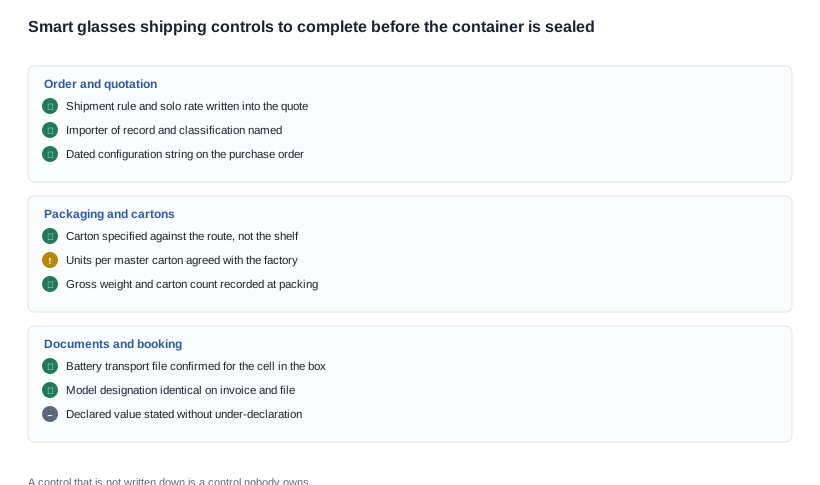
Nine questions, in the order to ask them
-
What shipment rule does this price assume, and what is the rate if the goods travel alone? Completion test: two numbers, in writing, in the quotation. This is the first question because it establishes whether the quotation can be planned against at all.
-
Is the packaging specified against this shipping route, and who approved it? Completion test: a packaging reference and a name. A packaging specification with no route behind it is a retail carton.
-
Which transport documents will accompany a battery-equipped consignment, and who prepares them? Completion test: a document list with a named owner and a date. Do not accept a list that does not cover the cell in the box you are ordering.
-
Who is the importer of record, and how are duty and clearance treated in this price? Completion test: a named party, a stated basis, and either an itemised line or a written statement that it is bundled. Both are acceptable; silence is not.
-
What is the model designation that will appear on the invoice, the artwork and the file? Completion test: one string, identical in all three places. If the supplier cannot name it, the artwork and the file will not agree.
-
How many retail units go into a master carton, and what are the packed dimensions? Completion test: a number and a dimension. This is the input to the chargeable weight, and it is the one the buyer can change.
-
What is the release condition set for this consignment? Completion test: a list the carrier will actually check. A booking is not a release, and a release is not a delivery.
-
What happens to a unit that arrives damaged, short, or not matching the configuration? Completion test: a process with a named contact, not a policy statement. The supplier verification article sets out how to test this before you rely on it.
-
What will you quote per unit, per carton, and per consignment, and at what volumes does each change? Completion test: a cost basis with break points. A single blended figure cannot be scaled into a programme.
One page, in the order the goods move
Take the answers and write them into one page before the order, in the order the goods will move. The page has three columns: what was agreed, who owns it, and the date by which it has to be true. That page is the cheapest insurance in the whole category, because it is the only artefact that survives a supplier change, a forwarder change and a year of growth.
Then do one physical check. Take a sample unit, photograph the markings, and compare the model designation against the designation on the quotation. This takes two minutes and it catches the single most common error in the list, which is a file or an artwork written for an earlier build of the same product.
The criteria for evaluating a supplier on this basis are worth stating plainly, because they are what separates a supplier who has done the work from one who has described it. The first is that the answer arrives in writing, with a document behind it. The second is that the document is dated and has an owner. The third is that it covers the configuration you are ordering and not a neighbouring one. A supplier who meets all three can be audited; a supplier who meets the first two can be asked again; a supplier who meets none of them is selling you a description of a capability rather than the capability. Before you order, run the sequence against both suppliers, because how a buyer asks the questions tells a supplier something too.

Turning each mistake into a line in the purchase order
A control that exists only in an email is a control that disappears when the person who wrote it changes role. The seven controls in this article are all expressible as purchase-order lines, and the version below is written the way a brand-side procurement manager can send it to a supplier for comment.
The clauses that carry the controls
The configuration clause names the model, the case capacity, the interface, the colour, the carton, the quantity and the date, and states that any change is a new configuration string requiring a new written approval. This one clause prevents mistakes five and six.
The packaging clause references the packaging specification by document and revision, and states the route conditions it is specified against. It prevents mistake two, and it costs nothing because the specification usually already exists.
The document clause names the transport document set, the party responsible for each item, and the date by which each must be in place relative to the production slot. It prevents mistake three.
The customs clause names the importer of record, the declared classification, the origin treatment, the basis on which the value is declared, and what happens if the classification is challenged. It prevents mistake four.
The shipment clause names the consolidation rule, the solo-shipment rate, the incoterm with a named place, the booking cut-off and the release conditions. It prevents mistake one and it gives the buyer a schedule to plan against.
The conformity clause states what happens to a consignment that arrives short, over-shipped, damaged, or not matching the configuration string, and names the person who is contacted. This is the clause that converts a returns problem from a dispute into a process.
Two clauses worth negotiating, and one that is not
Two of these clauses are genuinely negotiable and one is not, and confusing the three is expensive. The consolidation window and the solo rate are negotiable, because they depend on the supplier's consolidation schedule and on how the factory is prepared to hold goods. The packaging specification is negotiable in scope but not in principle: a supplier may propose a different carton, but a carton that is specified against the shelf rather than the route is not a negotiation, it is a defect.
What is not negotiable is the cost and cycle of certification itself, and the reason is structural rather than commercial. Testing and registration are per product family and per market. They do not fall with volume, they do not fall with a longer contract, and they cannot be amortised across orders that use a different configuration. The useful question about that cost is not whether it can come down but whether the scope is right, because an unnecessary market in the quotation is a cost the buyer chose.
What the incoterm has to travel with
Incoterms belong in the purchase order rather than in a side letter, and the reason is that a change of term moves three things at once: the point at which risk passes, the obligation to insure, and the point at which the customs entry is filed. If those three are separated, the buyer ends up carrying a risk they thought they had sold, and the forwarder is left defending a position that the documents do not support.
The same applies to a shipment rule. A rate quoted for a consolidated movement, a release condition, and an incoterm are three parts of one mechanism, and a buyer who negotiates one of them without the other two has moved the price and not the risk.
What we publish, what we do not, and what to send us
Here, the published catalogue is the part of the specification we can stand behind, and the rest is a question for a supplier's own file. We publish the configurations, the case capacities, the interfaces, the colours and the endurance figures, and we mark the rows that are open rather than filling them with a typical figure from a general data set. A buyer who builds a claim on an estimated number finds the error in the field rather than in the quotation, and what the correction costs is more than the question was.
The rows we do not publish for this category are these:
- Packed carton dimensions, gross weights, units per master carton, freight weights and the transport classification for a given configuration, because they depend on the final retail packaging and the destination rather than on the device.
- Our shipping terms, freight cost, transit times and customs handling arrangements, because they depend on the destination, the incoterm and the composition of the order.
- Minimum order quantities, production lead times and production capacity, because they are a commercial position rather than a specification and they change with the programme.
- Certificate numbers, issuing bodies and validity dates, and any per-model certification line. The catalogue includes a company-level export certification page, but it does not carry a per-model certification row, and we will not infer one from a company-level capability. Buyers will ask for CE, FCC and RoHS evidence, and for each of those the honest answer is which document is held for which model and which is not held.
- Per-model weight for all but one model. The catalogue publishes the MT6 glasses body weight at 158 g, which includes the 265 mAh battery and the camera and excludes the foldable charging case; the case weight is not published, and no other model has a published weight at all.
What we will do is take a configuration, a quantity and a destination market, and tell you which parts of the shipping arrangement are settled, which are open, and which have to come from a forwarder. We will itemise freight against a given configuration rather than quote a standard rate per unit, because a rate without a carton, a destination and a mode is not a rate.
Related reading
- Preparing a shipment for a cross-border sale — opening the route before the slot
- Shipping weight and the chargeable basis — the input that decides the freight band
- Sample policy and SOP template — turning the controls into a written procedure
- Camera and audio smart glasses range — the published configurations
- Logistics and shipping — the wider sequence
Send the configuration, the quantity and the market, and we will say which of the seven mistakes is already closed for you and which one is still open.


