

Smart glasses for content creation: the question a channel's claim set must answer
A content channel is not built on a specification sheet. It is built on a claim set: a short list of sentences the channel can say out loud, defend in a comment thread, and repeat without a supplier contradicting them. For smart glasses for content creation, the published catalogue rows are enough to make a defensible claim set, and they are not enough to make a competitive one. That gap is the whole subject of this article, because a brand that mistakes a published row for a capability ends up with a listing that a single customer video can take apart.
Three decisions have to be settled before a content channel is real: which tier the channel starts on, what the listing is allowed to claim, and what evidence the channel is going to produce itself. None of them is a product decision in the usual sense. All three are procurement decisions with an evidence chain attached, and each one has a document behind it.
The rule that follows from this is short. Everything the listing says must trace to a published catalogue row or to a measurement the channel has run and can repeat. Everything else is a marketing decision with a return exposure, and the exposure lands on the channel that made it rather than on the factory that built the unit.
What the catalogue publishes, and what that licenses a listing to say
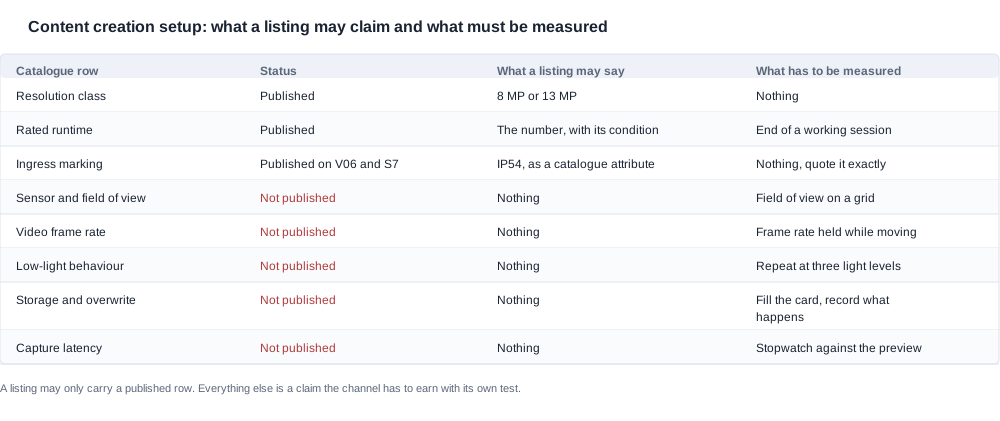
The published rows in this category are specific and narrower than most buyers expect. The catalogue covers twenty-eight models. Eleven of them carry a camera: the CY03 and the V03 Pro, the V06 and the CY05, the L1 Pro and the MT5, the L2 Utral and the KY06, the V03 and the MT6, and the S7. Eight are audio models: the D11 and the D12, the K01 and the LC-105-1, the G07 and the LC-105-2, and the K02 and the YK12. Three are sport models: the YKC02, the D17 and the ZH12. Charge time, rated runtime and cell capacity are published for all twenty-eight. The charging interface is published for all but four camera models. Two camera models, the V06 and the S7, carry an IP54 marking. One model, the MT6, has a published whole-unit weight of 158 g.
What that set of published rows licenses a listing to say is equally specific. A listing may state a resolution class: eight of the eleven camera models are published at 8 MP, and three — the L1 Pro and the L2 Utral, and the S7 — are published at 13 MP. A listing may state the rated runtime, provided the condition is attached, and no runtime in the range carries a published test condition. A listing may state the IP54 marking on the V06 and the S7, as a catalogue attribute covering splashing water and a dust protection level, because no third-party test report is published behind it. A listing may state the charging interface for the twenty-four models where the catalogue publishes one.
The reader, the decision, and the commercial risk behind it
The reader is a brand owner or a channel operator deciding whether to build a content programme around this hardware, or a procurement manager who has been asked to justify that decision with a unit price and a spec. The decision is what the channel publishes, on which tier, and what it can prove when a competitor's comment claims the footage is better. The risk being managed is the one that arrives after launch: a listing sentence that cannot be defended, discovered by a customer rather than by the channel, ending in a refund, a bad review and a repricing of the whole category in that market.
That risk is unusually concentrated in this category because the gap between a published row and a customer expectation is wide. A buyer can compare a case capacity directly. Nobody can compare a camera from a catalogue row, because the catalogue does not publish the sensor, the field of view, the video resolution and frame rate, the stabilisation, the low-light behaviour, the storage and overwrite behaviour, the capture latency, the thermal behaviour, the standby draw, the cycle life rating or the operating temperature range. The camera is the product, and it is the least published part of it.
The catalogue rows that decide whether a content channel can be specified at all
A buyer who has read the catalogue carefully arrives at a conclusion that sounds negative and is actually useful: this category can be sourced on published rows for everything except the camera, and the camera is exactly what a content channel is buying. So the specification work has to move from the supplier's datasheet to the channel's own protocol, and the protocol becomes the technical document that travels with the purchase order.
Resolution class, and the three claims it does not license
The resolution class is the strongest published row a content listing has, and it is still weaker than it looks. "8 MP" and "13 MP" describe the still-image output class of the camera module. They do not describe the video output, and they do not describe a frame rate, a stabilisation behaviour, a low-light floor or a storage policy. A channel that writes "13 MP camera" into a listing and then receives a comment asking for 4K video has a problem that no published row can solve, because the video specification is not published for any model in the range.
The same applies to the three claims that recur most often in this category's listings and have the least support in the catalogue. A frame rate claim is unsupported, because no video frame rate is published. A stabilisation claim is unsupported, because no stabilisation specification is published. A low-light claim is unsupported, because no low-light behaviour is published for any model. These are the three claims a buyer should decide about early, and the decision is usually to leave them out of the listing rather than to chase them, because the evidence chain to support them is a test protocol the channel must run and maintain.
Storage, overwrite behaviour and capture latency
Three unpublished rows matter more to a content channel than to any other buyer, and they are worth separating because they are three different commercial exposures.
Storage and overwrite behaviour. The catalogue does not publish how the camera stores files, how much it holds, what happens when the storage fills, or whether files are overwritten or deleted. For a channel that shoots a full day, this is the difference between a shoot that survives and a shoot that loses its afternoon. The mitigation is not a feature request; it is a test. Fill the storage on a unit from the production batch, record what happens next, and write the result into the incoming inspection criteria. The test is cheap and it is the single highest-value measurement a content channel can make before a large order.
Capture latency. The catalogue does not publish the delay between pressing the control and the file appearing. A channel that previews on a screen has to know whether the delay is a preview artefact or the device. The measurement is a stopwatch against a reference event, recorded on two units from the same batch, because a latency figure that differs between units of one batch is a manufacturing consistency problem rather than a specification.
Thermal behaviour. The catalogue does not publish an operating temperature range, and a channel that shoots outdoors in summer will find the answer by experience rather than by document. The test is to run a continuous capture at the ambient temperature of the target market and watch for a change in the output, and it has to be run on the units that will actually ship, because a first-article sample and a production unit are different evidence.
Picking the tier a content channel starts on
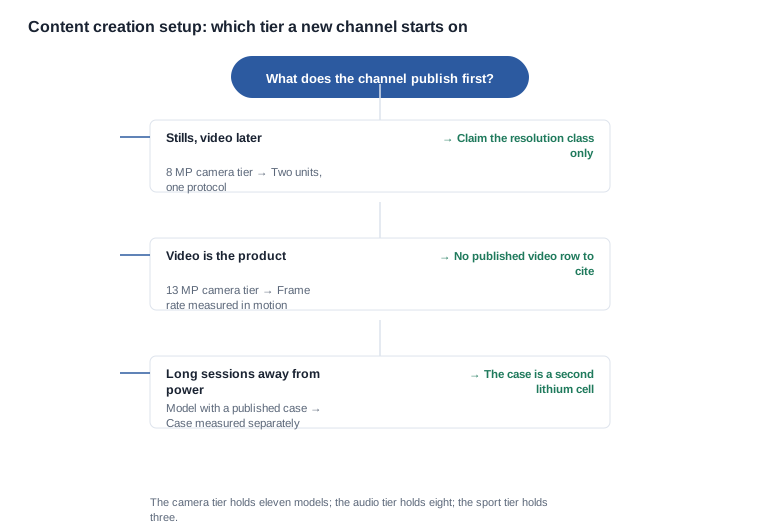
The tier decision for a content channel is made by the first deliverable, not by the price and not by the specification table. A channel that publishes short stills and voice segments has a different requirement from a channel that publishes continuous video, and a channel that publishes from a location without a socket has a third. Because our catalogue separates cleanly into three tiers, the decision is a shortlist of three or four models rather than a scan of twenty-eight.
Session length is the first constraint on any channel
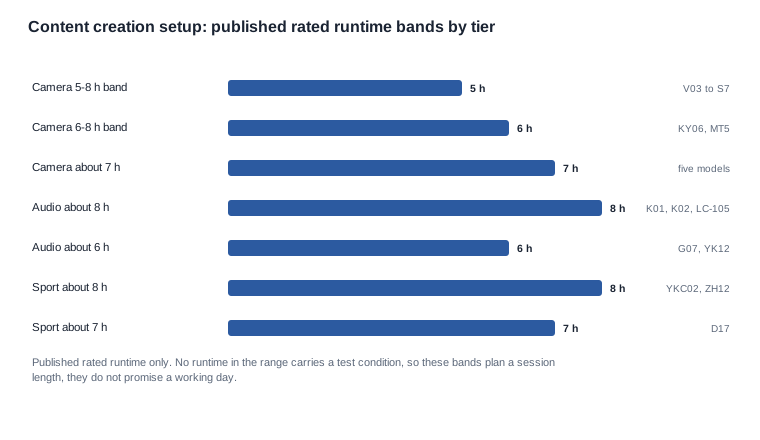
Published rated runtime is the row that governs how long a channel can shoot without a charging opportunity, and the published bands differ by tier. The camera tier publishes 5 to 8 hours on the V03 Pro and the V03, and the V06 and the S7, 6 to 8 hours on the KY06 and the MT5, and about 7 hours on the MT6 and the CY05, and the L1 Pro and the L2 Utral, and the CY03. The audio tier publishes about 8 hours on the K01, the K02 and the LC-105 pair, and about 6 hours on the G07 and the YK12, the two models with slim or removable temples. The sport tier publishes about 8 hours on the YKC02 and the ZH12, and about 7 hours on the D17.
None of those figures carries a published test condition, so they plan a session rather than promise a working day. A channel that plans two-hour recording blocks around the 7-hour camera band has a defensible operating assumption; a channel that puts "all-day recording" in a listing has made a claim the catalogue does not support and that a customer can disprove with one afternoon.
Three starting points: stills, video, or audio
A stills-led channel has the shortest path to a defensible claim set, because the resolution class is published and the still output is what the class describes. The models to shortlist are the 8 MP camera tier, and the decision between them is about battery architecture and case rather than about imaging. A video-led channel has the hardest path, because the video specification is not published for any model and the channel has to generate the evidence itself before it can make any comparative claim. An audio-led channel is the simplest commercially, because the audio tier has published cell configurations and published runtimes, while the temple control surface is not published for any model in that tier — so a channel listing that wants one is holding a question for the supplier rather than a row it can quote.
One practical point about tiers: the YKC02 is a sport model, not an audio model, and it should be shortlisted on the same footing as the D17 and the ZH12. It publishes a 70 mAh times two cell configuration, a magnetic charging method, Bluetooth V5.4 and a rated runtime of about 8 hours. Treating it as part of the audio range misdescribes it in the quotation, and the mistake propagates into the bill of materials and the listing.
How a content claim set is verified before it reaches a listing
The verification work in this category is the channel's own, because the camera rows the channel needs do not exist in any document it can request. That sounds like a burden, and it is a specific one: a protocol fixed before the first run, run on production units rather than on samples, and written into criteria the channel can enforce on the next delivery. The completion standard for each step is the same across all of them — a written artefact, not a feeling.

The test protocol and its completion standard
A protocol that changes between candidates measures the setup rather than the products, so it has to be fixed in writing before the first run and applied identically to every model on the shortlist. For a content channel the minimum protocol covers six conditions: the light level, the subject distance, whether the subject moves, the phone state, the storage state before the take, and the ambient temperature. Each of these belongs in the written sheet because each of them changes the output, and a channel that varies one of them between runs cannot compare the results.
Two rules make the protocol worth running. First, run it on two units from the same batch, because one unit cannot separate a design characteristic from a manufacturing inconsistency, and the two have completely different remedies — a product change and a supplier conversation. Second, write the result into the incoming inspection criteria rather than into a report, because a measurement nobody enforces on the next delivery is a demonstration.
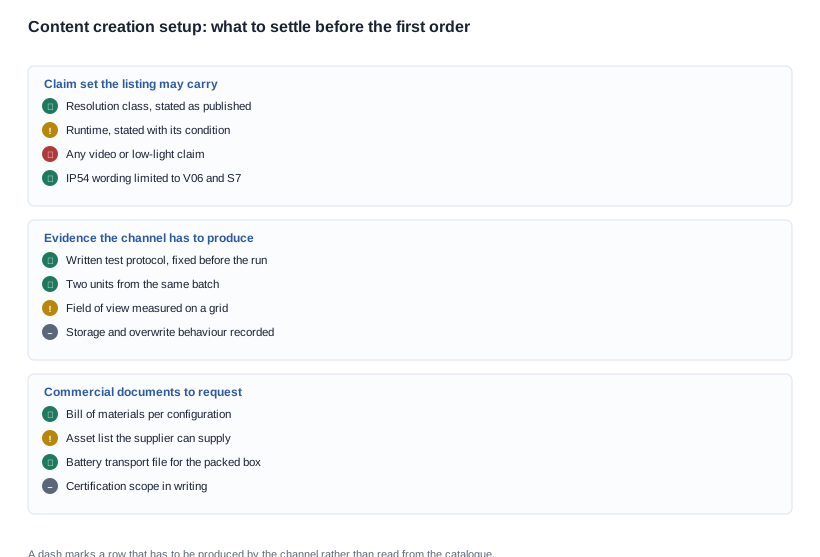
The request list for a content configuration
The request list for a content configuration has four parts. The technical set: the catalogue rows for the shortlisted models on one sheet, the charging interface row, the case capacity where a case is in the configuration, and the battery transport documentation for the packed configuration, which has to cover a case if a case ships, since a case is a second lithium cell. The evidence set: the written protocol, the measurement sheets with their conditions, and the certificate register, so that every certificate number can be looked up in the issuing body's public register and the covered model and configuration confirmed. The asset set: a written list of what the supplier can supply as imagery, because the catalogue carries no product photography at all, so a channel that needs listing assets has to plan for them rather than assume them. The commercial set: the bill of materials per configuration, the incoming inspection criteria and the agreed model designation table.
Two things are worth stating plainly in the request. First, the catalogue contains no per-model certification row and no CE, FCC or RoHS reference in its text, and its export certification page is a company-level page rather than a model-level claim — so a request for "our CE certificate for the MT5" should be answered with a document that names the model and the configuration, and the radio side is governed by the Radio Equipment Directive (EU) 2014/53/EU. Second, the lens material and the coating are not published for any model, so the channel cannot write a lens specification for the creator, and the instruction it ships has to be restrictive rather than generous. The buying checklist for this category is at smart glasses for content creation buying checklist, the legal questions are separated at smart glasses for content creation legal considerations, the product families are at AI camera glasses, and the scenario entry point is smart glasses for content creation.

Where content-creation channels lose money, and which terms stay open
A content channel's losses are rarely in the unit price. They are in the channel that produces nothing usable, the claim that has to be withdrawn, and the second production run that has to be assembled from a different configuration than the first. The commercial terms that stay open are concentrated in the same places, which is convenient.
Failure modes that reach the customer as a bad recording
A listing claim the channel cannot defend. The symptom is a comment or a review that dismantles a video specification the channel never published support for. The root cause is that a claim was written for positioning rather than from a row, and the prevention is the rule at the top of this article: every listing sentence traces to a published row or a repeatable measurement.
A shoot that loses its second half. The symptom is a channel that stops posting. The root cause is the storage and overwrite behaviour, which is not published for any model. The prevention is the storage test, run on production units, and written into the incoming inspection criteria.
A pre-order that ships a different configuration. The symptom is a channel whose delivered unit does not match the sample it tested. The root cause is that the model designation table was never agreed and the bill of materials was never fixed in writing. The prevention is to ask for both, and to make the designation on the unit a goods-in criterion.
A content programme with no images. The symptom is a listing that ships late, or that uses third-party imagery it cannot license. The root cause is that the asset plan was left to the launch week. The prevention is to ask the supplier in writing what imagery can be supplied, and to treat the answer as a delivery item with a date rather than as an assumption.
A channel that compared two models with two protocols. The symptom is a shortlist decision that reverses after the first public recording. The root cause is a protocol that changed between candidates. The prevention is to fix the protocol before the first run, and to keep the conditions with every result.
A second order that does not match the first. The symptom is a channel whose quality drifts without anyone changing a specification. The root cause is that the incoming inspection criteria were never written. The prevention is to write one criterion per measured characteristic, with the number and its condition attached, and to review it at the first repeat order.
The commercial room on a content-configuration order
The model-specific architecture — the cell configuration, the charging interface, the case architecture and the camera module itself — is set before any commercial conversation begins, and it is not a negotiation target. Certification cost and lead time are fixed in character, because they are laboratory and regulatory costs rather than positions a factory holds. Tooling is fixed in substance and negotiable in timing, and it should be quoted as a separate line so that the amortisation base can be examined.
The roomier ground for a content channel sits in the configuration and the evidence. Whether the supplier will run the channel's protocol against production units rather than engineering samples, and whether they will supply the recordings so the result can be re-judged, is worth more than any unit price reduction. Whether the case is included and at which of the published capacities — 1400 mAh on the CY03 and the CY05, and the L1 Pro, 900 or 1400 mAh as a configuration choice on the L2 Utral, or the foldable 1200 mAh case on the MT6 — is the cheapest way to build two price points from one platform, and it also decides the transport file. Whether the supplier funds a baseline measurement on the production batch is the document that answers every complaint in the second year. Whether the imagery can be supplied as part of the first order is a packaging and asset decision that sits on the same purchase order. Minimum order quantity tiers, and whether two shortlisted models can share a purchase order. Logo, lens tint and packaging artwork, including the kit contents and the language of the printed instruction. Splitting a first run into two deliveries against a staged payment, which is the cheapest way to make a content mistake recoverable. The pilot tranche of an order, which is how a claim set is put in front of real audiences before a full volume is packed.
A worked example. Assume a brand launching a content channel in a marketplace that carries the video quality complaints back to the seller. The first move is the claim set, and it is deliberately smaller than the team expects: the resolution class, the rated runtime with its condition, and the charging interface, and nothing else. The second move is the shortlist, and it is the 8 MP camera tier, because the first deliverable is stills and video is not yet part of the claim set, with the L2 Utral and the S7, and the L1 Pro held back for a second channel rather than evaluated against a claim set that cannot yet support them. The third move is the evidence plan, and it is written before the order: a protocol fixing the light level, the distance, the movement, the phone state, the storage state and the temperature, run on two units from the same batch, with the storage and overwrite behaviour recorded on the first run because that is the row with the largest commercial exposure. The fourth move is the price architecture, and it uses the case to build two points on the same platform, with the case treated as a second lithium cell in the transport file. The fifth move is the documentation set, and it includes the model designation table, the incoming inspection criteria and the asset list, so that the goods-in team can catch a substitution and the channel is not left without imagery at launch. The outcome is a channel that can defend every sentence in its listing, which is the only durable marketing asset a content channel in this category has.
What a content-creation buyer can hold us to
It is worth being precise: we publish the rows a buyer can order from and we will not fill the camera gaps with figures from another product. That means the resolution class, the cell configuration, the charging time, the rated runtime, the charging interface where the catalogue publishes it, the structural features that are published, the case capacities on the five camera models where they are published, the IP54 marking on the V06 and the S7 stated as a catalogue attribute, and the 158 g whole-unit weight on the MT6 with the exclusion of its foldable case stated alongside it.
What we do not publish and will not estimate: the sensor, the field of view, the video resolution and frame rate, the stabilisation, the low-light behaviour, the storage and overwrite behaviour, the capture latency, the thermal behaviour, the standby draw, the cycle life rating, the operating temperature range, the runtime test condition, and the charging method on the MT6 and the CY03, and the CY05 and the L1 Pro. No model in the range can be described as tested to IP54, because the catalogue publishes no test report behind that marking, and we will not offer a demonstration as if it were the result.
What we will do is take the deliverables, the tier, the shoot length, the channel and the target market, and tell you which published rows apply, which claims the listing can carry without evidence, which measurements the channel has to run itself, and which criteria belong in the purchase order.
What to send us next. Send the first deliverable, the tier you are considering, the expected session length, the channel, the target market and the price band, and we will return the shortlist with the published rows for each model, the claim set the documentation supports, the measurement plan the channel has to run, and the inspection criteria to write into the first purchase order.
Related reading
- How to enter the scenario — smart glasses for content creation
- The families the range covers — AI camera glasses
- The buying checklist — content creation buying checklist
- The legal questions — content creation legal considerations
Tell us the first deliverable and the shoot length, and we will return the claim set the documentation supports.


