
How to set up smart glasses for livestreaming: a live stream has no second take
A livestream is the only purchase in this catalogue that is consumed at the moment of delivery and cannot be repeated. A photograph that comes out soft can be re-shot; a training video can be re-recorded in the afternoon; a livestream that fails at the twenty-minute mark is a broadcast that happened, badly, in front of an audience. That asymmetry changes what a buyer in this category should be optimising for. Capability is a secondary question. Reliability under time pressure is the primary one, and reliability is not a catalogue row — it is a rehearsal.
Which means the setup for livestreaming is not the device and not the listing. It is a pre-flight routine, a spare unit, a charging window and a rehearsal that reproduces the real conditions. A buyer who treats the order as the deliverable has bought hardware; a buyer who treats the rehearsal as the deliverable has bought a broadcast unit, which is a different product at a different price.
The published catalogue rows are enough to build all four of those things, with one recurring gap. Eleven of the twenty-eight models carry a camera, and the catalogue publishes their resolution class but not the storage and overwrite behaviour, not the capture latency, not the field of view and not the thermal behaviour under a continuous run. Those four are exactly the rows that decide whether a long session ends with usable files. So the setup has to include the supplier's answers, and the rehearsal has to include the checks that substitute for the missing documentation.
The reader and the one-shot problem
The reader is a media operations lead, a production manager, a broadcaster, or a procurement manager buying on behalf of a small production house that will put a device in front of an audience. The decision is which configuration covers a session of a known length, what the kit around the camera contains, what has to be true before the broadcast starts, and what happens when something fails mid-session. The commercial risk is not a defective unit; it is a unit that is technically fine and operationally unusable, which is a failure the standard returns process cannot reach because the customer has already broadcast.
The second risk is quieter and more expensive: the same unit works in the rehearsal and fails at the event. That happens when the rehearsal did not reproduce the conditions, which is why the rehearsal protocol is a document and not a session.
The published rows that a broadcast can plan on
Four published rows carry the session plan, and the interesting one is the charge time rather than the runtime. Every model in the range publishes a charge time: two hours or less on twenty-six of them, and roughly one hour on the D17 and the ZH12. For a broadcast that difference is a schedule. A two-hour charge time means the pre-live charge has to start a full session-length before the broadcast if the unit is to be at full charge; a roughly one-hour charge time means the window is short enough that the kit can be topped up between the rehearsal and the broadcast, which is the difference between a kit that is ready and a kit that is gambling on the previous charge.
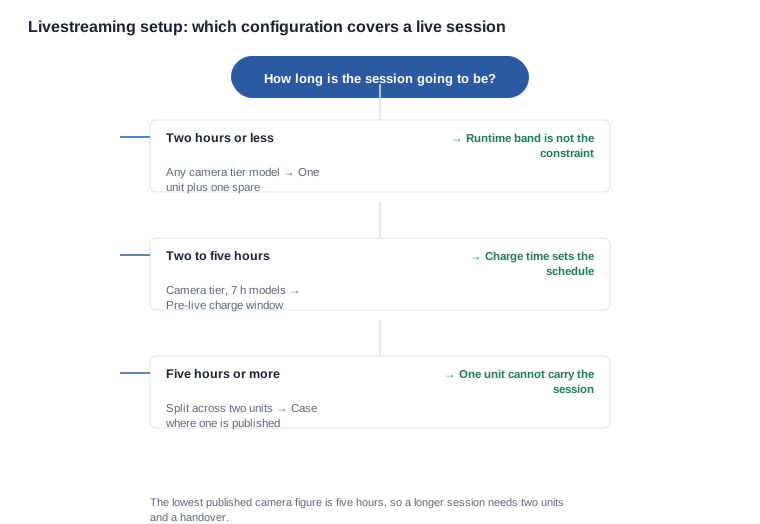
The rated runtime sets the session ceiling. The camera tier publishes 5 to 8 hours on the S7 and the V06, and the V03 Pro and the V03, 6 to 8 hours on the KY06 and the MT5, and about 7 hours on the L1 Pro and the CY03, and the MT6 and the L2 Utral, and the CY05. The audio tier publishes about 8 hours on the K01, the K02 and the LC-105 pair and about 6 hours on the G07 and the YK12. The sport tier publishes about 8 hours on the YKC02 and the ZH12 and about 7 hours on the D17. For a two-hour broadcast that is not the binding constraint. For a six-hour broadcast it is, and no runtime figure in the range carries a published test condition, so the safe reading of the lowest published camera figure is five hours.
The charging interface is the third row, and it decides the dock. Seventeen models publish a magnetic charging method, seven publish Type-C, and four publish no charging method at all: the CY05 and the CY03, and the L1 Pro and the MT6. A broadcast kit that includes a dock has to be built on a model whose interface is known, which removes four attractive camera models from the kit unless the supplier answers in writing.
The fourth row is the charging case, where one is published. Five camera models publish a case capacity: the L1 Pro and the CY05, and the CY03 — each at 1400 mAh, the L2 Utral at 900 or 1400 mAh as a configuration choice, and the MT6 with its foldable 1200 mAh case. The KY06 and the MT5 ship with a case whose capacity is not published, the catalogue publishes no case row at all for the V03 and the V06, and the V03 Pro or the S7, so what the broadcast kit carries for those four is an open item. A case in a broadcast kit is a second lithium cell, so it enters the battery transport documentation for the configuration, and the case's own charge time and input are not published for any model.
The pre-flight check, which is the actual setup
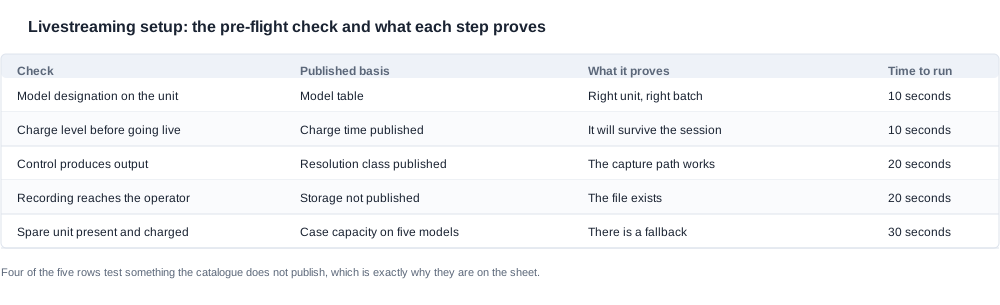
The device leaves the box and arrives on a desk. Between that point and going live, the setup is a routine that somebody has to perform under pressure, and a routine that is not written down is performed differently every time. The pre-flight sheet is the deliverable, and it is short enough to be used rather than filed.
The sixty-second check
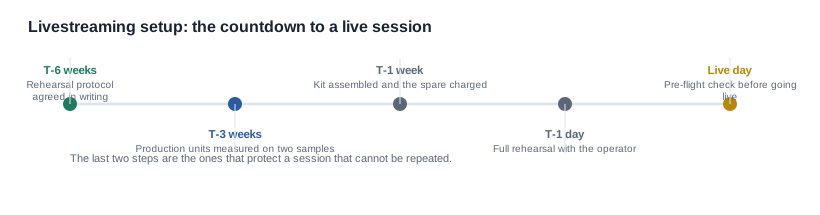
Five steps, in this order, because the order is what makes it fast: the ones that fail the session come first.
- Model designation on the unit, against the sheet, to confirm the unit is the model and the batch that was measured. Ten seconds, and it catches a substitution before the camera is even switched on.
- Charge level, read from the device's own indication, before anything else is touched. Ten seconds, and it is the only check that can end the session before it starts.
- Control produces output, confirmed on the device's own preview rather than on the operator's screen, because a monitoring application can show an image the device is not capturing. Twenty seconds.
- The recording reaches the operator, confirmed by starting and stopping a short take and seeing it land. Twenty seconds, and it is the step that substitutes for the storage and overwrite behaviour the catalogue does not publish.
- The spare unit is present and charged, physically, in the kit, not in a drawer in another room. Thirty seconds, and it is the only check that protects the session from a mid-event failure.
Why two units and a spare are not redundancy. A spare that has not been through the same pre-flight is an assumption. A spare whose charge state was not read is a worse assumption than no spare, because it produces a false sense of readiness and the false sense is what the operator acts on. So the pre-flight has to be run on the spare as well, and the sheet has to have a line for it.
Why the operator has to be in the rehearsal
The rehearsal is not a technical test. It is a test of the routine with the person who will perform it, because the routine fails in the hands of somebody who has not run it, not in the specification. A producer who has run the pre-flight three times can complete it in a minute; a producer running it for the first time will take three minutes, and a three-minute pre-flight on a broadcast deadline is a pre-flight that gets skipped.
So the rehearsal has to be run by the operator, on the real device, on the real kit, at roughly the real time of day, and it has to be followed by the pre-flight sheet as written. That is also the cheapest way to catch a documentation gap: if the operator cannot tell from the sheet how long the charge takes or which dock to use, the sheet is incomplete and the next event will find out.

The rehearsal is the acceptance test
In most categories the acceptance test happens at goods-in and the rehearsal is a courtesy. In livestreaming it is the other way round, and the reason is structural: the rows that decide whether a long session succeeds are unpublished, so the only way to establish them is to create them.
What the rehearsal has to reproduce
Four conditions have to match the real event, because they are the ones the published rows do not cover.
Duration. The rehearsal should run for the expected session length or close to it, because the failure mode it catches is a device that is fine for two hours and flat at four. The published camera band runs from 5 hours up, and the lowest published figure belongs to the S7 and the V03 Pro, and the V06 and the V03.
Lighting. The low-light behaviour is not published for any model, so the rehearsal is the only source of a fact about it, and it is also the fact a viewer is most likely to react to.
Movement. The rehearsal should include the kind of movement the broadcast will contain, because a camera held still in a rehearsal is not the same device as a camera carried across a site.
Continuity. The session should not be one take. A broadcast is made of segments, and the storage behaviour is unpublished, so the rehearsal should deliberately fill the storage and continue, which is the only way to find out what the device does next.
The completion standard is simple: the rehearsal produces a written result per condition, with the conditions attached, and the result becomes a line in the pre-flight sheet and a line in the incoming inspection criteria. A rehearsal with no written output is a demonstration, and a demonstration cannot stop a session.
Documents to request before the first order
Seven documents. The catalogue rows for every model in the kit, on one sheet. The charge time and runtime per model, with the conditions attached where the supplier holds them. The charging interface confirmed in writing for the four camera models where the catalogue publishes none. The storage and overwrite behaviour and the capture latency, which the catalogue does not publish and which the rehearsal will otherwise have to discover the hard way. The unit weight for the configuration, published for no model. The battery transport documentation for the packed kit including any case, since a case is a second lithium cell. And the model designation table, so that the first step of the pre-flight can actually be performed.
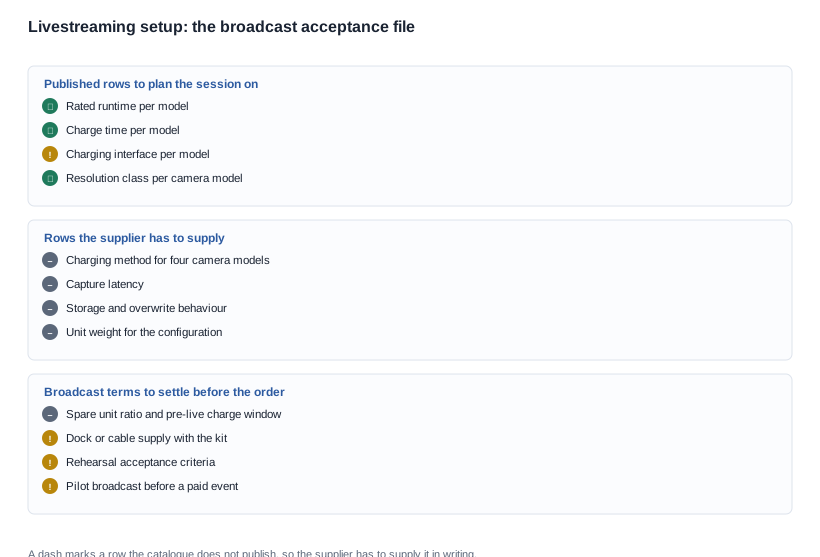
The kit around the camera
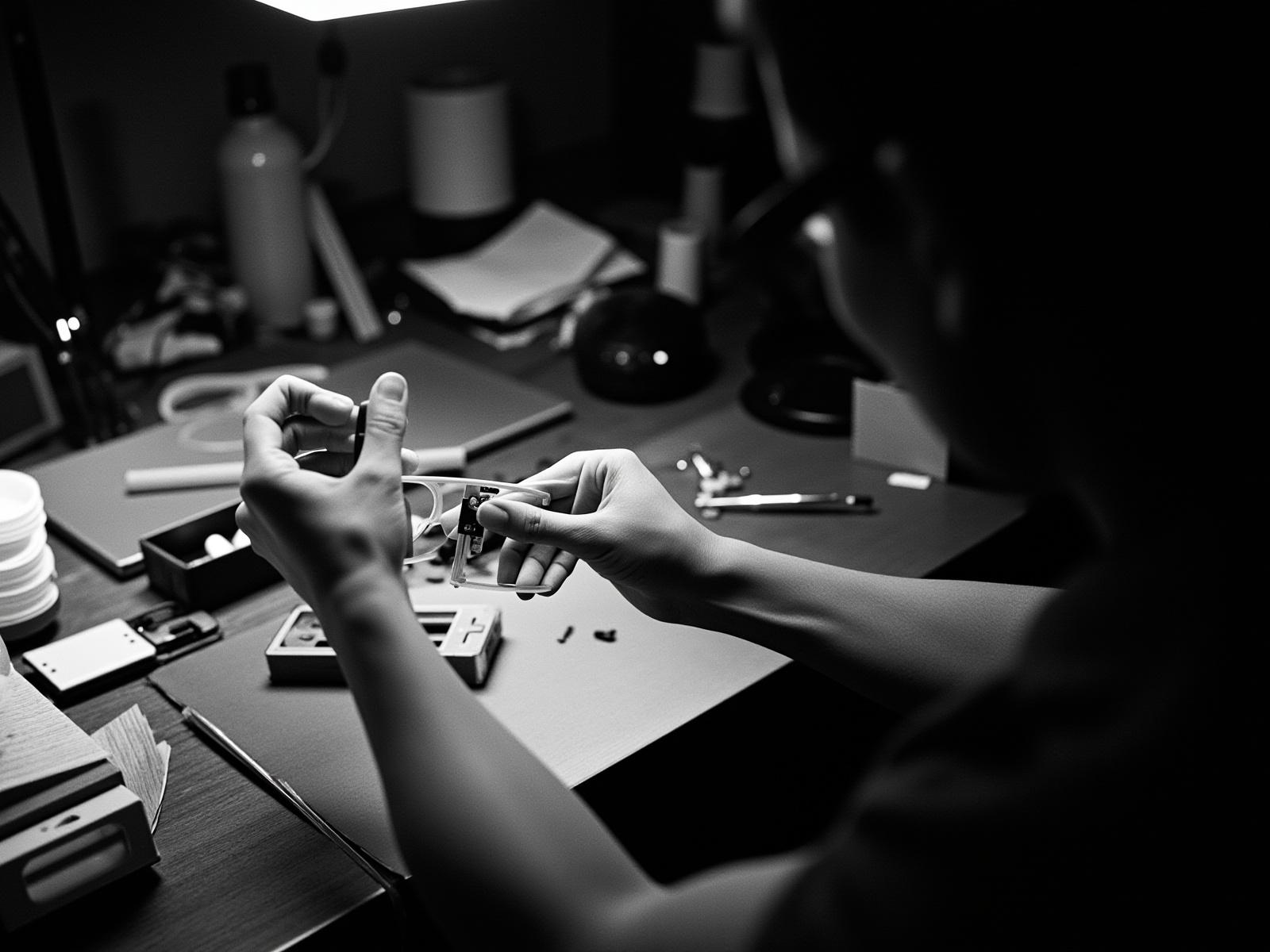
A broadcast unit is a camera plus four other things, and the four other things are where most of the procurement decisions sit. Each one is tied to a published row, and each one is a place where a plausible assumption turns out to be wrong.
Power, dock, cable and the published rows behind each
The dock or the cable. The charging interface row decides it. A magnetic configuration needs a dock or a proprietary cable, and the dock is then part of the kit, with its own footprint on the desk and its own failure mode. A Type-C configuration recharges from a cable that also charges the operator's phone and laptop, which is a logistics advantage and a logistics risk in one item. For the four camera models whose charging method is unpublished, the dock cannot be specified at all, and that has to be resolved before the kit is bought rather than after.
The spare. The spare ratio is a commercial term and an operational one, and it interacts with the case: a model with a published case can hold a spare's charge between events, and a model without a case row needs a second dock or a second cable in the kit.
The charge window. Derived from the published charge time, and it is the term that decides whether the kit is topped up between rehearsal and broadcast. The D17 and the ZH12 publish roughly one hour; everything else publishes two hours or less.
The storage. The camera models do not publish their storage capacity, their file format or their overwrite behaviour, so the kit has to carry whatever the rehearsal established, and the rehearsal has to establish it. If the rehearsal cannot fill the storage, then a smaller card or a different workflow is a decision that belongs in the kit rather than in the operator's pocket.
What the catalogue does not publish about the live chain
Four things, listed together because a broadcaster will ask for all four in one conversation: the sensor and the field of view, the video resolution and frame rate, the stabilisation, and the capture latency. The resolution class is published — eight of the eleven camera models at 8 MP and three at 13 MP — and that is the only imaging row that can be quoted. A broadcaster who publishes a frame rate or a stabilisation claim on the strength of this category's general reputation is publishing something the documentation does not support, and the channel that carries that claim carries the correction when a viewer asks.
Where livestreaming setups fail on the first live stream, and which terms stay open
The failures are all operational, and every one of them is preventable with a document that was not written. The terms that stay open are concentrated in the kit and the rehearsal, because that is where the money actually sits.
Six ways the first live stream fails
A flat battery discovered thirty seconds before the start. The symptom is a delayed opening. The root cause is that the charge window was never derived from the published charge time, so the kit was topped up against an assumption. The prevention is the second step of the pre-flight, every time, including on the spare.
A device that recorded but produced no usable file. The symptom is an empty take and a live audience waiting. The root cause is the storage and overwrite behaviour, which is not published for any camera model. The prevention is the continuity test in the rehearsal.
The wrong dock. The symptom is a unit that cannot be charged at the venue. The root cause is a kit built on a model whose charging method is unpublished, or a cable that was not in the kit. The prevention is to settle the interface before the kit is assembled.
A preview that was not the camera. The symptom is a broadcast with no video despite a working preview. The root cause is that the check was made on the monitoring application rather than on the device. The prevention is the third step of the pre-flight.
A kit assembled the morning of the event. The symptom is a missing item discovered at the venue. The root cause is that the kit was assembled from memory rather than from a written bill of materials. The prevention is to build the kit from the sheet, and to photograph it once.
A first event used as the first rehearsal. The symptom is a session that happened without a plan. The root cause is that the rehearsal was treated as optional because a spare was available. The prevention is a paid pilot event with the same criteria, which is the cheapest rehearsal available and the one most often skipped.
What the broadcast terms can still absorb
The model architecture is fixed, as is certification cost and lead time in character. Tooling is fixed in substance, quoted separately, and negotiable in timing.
The room in a broadcast order sits in the kit and in the evidence. Whether the supplier will measure the charge cycle on production units and provide the result, which turns the charge window from an estimate into a schedule. Whether the dock or the cable is supplied with the kit at a price, rather than being bought separately at a venue at the last minute. Whether the supplier will run the rehearsal protocol against the units that will actually ship, and provide the recordings, which is worth more than a unit price reduction because it moves the evidence from a demonstration to a criterion. Whether a spare unit ratio is included and whether the spares carry the same warranty period. Whether a case is included at a published capacity, which decides both the backup power between segments and the battery transport documentation. The minimum order quantity per configuration, and whether two models can share a purchase order. Logo, packaging artwork and the kit contents, including a printed copy of the pre-flight sheet in the case, which is the cheapest way to make sure the sheet arrives. Payment terms and whether the first delivery is split, so that a kit problem is found before the event rather than at it. And the pilot event itself, whether the supplier will support it, which for a one-shot broadcast is the only insurance that matters.
A worked example. Assume a production house shooting a four-hour site walkthrough with commentary, twice a month, with a second crew covering a different site on the same day. The first move is the session length, and four hours sits inside the camera band but above the flat 7-hour figures are unnecessary and below the band's lower end on the four models that publish 5 hours — so the shortlist takes the five models publishing about 7 hours, and the low-band models are held back. The second move is the kit, and the charging interface decides it: a Type-C model is chosen for the mobile crew, so one cable serves the phone and the device and the dock problem disappears, while the fixed crew takes a magnetic model with a dock that stays on the desk. The third move is the charge window, derived from the published two-hour-or-less charge time, with the kit topped up the evening before the event rather than on the morning. The fourth move is the rehearsal, run by the actual operator, four hours long, with the continuity test included because the storage behaviour is unpublished and a two-hour rehearsal would never reach the interesting part. The fifth move is the pre-flight sheet, five lines, printed and placed in the case, with the spare charged and checked on the same sheet. The outcome is a broadcast unit that is a routine rather than a hope, which is the entire commercial value of the setup in this category.
What a livestreaming buyer can hold us to
We publish the rows a broadcast can be scheduled around and we do not publish the rows we do not hold. That means the cell configuration, the charging interface where the catalogue publishes it, the rated runtime, the resolution class, the charge time, the case capacities on the five camera models where they are published, the ingress marking on the V06 and the S7 stated as a catalogue attribute, and the 158 g whole-unit weight on the MT6 with the exclusion of its foldable case stated alongside it.
What we do not publish and will not estimate: the sensor, the field of view, the video resolution and frame rate, the stabilisation, the low-light behaviour, the storage and overwrite behaviour, the capture latency, the thermal behaviour, the standby draw, the cycle life rating, the operating temperature range, the runtime test condition, the unit weight apart from the MT6, the pack gross weight, and the charging method on the L1 Pro and the MT6, and the CY05 and the CY03. We will not state that any model carries a certification our catalogue does not name, because the catalogue has a company-level export certification page and no per-model certification row, and its text contains no CE, FCC or RoHS reference at all.
What we will do is take the session length, the number of sessions, the venues, the kit contents, the operator count and the event calendar, and tell you which published rows apply to which model, what the charge window is, which models cannot be kitted until the supplier answers, and which terms belong in the order.
What to send us next. Send the session length, the number of sessions per month, the venues and their power availability, the kit contents you already own, the operator count and the next event date, and we will return the configuration split with the published rows for each model, the charge window, the pre-flight sheet's five checks with the published row each one rests on, and the acceptance criteria for the rehearsal.
Related reading
- Where the scenario starts — smart glasses for livestreaming
- The kit decisions — livestreaming accessories
- The procurement checklist — livestreaming checklist
- The families in the range — AI camera glasses
Tell us the session length and the next event date, and we will return the configuration split and the charge window.


