
A livestream fails in a small number of repeatable ways, and almost none of them are the device. The network drops in the room rather than in the studio, the second hour degrades rather than the first, and the consent step is the one failure a document can fix and nobody thinks to write down. That is why the smart glasses for livestreaming smart glasses checklist below is built the way it is: every check carries a pass line, and every pass line is tied to a specific published row or to a row nobody has published yet. The sheet is not a nicety for the person running the session. It is the document that tells a procurement manager which parts of the specification still have to be closed before the first order goes out, and the timeline image at the end of this page puts those closures on a calendar.
Smart glasses for livestreaming: the sheet is a specification, not a nicety
Who this is written for. The reader is a brand owner assembling a livestream line, a channel operator supporting a group of creators, or a procurement manager defending a deployment that has already been bought. The task in front of them is not a product evaluation. It is the construction of an acceptance document — a sheet that a presenter can work from in a room, an hour before the feed goes live, and that a buyer can hand to a supplier as a list of things that must be answered before a purchase order is signed. The fear behind that task is specific and unglamorous: a batch arrives, it works on the sample, and the first hundred units fail in a way that could have been written down in advance.
Why the same unit fails in two rooms. The catalogue publishes the electrical rows for every camera model, and those rows are close together. The camera models publish a resolution class of either 8 MP or 13 MP, cell capacities that run from 220 mAh to 290 mAh, a charge time stated as a ceiling of two hours or less on all of them, and rated use figures that sit between five and eight hours. The published differences are not what decides a session. The room decides it — the light, the noise, the connection, and the length of the block. A buyer who compares two models on capacity and runtime alone is comparing the two least decisive rows in the specification.
What actually moves the outcome. Three things do, and none of them is in the catalogue. The first is whether the device can hold a link for the length of the session, which depends on the phone, the platform and the venue connection rather than on the unit. The second is whether the frame stays where it was put, which depends on the mount and on the length of the block. The third is whether the people in frame knew they were being recorded. Those three account for most of the failures that reach a support desk, and they are the reason a checklist has more value than a specification sheet: the sheet is where they get written down before the room is booked.
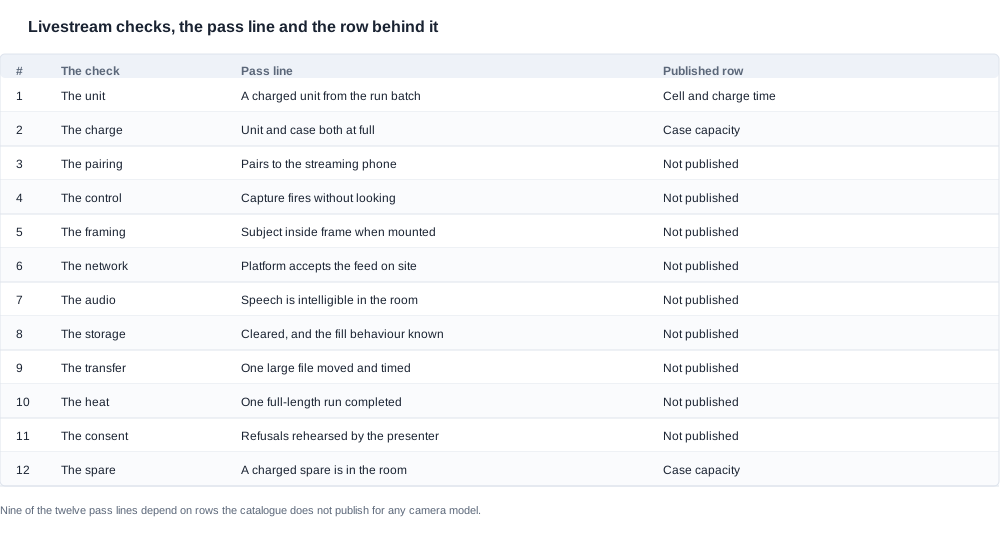
The table above is the whole sheet. Each row names a check, states the line the unit has to clear, and names the catalogue row that the check depends on. Nine of the twelve rows depend on rows that the catalogue does not publish for any model in the range. That is not a gap in the sheet; it is the finding, and it is the argument for treating the sheet as the specification rather than as documentation.
The three that most often decide a session
The network, the heat, and the consent. The network fails in a location rather than in a studio, and it fails on the venue connection rather than on the device. The heat degrades the second hour rather than the first, because the load of a continuous feed is not the load of a series of short captures. The consent is the one failure that a checklist can actually fix and the one that teams are least likely to write down, because it reads as a people problem rather than a specification problem.
A feed that fails on the network is a technical failure and arrives as a ticket. A feed that fails on consent is a brand failure and arrives as a complaint with the brand's name on it. Only one of the two is visible in the returns data, which is why the sheet puts the consent check on the same page as the charge check rather than in a separate policy document.
The nine rows nobody publishes
The link, the control, the framing, the network, the audio, the storage, the transfer, the thermal behaviour, and the video specification. For every camera model in the catalogue, the video format, the frame rate, the field of view, the storage capacity, the overwrite behaviour, the transfer path, the indicator behaviour, the device-to-phone linking sequence, the control scheme, the microphone rows, the network requirement and the thermal behaviour are all unpublished. The catalogue publishes the cell, the charge ceiling, the rated runtime, the charging method, the case capacity and the resolution class, and it publishes nothing else about how the device behaves in a live room.
That single fact changes how a buyer should read the sheet. A pass line that can be measured against a published row is a check the buyer can settle alone. A pass line that depends on an unpublished row is a request the buyer has to make, and the request is the deliverable. The livestreaming accessories page treats the physical kit as part of the same work for the same reason: an accessory that has to be specified is an accessory that has to be asked for.
Running the sheet as a rehearsal rather than a document
A checklist that has been read has not been run. The difference between the two shows up in the first week of a deployment, when the failures arrive in the order nobody expected, because the checks that were skipped were the ones that seemed obvious.

The sequence above is the minimum honest version. It starts with the request, because a buyer who has not asked for the unpublished rows cannot run the checks that depend on them. It takes the sample from the production batch rather than from a demonstration unit, because a demonstration unit is a unit that has been handled by nobody. It runs at full length in the real location on the real connection, because a short test in a setup room clears exactly the checks that were never going to fail. And it hands the sheet to somebody who has not held the device, because a sheet written by the person who assembled the kit is a sheet that only works in the assembly room.
Inducing the three failures nobody runs
The link, the control, and the storage. These are the three checks that a person running a rehearsal will skip, because the device links when they set it up, the trigger responds to the hand they already know, and the storage was empty an hour ago. Inducing the failure is the only way to learn what the recovery actually is.
- The link: begin the session from a locked phone screen, on the phone that will actually run the feed, with the unit in the state it will be in after it has been in a pocket.
- The control: put the unit on the presenter's head and ask for a capture without touching the frame, then ask for a second one while the presenter's hands are occupied.
- The storage: fill the device to the point where the next recording is at risk, and record what the device does.
Each of these three exercises produces a number or an instruction. A buyer who has run them before the first order can put the results into the acceptance criteria. A buyer who has not is buying the answer to the same question twice, once on a sample and once on a shipment.
The one message that closes nine rows
Send the request as a single list, once, and mark the date on it. Nine of the twelve checks depend on rows nobody has published, and a request that arrives as a trickle of one-line questions will get a trickle of one-line answers, each of which has to be chased separately. One consolidated list produces one consolidated answer, and the supplier can either answer it or say which parts they cannot.
The list itself is short, and the discipline is in refusing to expand it with adjectives:
- The sequence that links the device to the phone, and whether it works from a locked screen.
- The application name and the minimum version that works with the unit.
- The supported device list, so the buyer knows which phones and platforms are covered.
- The control scheme, including what happens when the trigger is pressed and held.
- The indicator behaviour, so the presenter can tell from the unit alone whether it is recording.
- The field of view, measured rather than described.
- The video format and the frame rate actually produced.
- The microphone rows, the pickup distance and the processing mode.
- The storage capacity, the format, and what happens when the device fills.
- The transfer path and a realistic transfer time for one large file.
- The runtime test condition, and the thermal behaviour over a full-length session.
What to do with a partial answer. A supplier who answers nine of the eleven has still closed most of the sheet, and the two that remain are the two that go into the acceptance criteria as observed facts rather than as published rows. That is a legitimate position, provided it is written down. What is not legitimate is discovering the gap during a live session, which is the failure mode the whole sheet exists to prevent.

What a livestream failure costs in a channel
A cancelled session is visible. The failures that cost more are the ones that do not cancel anything: a feed that runs for three hours and produces footage nobody can use, a session that is technically fine and visually wrong, a presenter who works around a device in a way that damages the brand.
The failures that repeat in the same place are specification gaps. A feed that drops at the same point in the same room, every week, is not a fault in the device; it is a condition the buyer has not written down. A feed that drops at a different point each time is usually the venue connection or the phone, and it is a problem the manufacturer cannot fix. Telling those two apart is the most useful thing a failure log does, and it is why the sheet asks for the symptom in one sentence rather than for a diagnosis.
The cost structure then becomes legible. A specification gap costs the sample cost, the pilot order and the engineering time to chase the answer. A venue problem costs the venue, not the supplier, and no amount of due diligence on the factory changes that. A consent failure costs the brand, and it is the only one of the three that cannot be recovered with a replacement unit. Buyers who separate the three before the order can put the effort where it actually reduces the loss, which is why the sheet carries a column for the row behind each check instead of only a column for the check.
What the returns data should be asked for. For the first shipment, ask for the units that came back and the reason recorded against each one, and ask specifically whether the reason was a failure during a session, a failure during a charge, or a physical fault. The first two are specification questions and the third is a manufacturing question, and a buyer who has not asked for that split will get a single return number that is meaningless.
Where the money sits in a livestream deployment
The commercial conversation for this category is mostly about per-unit cost, and the per-unit cost is rarely the line that decides the margin. The lines that decide it are the ones a buyer forgets to price: the spare units a channel must hold, the accessory set per creator, the case as a second cell, the shipping weight of the kit, and the returns rate of the first shipment.
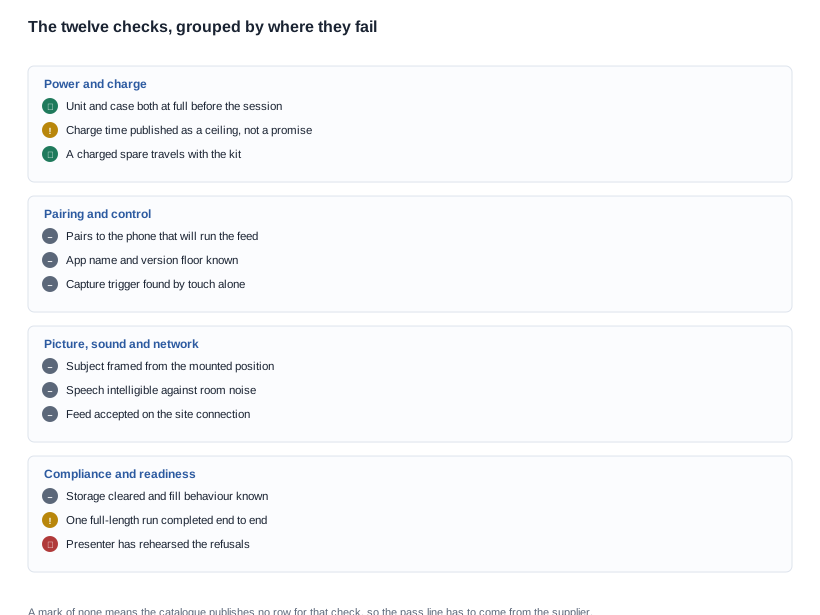
The grouping in that image is the commercial grouping as well. The rows marked as settled are the ones the catalogue closes: the cell, the charge ceiling, the rated runtime, the charging method, the case capacity and the resolution class. They are the rows a buyer can compare across suppliers without asking a single question. The rows marked as open are the ones that decide whether the deployment works, and each of them is a question with a delivery deadline attached to it.
What is worth negotiating, and what is not. The unit price and the volume tiers, the accessory and spare quantities per creator, the packaging specification, the delivery splitting against a staged payment, the warranty period with a stated response time, the return terms, the terms of a pilot order, the share of units taken at the pilot tier rather than the run tier — these are all real levers, and the share of the order taken at the pilot tier is usually the largest one, because it is the factory's own risk exposure that is being priced.
What is not a negotiation target. The certification cost and the certification lead time follow the process and the testing body, and they are per product family rather than per order. Tooling is often amortised across the first run, so ask which of the two is being quoted, because the two are frequently bundled into one line and a buyer who cannot separate them cannot tell an amortised charge from a one-off. The battery transport documentation is not a price item at all; it is a file that has to exist for the configuration being ordered, including the case. The requirements are set out at battery transport, and the clause language that protects the buyer is at contract terms.
What should be written into the agreement. The published rows for the configuration ordered; the unpublished rows the sheet depends on, each with the answer and the date it was given; the accessory and spare quantities per creator; the warranty period with a stated response; and the acceptance criteria that turn the sheet into a pass or a fail. The commercial structure of a first order is at pricing, the sample terms are at samples, and the minimum order tiers are at MOQ. The full set of product rows is at battery life and the camera rows are at ai camera glasses.
The order in which the closures have to happen
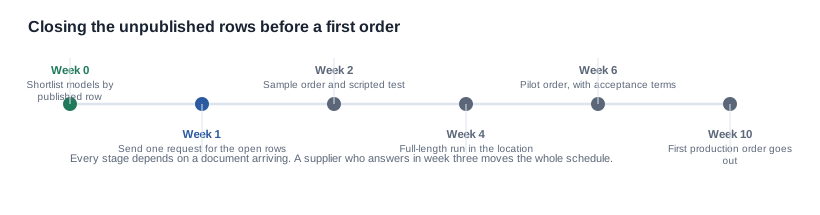
A schedule like the one above only works if each stage has a document arriving at the end of it. The shortlist stage is the buyer's own work and can be done immediately. The request stage depends on a supplier, and it is the stage that most often moves — a supplier who answers in week three moves every later stage. The sample and rehearsal stages depend on the answers, not on the purchase order, and that is the ordering most buyers get wrong: the rehearsal cannot be run against a row that has not been supplied.
What we publish, and what we will not claim. Our position is that we publish the rows a buyer can order from, and that we will not fill the gaps with typical values. For the camera range that means the resolution class, the cell capacities from 220 mAh to 290 mAh, a charge time stated as two hours or less on every model, the rated runtimes from five to eight hours, the charging method per model, and the case capacities where a case row exists — 1400 mAh on the CY03 and the CY05, and the L1 Pro, 900 or 1400 mAh as a configuration choice on the L2 Utral, and 1200 mAh on the foldable case of the MT6. We will also state plainly what is missing: the catalogue publishes no charging-case row for the V03 and the V03 Pro, and the V06 or the S7, and we do not read that silence as a statement that no case is supplied. The case the KY06 and the MT5 ship with has no published capacity. None of that is a defect, and all of it is a question worth asking before the order.
What we will not do. We will not publish a video format, a frame rate, a field of view, a storage capacity, a transfer path, a pairing sequence, a control scheme, a microphone row, a network requirement or a thermal behaviour for a model where the manufacturer has not provided one, and we will not present a published rating as though it were a pass line for a check it does not describe. We will not extend the IP54 marking on the V06 and the S7 to a test report, because the marking is a catalogue attribute and no third-party test report is published behind it. The reading of the two digits is at IP ratings, and the procedure for checking a certificate in the issuing body's public register is at certification checklist.
What to send us next. Send the models you are comparing, the session length, the platform, the volume and the target market, and we will tell you which of the twelve checks the published rows already settle, which ones need a written answer from the supplier, and which ones are yours to settle in the room. The channel itself is at smart glasses for livestreaming, the session setup is at how to set up for livestreaming, and the accessory set is at livestreaming accessories.
Send us the models, the session length and the volume, and we will return the twelve checks with the published row behind each one and the list of rows that still have to be closed in writing.


