

Smart glasses for running: a fit procedure is not a configuration
Smart glasses for running are set up three times — in the factory, on the channel shelf, and on a runner's head at six in the morning — and only the third of those decides whether the product is used at all. The middle one is a stock check. The first one is a manufacturing step. The third is a fit procedure, and it is the only one a buyer can actually design, because it is made of paper: a trial, a kit, a routine and a set of rules. If a buyer treats the setup as a configuration task — pair it, press the button, confirm the connection — then the setup will pass in the workshop and fail at the sixth kilometre, where the device has moved, the lens points at the ground, and the runner has already decided that the product is not for them.
Three things follow from that, and they shape every decision in this guide. First, the published specification settles far less of the setup than a buyer expects, because the catalogue publishes electrical and structural rows and leaves the physical properties open. Second, the setup document is the deliverable: it is what the factory produces, what the channel sells and what the runner reads, and it has to be written before the packaging artwork is locked rather than after the first complaint arrives. Third, the setup is a cost decision, not a feature decision — every item added to the kit is a per-unit cost, a freight weight and, in one case, a second lithium cell that has to be declared for transport.
The reader behind this guide is a brand-side buyer, a channel buyer or an e-commerce seller who already has a model in mind and now has to decide what goes in the box, what the insert says, and what the channel is allowed to claim. The situation is usually one of three: two quotations to compare, a new programme to open, or a market to enter. What sits underneath all three is the same fear, and it is not a bad price. It is an opening run that is not the sample that was approved, a customs file that holds the boxes at a frontier, or a returns burden that nobody put into the unit cost.
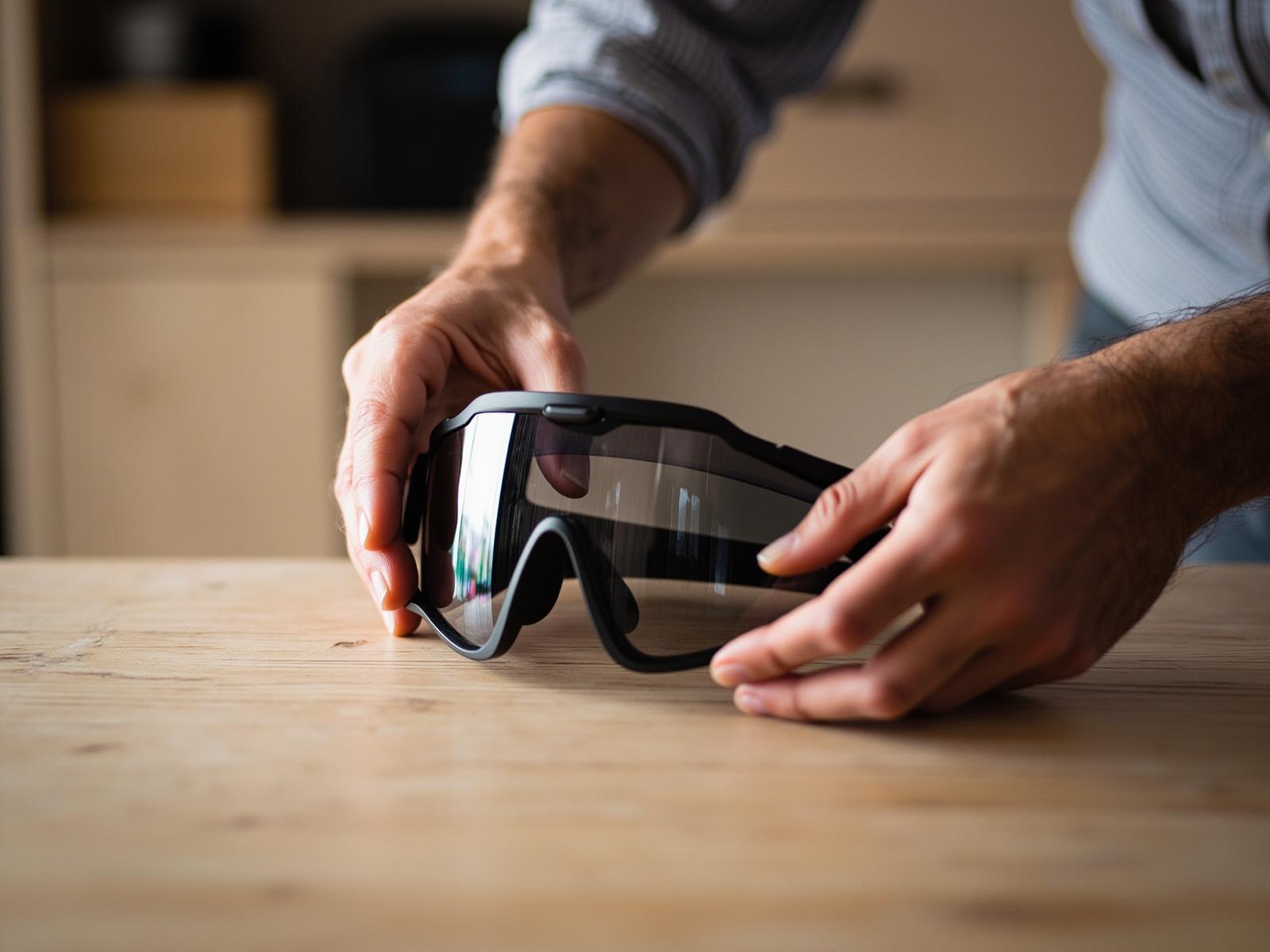
What the published rows settle and what they leave open
The catalogue publishes a consistent set of rows, and for a running programme they add up to more than a first-time reader expects. Every model in the range publishes a cell capacity, a charge time and a rated runtime, twenty-four of them publish a charging interface, the camera models add a resolution class, and the colour count is published where the catalogue carries it. The camera models additionally publish a case capacity on five of them — 1400 mAh on the L1 Pro and the CY05, and the CY03, 900 mAh or 1400 mAh as a configuration choice on the L2 Utral, and a 1200 mAh foldable case on the MT6. Two camera models carry a case whose capacity is not published, and four camera models — the S7 and the V03 Pro, and the V06 and the V03 — have no charging-case row in the catalogue at all, which is an open row rather than an absent feature and therefore a question for the supplier before a run is scheduled.
What that record settles for a running configuration is the electrical envelope: roughly how long the device runs, how long it takes to come back, and which cable it uses. The magnetic interface is published on seventeen models across the range and Type C on seven — the V03 Pro, the L2 Utral, the D11, the D12, the D17, the ZH12 and the bone-conduction model. Four camera models, the L1 Pro and the MT6, and the CY05 and the CY03, publish no charging-interface row at all; only the case capacity is published for them, so a buyer cannot state how they recharge without asking. That gap matters more than it appears, because the interface is the row that decides whether the runner needs to carry one more object.
Three comparisons in the catalogue actively mislead a buyer who reads a single column, and each of them has caught somebody. Capacity is published as cells and count, not as a total — 55 mAh × 2 on the LC-105 pair, the G07 and the YK12, 90 mAh × 2 on the K01 and the K02, 70 mAh × 2 on the YKC02, and a single 100 mAh cell on the D11 and the D12. Totalling them is a legitimate analytical step, but a derived total presented as a catalogue figure is a false claim, and a spreadsheet column that shows 110 mAh where the catalogue says 55 mAh × 2 is exactly the kind of error that survives a procurement review. Second, the same 100 mAh appears on four models with four different meanings: the AR glasses pair it with magnetic charging and about eight hours, the D11 and the D12 pair it with Type C and about seven hours, and the ZH12 pairs it with Type C and about eight hours. Read the capacity together with the interface or read nothing. Third, the eight audio models, the three sport models and the eleven camera models are separate classes, and a figure that belongs to one is not a figure for the others — the audio tier's roughly eight hours on the LC-105 pair is not the camera tier's five to eight hours.
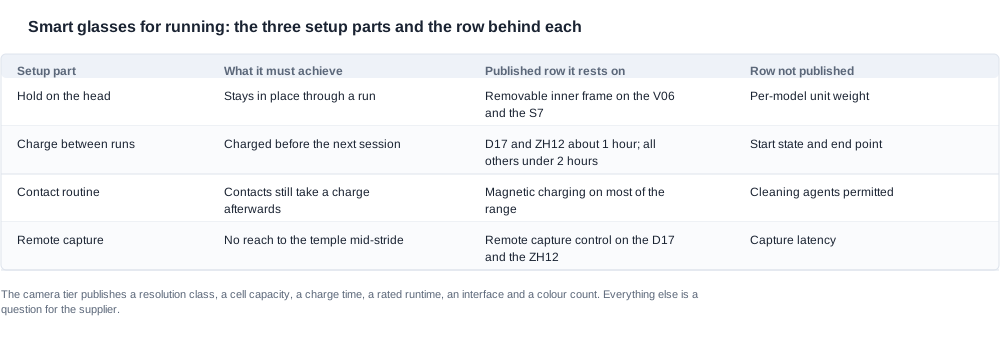
Two structural rows are published and both matter for a running programme. The V06 and the S7 publish a removable inner frame, which is an adjustable system rather than a decoration: it lets one outer frame serve different nose shapes, and in a channel with a wide size range that is a returns lever before it is a convenience feature. The D17 and the ZH12 publish a remote capture control, which removes the need to reach for the temple mid-stride — the movement that both ruins the framing and destabilises the position on the head. Everything else in the setup file is open: the lens material, the coating, the surface treatment, the hinge specification, the per-model unit weight, the field of view, the video specification, the operating temperature range, the cycle life rating and the runtime test condition. The single weight figure in the entire catalogue is 158 g for the MT6 — the whole unit including the battery and the camera, excluding the foldable case — and it belongs to a camera model with no published case row, so it settles nothing for a running configuration. A setup decision that leans on any of those open rows is a decision with no data behind it, and the honest move is to write the question down rather than to substitute a typical value.
The three setup parts and the criterion behind each one
A running setup has three parts, and each one needs a criterion. The three questions to ask before you order are the same for every part: how it is measured, the line that has to be met, and what an inflated version reads like. Without those criteria the setup becomes a set of instructions nobody can act on, which is the usual reason a setup document exists and is never read.
The fit procedure. The criterion is simple to state and impossible to satisfy from paper: the device stays in position through a run without adjustment. It is measured by a physical trial on more than one head, because the per-model unit weight is not published and a size chart would be guesswork. The line that has to be met is that no adjustment is needed and the lens still points where the runner is facing at the end of a session, not only at the start. The inflated version of this criterion is a fit claim built on a size chart or on the fact that the sample sat still on a desk for ten minutes. A device that shifts during a run produces soft, framed-away footage and a returns conversation at the same time, and no firmware change fixes either. This is where the removable inner frame on the V06 and the S7 becomes the published answer to a question the catalogue otherwise leaves open, and it is also why a detachable temple deserves a question: a temple that can be replaced rather than a whole frame written off changes the spare-parts strategy, which is a procurement decision, not a styling one.
The charging routine. The criterion is that the device is charged before the next session, and it has to be measured against the gap the runner actually has. The published basis is the charge time and the interface: the D17 and the ZH12 publish roughly one hour of Type C charging, and every other model in the range publishes two hours or less. The line that has to be met is that the routine fits inside the real gap rather than the theoretical one. The inflated version of this criterion is a charge time quoted without a start state and without an end point — the catalogue publishes how long charging takes, but not from what level and not to what level, so a charge time cannot be converted into a shift-interruption figure and cannot be treated as a case turnaround time either. A Type C configuration recharges from the cable the runner already carries, which removes an object from the kit entirely; a magnetic configuration needs the case carried, and the case is volume in a pack plus a second lithium cell to declare for transport.
The contact routine. The criterion is that the charging contacts still take a charge after a sweaty session, and it is measured by charging the device in the state it was actually left in. Sweat is salt, and a contact in a sweaty environment accumulates debris faster than any other part of the product ages. The line is simple: the unit charges after a day of use, not only after a night on a shelf. The inflated version is a permissive instruction — the device is wiped with whatever is in the pocket, and the lens material and the coating are not published, so there is no surface a runner can be told is safe against abrasion. One contact-cleaning item in the kit and one line on the insert removes this returns category, and it is the cheapest per-unit reduction available anywhere in a running bill of materials.
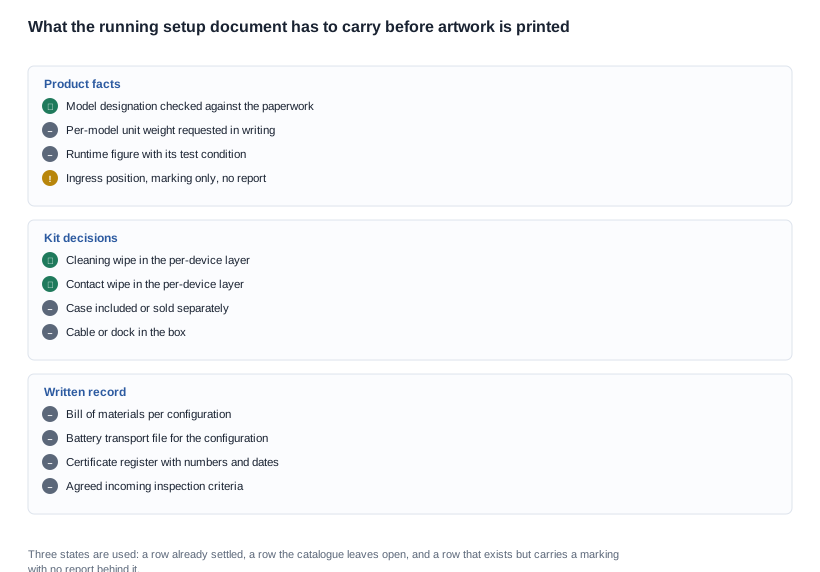
What the setup must not contain. Three additions are common in running setups and each of them creates a support cost rather than removing one. A general surface-wiping routine, for the reason above. A waterproof line in the artwork — the IP54 marking covers splashing water and a dust protection level, not immersion and not a sustained downpour, and no test report is published behind it, so a card that says waterproof is making a claim the documentation cannot carry, and the runner in a downpour is the customer who tests it. The digit reading is at IP rating advanced considerations. And a specifications panel on the packaging: a runner does not read it, a channel reviewer does, and the numbers that would satisfy a reviewer are not the numbers a runner uses. The failure list that comes out of a running programme is collected at running common problems.

The dependency order a running kit is built in
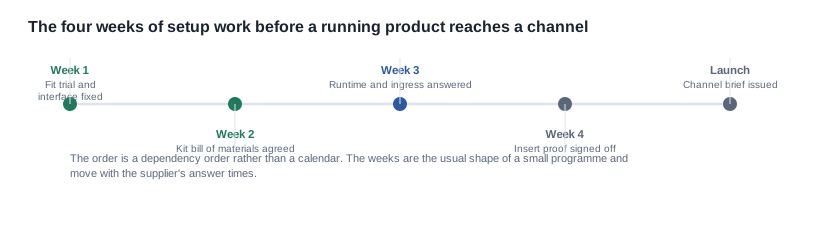
The order below is an order of dependencies, not a sequence of activities. Each step depends on the one before it, and a step taken out of order produces a document that has to be rewritten before it can be printed. That distinction matters commercially, because a rewritten insert is a second artwork round and a second approval delay, and the second one usually lands after the shipment date has been promised to the channel.

- The fit trial, on more than one head, before any artwork exists. Nothing downstream is valid until this is done, because the trial may rule out the configuration entirely.
- The consumables, the lens wipe and the contact wipe, and the decision about whether they are washable or single use. This is a per-unit cost decision, and it is the cheapest return reduction in the category.
- The interface, magnetic or Type C, and therefore the case decision and the cable count. This is the step that changes the transit file, the freight weight and the price point.
- The routine, the charging step and the contact step, each written as a single action attached to a moment the runner already has rather than as a paragraph of instruction.
- The insert, with the storage position first, then the cleaning step, then the rules. The order inside the insert is the order the runner needs them.
- The channel brief, worded against what the published rows support, so that the listing and the insert do not contradict each other.
Two trade-offs sit underneath the whole order, and a buyer is better off naming them early than resolving them late. The first is between a lighter frame and a larger cell, and the published record cannot settle it because per-model weight is not published for the running candidates. The second is between a case that extends the day and a case that adds volume to a runner's pack, which is also a transport-declaration decision. Neither can be resolved on paper, which is why the fit trial sits at the front of the order rather than at the end of the programme.
Where a running setup is written for the wrong reader
Six failures account for most of the setups that reach a channel without working, and each of them has a symptom, a root cause and a prevention that can be written into the order rather than discovered afterwards.
A setup written as a sequence of button presses. Symptom: a runner reports that the product "does not work". Root cause: the document describes a connection procedure and never describes what the device has to achieve on a head that is moving. Prevention: every setup line states an outcome, not an action.
A fit instruction that is a size chart. Symptom: returns that cannot be explained by a defect. Root cause: the instruction was written from the published rows, and the per-model weight is not among them. Prevention: the fit trial, on more than one head, before the artwork.
A charge routine that assumes a socket in a convenient place. Symptom: devices issued for a session and returned flat. Root cause: the routine was written to the catalogue charge time and not to the gap the runner actually has. Prevention: write the routine against a real gap, and record the charge time with its start state.
A wet contact written up as a defect. Symptom: a unit that comes back and tests perfectly in the workshop. Root cause: the contact was never wiped, and the fault was logged as a hardware failure. Prevention: the contact wipe in the per-device layer, and a fault-code sheet that separates "will not charge after use" from "will not charge at all".
A waterproof line in the artwork. Symptom: a review that names the brand. Root cause: the IP54 marking was read as a waterproof claim and no test report exists behind it. Prevention: the claim set is written from the marking, and the marking is described as protection against splashing water and a dust level.
No count of what went out. Symptom: a device that does not come back is simply bought again, and the accounts read it as a repeat sale. Root cause: there is no handover count, so the loss rate is invisible. Prevention: a count at issue and a count at return, reconciled against the shift roster.
What stays open commercially until the first shipment lands
The parts of the commercial position that are settled by the catalogue are settled by the catalogue, and a buyer who negotiates them is negotiating something that cannot move. The resolution class and therefore the ceiling on image quality, the cell configuration and therefore the runtime ceiling, the charging interface and therefore the charge routine, the ingress architecture on the camera models that carry the marking, the certification cost and its lead time, and tooling — which is amortised across the first order and quoted as a separate line rather than folded into the unit price. These are the fixed elements of the running configuration, and they are what makes the quotation comparable between two suppliers at all.
The parts that move are worth more attention than the unit price, and each one changes a configuration consequence rather than a preference. Whether the case ships in the box or is sold as a separate accessory is the largest single lever, because it is the difference between one price point and two, and it moves the artwork, the freight weight and the transit file together. The consumable quantities and their per-unit cost are the highest-return line in the category, and the quantity to negotiate is the quantity per device and the restock interval rather than whether they are included. Whether a protective film ships, and whether it is factory-applied, is usually the cheapest available reduction in the return rate on a product where a scratch is a return. Whether the supplier will review the insert artwork before it ships is the question that decides whether the setup document is tested or merely printed. Minimum order quantity tiers, and whether two models can share a purchase order, are open. Logo, lens tint and packaging are cheap to change between runs and expensive to change after the artwork is printed. Sending the opening order in two lots with the payment staged suits a running channel that is being built up in stages, and the quantity left at pilot level is where the widest margin sits, because that part of the order is the factory's own risk rather than the buyer's.
The documents to request before a deposit are the bill of materials per configuration with the case specification, the battery transport file for that configuration, the per-model unit weight, the runtime figure with its test condition, the ingress position in writing, the model designation table, the certificate register with numbers and validity dates, the agreed incoming inspection criteria and the packaging artwork proof. The clause language is at contract terms, the commercial structure of a first order is at pricing, and the product family is at sport smart glasses.
The short answer: we publish the rows a buyer can order from and will not fill the open ones with industry averages. For a running configuration that means the cell capacities, the rated runtimes, the resolution class, the charge times, the charging interface per model, the colour counts, the removable inner frame on the V06 and the S7, the remote capture control on the D17 and the ZH12, and the case capacities where they are published. We will not publish a frame weight we have not measured, and we would rather say that than quote a typical figure a buyer cannot verify. We will also not state that any model in our range is tested to IP54, because no test report is published behind that marking.
What we will do is take the session length, the interface the runner already carries, the channel and the price band, and tell you which published rows apply, which setup part to design first, and which claims the insert can carry without overreaching. The scenario entry point is smart glasses for running. Send us those four things and we will return the bill of materials each configuration should carry, the documentation that has to be settled in writing before the order, and the claim set the channel can defend.
Related reading
- Where the scenario starts — smart glasses for running
- The family this model belongs to — sport smart glasses
- The failure modes — running common problems
- The ingress consideration — IP rating advanced considerations
Tell us whether the run is recorded, the session length and the interface the runner already carries, and we will say which setup part to design first.


