

Smart glasses for security: the document a deployment cannot be without
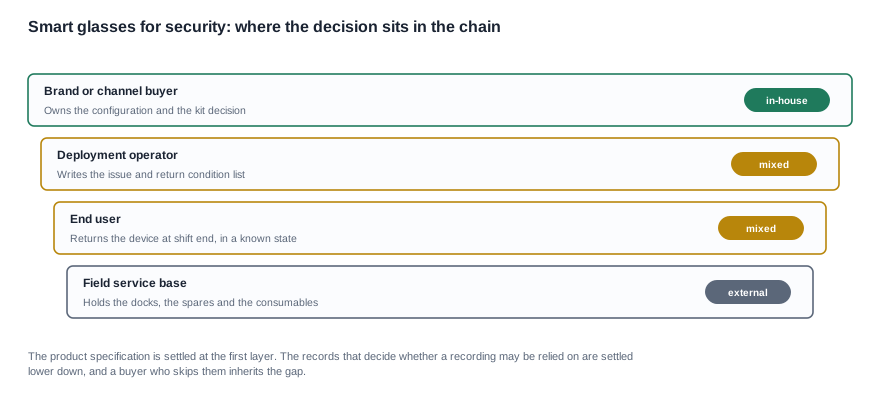
A security deployment rarely fails on hardware. It fails in three specific ways, and all three are decided before the first unit leaves the store: a recording was made that should not have been, a recording that should have been made was not, and a device reached a scene with a flat battery and a scratched lens. Each of those is a setup decision, and each is made in a document rather than in a device. That is what separates smart glasses for security from every other scenario in this catalogue: the configuration describes the product, and the setup document describes what the deployment is permitted to do. A buyer who confuses the two produces a device purchase and then discovers, at the point of use, that there is no rule about who may handle the footage and no standard for what condition a unit has to be in when it is handed over.
Four things have to be settled first, and none of them is a product question. What the recording is used for, and what the destination market requires of it. Who may carry the device and who may handle what it recorded. What condition a device has to be in when it is issued and when it is returned. And where it charges, who owns the consumables, and what happens at the end of a shift. Those four answers are the setup. Everything after them — the model, the kit, the charging architecture, the packaging — is downstream of them, and the downstream decisions are the cheap ones to change.
The reader here is a brand-side buyer, a channel buyer or an e-commerce seller with a security customer in front of them, usually a service company, a facilities operator or a retailer with a loss-prevention team. The situation is a quotation to compare or a programme to open for a named customer. What sits underneath is the same fear as in every other scenario: the consignment turns up other than the unit that was approved, the compliance file holds the boxes at a frontier, and the first deployment becomes a returns burden nobody budgeted. In a security deployment the version of that fear is worse, because the customer is measuring whether the recording can be relied on, and an unusable recording has no commercial value at all.
The four decisions that have to be closed before a unit is issued
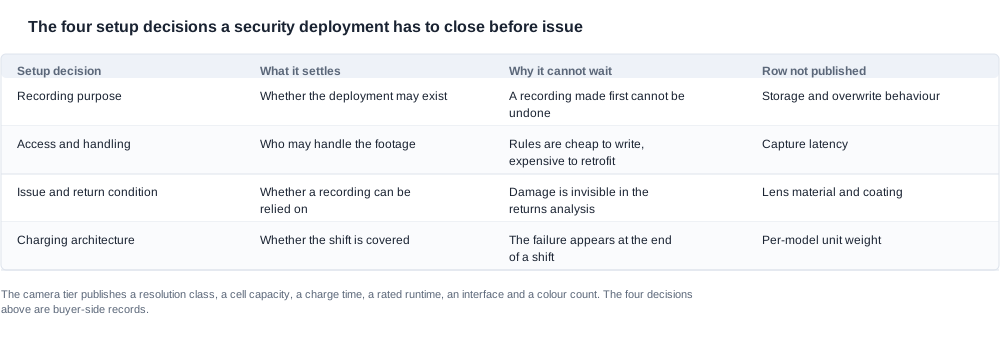
The recording purpose is the upstream question, and it belongs in the contract. A device carried on the head that records what the person in front of it sees raises a question no product specification can answer: who is recorded, what the recording is used for, and what the jurisdiction requires of it. For a security deployment that answer is made at the contract level — with the customer, their legal adviser and the destination market — and the setup document then carries it as a written position. The deployment-specific thread is at security legal considerations, the general product safety route is at general product safety regulation, and the document list is at certification checklist. A buyer who issues units before this is closed has manufactured a compliance problem that no product change can repair.
The access and handling rules decide who may do what. Two different populations touch a security device and they need different rules: the people who carry it during a shift, and the people who handle the recording afterwards — control-room staff, a retailer head of security, an external investigator. The rules are cheap to write and expensive to retrofit onto a deployment that is already running, because after that point the rules have to be enforced against people who have already formed a habit. That makes this the second decision, not the fifth. Its practical output is short: who may carry the unit, who may open or transfer the recording, where the recording is held, how long it is held, and what happens to it at the end of the retention period. A one-page document that answers those five questions is the deliverable.
The issue and return condition list is what protects the evidence, and it is invisible in the data. A unit issued with a scratched lens, a dirty contact or a flat battery produces material that cannot be relied on — and the failure never appears in a returns analysis, because the unit was used rather than returned. That is why the condition list has to be written, has to carry a visual reference, and has to be applied at issue and at return by somebody who has not seen the product before. Without a visual reference two officers will apply the same written standard differently. With one, the check takes seconds and the result is comparable across every site in the deployment.
The charging architecture decides the vehicle layer, and it is an installation decision. A magnetic device needs the correct dock at every charging point, which is a fixed asset the buyer has to place, maintain, insure and eventually replace. A Type C device needs a cable, which is a consumable replaced at a base. The interface is published per model — Type C on the V03 Pro, the L2 Utral, the D11, the D12, the D17, the ZH12 and the bone-conduction model, magnetic on seventeen models, and not published at all on the CY03 and the MT6, and the CY05 and the L1 Pro — and that last group has to be settled with the supplier in writing, because a fleet cannot install a dock layer on an interface nobody has confirmed. The charging decisions are at charging solutions, and the product range is at AI camera glasses.

The four decisions have a dependency order, and it is worth writing it down before any of them is discussed: the recording purpose decides whether the deployment is possible at all, so it comes first and every later decision is conditional on it. The access rules come second because they are cheap to write and expensive to retrofit. The condition list comes third, because it is the document the issuing officer actually uses. The charging architecture comes fourth, because it produces the kit layers. After that come the kit layers themselves, the handover count, and the one-page handover brief written for the person who issues the unit rather than the person who carries it.
What the camera tier publishes and what a security file has to close
The camera tier publishes a consistent set of rows: a resolution class, a cell capacity, a charge time, a rated runtime, a charging interface and a colour count. Eleven models carry a camera, and the resolution class splits into two groups — eight models at 8 MP (the V03 and the KY06, the MT5 and the MT6, and the CY03 and the V03 Pro, and the V06 and the CY05) and three at 13 MP (the S7 and the L2 Utral, and the L1 Pro). The cell capacities run from 220 mAh on the V03 and the V03 Pro up to 290 mAh on the L2 Utral and the CY05, and the CY03 and the L1 Pro, with the MT6 at 265 mAh, the S7 and the V06, and the MT5 and the KY06 — each at 260 mAh, and the MT5's 220 mAh cell with its own six to eight hours. Every camera model publishes a rated runtime, and the band runs from five to eight hours on the V03 Pro and the V06, and the V03 and the S7, through six to eight hours on the KY06 and the MT5, to about seven hours on the L1 Pro and the L2 Utral, and the MT6 and the CY05, and the CY03.
The charging case is the row that carries the most weight in a security deployment, and the catalogue states it in three different ways rather than two. Five camera models publish a case capacity: 1400 mAh on the CY03 and the CY05, and the L1 Pro, 900 mAh or 1400 mAh as a configuration choice on the L2 Utral, and a 1200 mAh foldable case on the MT6. Two more — the KY06 and the MT5 — are published with a case whose capacity is not stated. Three models have no charging-case row at all: the V03 and the V06, and the S7. That last group is an unpublished row rather than an absent feature, and a buyer who reads it as "no case" will build the wrong kit. One model, the V03 Pro, has no charging-case row. Getting this wrong in a fleet order is expensive in both directions: a unit issued without the case it was specified with is a complaint, and a case shipped that was never specified is a second lithium cell that has to be declared for transport.
The IP54 marking appears on exactly two models in the whole catalogue, the V06 and the S7, and no third-party test report is published behind it. It covers splashing water and a dust protection level; it does not cover immersion and it does not cover a sustained downpour. Every other model carries no ingress marking at all, so an insert that generalises the marking across the range is making a claim that the catalogue does not support. The digit reading is at IP ratings.
Everything a security file needs most is open. The sensor, the field of view, the video specification, the frame rate, the stabilisation, the low-light behaviour and the operating temperature range are not published for any model. So are the per-model unit weight beyond the single 158 g figure for the MT6 — the whole unit including the battery and the camera, excluding its foldable case — the runtime test condition, the cycle life rating and the standby draw. One gap deserves particular attention in this scenario: the storage and overwrite behaviour is not published for any model. In a content-creation programme that gap is an inconvenience. In a security deployment it goes to the heart of the recording, because a device that silently overwrites footage produces a gap in an incident timeline that nobody can reconstruct later, and the gap is invisible until the moment it is needed. That is the row to put at the top of the list of supplier answers, because it is the one that can invalidate a whole deployment rather than inconvenience it.
One more comparison warning applies here, because the camera tier is where buyers are most likely to read a single column. The same 100 mAh appears on four models with four different meanings across the range — the AR glasses pair it with magnetic charging and about eight hours, the D11 and the D12 pair it with Type C and about seven hours, and the ZH12 pairs it with Type C and about eight hours — so a capacity column read without the interface column produces conclusions that are simply wrong. And the catalogue publishes cells and count rather than a total: 55 mAh × 2, 70 mAh × 2, 90 mAh × 2 and single 100 mAh cells all appear. Totalling them is legitimate analysis, but a total presented as a published figure is a false claim, and the fleet specification is the last place where one should survive.

The kit by layer, and why the layer decides the return rate
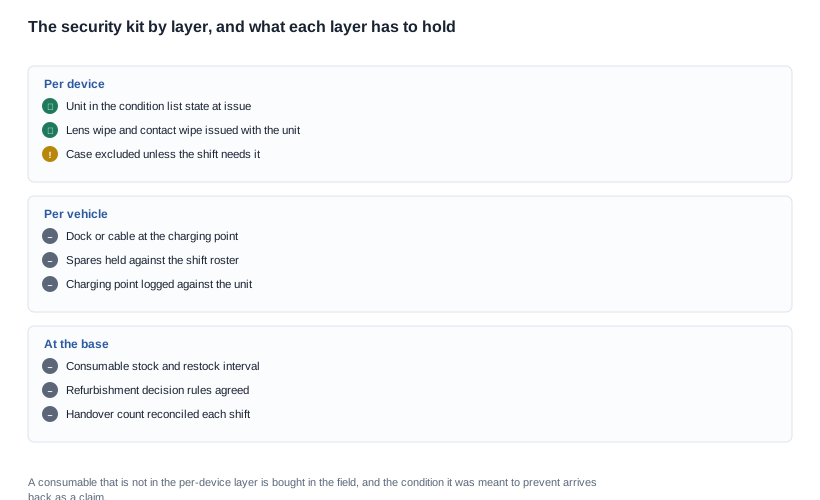
A fleet kit is not a kit. It is three kits at once, at three different places, and most of the returns in this category come from putting something in the wrong one. The per-device layer travels with the unit: the lens wipe, the contact wipe, and the unit itself in the condition the issue list describes. The per-vehicle layer is fixed to the charging point: the dock or the cable, and a log of which unit charged where. The at-the-base layer holds the consumable stock, the spares and the refurbishment decision rules.
The consumables belong in the per-device layer, and that is not a detail. A cleaning item and a contact-cleaning item cost a few cents each, and if they are held at the base instead, they get bought separately in the field, often from a different supplier, at a worse price, and the scratch or the charge failure they were meant to prevent arrives back anyway. The two consumables remove two distinct return categories: the scratch, which arrives as a soft-image complaint and gets attributed to the camera rather than to the wipe, and the wet contact, which arrives as a fault that tests perfectly in the workshop and produces a second and more confusing conversation. The highest-return line in a security bill of materials is not the device; it is the two items that stop the condition list from being the only defence.
The case is the item that usually gets decided wrongly for a fleet, and the reason is a misreading of the catalogue rather than a budget decision. For a fleet, a case per device is usually a decision to exclude, because it is a second lithium cell to declare for transport, a second object to track at handover, and a second thing to charge. The exception is a deployment whose shifts are long enough that the published runtime will not cover a shift on the device alone — and that exception has to be tested against the measured runtime rather than the published one, because no published figure carries its test condition. A device issued for a shift on the strength of an eight-hour rating with no condition attached is a device that will be flat before the shift ends, and the shift, not the specification, is what the customer notices.
The count is the last piece of the layer model and it is the cheapest one to get wrong. A device that does not come back is bought again, and in the accounts that reads as a repeat sale rather than a loss. Without a reconciliation count at issue and at return, the loss rate is invisible and the first sign of it is a budget that does not balance at the end of a contract.
Six ways a security setup fails in the first month
A setup written around the device rather than around the deployment. Symptom: a document that describes charging modes and battery figures while the questions that decide the deployment are still open. Root cause: the specification was treated as the setup. Prevention: the four decisions are answered before the model is chosen.
No condition list, so every handover is a judgement call. Symptom: inconsistent rulings on the same defect, and an argument with the customer about whether a unit was returned damaged. Root cause: no written standard and no visual reference. Prevention: the condition list, applied at issue and at return by the same role.
A waterproof claim in the insert. Symptom: an incident report that names the brand. Root cause: the marking was read as a waterproof rating. Prevention: the claim set is written from the marking, and the marking is quoted as protection against splashing water and a dust level.
Consumables held at the base instead of issued per device. Symptom: scratch and charge failures arriving as claims, at a replacement cost rather than at a consumable cost. Root cause: the kit was designed as a shipment rather than as a deployment. Prevention: the per-device layer.
A rules question left to the shift. Symptom: a device used where a recording was not permitted. Root cause: nobody owns the decision. Prevention: the rule is written at the contract level and referenced in the one-page handover brief.
A fleet bought without the storage answer. Symptom: a gap in an incident timeline that cannot be explained. Root cause: the overwrite behaviour was never established. Prevention: the storage and overwrite question is answered in writing before the order, and the answer is written into the setup document.
The commercial terms of a fleet that is issued, carried and returned
The catalogue settles more of the commercial position in this scenario than in most, and a buyer who negotiates the settled parts is spending time that would be better spent on the open ones. The resolution class and therefore the ceiling on image quality, the cell configuration and therefore the runtime ceiling, the charging interface and therefore the charging architecture, the ingress architecture on the two models that carry the marking, the certification cost and its lead time, and tooling — amortised across the first order and quoted as a separate line rather than folded into the unit price — are the fixed elements. They are also what makes two quotations comparable, because they are the same in both.
The elements that move are fleet-specific rather than product-specific. Whether a case is issued per device or held at the base is the first one, because for a fleet it decides a second lithium cell, a tracking obligation and a price point, and it is usually a decision to exclude. The kit layers and the consumable quantities are the second, and the quantity to negotiate is the quantity per device and the restock interval rather than whether the consumables are included at all. Whether the supplier will provide a handover template for the buyer's own operations team is the third, and it is worth asking for because the template is where the issue and return condition list gets turned into a working procedure. Whether the supplier will train a refurbishment partner on that condition list is the fourth, and it is usually cheaper than the buyer's own team writing it twice. Whether the storage behaviour is configurable is the fifth, and in this scenario it is a real question rather than a curiosity, because a device whose overwrite behaviour can be set is a device whose recording gap can be closed for an incident review. Minimum order quantity tiers are open. Logo, lens tint and packaging are open. A site-by-site rollout is the case where dividing the first order into two shipments with staged payment works, and how much of that order stays at pilot quantity is the term that carries the most give.
The documents to request before a deposit are the model designation table, the certificate register with numbers and validity dates, the written regulatory position per market, the issue and return condition list with its visual reference, the battery transport file for the configuration actually ordered, the kit list by layer, the storage and overwrite statement, the packaging artwork proof, and the agreed incoming inspection criteria. The clause language is at contract terms, the commercial structure of a first order is at pricing, the scenario entry point is smart glasses for security, and the buying-side list is at the security checklist.
Stated plainly: we publish the rows a buyer can order from and we will not fill the gaps with figures we cannot trace. For the camera tier that means the charge times, the rated runtimes, the cell capacities, the resolution class, the charging interface per model, the colour counts, the IP54 marking on the V06 and the S7, and the case capacities on the five models that publish one. We will not publish a frame weight we have not measured, we will not state that any model is tested to IP54, and we will not describe the storage and overwrite behaviour of a model whose behaviour we have not been given. We would rather tell a buyer that the row is open than send them a typical figure that fails at the moment it is relied on.
What we will do is take the deployment type, the recording purpose, the shift length, the number of units and vehicles, and the markets, and tell you which published rows apply, which of the four setup decisions has to be closed before the first shipment, and which documents have to be settled in writing before a purchase order is raised. Send those and we will return the configuration each layer should carry, the documentation list for the configuration, and the claim set the insert can defend.
Related reading
- How to enter the scenario — smart glasses for security
- The range covered — AI camera glasses
- The regulatory thread — security legal considerations
- The buying-side list — security checklist
Tell us the deployment type and the recording purpose, and we will say which setup decision to close first.


