

Smart glasses for security smart glasses legal considerations fall into two groups that are easy to confuse. There is the product compliance set, which is identical in every market and is covered in the compliance material. And there is the set of questions that arise specifically because a camera and a microphone are recording people in a place where most of them do not know they are being recorded. The second group is what this article is about, and the practical way to work through it is to allocate each obligation to the party that can actually discharge it.
We publish the camera platforms' configuration and the gaps in it, and we publish no data-flow detail, no recording-indicator specification and no retention model for any model. That absence shapes the article: every item below is either a document to request from a supplier or a decision to take, and none of them is a product feature to switch on.
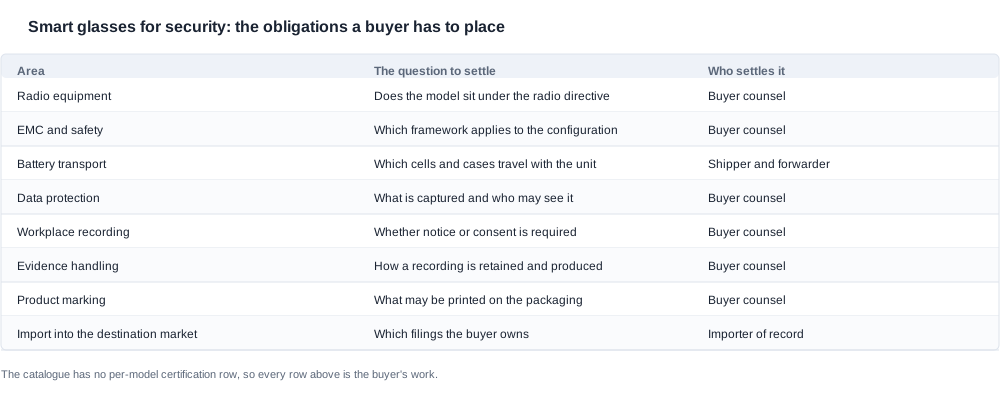
Smart glasses for security: who carries which part of the legal burden
Eight obligation areas apply to a security deployment, and each one has a different owner. Misallocating them is the most common cause of a programme that stalls after the units have arrived.
| Area | The question to settle | Who settles it |
|---|---|---|
| Radio equipment | Does the shipped version sit under the radio equipment directive | Buyer counsel, with the supplier's document |
| EMC and electrical safety | Which framework applies to this configuration | Buyer counsel, with the supplier's document |
| Battery transport | Which cells and which cases travel with the unit | Shipper and forwarder |
| Data protection | What is captured, and who may see it | Buyer counsel and the buyer's own record |
| Workplace recording | Whether notice or consent is required | Buyer counsel |
| Evidence handling | How a recording is retained and produced | Buyer counsel |
| Product marking | What may be printed on the packaging | Buyer counsel |
| Market access | Which filings the importer of record owns | The importer of record |
The allocation has a simple logic behind it. A document that describes a product belongs to the supplier, and it is requested per model and per configuration. A decision about what the organisation will do with recordings belongs to the buyer, and it cannot be delegated to a catalogue or a contract. The first group is a procurement task with a lead time; the second group is a legal task with a counsel. Conflating them produces the two failure modes this category sees repeatedly: a deployment that launched with an unresolved legal question, and a buyer who spent months trying to get a supplier to answer a question that was never the supplier's to answer.
Two consequences follow from that allocation and are worth stating because they change how a buyer should plan.
The supplier's documents have a lead time, so they belong at the front of the schedule. A per-model conformity file, a test report and a battery transport declaration are all produced by an external process, and none of them can be compressed by asking more urgently. A buyer who requests them in week one of a twelve-week programme has a realistic chance of having them in hand when the units arrive; a buyer who requests them after the units have arrived has already lost the time they would have taken.
The buyer's decisions have no lead time but do have a dependency. The retention rule, the lawful basis, the notice text and the data-flow description can all be produced by the buyer's own people, but they cannot be finalised until the product facts are known — and the product facts here are the ones the catalogue does not publish. In practice that means the request for the unpublished product facts is on the critical path, and it is the reason a compliance timetable in this category is really a supplier-document timetable with a legal review sitting on top of it.
One clarification about the radio directive is worth putting in the request for quotation, because the number is often quoted incorrectly in this industry. The European radio equipment framework is the Radio Equipment Directive (EU) 2014/53/EU. The EMC directive is a separate instrument with a different number, (EU) 2014/32/EU, and the two are confused often enough that a buyer who asks a supplier "which directive covers this" can receive an answer that conflates them. A request that names (EU) 2014/53/EU explicitly removes the ambiguity. What the catalogue can and cannot support is a separate matter, and it is covered below.


The order the compliance work has to happen in
Compliance work fails when it is run as a parallel activity rather than as a sequence with dependencies, because two of the steps have to finish before a third can start.
- Identify the destination market and the importer of record. Until this is settled, the applicable framework is unknown and every document request is a guess.
- Get the per-model conformity file for the exact configuration. Per model, because the catalogue contains no per-model certification row at all — the export certification page it carries is company-level and its content is images rather than extractable text. The catalogue text contains no CE, FCC or RoHS reference anywhere, so there is nothing to inherit and everything to request. The route is at the certification checklist.
- Check the radio and EMC position for the shipped version. Two separate questions, two different instruments, and the request should name (EU) 2014/53/EU for the radio question.
- Place the battery transport file for the cells and the case. A charging case is a second lithium cell with its own declaration requirement, and a case that travels with the operator travels on every shipment. The requirements are at battery transport.
- Settle the data and recording obligations before deployment. This is the step that has no supplier deliverable attached, and it is the one that stops deployments.
- Print only what the file supports. Marking comes last, never first.
Steps two and four are the two that are usually collapsed into one request, and collapsing them creates a specific problem. A single request for "the certification and battery paperwork" produces a bundle, and the buyer then has to work out which document covers the cells and which covers the case, which covers the model and which covers the variant. Splitting the requests means each document arrives attached to the thing it describes, and a bundle that arrives unattached cannot be used to close a compliance item at all. The cost of splitting is one extra line in a request; the cost of not splitting is a compliance file with an unreadable evidence section.
There is also a sequencing point between step one and step two that is easy to miss. The destination market determines the framework, and the framework determines which document is needed, but the model and configuration determine which document is valid. A buyer who requests the document before fixing the configuration can end up holding a file for a variant they have since changed, which is the single most common reason a per-model conformity file turns out not to cover the units that arrive. Fixing the configuration first is therefore not a procurement preference — it is a condition of the document being usable.
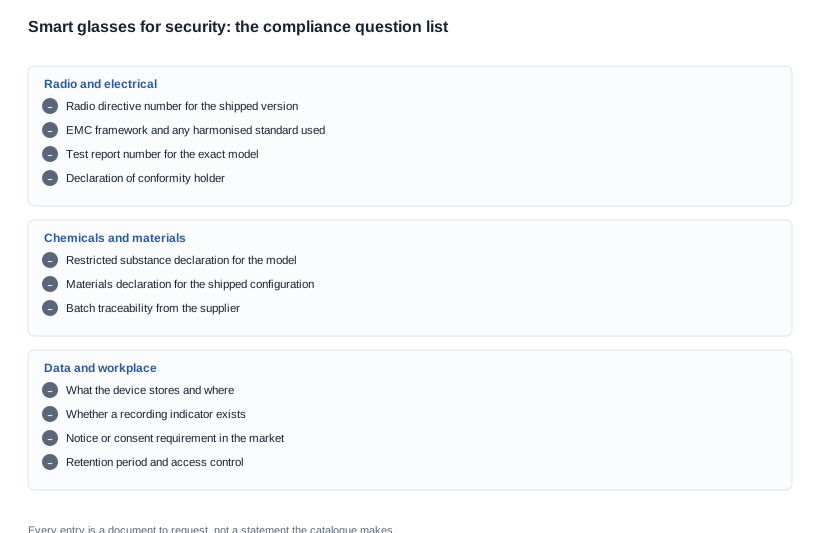
Two traps that surface only after deployment starts
The indicator, and the fact that the same device is worn in two very different contexts. A device used by a guard in a public place and a device used by a warehouse operative on a floor are the same hardware with the same lack of a published indicator, and they attract entirely different legal questions. A deployment that treats them as one product will get the public-place question wrong. The product-side fact that bears on both is the recording indicator, and the catalogue publishes no indicator specification for any model — so the question has to be put in writing before the order, and the answer determines whether the configuration is usable in the public context at all.
The evidence question. If a recording is used after an incident, it becomes evidence, and evidence has provenance: the time, the place, and the fact that it has not been edited. A device that records continuously onto a phone that nobody manages is in a weaker evidential position than one with a controlled capture and export path, and the export path is a product feature we cannot describe for our own models, because no export format or transfer path is published for any camera model.
A third one deserves naming even though it is not product-specific: the retention rule has to exist before the first recording, not after the first complaint. A continuous recording device with no retention rule produces a growing store of images of people who had no expectation of being recorded. The rule has to come from the operator, and the operator cannot write it without knowing what the device can be asked to do — which is the storage and overwrite behaviour the catalogue does not publish.
There is a fourth trap that only appears once a deployment has run for a while, and it is the one most likely to be missed because it produces no complaint at the time. The configuration drifts away from the compliance position it was assessed against. The shift pattern changes, the site changes, the recording purpose changes, the client changes, the market changes — and each of those changes can alter the legal position while leaving the hardware untouched. A deployment that was assessed for a static indoor post in one market is, a year later, running on a patrol in a public thoroughfare in a second market, on the same units and the same paperwork, with nobody having re-asked the original questions.
The reason this is a procurement issue as much as a legal one is that the trigger for re-assessment is usually a purchase or a redeployment rather than a legal event. A second order for the same configuration into a new market is the moment at which the compliance position should be re-checked, and a buyer who treats the second order as a repeat of the first has carried the first order's assumptions into a context they were not written for. Writing the re-assessment trigger into the agreement — a named event, a named owner and a named interval — is the cheapest available control, and it costs nothing but a clause.
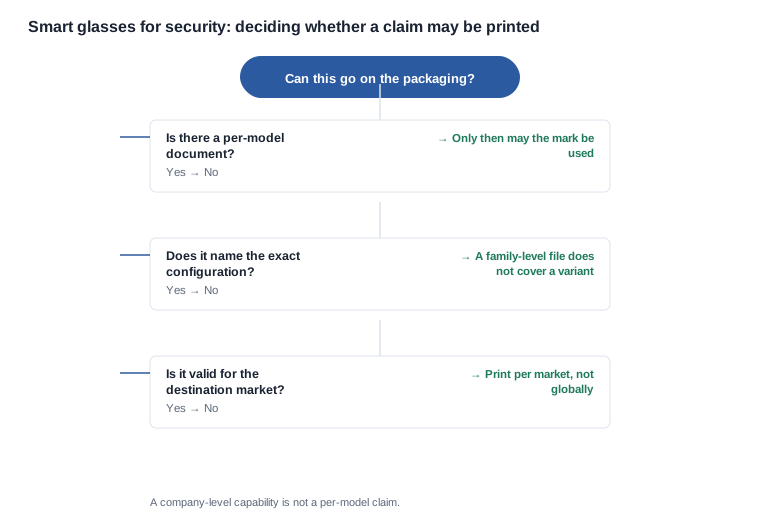

What may be printed on the packaging
A channel listing inherits its claims from whatever the supplier's material says, and in this category the material frequently says more than the documentation supports. The decision rule is short and worth putting in the artwork approval process.
A claim may be printed only when a per-model document supports it. The catalogue's export certification page is a company-level page whose content is images rather than extractable text, and the catalogue text contains no CE, FCC or RoHS reference at all, so no marking claim can be inherited from it. What can be inherited is a document the buyer holds for that specific model and configuration.
A family-level document does not cover a variant. This matters more than it sounds in this catalogue, because the platform similarities are strong: the V03 and the V03 Pro share a cell capacity and a runtime band, and the V03 Pro is a photochromic-lens configuration for which the catalogue prints no charging-case row at all. A buyer who relies on a platform-level file for a variant is relying on a document that was never written about the variant.
A claim is per market, not global. The same units going into two jurisdictions carry two different marking and documentation positions, and the artwork is usually shared. The correct arrangement is per-market artwork and per-market documentation sets, which is also why adding a second market is an artwork and documentation cost rather than a shipping cost.
The review sequence for artwork is short enough to be a checklist rather than a negotiation. For each claim printed: name the document that supports it; confirm the document names the exact model and configuration; confirm the document's scope covers the destination market; confirm it is current rather than superseded; and confirm the document holder is the entity that will be the manufacturer or importer in that market, because a declaration of conformity issued to a different legal entity carries less weight than the same document issued to the right one.
That last point catches buyers who have done everything else correctly. A conformity file obtained from a supplier is evidence that a product was assessed; it is not automatically a declaration that the buyer is entitled to place on the market. Where the buyer is the importer of record, the declaration has to sit with the buyer, and the supplier's role is to supply the test report and the technical file underneath it. This is a question to ask before the artwork is finalised rather than after, because re-cutting artwork and re-issuing documentation is one of the more expensive corrections available in a launch schedule.
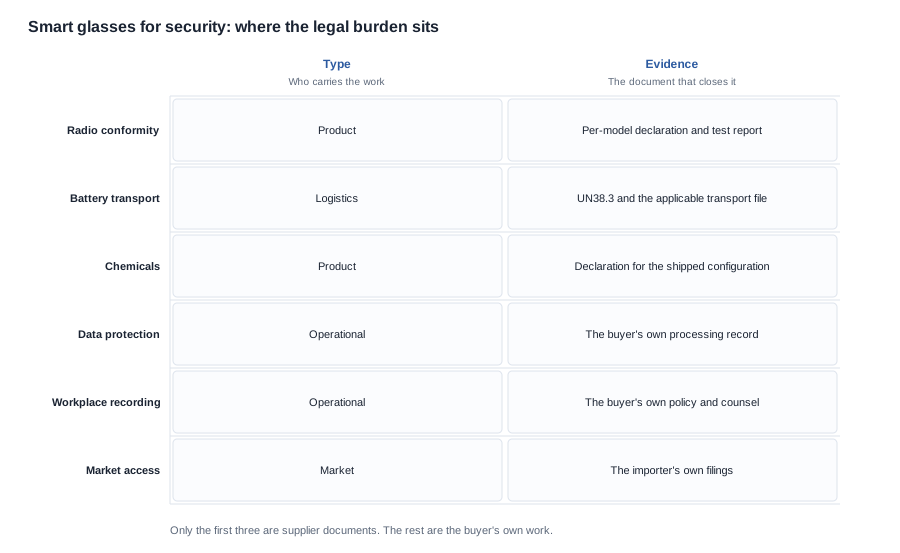

The questions only your own counsel can answer
Five questions in this category have no product answer at all, and a buyer who sends them to a supplier will get either a non-answer or an answer that creates a false impression of coverage. They should go to counsel, with the product facts attached so that counsel can reason from facts rather than from marketing.
What is the lawful basis for the recording, and does it differ between staff and members of the public? In many jurisdictions the answer is a legitimate interest rather than consent, and the difference matters because a legitimate interest has to be balanced against the interests of the people recorded.
Who is the controller and who is the processor? A security operator that puts its own people in the field with a device on a supplier's application is in a processing relationship, and the supplier's role has to be defined. Our own position is that we publish no data-flow detail for any model, so the data-flow description has to be established with the supplier and the operator separately from the legal framework.
Does the recording indicator obligation apply, and where does it apply? Not whether the device has one — whether the context requires it. The answer determines which deployments the configuration is suitable for.
What notice must be given, and to whom? Signage, staff notification and any public-facing notice are jurisdiction-specific and site-specific, and a device that cannot indicate recording is a device that cannot satisfy an indicator-based obligation.
What is the retention period, and what happens at the end of it? And the follow-on question that is asked less often: what is the procedure for a unit that is lost, and what happens to the material on it.
None of these five can be answered by a catalogue, a specification sheet, a quotation or a certificate. They are the buyer's own questions, and the reason to write them down is that the answer determines the configuration, the training and the documentation rather than merely confirming them.
The practical method for putting these to counsel is to attach the product facts to the questions rather than the questions alone. A counsel asked "may we record staff on these units" without knowing the capture behaviour, the storage behaviour, the transfer path or the indicator position will answer in the abstract, and an abstract answer is one that has to be revisited. A counsel asked the same question with the published configuration rows in front of them — the pixel tier, the cell capacity, the charge time, the runtime band, the charging method and the case position for the model in question, together with a written list of what is not published — can answer in the specific, and the specific answer is the one that goes in the compliance file.
That is also the reason to keep the two groups separate in the file itself. A compliance file that mixes the supplier's documents with the buyer's decisions becomes hard to review, because a reviewer cannot tell which items are facts about the product and which are positions the organisation has taken. Two subsections, one for the documents held and one for the decisions taken, with a date and an owner on each line, is a structure that survives an audit and that makes the open items visible.
The boundary of what we will publish about compliance
The short answer: we publish the hardware configuration and the gaps in it, and we will not describe a stored-forever recording as a neutral product choice or imply an indicator we have not confirmed. We publish no data-flow detail and no retention model for any model, and we would rather a deployment establish them with a local adviser than assume them from a product page.
We will also not state that our products are CE, FCC or RoHS certified, because the catalogue does not say that. The catalogue carries a company-level export certification page whose content is images rather than text, and its text contains no CE, FCC or RoHS reference and no per-model certification row. A per-model claim has to come from a per-model document, and the route is at the certification checklist with the battery transport file requested separately at battery transport.
What we can do is tell you which of the eight obligation areas our documentation answers and which are legal questions with no product answer, so the two are not confused, and we can give you the published configuration rows a counsel will need in order to reason about the deployment. The full compliance set is under market compliance, the deployment sequence is in how to set up for security, and the operational checklist is at the deployment checklist.
Related reading
- The deployment sequence — how to set up for security
- The deployment checklist — security deployment checklist
- The compliance set — market compliance
- The per-model route — certification checklist
Tell us the jurisdiction and the setting, and we will tell you which of the eight questions our documentation answers and which need a local adviser.


