Smart glasses for security smart glasses checklist is six checkpoints, and three of them decide whether a deployment can proceed at all: the recording indicator, the consent basis and the procedure for clearing a unit between users. Everything else on this list is operational and can be sorted out during a rollout. Those three are conditions, and if they are unresolved the deployment should not start. The catalogue publishes the camera platforms' resolution tiers, cells, charge times, rated runtimes, charging methods and case capacities, and it publishes no recording-indicator specification, no data-flow detail and no retention model for any model — so this list is written as a set of outputs to produce rather than a set of features to check.

Smart glasses for security: the six checkpoints of a deployment
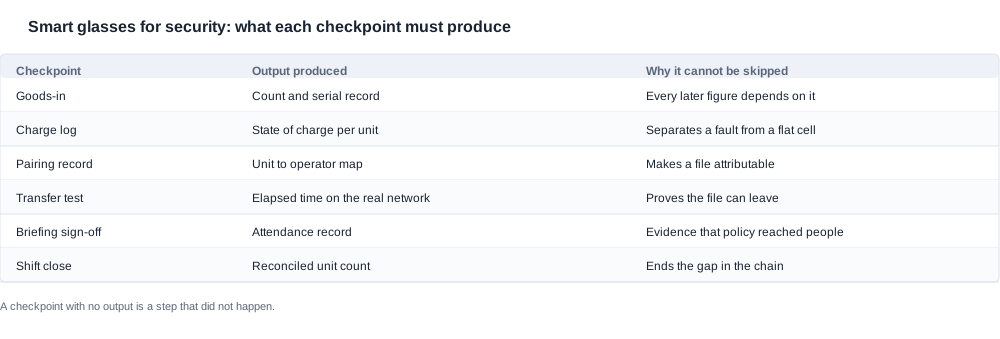
The six checkpoints run in a fixed order, and the order is not a preference. Each one produces a document or a record, and a checkpoint with no output is a step that did not happen.
Checkpoint one: goods-in. Count the units, record the serial numbers against the purchase order, and note the model designation of each. This is the step that makes every later figure possible. A deployment that skips the goods-in count cannot reconcile anything afterwards, cannot attribute a file to a unit, and cannot establish a defect rate — because there is no denominator.
Checkpoint two: the charge log. Every unit charged, and the state of charge logged against the serial. The published charge times make this cheap and routine: 26 of the 28 catalogue models publish a charge time of two hours or less, and only the D17 and the ZH12 publish approximately one hour. What none of those figures carries is a starting state or an end-of-charge criterion, which is precisely why the buyer has to log the state itself rather than infer it from elapsed time on the bench.
Checkpoint three: the unit-to-operator map. Each unit matched to an operator, with the mapping logged. This is the half of the evidence chain the buyer controls outright: the catalogue publishes no time-stamping method for any camera model, so the unit reference in the buyer's own record is what ties a recording to a device and a person.
Checkpoint four: the transfer test. A file emptied from a unit on the real network, with the elapsed time written down. This is the checkpoint most often deferred, because it reads as an IT task rather than a procurement task, and it is the one that determines whether the programme has a retrieval step or a gap in the record.
Checkpoint five: the operator briefing. Delivered, and recorded as delivered. The content that matters is the etiquette and the reporting route — what to record, when not to record, and who to tell — not the button sequence. The catalogue publishes no recording-indicator specification for any model, so whether an operator can be seen to be recording is a question the buyer's own policy has to answer, and the briefing is where the answer is communicated.
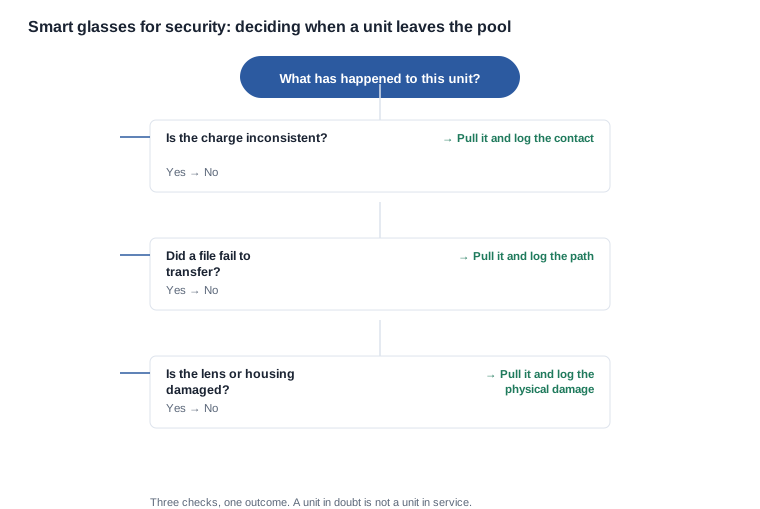
Checkpoint six: the shift close. The unit count reconciled, doubtful units pulled from the pool and logged with a reason, and gaps recorded with a reference. This is the checkpoint that converts a fleet from a box of devices into an accountable set.

The three conditions that stop a rollout
These three are not improvements. Each one is a precondition for the deployment being defensible, and each one has an unfortunate default if it is skipped.
The indicator. Whether the person carrying the unit can be seen to be recording. The catalogue publishes no indicator specification for any model, so this is the first of the three conditions and it is a product question the buyer must put in writing. The consequence of not resolving it is that the device records invisibly, which in a workplace creates a legal exposure that no amount of downstream policy can repair.
The consent basis. What the site, the staff and the public have been told, and on what authority. This is a question for the buyer's own counsel and it is jurisdiction-specific; the compliance material is at market compliance, and the operational sequence is at how to set up for security. The product-side facts that bear on it — the storage path, the recording indicator, the audio capture behaviour — are not published for any model, so the policy has to be written in terms of what the organisation intends to do and what the device is known to permit.
The clearing procedure. How a unit is cleared between users or between clients, and how that clearing is evidenced. This is the third condition and it is the cheapest to write and the most often omitted. It is also the one with the clearest operational failure: a device that carries the previous user's material to the next site is not a security problem in the abstract, it is a specific and reportable incident that the buyer's own policy was supposed to prevent.
The practical consequence of all three is that a deployment can be operationally ready and still not be ready to start. That is a better position to be in than the reverse, because the three are decisions and a decision can be made in a week — whereas a complaint is expensive, public, and arrives on somebody else's timetable.
A procurement team can turn these three conditions into a simple gate, and the gate is worth stating precisely because it is the difference between a deployment that starts and a deployment that is stopped. The deployment may begin when the operator briefing has been delivered and recorded, the consent basis has been confirmed in writing by the buyer's own counsel for the specific market and site, and the clearing procedure exists as a written step with a named owner and an evidential method. None of the three requires a factory document; all three require a buyer's own decision. That is the point: they are conditions the buyer controls, and a buyer who treats them as supplier deliverables has misunderstood where the risk sits.
What makes them conditions rather than improvements is the asymmetry of failure. An operationally imperfect deployment still produces usable records and still resolves disputes, and the imperfection gets fixed in the ordinary course of operations. A deployment that starts without one of the three produces records that may be unusable, and the fix is not available afterwards — the consent basis cannot be retrospectively obtained and the clearing procedure cannot be retrospectively evidenced. The cost of settling them before the start is a week of somebody's time. The cost of not settling them is a programme that stops.

The checkpoints that fail quietly
Three of the six produce no visible signal when they are skipped, and those three are where a deployment loses its record.
The goods-in count fails quietly because everything continues to function. The units work, the operators use them, the reports come out, and the absence of a denominator only becomes visible months later, when somebody asks how many units were in service last quarter and nobody can say.
The unit-to-operator map fails quietly because nothing prevents a unit from being handed to a different operator. The consequence surfaces at an incident review, where a file exists and there is no way to say whose shift it was on, and where the answer has to be reconstructed from memory.
The shift close reconciliation fails quietly in the same way. Each shift looks complete, and the accumulated drift is only visible when the physical count and the record diverge — which is usually at an inventory, at a site change, or when a unit is lost and nobody can say how many are missing.
There is a fourth that behaves differently and deserves separate mention. The transfer test does not fail quietly at all — it fails loudly, on day one, the first time an operator tries to retrieve a file and cannot. It is included in this section only because it is routinely deferred on the assumption that it will work, on the basis that the device recorded fine.

Running the checklist on a mixed fleet
A fleet that mixes camera models, audio models and sport models inherits three different configurations at once, and the checklist has to accommodate them rather than assume one.
The charging bench has to be planned per charging method. The catalogue publishes magnetic charging for 17 models and a Type-C interface for 7, and the four camera models that publish no charging method row at all are the MT6 and the CY03, and the L1 Pro and the CY05. A bench designed for one method leaves the other set with either no dock or a cable on every position, and the cable count is a function of shift overlap rather than of headcount. The audio and sport tiers differ again: the D17 and the ZH12 are Type-C with approximately one hour of charge time, which makes them the only models in the catalogue where the charge time affects the shift design itself.
The case reserve has to be planned per case position, and there are three answers. Five camera models publish a case capacity — the CY03 and the L1 Pro, and the CY05 — each at 1400 mAh, the L2 Utral at 900 or 1400 mAh, the MT6 at 1200 mAh in a foldable case. Two publish a case without publishing its capacity (the KY06 and the MT5). Four have no case row at all (the S7 and the V06, and the V03 and the V03 Pro), which is where the reserve question has to be put to the supplier in writing. A reserve policy written as "one case per unit" is wrong for at least four models in that list.
The shift plan has to be written against the runtime band of each model, not the fleet average. The camera tier publishes 5 to 8 hours on the V03 Pro and the V06, and the S7 and the V03, 6 to 8 hours on the KY06 and the MT5, and about 7 hours on the MT6 and the L1 Pro, and the CY05 and the CY03, and the L2 Utral. Averaging those bands produces a number that is true of no model in the fleet, and a fleet on a mixed shift plan needs the plan written per model.
One further item belongs on the checklist for any mixed fleet and is not a device question at all: a unit identifier that survives the case, the bench and the locker. The catalogue publishes no time-stamping method, so the buyer's own labelling is the mechanism that ties a recording to a unit, and it has to be legible under the lighting conditions of the site.
There is a further planning consequence of a mixed fleet that is worth naming, because it is invisible in a single-model deployment: the spare pool cannot be pooled across models without a plan for the cases. A spare unit drawn from the pool has to be usable with the model it replaces, and the case position determines whether that is possible. A spare for a model with a 1400 mAh case is that model plus that case; a spare for the V03 Pro, whose case position the catalogue does not publish, is that model plus whatever the fleet's fallback reserve happens to be. In a fleet that mixes case-published models with the four that have no case row, the reserve has to be modelled per model, and it is easier to model per model at procurement stage than to discover at month three that the pool holds units that cannot cover the gap they were bought for.
The same logic applies to the bench, and it is the reason the bench is on the checklist rather than in the facilities request. A bench position is a charging method, and the fleet contains three: magnetic, Type-C, and unpublished for four camera models that nevertheless publish case capacities. The fourth group is the awkward one — the L1 Pro and the CY05, and the CY03 and the MT6 — and the way to handle it is to confirm the charging method in writing per model as a condition of the purchase order, before the bench is designed rather than after.
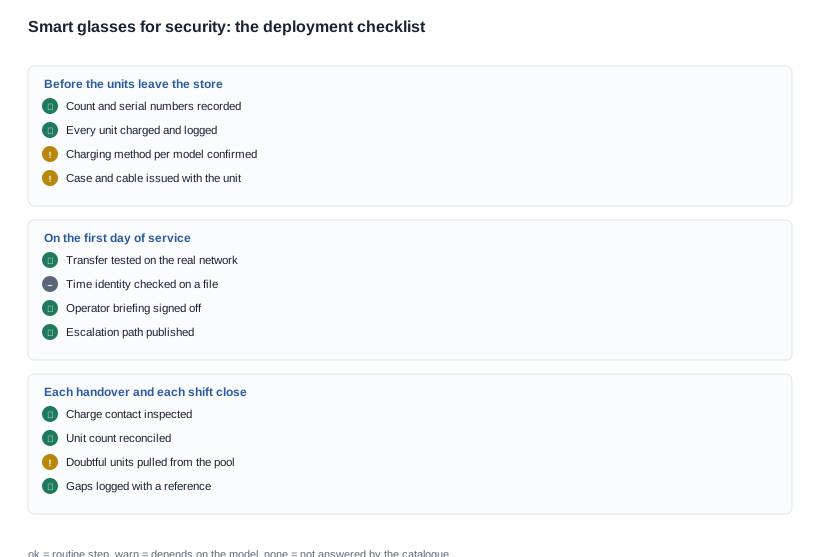
What a checkpoint has to produce
A checklist that produces only a tick is a list of intentions. Each checkpoint in this list has a defined output, and the output is what a later reviewer — an auditor, an insurer, a client, or the buyer's own operations manager — will ask for.
- Goods-in produces a count and a serial record. Every later figure depends on it, and a count without serials cannot survive a lost-unit investigation.
- The charge log produces a state of charge per unit per cycle. It is what separates a cell that has aged from a contact that is fouled, and the catalogue publishes neither a starting state nor an end-of-charge criterion.
- The unit-to-operator map produces an attributable record. It is the buyer's half of the evidence chain, since no time-stamping method is published.
- The transfer test produces a measured elapsed time on a named network. It is the only evidence that the retrieval step will work at shift volume rather than at demo volume.
- The briefing sign-off produces an attendance record and a policy acknowledgement. It is what demonstrates that the recording rules reached the people who apply them.
- The shift close produces a reconciled count, a list of pulled units with reasons, and a log of gaps with references. It is what makes the next month comparable to this one.
Notice that not one of these outputs requires a figure the catalogue has not published, and not one of them can be produced retrospectively. That is the practical argument for running the checkpoints in order: each output is a precondition for the next, and the last one is the only record that would prove the first five happened.
A deployment checklist that lives only in the operations team's folder will not survive the first audit, because an audit asks a different set of questions from an operations team. The six outputs belong in the procurement file as the evidence that the purchased configuration performs as specified, and that reframing changes who owns each one.
Checkpoint one and two are supplier-facing acceptance criteria. The goods-in count against the purchase order is the point at which a delivery discrepancy becomes a claim rather than an anecdote, and the charge log is the evidence that the delivered units can actually be charged to a known state. A buyer who writes "units charged and logged on receipt" into the acceptance criteria of the order has converted a good practice into a contractual obligation, and the supplier who cannot comply has said something important before the shipment leaves.
Checkpoint three and four are the buyer's own records, and they need a named owner. The unit-to-operator map and the transfer test are not the supplier's deliverables, so they cannot be written into a purchase order, but they can be written into the operating procedure with a named role against each. The reason to name the role rather than the person is continuity: in a security deployment, staff turnover is normal, and a procedure that names an individual rather than a role is a procedure that stops working when that individual leaves.
Checkpoint five and six are the compliance evidence. The briefing record and the reconciled shift close are what demonstrate that the recording rules reached the people applying them and that the deployed population is the population the policy describes. These two outputs are the ones an insurer, a client auditor or a regulator is most likely to ask for, and neither is a product document — both are the buyer's records, which means they exist only if the buyer's own procedure produces them.
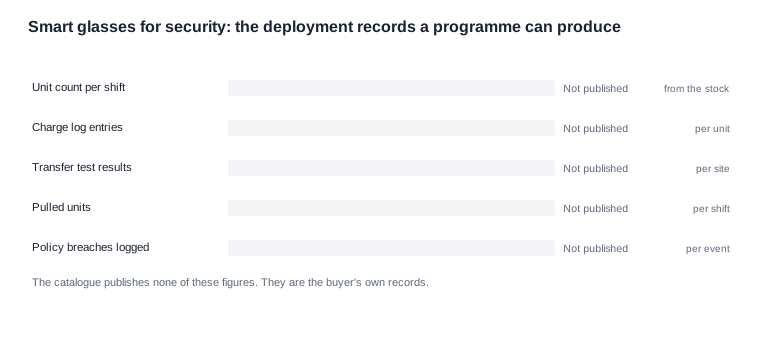
That last point is the one worth holding on to. In this category the buyer's own records are frequently the entire evidence base. The catalogue publishes the case capacities, the charge times, the charging methods, the resolution tiers, the cell capacities and the rated runtimes, and it publishes no storage behaviour, no transfer path, no time-stamping method, no recording indicator and no per-model certification. Almost everything a security deployment will later be asked to demonstrate is therefore a record the buyer makes, and the checkpoints are simply the schedule on which those records are made.
Where the checkpoints belong in the procurement file
A deployment checklist
Concretely, we publish the hardware configuration and the gaps in it, and we will not describe a stored-forever recording as a neutral product choice or imply an indicator we have not confirmed. We publish no data-flow detail, no retention policy and no recording-indicator specification for any model, and we would rather a deployment establish them with us and with its own counsel than assume them from a product page.
What we can do is tell you which of the six checkpoints our published configuration answers, and which three have to be settled before the devices are issued. The camera family is at AI camera glasses, the scenario entry point is at smart glasses for security, and the legal side is at security legal considerations. The written order of the whole sequence is at procurement contract terms, and the sample route is at procurement samples.
Related reading
- The setup sequence — how to set up for security
- The legal side — security legal considerations
- The camera platforms — AI camera glasses
- The commercial terms — procurement contract terms
Tell us the shift and the site, and we will tell you which of the six our documentation answers and which three have to be settled first.