

A Bluetooth version checklist is a short document that catches a surprisingly large number of problems, because the version is the one row that is always present and almost never the one that decides anything.
The structure of the problem is that a Bluetooth specification contains a version and a set of facts, and the facts are the ones that determine whether a product works with a customer's fleet. In our published range the version is 5.3 on the K01 and the K02 and 5.4 on the D11, the D12, the LC-105-1, the LC-105-2, the G07, the YK12, the YKC02, the D17, the ZH12, the A07, the AR glasses entry and the AI electrochromic entry. Fourteen of the twenty-eight models publish no version at all, including all eleven camera models. That is the entire Bluetooth content, and it corresponds to no other product difference in the range.
So smart glasses bluetooth version smart glasses buying checklist is a checklist for the rows that are missing, for the claims that should not be made from the version, and for the models that cannot be shortlisted until someone asks.
Smart glasses Bluetooth version: the screen that decides what gets shortlisted
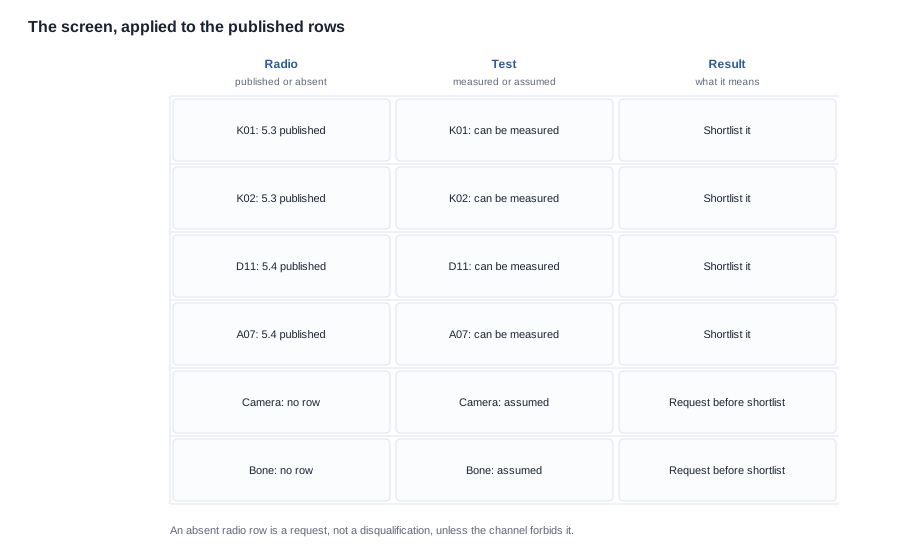
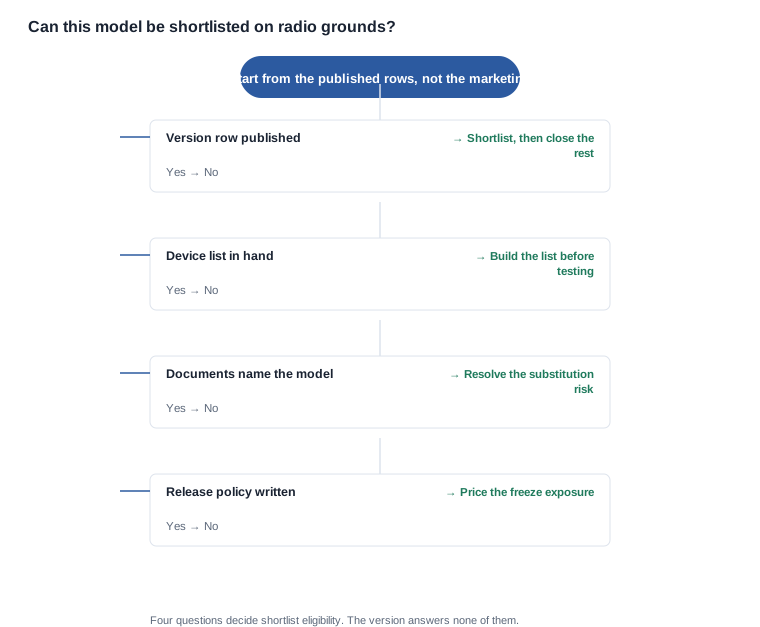
Before any checklist, there is a screen, and the screen is short because it is applied to the published rows rather than to a supplier's description.
The first question is whether the radio row exists. For fourteen models it does, and for the other fourteen it does not — and this is the single most important structural fact in this category, because a missing radio row is not a low version. It is a request. The eleven camera models — the MT6 and the L2 Utral, the MT5 and the V06, the CY03 and the KY06, the L1 Pro and the S7, the V03 and the CY05, and the V03 Pro — publish a cell capacity, a charging interface and a case capacity, and publish no Bluetooth version. So does the A05, the A06 and the bone conduction entry. A buyer who fills that cell with an assumption is building a compatibility claim on a number nobody wrote down, and the assumption will be quoted back at them by a customer.
The second question is whether the channel allows an open radio row at all. Some programmes can accept a model whose radio details are requested and closed before the first order; others cannot, because the listing, the app or the device list they have committed to fixes the radio generation. The screen is therefore programme-specific, and the answer should be written into the specification rather than assumed.
The third question is whether the model designation is precise enough to carry the radio claim. Three entries in our catalogue have no model designation at all, and a radio row attached to an undesignated entry cannot be tied to a document, a shipment or a warranty claim.
A fourth screen question belongs to the channel rather than to the product: whether the customer population is narrow enough for a compatibility statement to be written honestly. "Compatible with our customer's device list" is a defensible claim. "Compatible with all devices" is not, and the difference between them is the difference between a screen and a rejection.
Where the channel does allow an open radio row, the screen changes shape rather than disappearing, and this is the case most camera programmes fall into. The eleven camera models publish excellent electrical rows — cell capacities from 220 mAh to 290 mAh, six of them with published case capacities, magnetic charging throughout — and publish nothing at all about the radio. Rather than eliminating them, the practical procedure is to carry them forward with an attached condition: the radio facts are requested before the sample order, the listing copy is written without a compatibility claim until the grid is closed, and the purchase order makes the radio row a precondition of the first delivery. The condition has to be written into the order rather than held in an email, because an email condition is not a condition; it is a hope that gets remembered differently by two departments.
Nine checklist rows, in the order they disqualify
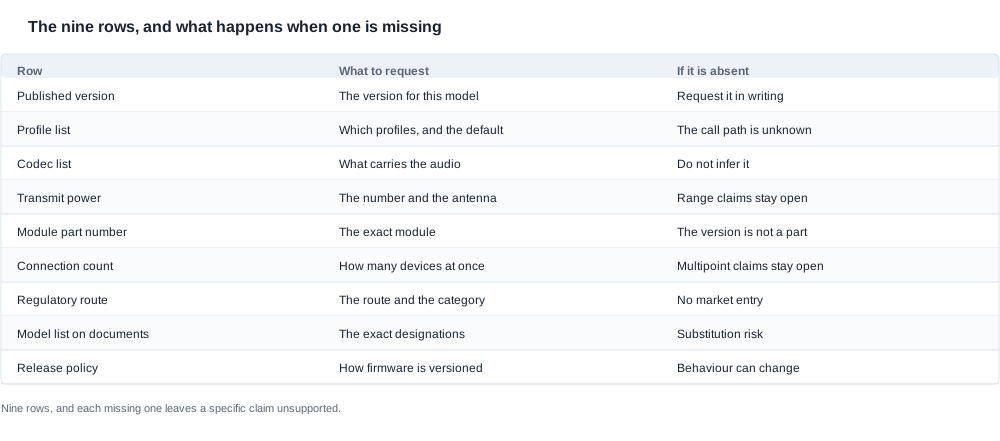
The order matters, because the early rows can end a shortlist on their own and there is no point negotiating the later ones for a model that has already failed.
Row one, the published version for this model. 5.3 on the K01 and the K02, 5.4 on the twelve named models, and nothing at all on the other fourteen. Record it as a fact about the platform rather than as a ranking, and if the row is empty, make the request rather than the assumption.
Row two, the supported profile list and which one is negotiated by default. This is the row that decides the microphone path in a call, and it is the one most often absent from a datasheet. The profile that gets negotiated by default determines what the other end of the call receives, and it is invisible in the version.
Row three, the supported codec list. What carries the audio, and whether the microphone path depends on one of them. A device can run a current radio and still negotiate only the baseline codec, which caps call quality well below what a wideband codec delivers.
Row four, the transmit power and the antenna configuration. The two numbers that determine range, and neither of them is derivable from the version. A figure quoted without the environment it was measured in is not a range claim, it is a claim about a laboratory.
Row five, the module part number. This is the row that makes a version actionable. A module part number tells you what can be substituted, what has to be requalified and what the supplier's notice obligation should cover. A version tells you only which generation the part belongs to.
Row six, the connection count and the multipoint behaviour. How many devices can be held at once, and whether audio moves automatically when one of them starts making noise. Multipoint on its own is a count, not a behaviour.
Row seven, the regulatory route per market. The route, the category where the product processes personal data, UKCA for the United Kingdom, FCC for the United States, and the Bluetooth SIG qualification. In the European Union the Radio Equipment Directive (EU) 2014/53/EU applies with the EN 18031 harmonised standards cited into it, and the cybersecurity requirements within EN 18031 have been a mandatory component of the CE mark since 1 August 2025. The General Product Safety Regulation (EU) 2023/988 applies from 13 December 2024. None of that is a property of the radio version.
What to ask for here is specific enough to be answerable. For each market you intend to sell in: which route the product takes, which harmonised standards and which category the product falls into, which document carries the assessment, and which exact model designations appear on it. The model list question and the regulatory question are the same question asked twice, which is why they are adjacent on the list. A programme that enters three markets is running three assessments rather than one, and the checklist has to record which of them the supplier already holds and which are a lead time item. The entry schedule for each market is the output of this row, and it is usually the date that determines whether the programme launches in one country or three.
Row eight, the model list on the documents. A family-level document does not cover a specific model. This is the most consequential row on the list and the one invisible unless somebody reads the document, because the model string is what catches a substitution and it is the only field that changes when a platform is swapped.
Row nine, the firmware release policy. The version a customer experiences is the shipped image's, and a product with no stated policy is a product whose behaviour can change without notice. At fleet scale this is the row that decides whether a freeze risk is priced or ignored.
The compatibility grid you build before any sample arrives
The checklist above is a document exercise. The compatibility grid is the test exercise, and it has to be built before the first sample is ordered, because the grid decides which samples are worth ordering.
The grid has two axes: the host device on one side and the model on the other. Every cell carries one of three states, and the states are what make the grid useful rather than decorative. Measured means the pairing flow completed with that host device on that model, on a unit from the lot you intend to buy. Assumed means the combination is expected to work because of the platform or the shared firmware, and nobody has observed it. Failed means it was attempted and did not work, and the failures are the most valuable cells in the document.
Building it takes a device list and a sample set. The device list is the exact host models your customers run, with their operating system versions, and it should be short — four or five models covering the platforms that matter. The sample set should include at least two models whose published radio rows differ, because that is where the assumptions break.
Two rules keep the grid honest. First, a cell is only "measured" if the pairing flow completed twice on two separate units, because a single successful pairing is also what happens when a unit is faulty. Second, the grid is frozen with a date and a firmware version attached to every cell, because a radio behaviour is a property of a version and not of a model, and an undated grid describes a product that no longer exists.
A third rule concerns the failed cells, and it is the one most often skipped. A failed cell must carry the observation, not the conclusion: what was attempted, on which host version, with which image level, and what happened. "Does not work" is a note, not a finding; "does not complete the pair sequence within thirty seconds on the older host, on image level 2, reproducible on two units" is a finding that a supplier can act on. The value of recording failures rather than only passes is that the next programme inherits the answer instead of repeating the test, and the supplier gets a specific problem to fix rather than a general complaint.
The output of the grid is a compatibility statement you can put in a specification: which host devices were tested, which models were tested, on which image level, on which date, and which combinations remain untested. That statement is worth more than a version number because it is the only form of the claim that survives a customer who asks how you know. It also survives an internal review, because every cell in it can be traced to a unit, a date and a result rather than to an opinion about how the radio probably behaves.

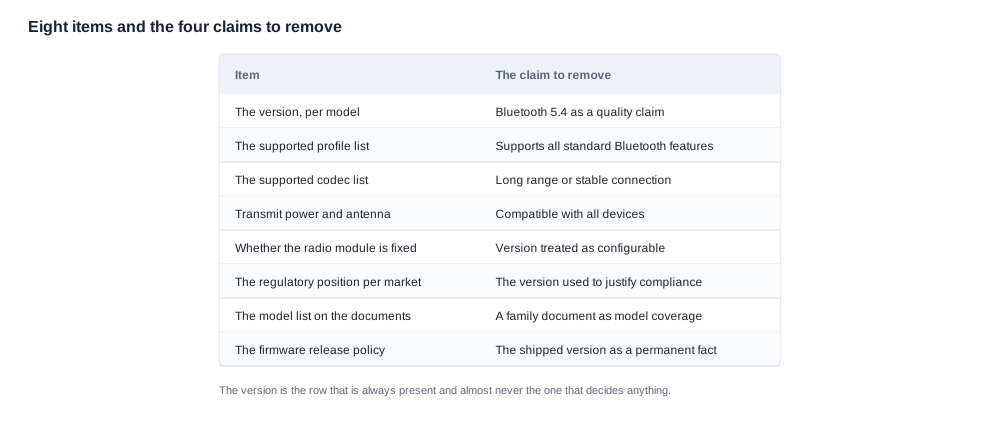
Four claims to strike from the specification before it is issued
A checklist that only gathers evidence is half a checklist. The other half removes the claims that the evidence does not support, and in this category four of them arrive by habit rather than by intent.
"Bluetooth 5.4" used as a quality claim. In our own catalogue the version corresponds to no other published difference — not to the cell, not to the charging interface, not to the hours figure. A specification that ranks models by it is ranking by the manufacturer's procurement history, and a customer who notices that will discount the rest of the sheet.
"Supports all standard Bluetooth features." A list is a specification. A phrase is not, and a phrase cannot be tested, so it cannot be defended either.
"Long range" or "stable connection." Both are outputs of the transmit power, the antenna and the environment, and neither is described by the version. If the range is worth claiming, it is worth claiming with the distance, the environment and the host device.
"Compatible with all devices." The compatibility is the intersection of the device, the phone, the application and the platform, and it is bounded by the oldest one in the list. Writing the actual list costs one paragraph and removes an entire category of dispute.

How the checklist turns into a shortlist of one or two models
Worked through, so that the sequence is visible rather than described.
A channel buyer whose customers run three phone models in two operating systems needs a product that pairs with all of them and whose radio facts can be stated in a listing. Step one, the screen: the camera models are eliminated because the programme cannot accept an open radio row on a listing, which leaves the audio platforms and the D11 and the D12, and the K01 and the K02. Step two, the checklist on what remains: the version rows are published on all of them, so no requests are needed for row one; the profile, codec, transmit power and connection rows are absent on all of them and become a single request list of four items per model. Step three, the grid: two host devices from the customer list against the two shortlisted models, with the cell for the older host device left explicitly untested rather than assumed. Step four, the claims: the version is removed from the listing copy, the range sentence is replaced by a measured statement once the transmit power arrives, and the compatibility sentence becomes the tested list.
The result is a shortlist of two models with an attached request list, a grid with named gaps and a set of claims that survive scrutiny. The version number never appeared in the decision. That is not a criticism of the version; it is a statement about where the decision sits.
The cost of running this process is a few days of engineering time and one round of document requests, and the cost of skipping it is a compatibility complaint that arrives from whichever host device was never on the list. The cost of running it late is higher again, because a grid built after a complaint is built on the complaint's host device and one or two others, which is the smallest possible grid and the one least likely to find the next problem.
Two questions to ask a supplier at the end of this step, because they decide whether the grid can be closed at all. Who runs the qualification against our device list, and do we receive the raw result or a summary of it? And what happens to the models on the grid that fail? A supplier who will produce raw results turns a grid into evidence; a supplier who returns a summary leaves the document unattributable, and an unattributable compatibility statement is a statement you cannot defend when a customer asks how you know.
What we can answer directly, and what we will not guess
The boundary we hold: the Bluetooth version does not belong on a buying checklist, and we would rather explain that than leave the row off quietly. We publish the version each model actually uses because publishing it is honest, but our own published data shows the version tracks no product difference at all — not runtime, not range, not the pair experience, not audio behaviour. A buyer who ranks models on the version is spending a column on a figure that has not decided a single outcome in this catalogue. It is worth requesting, it is worth filing, and it is not worth comparing on.
We will also not tell you a product is compliant in a market on the basis of its radio version, and we will not tell you a document covers your model without seeing the model list on it. Naming precision is the part of this category that quietly fails. Our catalogue contains one entry listed as "L2 Utral", with a note that "Utral" appears to be a typographical rendering of "Ultra" and a further designation of "Utral Pro Max" whose meaning is not published, which is exactly the kind of naming precision a compliance file depends on and the kind of thing that has to be resolved before the paperwork, not after.
What we can answer directly: the published version for the fourteen models that carry one, the fact that the other fourteen carry none, the charging interface, the rated runtime where the catalogue states one, the cell capacity, and the case capacity where it states one. What we will not guess: a codec, a profile, a connection count, a range, a verified device list or a coexistence behaviour.
The reason for holding that line is not caution for its own sake. Each of those six values is a row a customer can act on: a codec decides a call quality complaint, a connection count decides whether a two-device workflow is possible, a range decides whether the product works in the environment it is sold into. A value we cannot verify becomes a value the customer quotes back at us, and the first time it does, the whole sheet loses credibility with them. An honest empty row costs one document request. A filled row that turns out to be wrong costs the relationship.
If you tell us the models and the host devices your customers use, we will say which of the nine items we can answer directly and which will have to be requested from the factory — and which of them are worth the request.
Related reading
- Bluetooth connectivity and versions
- Bluetooth version procurement checklist
- Bluetooth version supplier verification
- Bluetooth SIG compliance
- The radio facts a fleet programme needs — advanced considerations
Tell us the models and the host devices and we will say which items we can answer directly.


