
Smart glasses camera technology: tiers without sensor data
Testing a camera before ordering is the step most buyers compress, and the reason is that there is so little published to test against that a test plan appears to be unnecessary. The published position in this category is two resolution tiers and a set of electrical rows, and the attributes that decide whether a camera is any good — the sensor, the field of view, the video format, the frame rate, the stabilisation, the low-light behaviour — are the attributes that were never published. So the test has to be designed by the buyer, and what it should establish is a set of criteria the programme can be held to, not a comparison against a figure that does not exist.
The decision, in three sentences. Do not shortlist on the resolution tier: eight megapixels and thirteen megapixels describe what the sensor collects, not what a viewer sees, and in low light a smaller sensor with larger pixels can beat a larger one. Shortlist on the walk test, because a camera that cannot hold a usable frame rate while a person is moving is unusable for the channels that pay for this category, whatever its resolution. And write the acceptance criteria before the samples arrive, against attributes a sample can actually be judged on — if the criteria do not exist before the test, the exercise is a demonstration with no pass condition.
Who is running this evaluation, and what it is defending. The reader is a brand-side product manager or a channel buyer assembling a camera line, and they are usually one sample order away from committing to a production volume in the tier where the published specification is thinnest. What they are defending is a launch date, a content production workflow, and a claim on the listing that says something about what the customer can record. The most expensive mistake in this category is not choosing the wrong camera; it is choosing correctly and then discovering the criteria did not exist, which means the same shortlist has to be argued again after the first customer complaint.
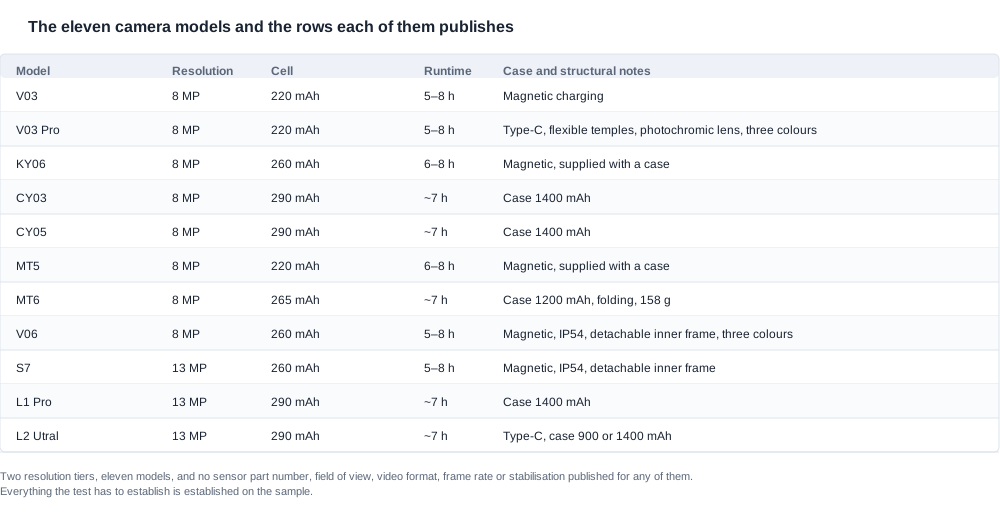
What the camera tier publishes. Eleven models carry a camera, in two resolution tiers: eight models at 8 MP and three at 13 MP. The thirteen-megapixel models are the L2 Utral and the S7, and the L1 Pro, and the eight-megapixel models are the CY03 and the V03 Pro, the MT5 and the CY05, and the KY06 and the V03, and the MT6 and the V06. Cell configurations run from 220 mAh on the MT5 and the V03 Pro, and the V03 up to 290 mAh on the L2 Utral and the CY03, and the L1 Pro and the CY05, with the V06 and the KY06, and the S7 — each at 260 mAh and the MT6 at 265 mAh. Rated runtimes are roughly five to eight hours, and roughly seven hours on the four case-equipped models that publish a single figure. Case capacities are 900, 1200 and 1400 mAh. The V03 Pro publishes Type-C charging, flexible temples, a photochromic lens and three colours; the V06 and the S7 publish a detachable inner frame and a catalogue-marked IP54; the MT6 publishes a folding 1200 mAh case and a unit weight of 158 g, which is the only unit weight published for any model in the entire catalogue.
What is not published, and therefore what the sample has to establish. The sensor part number, the field of view, the video resolutions and frame rates, the container format, the stabilisation, the low-light behaviour and the storage format. There is no third-party image report to lean on either. The consequence for a buyer is simple and slightly uncomfortable: nothing in the published data can disqualify a camera, so the shortlist can only be built by measurement.
Where the money sits in a camera line. The sensor, the optics and the video pipeline are the expensive part of the bill of materials, and they are the part a factory will not substitute without telling you. The negotiable part is everything around them: the resolution tier, the case, the colour count, the number of markets, the artwork rounds and the number of model designations in the file. Two quotations that differ by a fifth on unit price can be the same camera with different packaging, or a different camera with the same packaging, and the specification is what tells you which.
The five things to fix before the sample arrives
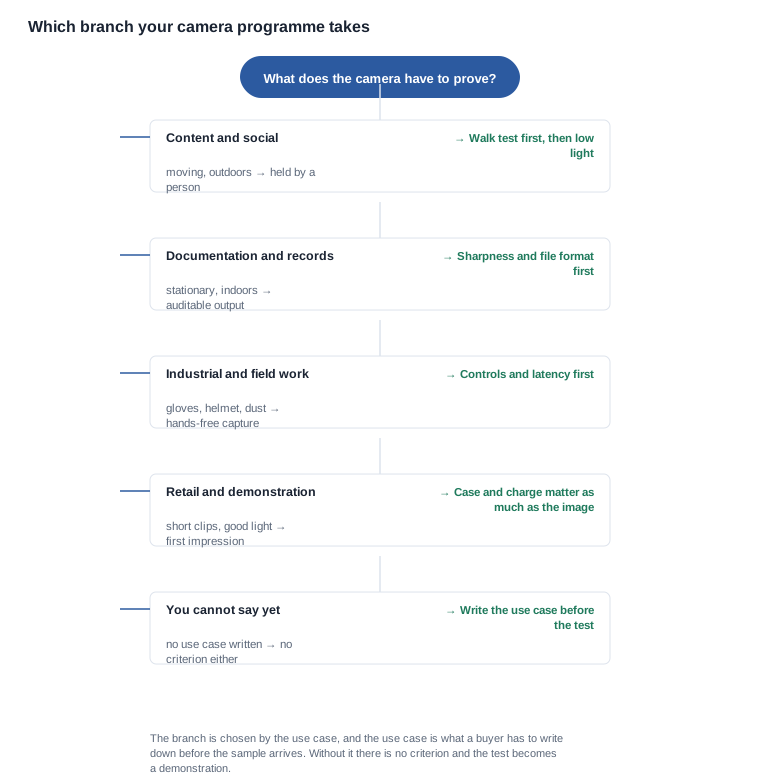
1. The load profile and the environment. Where the camera will be used and what the wearer will be doing while it runs. A walk test, a low-light test and a stationary test are three different products, and the published runtimes of roughly five to eight hours reflect a load that has to be named. A brand selling to content creators and a brand selling to a field-service team are testing two different requirements, and they should not share a sample round without saying so.
2. The resolution tier, confirmed on the unit. Whether the unit under test is 8 MP or 13 MP, read from the unit rather than from the box. This is a substitution check as much as a test, and it is the cheapest check in the programme.
3. The acceptance criteria, written before the test. Not a number to compare against, but a number to compare against a requirement. Write the criterion as an outcome a reviewer can judge — whether the frame holds a usable rate while the wearer walks at a normal pace — rather than as a specification you hope the sample matches.
4. The sample size, and where the units come from. One unit tells you whether it works. Two from different production runs tell you whether it works consistently, and a unit from a pre-production build tells you less than either. Where the camera is the reason the customer buys, three units is the minimum that says anything about yield.
5. Whether the sample is the production configuration. A sample that differs in a cell, a colour, a firmware version or a lens invalidates everything, and the difference is invisible from the outside. Ask for the configuration in writing and check it against the unit.
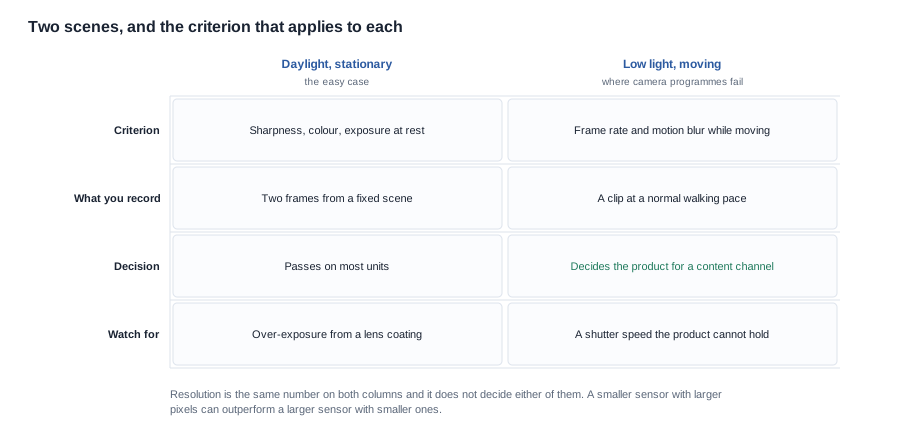
The walk test, and why it decides more than the megapixel number
The walk test is the single most common reason content businesses are disappointed with this category, and it is the one test a buyer can run without any equipment and without any published figure.
What to do. Record a clip while the wearer moves at a normal pace — the pace of someone walking down a street, not the pace of someone testing a product. Then watch it at normal speed and at half speed, and look at the frames rather than at the duration. What you are looking for is whether the frames are individually usable or whether the motion smears.
Why a slow shutter shows up here and nowhere else. A stationary frame can look sharp on a moving subject because the sensor is not being asked to freeze anything. The moment the wearer moves, a shutter speed that is too slow turns a walking pace into a blur. The test that exposes it is the only test that exposes it, and it takes four minutes.
How to write the criterion. The pass line should be a number you can agree on before the test: the frame rate the recorded clip holds for its full duration, and the proportion of frames that are visibly smeared when played back. Both are judged by a reviewer against a written line rather than by a feeling. A criterion like "the video looks smooth" is what makes a camera programme fail in the field, because it cannot be applied to a delivery.
The load profile changes the result, so it belongs in the criterion. A wearer walking on a flat path, a wearer walking while turning, and a wearer climbing stairs produce different results, and the third is the one that exposes a weak shutter. Pick the one that matches the channel and write it down.
What the test cannot settle. The walk test does not tell you whether the frames are correctly exposed, because a fast shutter and a correct exposure are different properties, and a camera can be sharp and unusable at the same time. It also does not tell you how the recording behaves over a long session, which is where the storage and the thermal behaviour enter.
Low light, where the resolution figure points the wrong way
The trap in this category is that resolution and image quality are different properties, and the published number is the one buyers quote. A larger pixel gathers more light than a smaller one, so a sensor with fewer pixels but larger ones can produce a cleaner image in a dim scene than a sensor with more pixels and smaller ones. Nothing in our published data says which is true for any model in the range, because the sensor part numbers are not published.
How to run the comparison. Put both tiers in the same environment at the same time, rather than comparing a clip shot in one room with a clip shot in another. Choose the environment the channel actually shoots in — a shop floor, a street after dark, a warehouse — and fix the exposure settings the device uses by default, because an automatic exposure mode will compensate differently in each take and will hide the very difference you are looking for.
How to judge the result without a published figure. Write the criterion as a comparison with something the buyer already has: a reference clip from the existing phone, shot in the same place at the same moment, and judged side by side. That gives a buyer an absolute anchor without needing a laboratory, and it is the only honest way to make a "low-light capable" claim that a customer can check.
The lens coating changes the result more than the sensor does in bright scenes. A coated front element can flare or wash out a frame where an uncoated one does not, and the result is a clip that looks overexposed in a way the resolution figure would never predict. Check a bright scene as well as a dim one; a camera programme that only tests low light will not find this.
What the supplier question is worth. Ask for the sensor part number first, in one line, because one part number settles the low-light question better than any amount of description. A supplier who gives a part number has a datasheet; a supplier who answers with a resolution tier is reading your question back to you. The second question is the field of view, in which convention, at what focal length. The third is the supported video resolutions and frame rates, and the container format. The fourth is whether the sample is the production configuration, and what the firmware version is.
The four questions, in the order that settles the most. The sensor part number settles low light. The field of view, with its convention stated, settles whether the product can be used at all in a confined environment. The video resolutions and frame rates, with the container, settle whether the output can be edited. The production configuration question settles whether the whole evaluation is valid.
Field of view, storage and the controls, measured on the unit you received
The field of view has to be measured, and the convention has to be recorded with the number. Diagonal, horizontal and vertical are not interchangeable, and a supplier quoting a diagonal figure against a buyer measuring a horizontal one produces a disagreement that looks like a defect. Measure it on the received unit with a stated method, and record the convention next to the number so that the next comparison is like-for-like.
The storage test is about behaviour under pressure, not about capacity. Fill the storage deliberately, then observe what the device does at the boundary: whether it warns, whether it refuses to start a new recording, whether it overwrites, and what the customer is told. Then measure the session length a customer would actually get, because the number of minutes of usable recording is the figure that belongs in a listing, and it is a function of the storage, the format and the frame rate together.
The controls test is a product test disguised as an input test. The shutter control has to work while the wearer is moving, and the capture latency has to be measured on the real control rather than on the app. A camera that takes two seconds to start recording is fine for a tripod and useless for the moment that made the customer put the glasses on. Where a model publishes a remote shutter — the D17 and the ZH12 in our range both do — the remote and the temple control are two different input paths and both have to be tested.
What to record with every result. The unit's model designation and configuration, the resolution tier read from the unit, the firmware version, the sensor part number if it was supplied, the environment and the lighting, the movement in the walk test, the frame rate observed, the capture latency, the protocol, and the tester. Without those, a result is neither repeatable nor comparable with the next supplier's.
What a test cannot establish. It cannot establish production consistency, because two units from one build is not a production run. It cannot establish behaviour in a different environment, because a camera tested indoors has not been tested outdoors. It cannot establish behaviour over the product's life, because a frame's alignment and a cell's capacity both drift. And it cannot establish whether the published specification matches the sample — the sample is a unit and the document is a document, and the two are checked separately.
Building an acceptance file when the supplier has no specification to hand
The acceptance file is the deliverable of this exercise, and it has four parts. The first is the criteria, written before the samples arrive, in the language of outcomes. The second is the protocol, with the environment, the movement, the lighting and the method for each test, so that a second buyer could repeat it. The third is the results, with the configurations and the firmware recorded alongside every reading. The fourth is the signature — a supplier statement that the criteria were known before the samples were tested, because a supplier who agrees the criteria afterwards will agree anything afterwards.
What to request in writing, and the pass line for each. The sensor part number: one part number, and a datasheet reference if there is one. The field of view: a figure with the convention and the focal length. The video resolutions and frame rates with the container format. The firmware build identifier and the update mechanism. The model designation for the exact configuration, with the certificate numbers. The storage format and the session length at the default settings. And a written statement of the low-light behaviour, or a statement that it is not published.
What a soft answer sounds like in this category. "HD camera" for a resolution question. "Wide angle" for a field-of-view question. "Full HD video" for a frame-rate question. Each of those is a listing phrase rather than a measurement, and each one is a criterion the programme cannot be held to.
The four clauses that make the file enforceable. The model designation as a line item, with the certificate numbers attached. The acceptance criteria for the sample, referenced by test number. A notice clause for any change of sensor, lens, firmware build or video pipeline, because each of those invalidates the criteria that were written against the previous configuration. And a clause naming who bears the cost when the sample does not meet the acceptance criteria.
A worked protocol for a content channel
This is a worked case rather than a client project. What it shows is the order.
Assume a brand opening a camera line for a short-form content channel, with two candidate models: an eight-megapixel unit with a 220 mAh cell and magnetic charging, and a thirteen-megapixel unit with a 290 mAh cell and a 1400 mAh case. The channel produces walk-and-talk clips in daylight and evening city locations, and the brand's listing has so far promised "high-definition capture" without a number.
The first decision is the load profile. The brand writes the channel's actual shooting pattern into one line — a wearer walking at a normal pace, outdoors, in daylight and after dark — and that line becomes the environment for every test. The consequence is immediate: the walk test is the primary test and the low-light test is a second test, not a formality, and the two candidates are judged on the same scenes rather than on their datasheets.
The second decision is the criterion, written before the samples arrive. The brand writes two lines: a frame-rate floor for the daylight walk clip, and a side-by-side comparison against a reference phone clip for the evening scene. The supplier receives the criteria in writing, with the order, and one candidate accepts them immediately while the other asks for a week — which the brand reads as a sign that its own criteria are reasonable.
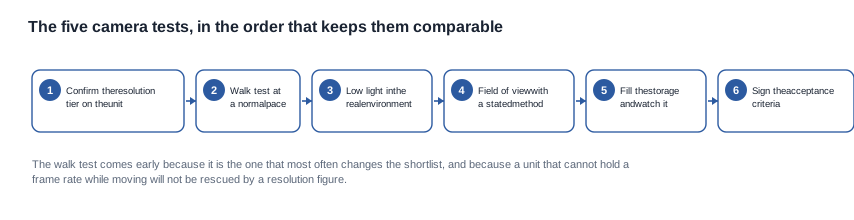
The third step is the sample run, in the order that isolates the cause. Resolution tier confirmed on the unit. The walk test, with the clip judged frame by frame rather than by feel. The evening scene, shot on the same evening as a phone reference clip. The field of view measured with a stated method. The storage filled deliberately, and the session length recorded. The capture latency measured on the real control.
The fourth step is the finding that changes the shortlist. The thirteen-megapixel unit holds its frame rate better in daylight and produces a cleaner still, but its evening clip is worse than the eight-megapixel unit's, because the resolution tier said nothing about the sensor and the sensor happened to favour the smaller, larger-pixel option. That finding is the whole reason the test was worth running, and it is invisible in every published row.
The fifth step is the claim. The brand drops the phrase "high-definition capture" and replaces it with two specific statements: a frame rate for daylight walking, and a stated comparison basis for low light. The listing gets shorter and the returns in the content channel stop.
The sixth step is the order. The brand puts the sensor part number, the firmware build and the model designation into the purchase order, attaches the acceptance criteria, and holds the retention against the documentation package. It also asks for notice before any change to the sensor, lens or video pipeline.
The result is a shortlist that was decided by measurement, a listing claim the customer can check, and a purchase order that contains criteria rather than adjectives. The resolution tier, which is the only camera figure the catalogue publishes, did not decide any part of it.
What the eleven camera records can and cannot settle
The boundary we hold: the published camera data will carry a buyer no further than a shortlist, and we will not pretend otherwise. The resolution tiers and the electrical rows are accurate as published, and an 8 MP or 13 MP figure stays a count of what the sensor collects rather than becoming a claim about image quality, because the sensor data that would support such a claim is not published to us. That leaves the programme with a choice to make deliberately: either the acceptance criteria are written down before the sample arrives, against the attributes a sample can actually be judged on, or the whole exercise is a demonstration with no pass condition. Most buying problems in this category come from discovering the second option too late.
We will also say plainly that the four published colour options on the V06, the three on the V03 Pro, the case capacities of 900, 1200 and 1400 mAh and the 158 g unit weight on the MT6 are the only frame-level and imaging-adjacent rows we hold, and that a buyer who treats them as an imaging specification will find nothing there.
Three things to settle before a camera is shortlisted
Ask for the sensor part number in the first message, in one line. It is the answer that settles the low-light question, and a supplier who cannot supply it is telling you the camera row was never the interesting part of the design.
Write the load profile and the two acceptance lines before the samples are ordered. A criterion written afterwards is a description, and a description cannot refuse a lot.
Send us the model, the channel and the shooting pattern, and we will say which of the five tests matters and what to write down as the criterion. The background is under camera imaging technology, the criteria are in camera procurement checklist, the published rows are in camera key specifications, and the range is at AI camera glasses.
Related reading
- Camera imaging technology
- Camera procurement checklist
- Camera key specifications
- AI camera glasses range
Tell us the model and the use case and we will say which test matters.


