

A camera procurement checklist in this category has an unusual shape, because the rows a buyer would normally compare are exactly the rows the category does not publish. The published camera data is two resolution tiers, 8 MP and 13 MP. The sensor model, the field of view and its convention, the video resolution and frame rate, the stabilisation type, the low-light behaviour, the storage capacity and format, and the overwrite behaviour are all Not published for every camera model in our catalogue.
That makes the checklist something other than a comparison list. It is a request list, a test list and a criteria list, in that order. The criteria list is the part that matters most, because it is the only part that converts an absent row into a decision rather than a surprise three months after launch.
What the camera tier does publish is worth stating before the checklist starts. Eight models carry the 8 MP tier — the CY05 and the MT5, the CY03 and the V03 Pro, and the V03 and the KY06, and the V06 and the MT6 — and three carry the 13 MP tier: the L2 Utral and the S7, and the L1 Pro. Cell capacity runs from 220 mAh on the MT5 and the V03, and the V03 Pro, through 260 mAh on the S7 and the KY06, and the V06 and 265 mAh on the MT6, to 290 mAh on the L1 Pro and the L2 Utral, and the CY03 and the CY05. Charge time is two hours or less across the group. Rated runtime runs from about seven hours on the 290 mAh configurations to five to eight hours on the 220 mAh ones and six to eight hours on the KY06 and the MT5. Seven of the eleven ship with a charging case; the case capacity is published for five of them at 1400 mAh, 1400 mAh, 1400 mAh, 900 or 1400 mAh and a foldable 1200 mAh. Unit weight is published for one model in the whole catalogue, the MT6 at 158 g for the glasses unit excluding its foldable case.
So smart glasses camera technology smart glasses checklist for procurement teams is a checklist for a specification with six missing rows, and it is written in the order a procurement team can actually use it.
Smart glasses camera technology: checklist, not a comparison
The comparison trap in this category
Comparing camera glasses on the published data is possible, and it is close to useless. Sort eleven models by resolution and you have sorted them by a number that carries almost no information: an 8 MP sensor with large pixels can produce a better image than a 13 MP sensor with small ones, and neither figure appears anywhere in our catalogue. Sort them by runtime and you have sorted them by a rating that carries no test condition at all — no load, no ambient temperature, no recording mode, no statement about whether the camera was running.
The practical consequence for a procurement team is that the shortlist has to be built on the published rows and closed on something else. The published rows do real work: they exclude the eleven models that have no camera, they separate the 8 MP group from the 13 MP group, they tell you which models carry a case and which do not, they tell you which model is the only one with a published weight, and they tell you which of the eleven will need a Type-C port rather than magnetic charging. What they cannot do is tell you whether the product does the job you are buying it for.
What the checklist is actually for
Three lists, and the sequence matters more than the length of any of them.
The request list is what you ask the supplier for. Its purpose is to convert the six absent rows into answers, before anyone writes a product page. The criteria list is what you write down yourself, because no supplier will write an acceptance criterion for you, and the criteria are what make the answers enforceable. The test list is what you run on the units that arrive, because answers in an email are still claims until a measurement confirms them.
A procurement team that skips the criteria list and goes straight from request to test ends up with a sample that proves the supplier was right, because there is nothing written down for the sample to fail.
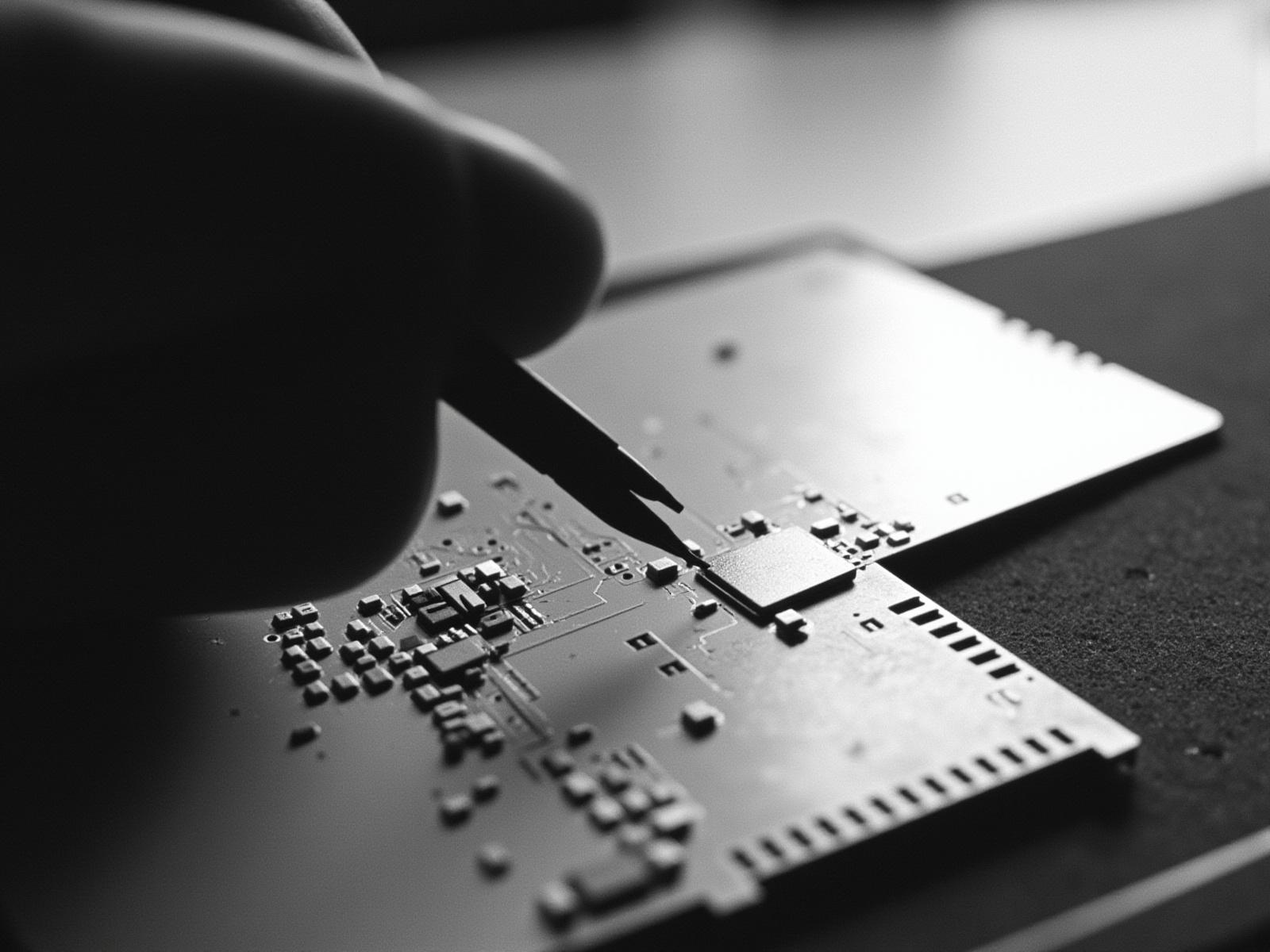
The six imaging rows to request, and the decision each one settles
The sensor model and the pixel size
Not published. The sensor part number is a single string, and it is the most informative single answer a supplier can give, because it determines the pixel size, the light-gathering behaviour per pixel, the era of the design and therefore whether a plausible low-light result is even available. A supplier that can produce the part number has the measurement infrastructure behind everything else on this list, which is why it is the first question and not the fifth.
The decision it settles: whether the imaging tier can be shortlisted at all, or whether the shortlist has to stay at resolution until a sample settles it.
The field of view, and the convention it is quoted in
Not published. The angle the lens sees decides whether first-person video works at all, and the convention decides whether two suppliers' figures can be compared. Diagonal, horizontal and vertical are not interchangeable, and the same lens quoted on two conventions gives two numbers. The frame's own geometry also contributes: a camera assembly has to sit inside a temple, and part of the frame is in the shot.
The decision it settles: whether the product can be sold on the footage it produces, or only on stills.
The video resolution and frame rate, with the container
Not published. A device that records stills only and a device that records moving images are different products sold with the same word. The frame rate is what separates usable walking footage from unusable walking footage, and the container is what decides whether the file opens in the customer's editing software without a converter.
The decision it settles: whether this is a camera or a stills camera with a video-shaped listing, and whether the downstream workflow needs a conversion step it was not planned for.
The shutter behaviour
Not published. A camera in glasses is nearly always moving, and exposure time is what stops motion from smearing. This is the row most likely to be skipped, because it does not appear on most marketing sheets, and it is the row that decides whether a buyer who has paid for a camera platform can actually use the output.
The decision it settles: whether moving footage is watchable, which is a different question from whether it is high resolution.
The stabilisation type and its performance
Not published. Optical, electronic and software stabilisation are three different implementations with three different artefacts and three different costs, and the word on its own settles nothing. The performance figure, if there is one, needs a condition attached in the same way as every other number in this list.
The decision it settles: whether the footage from a moving person is usable without post-production, and whether the processing load competes with the camera for the power budget.
The storage capacity, the format and the overwrite behaviour
Not published. The first two are the obvious questions. The third is the one that catches people, and it is worth asking explicitly: what happens when the storage fills during a session? A device that stops recording without warning reads to a customer as a broken unit, and a device that deletes the oldest file without saying so reads as a device that lost their work. Both are entirely preventable if the behaviour is known before the product ships rather than after the first complaint.
The decision it settles: how long a session can be, and whether the product can be the primary capture device for the customer rather than a secondary one.
Five platform checks that sit either side of the camera
The six rows above sit inside the camera. These five sit around it, and a buyer who works through the imaging list without them ends up with a beautifully specified sensor attached to a platform nobody has checked.
- The cell configuration and the rated runtime. The camera is the dominant load in this tier, and the published runtimes of roughly five to eight hours reflect it. The duty cycle behind that figure is the question to ask, and for a camera product the answer determines whether the case is an accessory or the working day.
- The charging interface and the case capacity. Magnetic charging is the norm across this group, with the V03 Pro published as a Type-C port, and the L2 Utral catalogue page carrying a Type-C interface badge. The case capacity is published for five camera models; the KY06 and the MT5 are shown with a case whose capacity the catalogue does not state, which means a buyer cannot compare those two against the 1400 mAh models without asking.
- The mass and how it is stated. The only published weight in the whole catalogue is the MT6 at 158 g, and that figure is the glasses unit including its battery and camera, excluding the foldable charging case. No bare frame weight is published anywhere in the range. A buyer should ask for the weight of the exact configuration they intend to ship, with the battery included and the case excluded, and should write down which of those the number covers.
- The documentation position for the exact configuration. Our published position is that the catalogue's export-certification page carries ten patent certificates — eight appearance-design patents and two utility-model patents — and names no CE, FCC or RoHS marking, so the certificate numbers for a specific model are a document to request rather than a line to copy. A camera change is a product change: a lens configuration or a firmware behaviour that alters what the device does can alter the file that covers it.
- The AI feature position. Which models carry which features, whether the processing runs on the device or in a service, whether a subscription is attached and where the data is stored are all Not published in our range. A camera with an on-device model is a different data position from a camera with a cloud service, and it is a different cost position too.
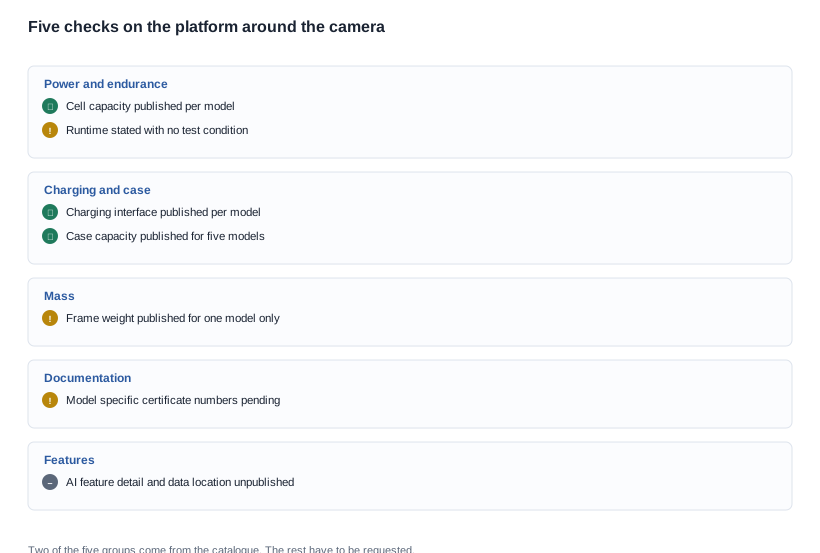
How the platform checks decide the sample you order
The five checks are not a form to fill in; they are the filter that decides what the sample has to prove. If the runtime row comes back with no duty cycle, the sample has to test runtime under the customer's actual recording pattern, because the published figure will not answer it. If the case capacity is unknown for the model being quoted, the sample has to include the case, because the packing configuration depends on it. If the weight answer does not say whether the battery is included, the sample has to be weighed in the shipping configuration.

The acceptance criteria you have to write yourself
Five criteria, written before the sample arrives
- A field-of-view minimum, stated in a stated convention, measured on the received units. A criterion the buyer writes is a criterion the buyer can enforce. A row that is absent is a gap that gets discovered.
- A minimum video resolution and frame rate, with the container named. The container matters as much as the number, because it decides whether the customer needs a conversion step.
- A minimum usable frame rate while the person is walking. This is a testable criterion, it is the one that matters for a content product, and it is the one most often left out in favour of a resolution figure that does not answer it.
- A storage behaviour requirement. Either oldest-first overwrite, or a stated minimum session length, measured by filling the storage deliberately rather than by asking.
- A maximum capture latency, stated in milliseconds. From the control press to the written file, because a content customer notices the difference and describes it as a broken product.
Turning criteria into a protocol that survives disagreement
A criterion without a protocol is an opinion, and an opinion agreed in an email is not enforceable. The protocol that closes these rows is short: a measurement of the field of view on the received units against a stated reference point; a recording made while walking, watched rather than measured, because the shutter problem shows up in playback and not in a specification; a recording in the environment the customer actually works in, compared across units rather than against a marketing claim; a deliberate fill of the storage to observe the behaviour; and a timed press-to-file sequence.
The protocol has to be written down before the first reading is taken, because a protocol designed afterwards is a description rather than a test. The sample size has to be stated, because one unit is a demonstration and three units is a consistency observation. And the protocol needs to name the units it applies to, which brings the batch back to the exact model designation on the purchase order.
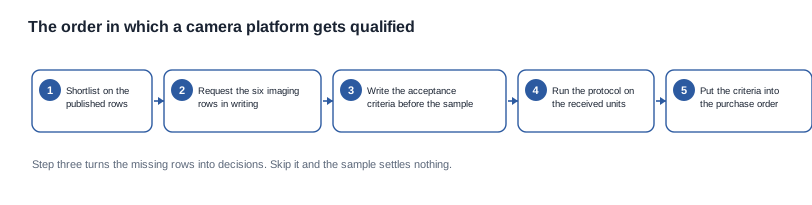
Where the criteria live after the sample
The criteria belong in the purchase order, attached to it, with the measurement conditions and the sample size written in. If the criteria sit only in a design review document, a lot that fails them is a lot nobody can refuse, and the cost of that argument is paid in returned stock rather than in a rejected delivery.
Sequencing the checklist: which row to chase first
Starting from the use rather than from the list
The six imaging rows are a set, but chasing all six at once produces six partial answers. A better starting point is the use the product is sold on, because the use determines which of the six is decisive and which four can wait.
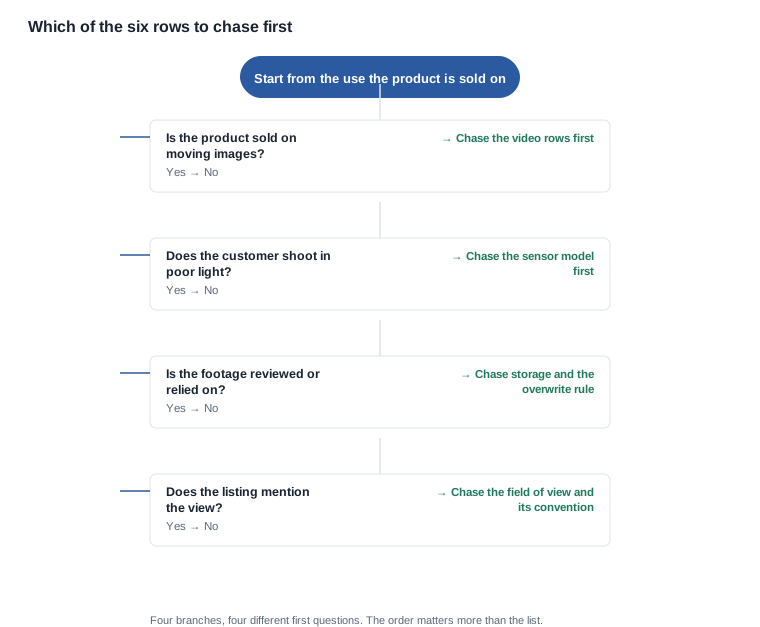
If the product is sold on moving images, the video resolution and frame rate come first, and the sensor model second. If the customer shoots in poor light, the sensor model comes first, because pixel size governs the plausible low-light result and everything else in the list is secondary to it. If the footage will be reviewed by someone else — insurance, field service, quality control — then storage capacity and the overwrite rule are decisive, because a session that stops recording is exactly the failure that use case cannot tolerate. And if the listing mentions the view, the field of view and its convention must be settled before any copy is written, because a claim about what the customer sees is the easiest kind to make and the easiest kind to disprove.
The two rows that are always worth asking
Two questions on this list are worth asking regardless of the use, because their answers change the shape of the whole programme rather than one row of it. The first is whether the camera family has a published radio version, because in our catalogue it does not, and the radio is the layer that determines whether the unit connects to the customer's phone at all. The second is whether the AI processing runs on the device or in a service, because a service is a market availability question, an ongoing cost and a data-handling question, while on-device processing is none of those.
The order we would work in
Ask for the six imaging rows and the two programme questions in one written request, before the quotation is compared. Write the five acceptance criteria while waiting for the answers, because the criteria are independent of them. Run the protocol on the received units against the criteria, not against the supplier's description. Then move the criteria into the purchase order, because that is the point at which the checklist stops being a document and starts being a commitment.
What the checklist changes in the commercial conversation
A completed checklist also changes how the commercial terms are read, which is why it is worth finishing before the price discussion rather than after it. The six imaging rows determine whether a quotation covers the configuration you intend to ship, and two quotations that differ only in whether they include the camera module are not comparable at any unit price. The platform checks determine what a sample order has to contain: a camera programme needs more sample units than an audio one, because the reference unit and the comparison unit have to sit alongside the production units, and that is a line in the quotation that is usually buried.
The criteria also set the position on defect handling before the first delivery. Once a field-of-view minimum, a minimum frame rate and an overwrite behaviour are written into the order, a lot that misses them is a lot with a documented ground for refusal, which is a cheaper outcome than discovering the same mismatch after the units are in the channel. Buyers often treat the checklist as a technical exercise and the commercial conversation as a separate step; in this category the two are the same step, because every one of the missing rows eventually arrives as either a sample cost, a defect rate or a marketing claim.
Finally, the checklist determines what evidence a brand needs to keep for its own compliance team and for the marketplaces it sells through. Our catalogue publishes no model-specific certificate number and carries no per-model certification row, so a buyer working from our range will be asked for evidence on every model in the order. A checklist that has already identified the six imaging rows and the five acceptance criteria leaves only the documentary rows outstanding, which is a much smaller conversation to have with a supplier than the whole set at once.
Every Line Should Arrive With a Document
Here, we publish the 8 MP and 13 MP resolution tiers and the electrical rows because those are the rows we can put a document behind, and we will not convert either of them into an image quality statement, because the sensor evidence needed to support one is Not published to us. That is why the camera lines on our checklist ask for the sensor part number and the field of view rather than for a quality description: a line that cannot be evidenced is a line nobody should sign.
We will also be direct that in this category a procurement checklist cannot be a comparison list. It is a request list, a test list and a criteria list, and the criteria list is the part that makes the missing rows into decisions rather than surprises.
If you tell us the model and the use, we will say which of the six rows are decisive and which criteria to write.
Related reading
- Camera key specifications
- Camera what the spec sheet omits
- Camera supplier verification
- Camera compatibility considerations
Tell us the model and the use case and we will say which rows to request and which criteria to write.


