

A sample test tells you whether an AI feature works. A staged test with real users tells you whether anyone uses it, and a third test tells you whether it still exists in six months — and that third one is the one a buyer actually buys. An assistant on smart glasses is a dependency, not a component: the model runs somewhere, somebody operates the service, and a customer who has used the feature for a fortnight discovers it in a way a buyer never does. So the programme has to answer three questions in order — what happens when the service is not there, how often real people reach for the feature, and whether it is still there a year later — and the answers have to become contract clauses, because the third question is not a technical risk, it is a commercial one. We publish no wake rate, no false activation rate, no command success rate, no latency, no recognition accuracy and no offline behaviour for any model, and we will not estimate them.
Smart glasses AI features: what fails, and when
The difference between a demonstration and a customer's first week
Our catalogue names an AI voice assistant among the key technologies for the AI camera glasses family, and our independent site describes AI translation on the K01, which is an audio model. Those are the two claims we can evidence. Everything else in this category — the wake rate, the false activation rate, the command success rate, the latency, the recognition accuracy, the offline behaviour — is not published for any model, and we will not estimate it.
That gap exists for a reason, and the reason shapes the whole buying approach. The behaviour of an assistant is generated by the model and the service behind it rather than by the factory, so a number describing it belongs to whoever runs that service. A factory can report what its own firmware does with the result, and it can report how a shipped unit behaves when the result never arrives. What it cannot do is promise what the model will do next month, because the model is not its to change.
The structural consequence is that a demonstration and a customer's first week are different events. A demonstration unit has the accounts linked, the language set, the region configured, the network known to work, and somebody in the room who knows what to do if it does not. The out-of-box unit is what the customer receives, and the difference between those two states is where most of the findings are.
The reader is a brand product manager, a sourcing buyer or a channel buyer who has to decide whether an AI assistant is a headline feature or a line item, and who is holding samples, a target price, a channel and a feature list. The risk being managed is a launch where the feature is announced, does not survive contact with a real household, and comes back as a refund liability and a review problem rather than as a technical ticket.
What a buyer is trying to avoid
Shipping a feature that customers stop using. A feature that gets less used in the second week than the first has told you something important even if every individual test passed. A product sold on a feature nobody reaches for is a product with a refund liability and a review problem.
A listing that says the feature works without a connection, when it does not. The wrong-conditions stage decides whether the failure is graceful, and it is the stage that decides what the listing may say.
A result that flatters the product because the tester was invested. A colleague who has an interest in the outcome will use the feature properly, and using it properly is not the same as needing it.
A dependency the brand does not know it has. This is the one that is unique to this category. Every other feature on the product is made by somebody the buyer has contracted with. This one may not be, and if the buyer has not asked, the answer is the default: the service is operated by somebody else, and it can be changed or withdrawn by somebody the brand has never met.

The buying task: deciding what happens when the service is not there
Who operates the service behind the feature
Before anything is measured, the brand has to establish the ownership of the feature, because the ownership determines the commercial structure of the whole programme and it is the hardest thing to change later.
Three questions settle it. Is the model running on the device or on a server? Who operates the server if it is a server? And what happens to the feature if that operator changes their pricing, their model, or their mind about supporting the product?
These are not technical curiosities. A device-side assistant has a service life tied to the product and a behaviour the factory controls, which makes it a specification problem. A server-side assistant has a behaviour the factory does not control, which makes it a supply chain problem, and the brand is now negotiating with two counterparties instead of one. The distinction decides the total cost of the programme, the contract structure, and whether the feature can honestly be described in the listing as something the product does.
The second thing to settle is what the brand is entitled to know about a change. A feature that can be changed without a contractual notice to the brand is a larger commercial exposure than a unit price difference, because the brand has committed packaging, copy, training and support scripts to a behaviour it does not control. A notice obligation, with a period attached, converts that exposure into a manageable one.
The third thing is what happens when the service is withdrawn. There is always an answer in practice, and the answer is usually that the feature stops existing for customers who have already paid for a product that was advertised with it. The clause that names a fallback state — an offline behaviour, a reduced command set, a local fallback — is worth more than any feature the service provides, because it is the only part the brand can guarantee.
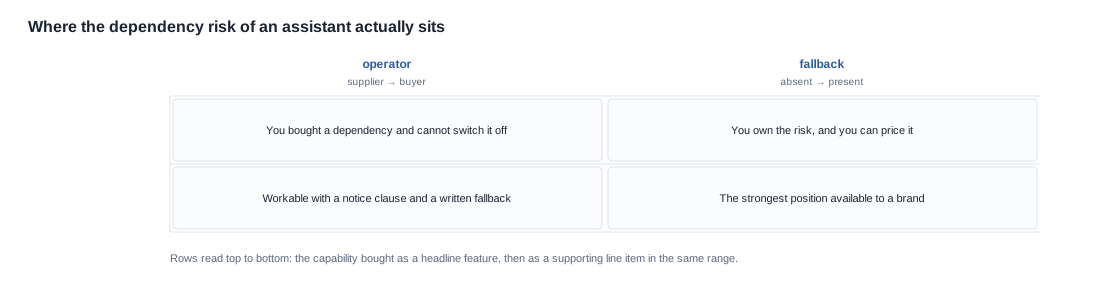
The matrix above puts the two dimensions that matter next to each other. The bottom-right cell is the strongest position a brand can reach, and it is reachable by contract rather than by technology. The top-left cell is the most common position in this category, and the mitigation for it is not a better model — it is a fallback state and a notice period.
The four degradation states, and the thresholds that go with each
The four states and the clause each one requires
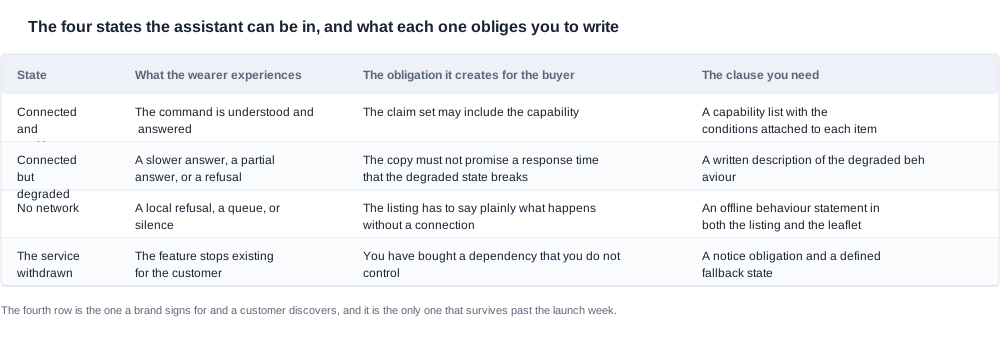
The assistant is not in one condition, it is in four, and each of them imposes a different obligation on the brand's copy and a different clause on the contract.
Connected and working. The command is understood and answered. The obligation here is the smallest: the claim set may include the capability, provided the capability list carries its conditions. "Understands natural speech" becomes "recognised a command from a list of forty phrases, in a room at a stated noise level, on a stated firmware build" — a claim rather than a capability.
Connected but degraded. A slower answer, a partial answer, or a refusal. This is the state nobody writes about and everybody experiences, and it is where the promise in the copy usually breaks. The threshold to hold is a written description of the degraded behaviour, produced by the supplier rather than by the brand, because the brand cannot describe it accurately from the outside. A listing that promises a response time is a claim about the degraded state, not about the working one.
No network. A local refusal, a queue, or silence. The threshold is that the behaviour is specified and that the specification is visible to the customer in both the listing and the leaflet. A device that fails silently in a lift is a support contact; a device that says what it is doing is a feature.
The service withdrawn. The feature stops existing for the customer. The threshold is contractual: a notice period, a defined fallback state, and the price at which the brand can require the service to be kept alive. This row is the one a brand signs for and a customer discovers, and it is the only one that survives past the launch week.
A useful discipline for all four is to write the copy against the worst state you can reach rather than the best one you can demonstrate. A listing that survives the no-network state and the degraded state will survive the working state automatically, and the reverse is not true.
The questions to put in writing before the deposit
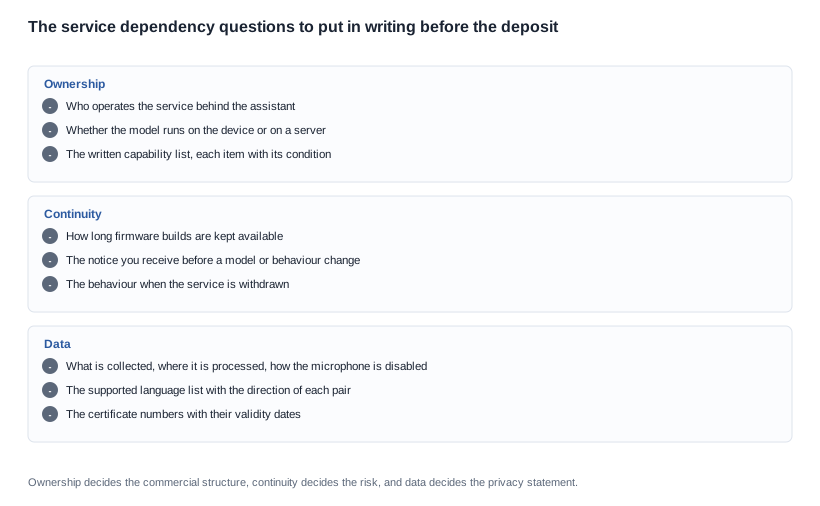
The three groups in that checklist are arranged by what they decide rather than by who supplies them. The ownership group decides the commercial structure of the programme, and it is the group that has to be closed before a contract is drafted. The continuity group decides the risk, and it is the group that decides whether the brand can sleep at night after the launch. The data group decides what the privacy statement can say, and it is the group that a market with its own data rules will ask about. Nine rows in total, and the questions to ask are the same for every candidate, which is what makes the comparison between them fair.
- Who operates the service behind the assistant, and is that the factory, the app operator, or a third party.
- Whether the model runs on the device or on a server, and what the device can do without it.
- The written capability list, with each item and the condition it applies to.
- The supported language list, with the direction of each pair if translation is claimed.
- The data description: what is collected, where it is processed, and how the microphone is disabled.
- The update mechanism, and how long firmware builds are kept available.
- The notice the brand receives before a model or behaviour change.
- The behaviour when the service is withdrawn, in writing.
- The certificate numbers with the issuing body and their validity dates.

Building a two-week programme that produces adoption evidence
The six stages and the record they produce
The programme runs over two weeks with people who have no interest in the outcome, and the two numbers that matter come out of it: the use rate and the failure mode distribution.
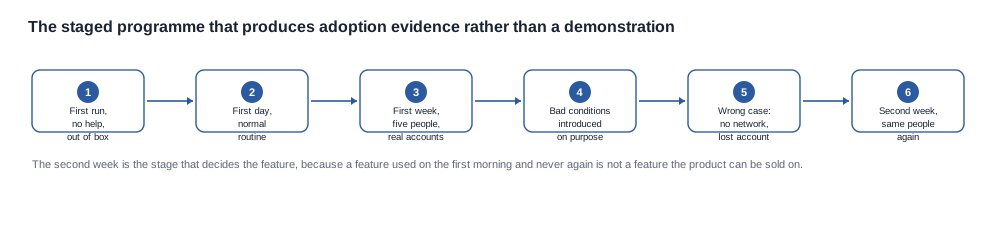
Stage one is the first run with no help. One person, one unit, out of the box, onto a phone that has never paired with it. Watch and do not intervene. This stage catches the configuration problems a sample test skips: the language is not set, the account is not linked, the region is wrong, a permission is missing, and the first attempt fails for a reason that has nothing to do with the feature.
Stage two is the first day with the person's normal routine. Did the feature get used once, or three times, or not at all? Ask the next morning rather than in the moment, because the answer in the moment is contaminated by the demonstration effect.
Stage three is the first week with five people, their own devices, their own accounts and their own networks. Now the variability appears. Some will be in a noisy place, some will have an accent, one will have an old phone. A feature that works for four of five is a feature that will generate a return from the fifth.
Stage four is the bad conditions, introduced deliberately. A noisy café, a weak signal, a dark room, a phone with a low battery. This is where the false activation rate and the latency become visible, and it is the stage a demonstration never reaches.
Stage five is the wrong conditions. The device with no network, and the device whose account has been lost. The question is whether the failure is graceful, and the answer is what the listing may say.
Stage six is the second week. Ask the same five people again. The question is whether the behaviour has changed.
The record is five fields and no more: the person, the device, the firmware build, the condition, and the outcome. The use rate and the failure mode distribution are then derived from the record rather than remembered. The build number is the column that gets left out, and it is the one that lets you compare the second week against the first, or a support case three months later against the result you wrote down.
The thresholds worth holding
The use rate is the number that predicts whether the feature matters. How many times a real person reached for it in a day. A feature that a motivated tester uses twenty times in an hour and a normal person uses twice in a day is a different feature, and the second number is the one that matters.
The failure mode distribution matters more than the failure count. Not how many failures there were, but what kind. A feature that fails silently in a noisy room needs a different remedy from one that fails slowly on a weak network, and the two remedies are owned by different people.
A capability list without conditions attached is a list of intentions. The threshold to hold is that every capability arrives as a number, a condition and a sample size, or it does not arrive at all.
The build identifier must be recorded for every result. It is what makes a support case three months later comparable with a number written down in a test room, and it is the cheapest field to record and the most expensive to reconstruct.
The data description is a commercial fact, not a technical detail. It determines who operates the service, what a privacy statement can say, and what happens in a market with its own data rules. A brand that cannot describe where the data goes cannot write the privacy page, and a brand that cannot write the privacy page cannot launch.

Where an AI feature programme breaks after the launch
The feature is announced in a listing and nobody uses it. The root cause is that the programme stopped at the lab stage, where everything works because the tester is invested. The prevention is to run through to the second week and to treat the use rate as a gate on the copy rather than a statistic to report afterwards.
The first-run failure is written off as a firmware bug. The root cause is that it was usually a configuration, a language, an account, a permission, or a missing step in the manual. The prevention is to read the quick start guide against the first-run findings, because the fix is often a paragraph rather than a firmware release.
The listing says the feature works without a connection. The root cause is that the wrong-conditions stage was skipped, or that the failure was not graceful. The prevention is to run the stage and to make the listing describe what the user actually sees.
The service changes and the product stops matching its packaging. The root cause is that there was no notice obligation, so the change arrived as a surprise to the brand and to every customer who read the old copy. The prevention is to make the notice period a contract term, and to include a review of the copy in the change procedure.
The support team cannot answer a question about the feature. The root cause is that the capability list was written as a list of intentions and no result was ever recorded in a form the support team can quote. The prevention is to give the support team the capability list with its conditions and the firmware builds, which is a document, not a meeting.
A customer reports that the feature worked and then stopped. The root cause is that the service changed, or the account lapsed, or the build was deprecated. The prevention is a written statement of what the customer should do, which in practice means telling them the truth about the fallback in the leaflet rather than in a support reply.
A worked scenario: a brand deciding whether the assistant is a headline
This is a worked case rather than a live order. It is here to set out the order.
Assume a consumer brand considering an AI camera line for a general market, with two candidate platforms and a listing that has to be written in six weeks. The binding constraint is not the price. It is that the brand's previous launch had a feature that stopped working for some customers, and the brand's own support team had no answer for them.
The ownership question comes first, before either platform is compared. The brand asks the two questions — where the model runs, and who operates the service. One candidate runs on the device and the brand can describe the behaviour. The other runs on a service the brand does not contract with, and the supplier's answer includes a notice period and a written fallback state. That answer changes the comparison entirely: the first platform has a technical risk the brand can manage, and the second has a dependency risk the brand can only paper over.
The four states are written into the contract before the copy is written. Working, degraded, no network, and withdrawn. For the second platform, the supplier provides the degraded description and the fallback state in writing, and the brand agrees the wording of the no-network behaviour. The copy is then written against the worst state, which is a slower and less exciting listing but one that survives.
The staged programme runs on out-of-box units. The first run on a fresh phone catches two configuration problems that would have been invisible on a prepared unit. The first week on five people produces one account problem and one weak-network failure. The second week produces a use rate that is modest, and the brand decides that the feature is a line item rather than a headline.
The copy is adjusted to match. Because the use rate is modest, the feature is described in the second paragraph of the listing rather than in the title, and the support script and the leaflet are written to match. The brand accepts a smaller claim and removes a launch risk.
The commercial structure follows the ownership. For the platform the brand can contract with, the brand negotiates the notice period and the build retention, and asks for a second sample round so that the fallback state can be verified on a production unit. For the platform it cannot, the brand asks for a device-side fallback as a condition, and if the answer is no, the brand drops that candidate.
The result is a line with a modest claim, a written fallback, and a support team that can answer the question. The decisive decision was the ownership question, and it was taken before the copy was written.
Where the AI programme loses its margin
The packaging and the copy are committed to a behaviour the brand does not control. This is the largest single exposure in the category, and it is not visible on any quotation. The mitigation is a notice period and a review clause, both of which cost the supplier nothing if they have nothing to hide.
The fallback state is not built, so the no-network behaviour is whatever the firmware happens to do. The cost of this appears in the support inbox rather than in the launch, which makes it harder to fix and more expensive to carry. Building the fallback into the acceptance criteria before the first article is inexpensive.
The build retention is short. A build that is withdrawn six months after launch means the units in the field cannot be reproduced, and a product that cannot be reproduced is a product whose second order is a different product. The build retention period is a term worth negotiating hard, and it is often quietly short.
The use rate is never measured, so the copy is written on the demonstration rather than on the evidence. The trade-off a buyer should make deliberately is between a shorter programme and a correct claim. A two-week programme costs two weeks; a listing that overstates the feature costs the whole run.
The translation claim is carried without a direction. A language pair that works in one direction and not the other is a claim that fails in exactly the market the brand was trying to reach. The supported language list with the direction of each pair is a one-line request that prevents a market-by-market failure.
What we publish about the assistant, and what we will not estimate
The working rule we apply: we would rather a buyer run the programme than believe a demonstration, and we will support the test rather than present a result.
We publish the AI capabilities our documentation supports and mark the rest as open. We publish no wake rate, no false activation rate, no command success rate, no latency, no recognition accuracy, no translation accuracy and no offline behaviour for any model, and we will not estimate any of them. That means the six stages above are the only way these numbers come into existence, and we would rather help produce them than quote figures we cannot support.
We will also be direct about which findings we can act on. A configuration, a language, an account, a permission or a missing step in the manual is ours to fix, and the fix is usually a paragraph in the quick start guide. A model behaviour, a latency profile or a service architecture is a matter for the app and the firmware, and we will tell you which is which before you build a launch plan on it.
What we will do is help you design the six stages, agree what will be recorded, supply units with a known build, and report the results including the ones that are unflattering, because a feature that survives the second week is worth more than a demonstration that survives a trade show. The background is under AI features, the scripted lab protocol is in how to measure AI features, the pre-order plan is in testing AI features before ordering, and the claim mistakes to avoid are in AI common mistakes.
Four actions before the assistant goes on a listing
Ask the ownership questions in writing. Whether the model runs on the device or on a server, who operates the service, and what the brand is told before it changes. The answers to these three questions decide the commercial structure of the programme, and they are cheaper to obtain now than to renegotiate after the copy is printed.
Send the nine-row request list to every candidate. The questions to ask are identical for all of them, so the comparison is fair and the answers are comparable.
Write the four degradation states into the acceptance criteria. Working, degraded, no network, withdrawn. The copy is written against the worst one, and that is the copy that survives.
Send us the feature you intend to publish. We will design the six stages with you, tell you which measurements decide the question for your channel, and report the results including the ones that are unflattering.
Related reading
- The scripted protocol on a sample — how to measure AI features
- The pre-order plan — testing AI features before ordering
- The claim mistakes to avoid — AI common mistakes
Tell us the feature you intend to publish and we will design the six stages with you.


