

Smart glasses for education: the case where only one track is objective
Testing smart glasses for education means testing two different things at the same time, and they fail for completely different reasons. The first is whether the device does what it is supposed to do: power on, connect, record, hold a charge through a lesson, and sit properly on the head of the person using it. Those checks are objective, repeatable and cheap, and most of them map directly onto a published specification row. The second is whether the documentation allows the deployment to happen at all: whether the market's requirements for a product used by children have been established, what happens to the data, who may see it, and what the institution may be told. Those checks are not repeatable, they are not cheap, and none of them is answered by a catalogue.
Education deployments stall on the second track almost every time. The reason is specific and it is not a gap in the product: the catalogue publishes the electrical and structural rows for the children's models — a 40 mAh cell on the A05 and the A06, 70 mAh on the A07, a rated runtime of about twenty hours, magnetic charging, a charge time of two hours or less, and a Bluetooth version on the A07 — and it does not publish certification status for those models, nor any data-handling position, nor any cleaning compatibility statement, nor any per-model unit weight. A buyer who reads the catalogue expecting those rows will conclude the product is undocumented, and a buyer who accepts a general compliance statement as though it covered a children's-product requirement will discover the gap at renewal, in the middle of an academic year, with devices already in use.
So the acceptance plan below is deliberately split. Track one is what a technician can execute in an afternoon. Track two is what a buyer has to obtain in writing before the first unit is deployed, and it is a project with a schedule rather than a document that is going to arrive. A deployment that starts with acknowledged gaps goes considerably better than one that assumes them away and meets them at renewal.
The reader here is a channel buyer or an e-commerce seller whose customer is an educational institution, or a brand-side programme manager working directly with one. The situation is usually a pilot across one site, a framework agreement across a district, or a quotation to compare against a competitor who is already listed. Underneath that is a fear common to every scenario — an opening run that is not the unit the buyer approved, a compliance file that holds the boxes at a frontier — plus the institutional one, which is that an education customer has a safeguarding lead, a data protection position and a renewal date, and all three of them will ask questions the sales conversation did not cover.
Track one, the objective checks and the published row each one uses
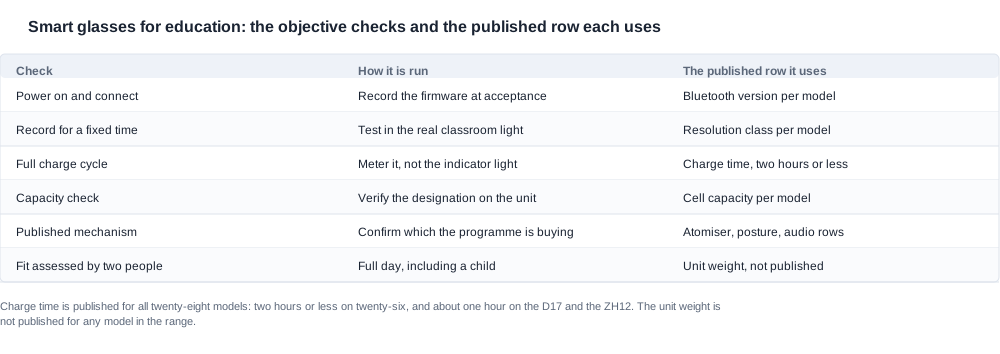
These are the checks that produce a comparable result, and each one is tied to a row in the catalogue so that the result can be written into an acceptance document rather than into an opinion.
- Power on and connect, and record the firmware version at acceptance. That version number is the number the institution will need at renewal, and it is the cheapest insurance in this list. The published row it depends on is the Bluetooth version: the A07 publishes V5.4, while the A05 and the A06 publish no Bluetooth row at all.
- Record for a fixed duration, in the actual classroom lighting. The camera models publish a resolution class — 8 megapixels on the V06 and the V03, the V03 Pro and the CY05, and the MT6 and the MT5, and the CY03 and the KY06, and 13 megapixels on the L2 Utral and the L1 Pro, and the S7 — but the sensor, the field of view, the video resolution and the frame rate are not published for any of them. A resolution claim therefore tells you the class and nothing about the picture, which is why the recording has to be judged in the room it will be used in.
- Run a full charge cycle, and meter it rather than trusting the indicator light. The charge time is published for all twenty-eight models in the range: two hours or less on twenty-six of them, and about one hour on the D17 and the ZH12. The published figure has no starting level and no end point attached to it, so it settles how long the process takes rather than how much usable charge comes back.
- Check the declared capacity against the unit. Published capacities run from 40 mAh on the A05 and the A06, through 70 mAh on the A07, up to 290 mAh on the L1 Pro and the CY05, and the CY03 and the L2 Utral. Verify the model designation on the unit against the model designation on the paperwork, character for character, because that designation is the only traceability anchor the institution has.
- Confirm which published mechanism the programme is actually buying. The A05 and the A06 publish a lens-type electronic atomiser together with correct-posture and correct-distance detection; the A07 publishes neither and carries open-ear audio instead. These are different products with different instructions, and a procurement line that says "children's smart glasses" without a model designation has not specified anything.
- Have the position assessed by more than one person, and by a child where the product is for children. The per-model unit weight is not published for any model in the range, so this measurement cannot be obtained any other way. The single weight figure in the catalogue — 158 g for the MT6, the whole unit including the battery and the camera and excluding its foldable case — belongs to a camera model and settles nothing for a children's configuration.
The conditions have to be fixed before the first check, not recorded afterwards. Six variables decide most of these results: the light level, the distance from the subject, the movement, the phone state, the storage state and the ambient temperature. Fix them for the baseline, then change them one at a time. That discipline is what turns an afternoon of testing into a result that a second technician at another site can reproduce, and it is also what allows two candidate configurations to be compared with each other rather than merely described. A charge cycle measured in a cold corridor and a charge cycle measured in a warm classroom produce two different numbers, and neither of them is the number that appears in the catalogue — because no published figure in this range carries a start level, an end point or a temperature. The same applies to the recording checks: a fixed scene, a fixed light, a fixed distance, and the device settings written down.
The checks that are not on this list are the ones a buyer usually wants to add. A purchaser of an education programme will ask about the classroom environment, about how the device behaves across a full teaching day, and about whether it survives being handed between people. Those are legitimate questions and none of them belongs in the acceptance document until it has a pass line attached to it, because a check without a pass line produces an argument at the end of the pilot rather than a result at the start of it. Write the pass line first, then run the check.
Track two, the five items that decide whether a deployment can go ahead
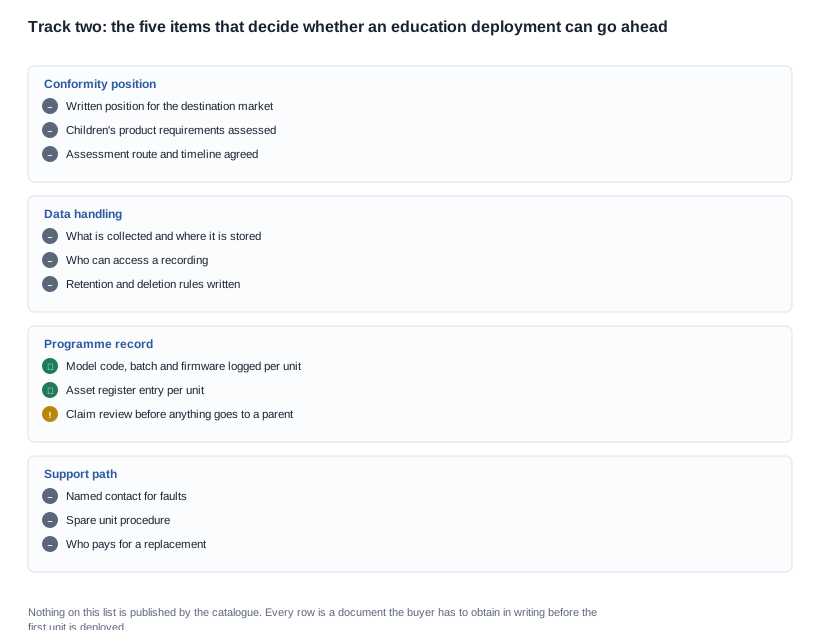
This is the track that decides whether the education programme happens, and it has five items. None of them is answered by the catalogue, and each one is a document the buyer has to obtain in writing.
Certification status for the market the product is going into. For the children's models in this range, certification status is not provided. Children's products typically attract additional requirements in their destination markets — EN 71 in the European Union, and CPSC or ASTM F963 requirements in the United States — and those sit separately from the general consumer obligations that a general compliance statement would cover. If the answer is that nothing is documented, that is a project with a schedule attached to it, not a document that is going to turn up. The document to obtain is at certification checklist.
Data handling. What is collected, where it is stored, who can access it, and what happens to recordings of children. The catalogue's own position for the children's models is that the app capability requires verification, and data handling is not published at all. An institution should not be given a device until these answers exist as written documents, because a safeguarding lead will ask the same four questions in the same order and the answers have to be repeatable by a second person.
Claim review. No health, vision or myopia claim may be made in an education setting, and that is a hard line rather than a matter of tone. The published mechanisms on the A05 and the A06 are a lens-type electronic atomiser and posture and distance detection, and the published mechanism on the A07 is open-ear audio; none of them is a statement about a child's eyes. A claim made to a parent or a school is treated differently from one made to a retail customer, and it is safer to assume the school will read it aloud to a parent.
The configuration record. Model code, batch or serial, and firmware recorded per unit at acceptance and entered into the institution's asset register. Without that record the institution cannot answer a renewal question about its own fleet, and a renewal question is guaranteed.
The support path. A named contact for faults, a spare-unit procedure, and a decision on who pays for a replacement. None of these is published, and all three belong in the agreement rather than in a conversation.

What acceptance has to produce, and what the operating report has to catch

Acceptance should produce a signed document containing the tested unit identifiers, the firmware versions, the results against the published specifications, the outcome of track two with a list of anything unresolved, and the agreed configuration lock. The unresolved list is the part that matters. An item recorded as unresolved is a known item with an owner and a date; an item waved through is an unknown item that arrives at renewal with the fleet in use and nobody able to say who signed it off.
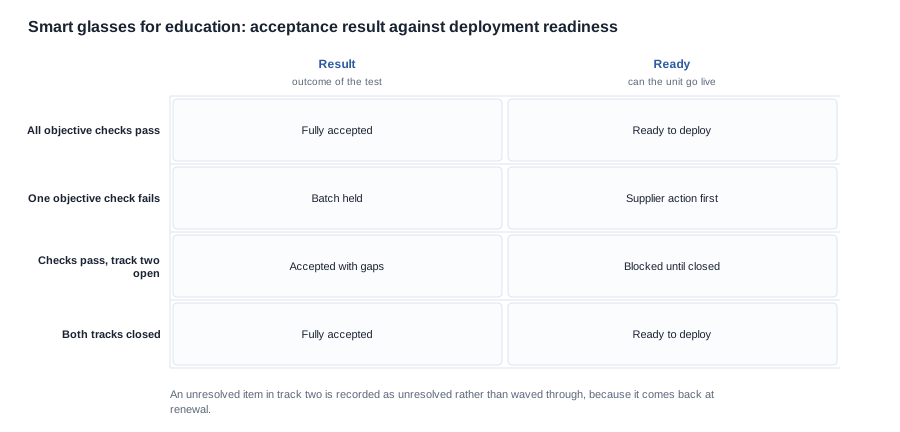
Operations then take over from acceptance, and they are a different discipline with a different output. The reporting that prevents a repeat is a monthly device count against the class register, fault causes separated into hardware, configuration and custody, and a charge-cycle check on a sample of the fleet. Two patterns matter more than the totals. A rising custody fault count points at a procedure rather than at the product — the device is being charged incorrectly, stored near something it should not be near, or handed over without the condition check. A single unit failing repeatedly while its batch-mates behave points at a batch rather than at the design, and that is a conversation with the supplier about a specific production window rather than a general quality complaint.
The charging side of a deployment is at how to charge for education settings, and what the children's models in this range actually do is at kids eye protection technology explained. The second of those is worth reading alongside the rules list, because a family rule written from a published feature and a family rule written from a brochure are different documents.
The configuration lock is what makes the acceptance document worth keeping. A lock is a short statement of the things that may not change without the acceptance being repeated: the model code, the firmware version, the published mechanism the programme is buying, the charging interface, the case configuration where one is published, and the packaging. Without it, a renewal conversation turns into a discovery exercise — someone has to establish what is actually in the building before anyone can ask whether it still works. With it, the renewal conversation starts from a known state and the only open questions are the ones the programme actually changed. For an institutional customer this is worth more than it looks, because the institution has to answer the same question about its own fleet every year, and the answer has to survive a change of supplier as well as a change of staff.
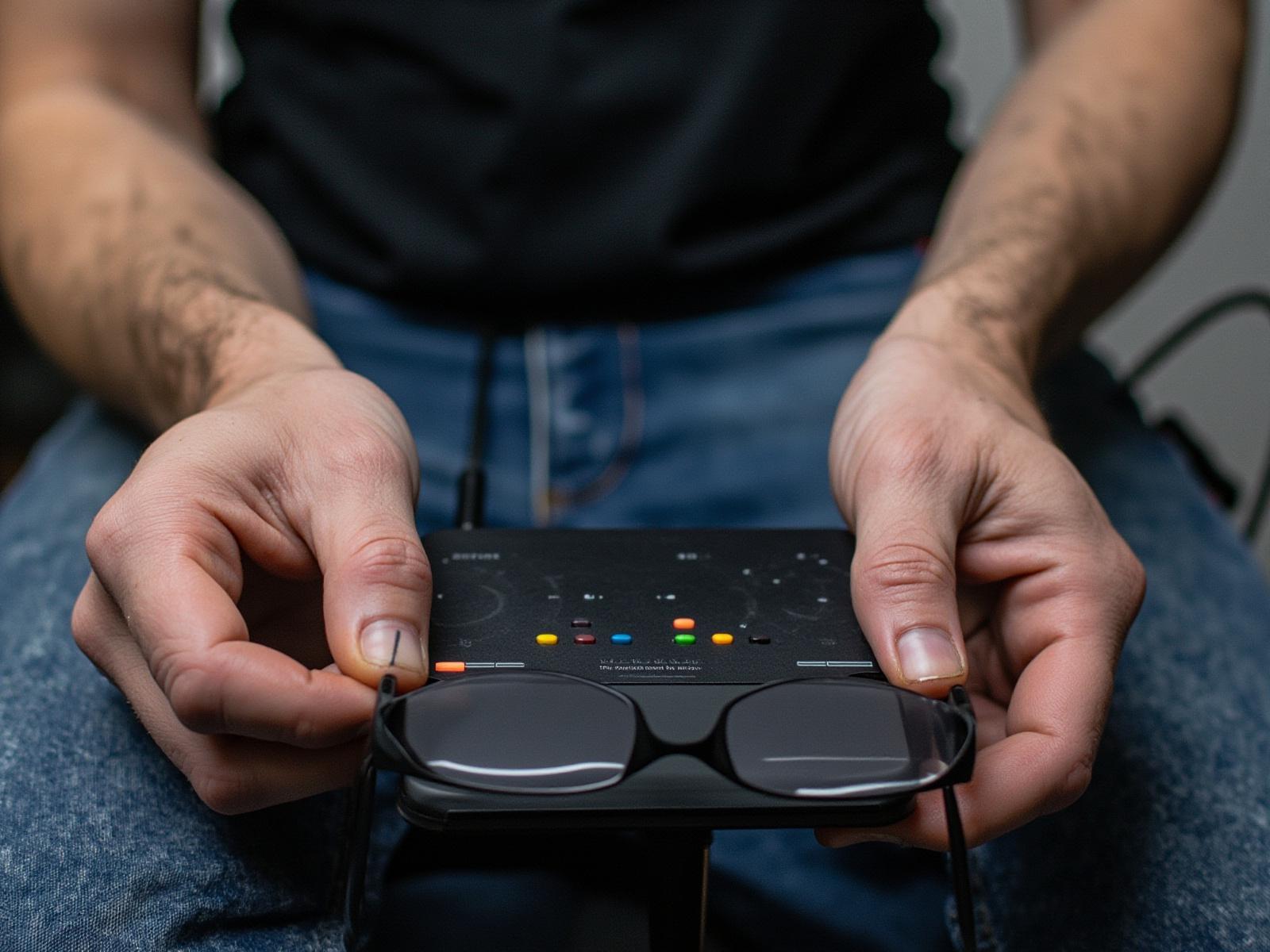
Where an education deployment stalls
A general compliance statement used as a children's-product answer. The document exists, it is signed, and it covers consumer obligations rather than the additional requirements that attach to a product used by children. Prevention: ask for the position per market, in writing, naming the requirements.
An acceptance sheet that treats track two as a formality. The device checks are signed, the deployment is announced, and the conformity position is still open. Prevention: the unresolved list travels with the acceptance sheet and is reviewed before the order.
A rules list written from a feature list rather than from a family conversation. The features are the same either way; the difference is whether the household can enforce the rules at seven in the morning. Prevention: one sentence per published feature, drafted with the family and not with the brochure.
A runtime quoted as a working day. The roughly twenty-hour figure published on the A05, the A06 and the A07 describes a light workload with long idle periods, not continuous use. A classroom timetable is close to the standby case, but a class that is used all afternoon and carried home is not. Prevention: measure the routine over a real week and write the routine down.
No configuration record. Symptom: a renewal question the institution cannot answer about its own fleet. Prevention: the per-unit log at acceptance, entered into the asset register the same day.
A support path with no owner. Symptom: a fault on the first Monday of term with nobody to call. Prevention: a named contact, a spare-unit procedure and a payment decision, all three in the agreement.
The commercial position behind an education programme
The published rows settle the product side of an education programme and they do not settle the programme side. The resolution class, the cell configuration and therefore the runtime ceiling, the charge time, the charging interface, the published mechanisms on each model, and the certification cost and its lead time are the settled elements, and tooling is amortised across the first order and quoted as a separate line rather than folded into the unit price. Those rows are what make two quotations comparable.
The open items are institutional rather than industrial, and each one has a commercial shape. Whether a conformity assessment route is funded and by whom is the first, because it is a cost and a lead time that the catalogue does not carry. Whether the per-model unit weight, the lens material and the coating, and the cleaning agents that are prohibited are supplied in writing is the second, and it is the group of rows that decides whether the family's handling rules can be written at all. Whether the configuration record is produced per unit by the factory, or has to be created by the institution, is the third, and it is a per-unit cost that is easy to forget because it appears as somebody's time. Whether the insert is printed, digital or both is the fourth, and it decides whether a parent's first instructions arrive in the box or in an email. Whether the data-handling documentation is provided as a document or has to be drafted by the buyer is the fifth. Minimum order quantity tiers are open, and whether two models share a purchase order is open. Logo, lens tint and packaging are open. A school programme that is rolled out term by term is the case where the opening order is split into two deliveries with staged payment, and the units that stay at pilot quantity are where the largest discount sits.
A framework agreement changes what the commercial terms are for. An educational customer that buys once and re-orders annually is not the same customer as one that takes a single order, and the difference shows up in three places. The first is the configuration lock: if the accepted configuration is written into the framework, the annual order does not have to be re-specified, and the re-specification is where the disagreements live. The second is the certification and data-handling documentation, which is expensive to obtain once and cheap to reuse, and which therefore belongs in the first agreement rather than in each subsequent one. The third is the fault and returns pattern, which is what turns the pilot tier into the run tier, and which needs the channel to keep a record across both tiers rather than treating the pilot as a throwaway. The questions a buyer should ask before accepting a framework are therefore not about the unit price: they are about whether the configuration, the documentation and the defect record carry forward, and whether the acceptance criteria from the pilot become the inspection criteria for every later delivery.
The documents to request before a deposit are the conformity assessment position per target market, the data-handling position, the per-model unit weight, the lens material and coating statement, the prohibited cleaning agents, the per-unit configuration record format, the support path, the model designation table, the certificate register with numbers and validity dates, the packaging artwork proof and the agreed incoming inspection criteria. The clause language is at contract terms, the commercial structure of a first order is at pricing, and the scenario entry point is smart glasses for education.
Concretely, we will give you the published specifications to test against and name the gaps plainly, including the ones that make an education deployment harder — certification status for the children's models, data handling, and every acoustic and camera specification. We will not present a general compliance statement as though it covered a children's-product requirement, and we will not make or imply a health, vision or myopia claim for any model, because we have no data for one and the applicable children's product requirements for the major markets have not been assessed for this range. Unit prices, minimum order quantities and production lead times are confirmed per enquiry rather than published as fixed numbers.
What we will do is take the deployment size, the destination market and the session pattern, and tell you which published configurations exist, which track two items are outstanding, and what documentation work has to be closed before the first unit is deployed. Send those three and we will return the acceptance checklist for the configuration, the unresolved list template, and the assessment route for the market you have named.
Related reading
- How to charge for education settings — the operational pattern
- Certification checklist — the documentation file
- Kids eye protection technology explained — what the children's models do
- Smart glasses for education — the scenario entry point
Tell me the deployment size, the destination market and the session pattern, and I will tell you which published configurations exist and what documentation work is outstanding.


