

Smart glasses for field work: the case where the shift ends the test
A field-work test that ends at a bench tells a buyer what the device does in a controlled room, and a field-work device spends its life in a vehicle, a site cabin and a pocket. The four exposures that decide whether the product survives a crew — dust in the charging contacts, vibration in the frame and the temple, water on the lens and the contacts, and cold — only appear after hours, and only in the conditions the crew actually works in. So the protocol below has two halves: a bench half that produces comparable numbers, and an environment half that confirms those numbers still hold afterwards. A buyer who runs only the first half has measured a laboratory product, and the difference between the two shows up in the third week of a deployment rather than in the test week.
There is a second reason the environment half matters more than it looks, and it is a procurement reason rather than an engineering one. The exposures are not uniform across a fleet. A unit on a commissioning crew works in a van and a plant; a unit on an inspection crew works outdoors in bad weather; a unit on a support crew works in an office for a week and then outdoors for a day. So the environment half is not one test applied to a range — it is the test that decides whether one configuration can be sold for all of those uses or only for the one it was tested in. That is a question about the product's commercial reach, and it is decided by whether the buyer can produce a defensible statement for the worst crew rather than for the average one.
Our published position for the sport family is a resolution class, a charge time, a cell capacity, a colour count, a charging interface, a rated runtime, and the IP54 marking on the two camera models that carry it with no test report published behind it. Not published for any model: the sensor, the field of view, the video resolution and frame rate, the low-light behaviour, the storage and overwrite behaviour, the per-model unit weight, the hinge specification, an operating temperature range, a cycle life rating or a runtime test condition. Which is why the environment half is where the buyer gets information the documentation cannot give, and why the pass lines have to be written before the run rather than read out of it afterwards.
The reader here is a brand-side buyer, a channel buyer or an e-commerce seller supplying a service company, a utilities operator, a facilities contractor or an inspection business. The situation is usually a quotation to compare, a new programme to open for a contract, or a tender to answer. The fear common to every scenario sits underneath — the first batch turns up other than the sample that was approved — with one addition that belongs to this scenario: a device that works in the demonstration and fails on a Tuesday afternoon in the rain is a returns problem that the crew reports, and a crew reports problems to its own supervisor before it reports them to the supplier.
The bench half, and the number each stage produces
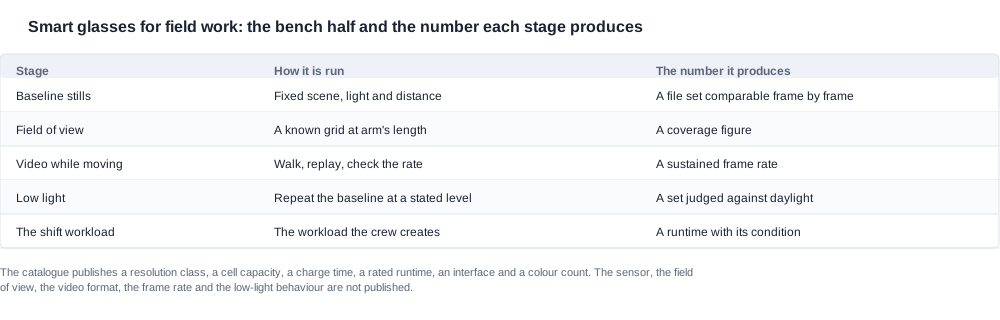
The bench half is not optional and it is not sufficient. It exists so that the environment half has something to compare against, and every stage produces a number rather than an impression.
Baseline stills. A fixed scene, fixed lighting, fixed distance, shot across the candidate range. The number is a file set that can be compared frame by frame, and its value is entirely in the comparability — one good still proves nothing about the next model shot in a different room.
The field of view, measured. A known grid at arm's length, and then the covered width and height read off it. The number is a coverage figure, and it is also a check on the listing photographs, because a listing image taken at a focal length the product does not have is a misrepresentation that surfaces as a return.
Video while moving. Record while walking, replay, and check whether the frame rate holds. The number is a sustained frame rate and a stated format. Neither the format nor the frame rate is published for any model in this range, and both are properties of the session rather than of the specification.
Low light. Repeat the baseline at a stated low light level and judge the set against the daylight set. The number is a comparable judgement, and the stated level is what makes it arguable in either direction.
The shift workload. The workload the crew actually creates, run to the end of a shift. The number is a runtime with its condition stated, and what happens at the limit. This is the stage that converts a catalogue rating into a plan, and it is the stage most often skipped because it takes a whole shift.
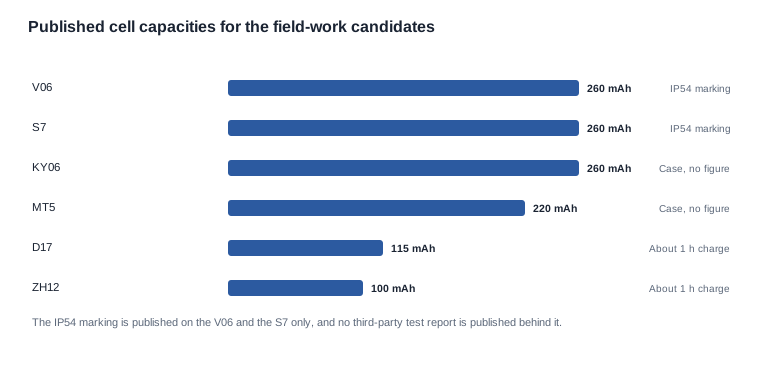
The published rows that a field-work buyer compares on are the endurance ones, and they differ by model in a way that matters. The D17 publishes a 115 mAh cell with about seven hours of runtime and roughly one hour of Type C charging, and the ZH12 publishes a 100 mAh cell with about eight hours and roughly one hour of Type C charging — those two are the only models in the range that publish a one-hour charge, and for a crew that recharges between shifts, that hour is the difference between a device that is ready and a device that is not. The camera models sit at the other end: the V06 and the S7 at 260 mAh with five to eight hours, the KY06 at 260 mAh with six to eight hours, the MT5 at 220 mAh with six to eight hours. The cell values are published as cells and count rather than as totals, so a specification sheet that shows a derived total is making a statement the catalogue does not support.
The environment half, which is where the decision changes

Dust in the charging contacts. A device charged in a vehicle or a site cabin accumulates debris on the charging interface, and the failure is gradual enough that nobody reports it until the device will not charge on the morning it is needed. So the environment run has to end with a charge attempt in the state the device was actually left in, and that charge attempt is a pass line rather than an observation. A device that fails it is not necessarily a defective unit — it is a product whose routine has not been designed, and the remedy is a consumable and a line on the insert rather than a rejection.
Vibration in the frame and the temple. A vehicle road and a site floor put a cyclical load into the frame that a bench never does, and the visible result is hinge play and temple movement. The published unit weight exists for one model in the entire catalogue — 158 g for the MT6, the whole unit including the battery and the camera and excluding its foldable case — and the hinge specification is not published for any model, so both have to be measured: a temple and hinge check before and after the vibration, with the result compared against a drawing. That comparison needs a drawing, which is another item to request.
Water on the lens and the contacts. The IP54 marking is published on exactly two models, the V06 and the S7, and it covers splashing water and a dust protection level — not immersion, not a sustained downpour — and no test report behind it is published. So the environment run can produce a statement of the form "tested in conditions of X for Y hours, after which the pass lines were still met", which is a defensible observation with its conditions attached. It cannot produce "IP54 tested" or "rainproof", because those assert something the documentation does not support. The digit reading is at IP ratings.
Temperature. The published data contains no operating temperature range and no low-temperature characterisation, and cold reduces the usable capacity of a lithium cell. A buyer who cannot obtain the range has to word the endurance claim accordingly, which is a copy decision and a much cheaper one to make before the artwork than after the first complaint. A crew that works outdoors in winter is the case where this matters, and it is also the case where a published runtime quoted without a condition is most likely to be wrong.
Storage and overwrite behaviour. This one is not published for any model in the range, and in a field-work deployment it is the gap that matters most after the runtime. A crew that records for four hours does not want a device that quietly replaces the first hour with the fourth. The capacity, the overwrite rule and whether there is any notification at the limit are three questions that have to be answered in writing, and the answer decides whether the crew can leave the device running or has to trigger a transfer at a fixed point in the task. That in turn decides the accessory chain — whether a dock with storage, a rotation of units, or a manual transfer step belongs in the kit — and the accessory chain is a per-unit cost that the programme either priced or forgot. A buyer who asks this question before the order is deciding the kit; a buyer who asks it afterwards is deciding the budget.
The re-check. Every stage above ends with the pass lines being re-checked on the same unit. That is the step that turns the environment half into evidence rather than into anecdote, and it is the step most often left implicit — the crew puts the device back in the case at the end of the day and nobody checks whether it still holds a charge.
The checklist to run before the purchase order
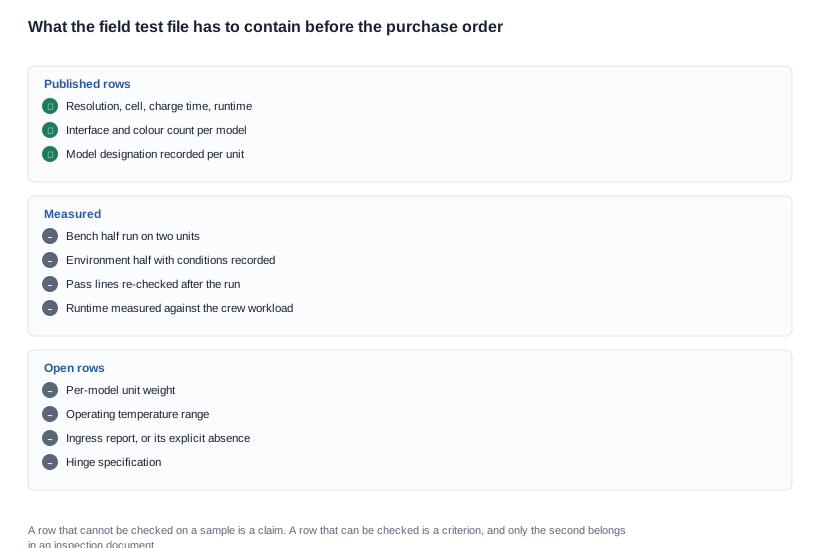
- The published rows per model — resolution tier, cell capacity, charge time, interface, colour count — with the model designation recorded, because it is the only traceability anchor a deployment has.
- The four supplier answers, in writing: the sensor part, the field of view, the video format and frame rate, and the runtime under the crew's workload, each with a method.
- The bench half, on two units from the same batch, so a manufacturing inconsistency is separated from a design characteristic.
- The environment half, after the bench half, with the conditions recorded and the pass lines re-checked afterwards.
- The certificate register, with numbers and validity dates, checked against the issuing body's public register, with the model on the certificate matching the model being ordered.
- The battery transport file for the exact configuration, including the case if one is included — a shipping gate rather than a quality item.
- The sample configuration check, confirming the unit is the production configuration rather than a promotional batch.
The product shortlist is at field work product recommendations, the model comparison is at comparing models for field work, and the sampling procedure is at samples. The scenario entry point is smart glasses for field work.
Six ways a field test programme goes wrong
A protocol that stops when the unit passes on a bench. The exposures that decide a crew deployment only appear after hours, and the pass lines have to be re-checked afterwards. Prevention: the environment half is not optional and its pass lines are written first.
Testing one unit. One unit cannot separate a design characteristic from a manufacturing inconsistency, and the remedy is different in each case. Prevention: two units from the same batch as a minimum, and the spread recorded.
A wet contact written up as a defect. The unit comes back, tests perfectly in the workshop, and produces a second and more confusing conversation. Prevention: a fault-code sheet that separates "will not charge after use" from "will not charge at all", and a contact-cleaning item in the per-device layer.
A protocol with no conditions attached. "Eight hours" without the workload behind it is the most expensive sentence in a procurement file, because a crew will test it on a real shift and find the difference. Prevention: the condition travels with the number into the agreement and into the channel brief.
Testing the specification rather than the device. A row that cannot be checked on a sample is a claim; a row that can be checked is a criterion, and only the second belongs in an inspection document. Prevention: every published row is classified as criterion or claim before the test starts.
A result that never becomes a criterion. A measurement nobody writes into the incoming inspection is a demonstration, and a demonstration is the supplier's document rather than the buyer's. Prevention: every measured figure ends as a line in the incoming inspection criteria.
What the field test is worth commercially
A field-work programme is bought on the assumption that the device will work in the environment, and that assumption is what the test settles. The six stages and the environment run cost days of crew time rather than minutes of bench time, and they are the only thing that converts an open specification into a statement a contract can carry. That is worth real money in a bid, because a buyer who can state "tested in the conditions of X for Y hours, after which the pass lines were still met" is bidding with a position rather than with a brochure.
The settled elements of the commercial position are the published ones: the resolution class and therefore the ceiling on image quality, the cell configuration and therefore the runtime ceiling, the charging interface and therefore the charge routine, the ingress architecture on the two models that carry the marking, the certification cost and its lead time, and tooling, which is amortised across the first order and quoted as a separate line rather than folded into the unit price. These do not move, and they are what makes two quotations comparable.
The elements that do move are specific to this scenario. Whether the supplier will run the protocol against production units rather than engineering samples is the first, and it is the difference between a result and a guess. Whether the supplier will supply the recordings and the measurements so the result can be re-judged later is the second. Whether a case is included and at which capacity is the third, and for a fleet it is usually a decision to exclude: a case is a second lithium cell to declare, a second object to track at handover and a second thing to charge. The incoming inspection criteria are a negotiation between two parties rather than a unilateral document, and that is worth saying out loud when it is raised. Whether the supplier funds a baseline measurement on the production batch is the fifth, and it is the document that answers every complaint in the second contract. Whether a drawing can be supplied for the hinge and temple check is the sixth, because without one the vibration result is an opinion rather than a comparison. Minimum order quantity tiers are open. Logo, lens tint and packaging are open. A crew rollout that goes crew by crew is the case where a first order split into two deliveries with staged payment works, and the quantity kept back at pilot level is where the price has the most give.
A tender changes what the commercial terms have to prove. A field-work buyer answering a tender is not choosing between two suppliers on price; the buyer is defending a price to somebody else, and that changes which rows matter. The published rows have to be presented in a form that survives a question from the buyer's own client, which means the interface, the cell, the charge time and the runtime have to be quoted as catalogue values with the open rows marked as open rather than left out. A tender document that lists only the rows that are settled reads as incomplete to an evaluator, and one that lists an estimate reads as unqualified. The written answers to the four supplier requests are what make the submission defensible, and asking for them before the tender is submitted is what makes the timeline survivable — because the answers are a lead time, and a lead time that starts after the submission date is a lead time that arrives too late.
The documents to request before a deposit are the signed test sheet with its conditions, the output parameter sheet with methods, the per-model unit weight, the operating temperature range, the ingress report or the explicit absence of one, the temple and hinge drawing, the model designation table, the certificate register, the battery transport file for the configuration, and the agreed incoming inspection criteria. The clause language is at contract terms, the commercial structure of a first order is at pricing.
The short answer: we publish the rows a buyer can order from and we will not fill an open row with a typical value. For the field-work range that means the charge times, the resolution class, the rated runtimes, the cell capacities, the charging interface per model, the colour counts, the IP54 marking on the V06 and the S7, the removable inner frame on those same two models, and the case capacities on the camera models that publish one. We will not publish an operating temperature range we have not been given, we will not publish a per-model unit weight we have not measured, and we will not state that any model is tested to IP54, because no test report is published behind that marking and the two models carrying it are the only ones that do.
What we will do is take the shift length, the environments, the workload, the fleet size and the markets, and tell you which stage decides the purchase, which published rows apply, which pass lines have to be written before the run, and which numbers have to be confirmed on a production unit before a purchase order. Send those five and we will return the protocol written for your environments, the pass lines, and the document list that has to be settled before the order.
Related reading
- The entry point for this scenario — smart glasses for field work
- The product shortlist — field work product recommendations
- The model comparison — comparing models for field work
- The sampling procedure — samples
Tell us the shift length and the environments, and we will say which stage decides the purchase.


