

An ecommerce team that has not been trained on a product will sell it the way they sell everything else, which means they will make claims. In this category the claims are the problem: almost every published figure is a specification, and a specification sold as a benefit becomes a claim the seller has to defend. Two hours of training is enough to fix that, and the training below is structured backwards — it starts with what may not be said, because that is where returns come from.
Two further conclusions set the scope of that two hours. The first is that a marketplace channel punishes a claim differently from a store: a store absorbs one wrong answer, and a marketplace publishes the wrong answer where a competitor can point at it and where a review can repeat it. The second is that the published data in this category is genuinely incomplete, which is why the training has two lists rather than one — a published set and a not-published set — because a team that knows what is missing stops trying to fill the gap and starts asking the supplier instead.
The third conclusion is that the training is only half of the job. A team can be trained perfectly and still return a quarter of what it sells, because the returns are not measuring the conversation in the chat but the configuration in the box. Which is why the second hour ends with a fixed returns reason list: a returns process that tags causes becomes a measurement, and a measurement is what tells you whether the problem is the product or the listing.
A smart glasses for ecommerce team that has not been trained will sell a claim
Who the training is for, and what it prevents
The reader is a brand-side buyer, a channel buyer or an e-commerce seller with a marketplace listing, and the situation is one of three: the team is about to take delivery of a new model and the listing is already written, the training has to be delivered to staff who turn over every season, or the return rate on a specific model has become visible and the cause has not.
The commercial argument is the most direct one in this category. A listing that claims something a competitor can screenshot generates a return, and a return in a marketplace channel costs the refund plus the shipping plus the lost margin, and it also costs the review score, which compounds across every later order. The claim therefore has a price attached to it, and the price is knowable before the first order rather than after the hundredth.
The legal argument is sharper in some markets. A claim about protection, about a child's eyesight, or about water resistance is a claim about the product, and the party that made it carries it. A member of staff improvising a claim in a support chat is the brand making that claim, in a channel where it is recorded in writing and can be forwarded.
The practical argument is the simplest, and it is the one that decides whether the training is worth two hours. The published data in this category is incomplete, and the incompleteness is concentrated in exactly the rows a customer asks about: the per-model weight, the sensor part numbers, the field of view, the video specification, the acoustic figures, the storage behaviour, the ingress evidence and the certification numbers. A team that knows the shape of those gaps stops answering from memory.
What the published set has to contain
The team should be able to state the configuration of the models they are selling without looking anything up. That is the charge time, the resolution tier, the cell capacity, the rated runtime with its caveat, the charging interface, the case capacity where it is published, the Bluetooth version where it is published and the available colours. It is a short list and it is learnable in twenty minutes, and it is the list that makes every other answer possible.
The part that matters is the second list: what is not published. The unit weight for every model except the single figure at 158 g, which is the whole-unit weight of the MT6 glasses including the cell and the camera and excluding the foldable case. Sensor part numbers. Field of view. Video resolution and frame rate. Ingress test report numbers behind the IP54 marking. Certification numbers. The acoustic figures. The storage behaviour. The AI implementation details. A team that knows both lists can answer a question honestly instead of guessing, and the second list is what protects the brand from the questions it cannot answer.
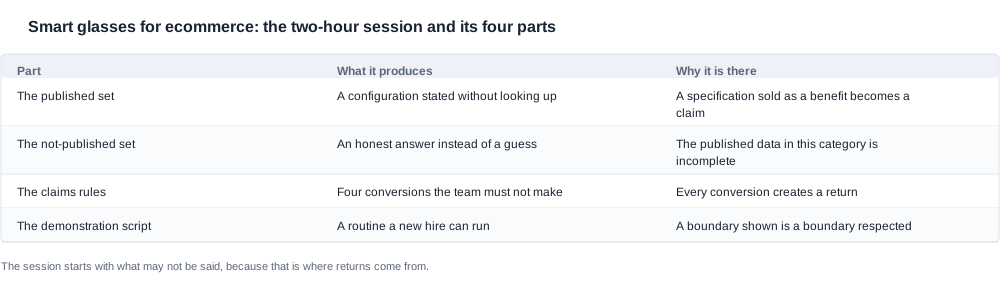
Smart glasses for ecommerce: the two-hour session and its four parts
Hour one: the published set and the claims rules
Hour one part one is the published set, and it is taught as a recitation rather than as a document to be distributed, because a set that is distributed is a set that is guessed at. The teaching method that works is to name the models on the shelf and ask for the configuration out loud. Twenty minutes is enough for a small team, and it is enough because the list is short.
Hour one part two is the claims rules, and they are four rules simple enough to be memorable. Never turn a rating into a conclusion: the catalogue publishes IP54 on the V06 and the S7, that is a marking, and the second digit means protection against splashing water rather than immersion. Never turn a capacity into a duration: a 290 mAh cell is not a runtime, and a rated run of about seven hours is a figure under a condition rather than a working day. Never turn a resolution into an image-quality claim: 13 MP is a tier rather than a picture, because the sensor part number and the field of view are not published for any model. And never state a safety or health benefit: there is no vision claim to make in this category, and the children's line carries a posture and distance reminder, which is a reminder rather than an outcome.
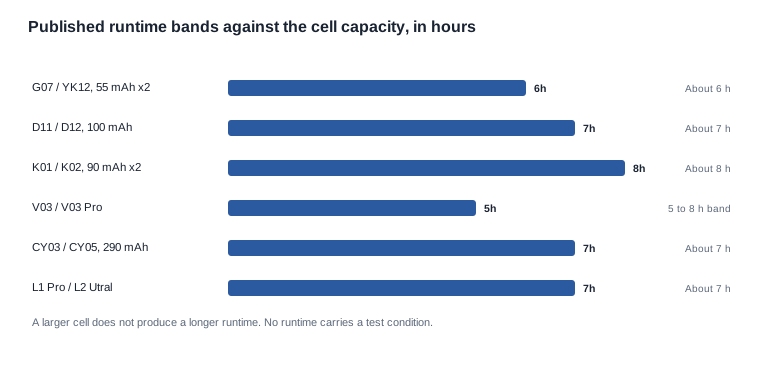
The chart above is the evidence for the second rule, and it is worth keeping in the training material rather than only in the buyer's file. The cell capacity does not predict the runtime: the 55 mAh per side tier publishes about six hours, the 100 mAh models publish about seven, the 90 mAh per side tier publishes about eight, and the 290 mAh camera models publish about seven. A seller who reads the capacity off the spec sheet and multiplies it into a working day will promise more than the published row supports, and the customer will be the one who finds the difference.
Hour two: the demonstration script and the returns triage
Hour two part one is the demonstration script, and it is a ten-minute routine a new member of staff can run on their first day. Connect the device, show the camera, show the audio, show the case, show the charging, and then — critically — show what it does not do. Demonstrating the boundary is what stops the team from improvising past it, and the boundary is easier to demonstrate than to explain: the reviewer on the other side of the screen is looking for the thing that does not work.
Hour two part two is the returns triage, and it is the part that turns a returns process into a measurement. Tag every return with one reason from a fixed list: weight and pressure, battery, connectivity, the use case, the price, and the claims. The list is deliberately short, because a long list produces inconsistent tagging and inconsistent tagging produces a number that cannot be compared month to month. The ratio between the first two reasons and the rest tells you whether the problem is the product or the listing, and that ratio is what decides where the next hour of work goes.
The handover completes the session: name the person who owns the escalation to the supplier, and give the team the rule for when to use it. The rule should be narrow and mechanical — a question the published data cannot answer, or a pattern of five or more returns carrying the same tag — because a rule with judgement in it will not be applied consistently under pressure, and a rule that is applied consistently is the only one that produces a pattern worth escalating.
Thresholds the ecommerce team is allowed to work to
The evaluation criteria a sales claim has to pass
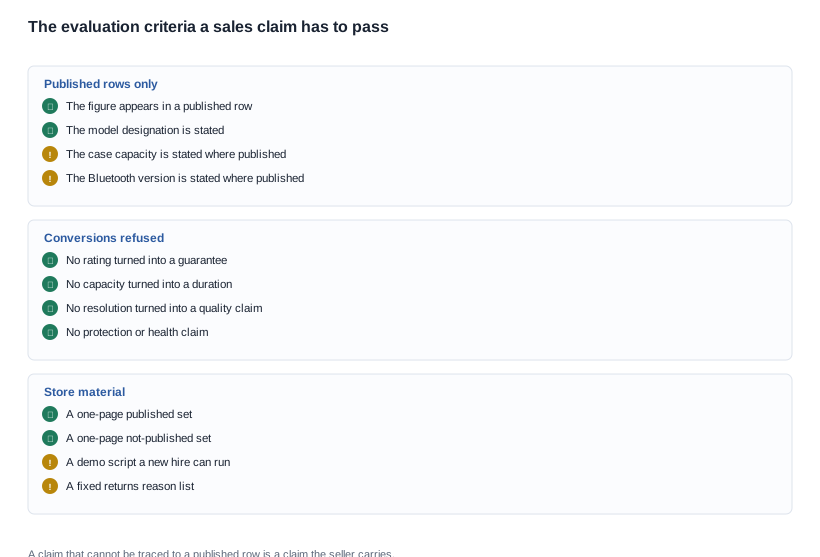
A trained team still needs a standard to be held to, and the standard has to be short enough to be applied in a live chat. Four criteria do most of the work. Every figure in the answer appears in a published row for that exact model. Every conversion is refused: no rating turned into a guarantee, no capacity turned into a duration, no resolution turned into a quality claim, and no protection or health claim of any kind. The model designation is stated, so that the answer and the unit on the shelf can be tied together later. And where a row exists but is incomplete — the case capacity on some models, the Bluetooth version on the camera models, the runtime without its condition — the answer says which part is missing.
The last of those four is the one teams resist, because saying "that figure is published but the condition is not" feels like a weaker answer than a number. It is not: it is the answer that survives a customer who has tested the figure themselves, and it is the answer that a competitor cannot improve on without publishing something the catalogue does not contain.
The four claim conversions that must never happen
The conversions are worth separating from the general criteria because each of them is a specific sentence that a team will otherwise produce, and each of them is easy to catch in review. "It is waterproof" converts a marking into a guarantee. "It lasts all day" converts a band into a duration. "It takes really sharp photos" converts a resolution tier into a quality claim. And "it protects your eyes" converts a reminder into an outcome, which in this category is not merely unsupported but is the kind of claim that carries a regulatory exposure of its own.
The red flags to watch for in a review are the same four sentences with different nouns. A seller who says "it is rain-proof" is making the first conversion with a synonym. A seller who says "the battery lasts a full ride" is making the second with a specific scenario attached, which makes it worse rather than better because it is checkable. The evaluation criteria for a claim therefore work as a checklist before a listing goes live and as a set of examples in the training session.

Turning the training into a returns measurement
The fixed reason list and why it has to be fixed

The reason list has to be fixed and short, and the reason it has to be fixed is that the ratio between reasons is the only signal that separates a product problem from a listing problem. Weight and pressure together point at the fit and the physical specification. Battery points at the charge routine and the case. Connectivity points at the pairing procedure and the phone range. The use case points at the channel decision. Price points at the tier. And claims points at the training itself, which is the reason to keep the tag even when it is uncomfortable.
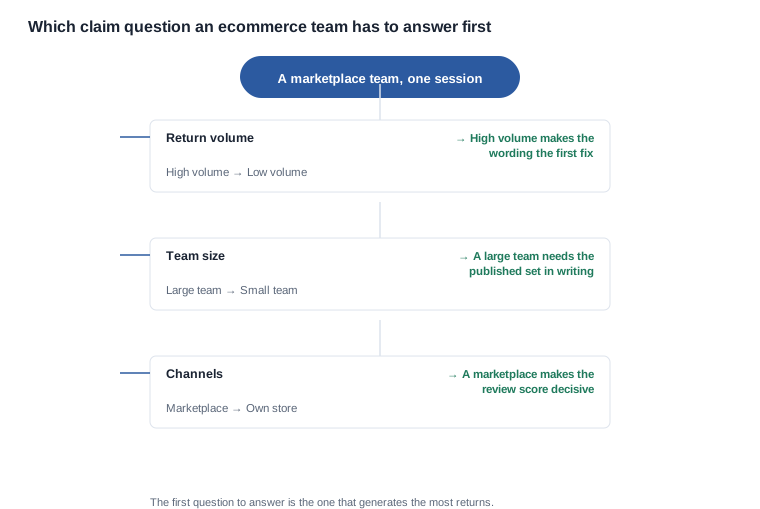
The flow above is the sequence a returns desk follows weekly, and the weekly cadence matters more than the sophistication of the analysis. A count that is taken monthly tells you what happened; a count taken weekly tells you which change did it. The escalation rule sits at the fifth step of that sequence, and it is deliberately mechanical: five returns on one tag, or one question the published data cannot answer.
The last step is the one that closes the loop, and it is the one most programmes omit. After a listing change, the published set and the claims rules are re-checked against the new copy, because a listing change is exactly when a new claim enters by accident — a phrase copied from a competitor, a comparison added to a bullet point, a figure that was true for a previous model. A change that adds wording is a change that needs the criteria applied to it again.
What the team will be asked, and how to answer
Prepare answers to these, because they are the ones that arrive in every category. How long does the battery last? The published figure is the rated run under a stated condition, and a mixed day is shorter; offer the case, and offer the tier that suits the customer's day rather than the tier with the biggest number on the page. Is it waterproof? The marking is IP54 on the V06 and the S7, which means a dust protection level and protection against splashing water, and it is a catalogue marking with no third-party test report number published behind it — describe the marking and stop there. Does it protect my eyes? No such claim is made and none should be; the children's line carries a posture and distance reminder, which is a prompt.
Is it better than the competitor? Compare the published configurations and let the comparison be about what is published, because the competitor's published figures are not in your control and their unstated ones are exactly as unpublished as yours. What is the difference between these two models? The 8 MP and 13 MP platforms, the 220 mAh and 290 mAh cells, the case options, the charging interface, the colours, the Bluetooth version — answer from the published list and offer the sample.

Where ecommerce training programmes go wrong
A feature tour. The team learns what the device can do and not what it should not be done with, and then repeats the capability to a customer as a promise.
A published set with no not-published set. The team learns what to say and not what not to say, and fills the second gap from memory every time a customer asks something the catalogue does not publish.
A claims rule with no example. A rule stated abstractly is a rule that gets paraphrased by each member of staff, and the paraphrase drifts toward the more useful-sounding version.
A returns list that changes. Tag reasons are chosen by the person handling the return, and without a fixed list the counts are not comparable and the ratio is not a measurement.
No escalation owner. A question the published data cannot answer goes into a chat, and the pattern never reaches the supplier, so the row stays open for the next customer.
A training session delivered once. Staff turnover in a marketplace operation is continuous, and a session that is not scheduled for new starters is a session that has to be redelivered in a hurry later.
The commercial terms an ecommerce training programme has to settle
Terms that move and terms that do not
The commercial value of a training programme in this channel is the difference between a return and a sale, so the terms that move with it are the ones that change what the team can say and what the returns desk can do. The first is whether the supplier reviews the published set, the not-published set and the claims rules before the listing goes live — this costs the supplier nothing and removes the largest source of unverified wording. The second is whether the supplier supports a training session at all, and whether it is delivered remotely, which for a marketplace team with staff in several locations is the difference between a session that happens and one that does not.
The third is the sample programme, because a trained team that has handled a sample answers questions differently from one that has only handled a photograph. The fourth is the consumables and their per-unit cost, since the lens item and the contact item are what make the handling instructions true. The fifth is the warranty and returns route, which for a marketplace seller determines whether a return is a refund, a replacement or a return-to-stock, and the difference in cost between those three is the number that determines whether a listing with a high return rate is still profitable.
Order bands are negotiable, and so is how much of an order is held back at pilot quantity, because a seller on a marketplace can usually absorb a small pilot, measure the returns on it and only then commit to the full run. Logo, lens tint and packaging are cheap to change between runs and expensive to change once the listing photography is shot. Where a first order goes out in two parts and the money follows inspection rather than shipment, the arrangement suits a channel that is running a new model beside an old one.
What does not move is the camera and audio architecture, the cell and the charging interface, and therefore every figure the published set quotes. What certification costs, and how long the test takes, are fixed by the programme and by whoever runs the test. The tooling charge is amortised across the first order, and it appears on its own line rather than within the unit price. Here is where to look: the contract wording is at contract terms, and the pricing architecture of a first order at pricing.
A hypothetical marketplace programme, step by step
Take an online retailer that sells an audio model and a camera model across two marketplaces, with a third channel — its own store — planned for the following year, and a return rate on the camera model that is roughly twice the audio model's.
The first decision is the diagnostic one, and it comes before any training is scheduled: the returns are tagged against the fixed reason list for one quarter, and the pattern shows that the camera model's returns are concentrated in the claims reason and in the battery reason. The second decision follows from that pattern, and it is that the camera listing's wording is the first thing to fix, before any session is delivered — because a session that teaches the right rules to a team that is still reading an old listing teaches against itself.
The third decision is the two-hour session itself, structured from the published set outward rather than from the features inward, and the claims rules are taught with the four specific sentences rather than as abstract principles. The fourth decision is the store material: a one-page published set, a one-page not-published set, and a demo script a new starter can run on day one without a colleague standing beside them.
The fifth decision is the escalation rule and its owner, with the five-return threshold agreed with the supplier in advance so that the pattern is acted on rather than discussed. The sixth is the commercial one: the pilot share on the camera model, the split delivery, and the warranty and returns route that determines whether a camera return is a refund or a replacement. The outcome is a channel where the claims are traceable to published rows, the returns measure something, and the next quarter's decision about the camera model is made on a ratio rather than on a feeling. Nothing here is a report of a specific engagement; it is an illustrative sequence, and what is worth taking from it is the sequence of the decisions rather than the numbers that sit inside it.
What we publish for an ecommerce configuration
To put it plainly — we publish the per-model specifications and the colour and configuration options, and we mark the rest as Not published: unit weight for every model except the one at 158 g, the sensor part numbers, the field of view, the video specifications, the ingress test report numbers, the certification numbers, the acoustic figures, the storage behaviour and the AI implementation details.
We will support a training session with the material for the models a team actually sells, and we will tell you plainly which questions we cannot answer. What we will not do is provide a list of selling points that includes a claim we cannot evidence, because a training pack that overclaims teaches a team to overclaim. We will also not describe any model in the range as certified to CE, FCC or RoHS, because the catalogue carries no per-model certification row and no such wording in its text, and we will not extend the IP54 marking beyond the V06 and the S7.
What we will do is take the models, the markets, the channels and the price band, and return a one-page published set, a one-page not-published set, and a claims list the team can be held to. The model range is at AI camera glasses, the buying criteria are at ecommerce buying checklist, and the scenario entry point is smart glasses for ecommerce.
What to send so the claims list can be written for your team
Send the models you sell, the markets, the channels and the price band, and we will give you the published set, the not-published set and the claims list your team can be held to. If the returns are already running, send the reason breakdown instead — that is the fastest way to work out whether the problem is the listing, the configuration or the training.
Related reading
- AI camera glasses range — the models and their published rows
- Ecommerce buying checklist — the selection criteria
- Smart glasses for ecommerce — the scenario entry point
- Smart glasses for ecommerce — the application page


