
Ecommerce sellers ask the same cluster of questions, and the reason the answers matter is that a marketplace listing is a legal document as much as a marketing one. Every claim on a product page has to survive a competitor screenshot, a customer complaint and, depending on the market, a regulator. These are the questions we are asked most often about smart glasses for ecommerce, grouped by the decision each one unblocks, with the short answer first and the detail underneath.
Smart glasses for ecommerce: the questions a listing has to answer
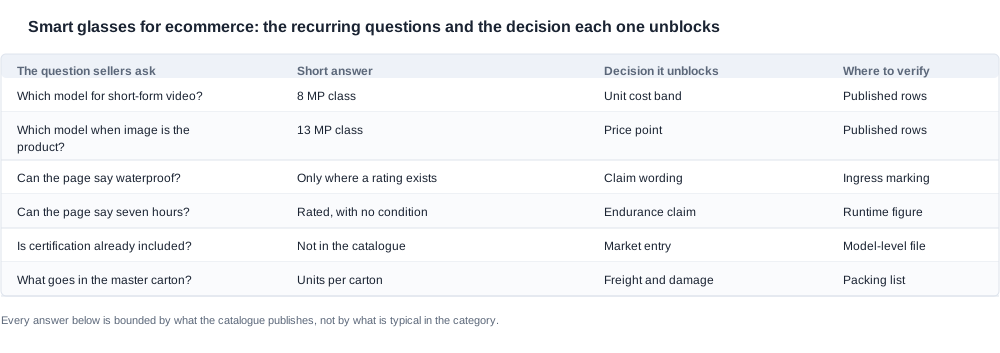
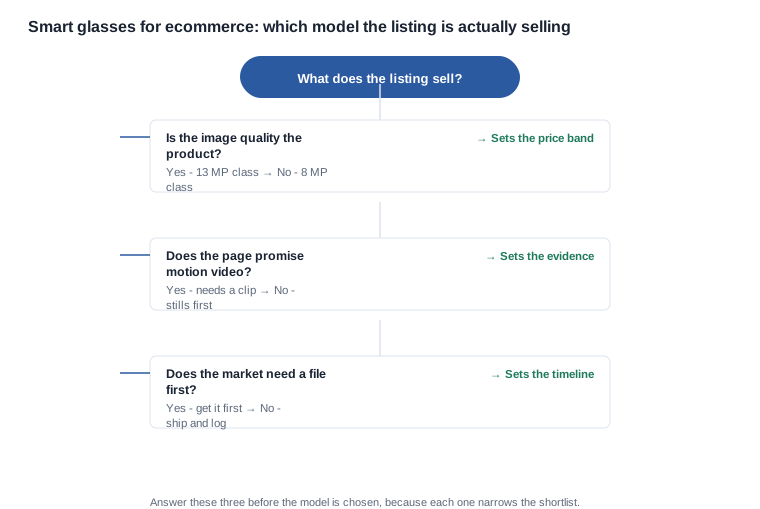
The short answer to the meta-question. Every recurring question in this category falls into one of three kinds, and telling them apart is most of the work. The first kind is a selection question — which model, which configuration, which price band — and it is answered from the published rows. The second kind is a claim question — what may the product page say — and it is answered by comparing the page against what the catalogue publishes and what you have measured yourself. The third kind is a document question — what has to exist before this can ship — and it is answered by asking, in writing, before the order. Sellers lose time because they treat the three kinds as one stream of enquiries, when in fact the claim questions should be answered before the model is chosen and the document questions should be answered before the purchase order.
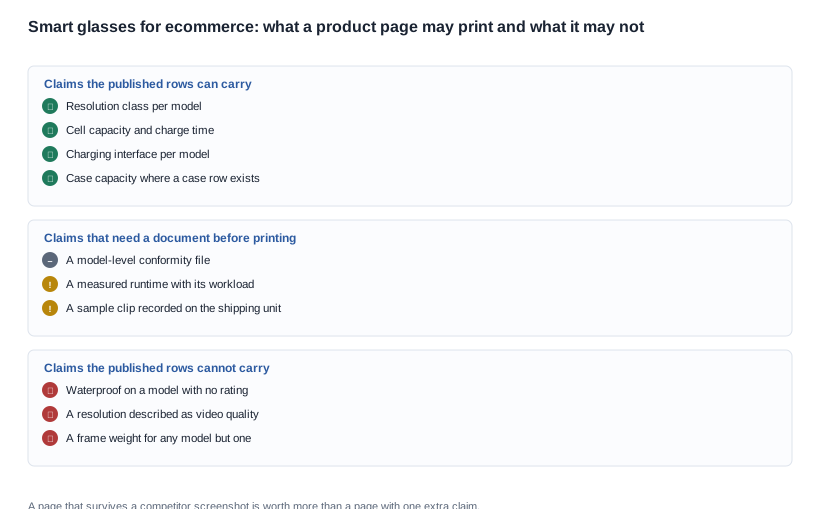
Why the answers have a boundary. The published position in this range is precise about the electrical rows and silent about a long list of others. The catalogue publishes the charge time, the cell capacity, the resolution class, the rated use, the charging interface and the case capacity where a case row exists. It does not publish, for most models, a unit weight, the sensor part number, the field of view, the video resolution and frame rate, the ingress rating with a report number, the storage path, the transfer method, the operating temperature range, or any certification number. An answer that ignores that boundary is the kind that produces a refund: not because the device is wrong, but because the page promised something the documentation never did.
Which model carries the content you are actually selling?
The short answer is that the camera tier sets your cost, not the flagship does. Our catalogue carries 8 megapixel platforms on 220 mAh and 260 mAh cells, and 13 megapixel platforms on 290 mAh cells with a 1400 mAh charging case, and the difference between them in a listing is a price point and an image quality claim rather than a different product category.
What decides it is the content. If the selling point is a hands-free first-person video for short-form social, the 8 megapixel platforms are usually enough and they are considerably easier to make work at a retail price point. The V03 and the V03 Pro publish 8 megapixels on a 220 mAh cell with a five to eight hour rated use, and the MT5 publishes the same cell with a six to eight hour band. If the content is a professional workflow where image quality is the product, the 13 megapixel tier earns its cost: the S7 and the L2 Utral, and the L1 Pro publish 13 megapixels, and the L1 Pro and the L2 Utral pair that with a 290 mAh cell and a 1400 mAh case while the S7 carries a 260 mAh cell.
Either way, the battery and the charging case are what a customer will actually notice, and the case is a large part of the retail proposition. It is also a second lithium cell, which means it changes the parcel, the freight weight and the transport documentation — and the case configuration is a decision made before production rather than a feature selected afterwards. The L2 Utral is published at both 900 and 1400 mAh, the L1 Pro, the CY03 and the CY05 — each at 1400 mAh, the MT6 with a 1200 mAh foldable case, and the catalogue lists no case row at all for the V03, the V06 or the S7.
When the listing carries two models. Many channels run one camera model and one audio model under one brand at two price points, and that is where configuration decisions become visible to a customer. The two models differ in what arrives in the box. A camera model may ship with a 1400 mAh case or a 1200 mAh foldable case, while the audio models in this catalogue use magnetic charging with a doubled cell on several models and a single 100 mAh cell on the D11 and the D12. The charging interface decides whether the customer needs a cable they already own or a case that has to travel with the product, and that difference has to be visible on the page, in the box and in the freight calculation. Two price points are the easy half of that decision; keeping the case configuration honest under both of them is the half that decides whether the second price point survives its first returns cycle.
The second question, which is about hardware rather than model: is the interface magnetic or Type-C? The catalogue publishes magnetic charging on the S7 and the MT5, and the KY06 and the V06, and the V03 among the camera models, and Type-C on the V03 Pro and the L2 Utral. For the L1 Pro and the CY03, and the MT6 and the CY05 the charging method is not published at all, although all four do publish a case capacity. The interface determines whether a customer needs a cable they already own or a case that has to travel with the product, and that in turn determines what you put in the box and what you print on the page.
What can the product page actually claim?
Only the figures the supplier publishes, plus what you have tested yourself. That is the whole rule, and it is stricter than it sounds, because the temptation is to fill the gaps with category-typical values.
The resolution claim. A resolution figure is a stills figure until the video output format, the frame rate and the field of view are published, and none of those three is published for any model in this range. So "13 megapixels" can go on the page as a specification. "13 megapixel video" cannot, because it converts a published number into an unpublished capability — and a buyer who receives a stills-first device with a narrower view will describe the result as a defective camera rather than as a misunderstanding.
The ingress claim. Only two models in the whole catalogue carry an IP marking: the V06 and the S7, both at IP54. The second digit of IP54 covers splashing water, and the first is a dust protection level; the marking does not cover immersion, a sustained downpour or a shower. No third-party test report is published behind the marking. A page that says "IP54 waterproof" has moved from a specification to a conclusion, and the second word is the one that produces refunds. "IP54 rated, as published in the catalogue" is defensible; "waterproof" is not, and the buyer who tests it in the rain is the customer who decides that.
The endurance claim. The rated use figures are five to eight hours on the 220 mAh models and the V06 and the S7, six to eight hours on the KY06 and the MT5, and about seven hours on the 290 mAh models and the MT6. No test condition is published for any of them. "Up to about seven hours" is a claim; "about seven hours under continuous playback" is a specification, and the second one is only available if you have measured it yourself on the unit you are shipping. The charge time of two hours or less is a ceiling, so it cannot be printed as "under two hours" without changing the assertion.
The weight claim. Exactly one weight figure exists in the catalogue: 158 grams for the MT6 glasses themselves, including the 265 mAh cell and the camera and excluding the foldable case.
The certification claim. This is the one sellers most often get wrong, so it is worth being exact. One company-level export certification page appears in the catalogue, with images rather than text on it, and no CE, FCC or RoHS reference appears in the catalogue text. There is no per-model certification row anywhere in the catalogue, and no record of a certification number pending confirmation for any model either. A buyer who needs a model-level conformity file has to request it from the company that holds it, in writing, as a document — and until it exists in that form it cannot be printed on a page or a package. Where the destination market requires it, the file is a condition of listing, not a formality.
The assistant claim. The AI assistant is listed as a key technology across the camera range, and that is exactly as far as the published material goes. The model behind it is not published, whether it works offline is not published, whether it carries a subscription is not published, and where the data is processed is not published. A page that lists the assistant as a feature and says nothing else is accurate. A page that promises answers without a connection, or answers that never leave the device, or answers included in the price forever, is making four claims the catalogue does not carry.
In an ecommerce listing the practical version of this is a return. A buyer who expected offline answers and received a feature that needs a phone and a network will describe the result as a broken product, and the fix is a sentence on the page rather than a refund on the invoice. If you are selling this category into a market where data handling is part of the purchase decision, then say what is known about where the processing happens and say plainly what is not known, and let the buyer make that trade-off themselves. The same reasoning applies to any feature the catalogue lists without a specification attached: the listing can carry the feature, and it cannot carry a performance claim about the feature.
The one number most channels print by mistake. The weight. Exactly one weight figure exists in the catalogue — 158 grams for the MT6 glasses themselves, including the 265 mAh cell and the camera and excluding the foldable case — and it is easy to read that as a range-wide figure because it is the only figure available. It cannot be extrapolated to the CY03, the L1 Pro or anything else, and the case weight is not published for any model. A page that prints "lightweight" without a figure is defensible as a description and indefensible as a specification, and a customer who compares the parcel against another brand's parcel is comparing the case as well as the glasses.

What does the destination market require before the first shipment?
The destination decides, and the gap is usually discovered at customs clearance rather than at the order. For a general-audience product the requirement set is the radio and chemistry set that applies in the target territory, and the numbering to quote when you ask is the Radio Equipment Directive (EU) 2014/53/EU for the radio side, not the EMC directive number, which is a different instrument. For a children's product the position is thinner still, because the requirements for children's eyewear in Europe and in the United States are additional to the standard ones and cover mechanical and small-part properties that a product aimed at adults does not have to meet.
The practical consequence for an ecommerce seller is that the product page, the packaging artwork and the conformity file have to agree with each other and with the destination. A claim on the page that the file does not support is a problem at the point a customs broker or a marketplace compliance team looks at it, and by then the listing is live and the artwork is printed.
The questions worth asking, in the order that stops the most work. Which requirements apply to this exact configuration in the market you are shipping into. Who holds the evidence, and in what form it can be transferred to you — because a district or a marketplace team will ask for it as a document with a holder named on it. Whether the packaging artwork has to carry any marking or wording, and who approves it. Whether the labelling obligations are the same for a single unit as for a bulk order. And, for the range as a whole, what the position is on the models where the catalogue publishes no charging method at all.

How do packing, freight and the lithium cell change the first order?
The ship carton is not the sample carton, and the packing list has to be frozen before the freight is booked. A single unit usually arrives in a padded mailer; a bulk order arrives in a master carton, and the master carton is where the damage happens. Get the packed dimensions and the gross weight of the master carton in writing, with the number of units per carton, and get the answer against the final retail packaging rather than an assumed one.
Every model in this catalogue runs on a lithium cell, so the transport classification and the cell documentation have to be settled before the booking rather than discovered by the forwarder afterwards. That gets more complicated, not less, when the configuration includes a case, because a case is a second cell with its own capacity: 1400 mAh on the CY03 and the CY05, and the L1 Pro, 900 or 1400 mAh on the L2 Utral, 1200 mAh on the MT6's foldable case, and a case of unstated capacity on the KY06 and the MT5. The requirement for the transport file is at battery transport, and the packing procedure for a first shipment is at packing for an ecommerce shipment.

On support after launch, ask what the supplier supports and what it does not, separately. Firmware and system customisation, application builds, Bluetooth naming, packaging and logo customisation and temple styling are within what we describe as our customisation scope. Repair, returns handling, spare-unit logistics and long-term firmware support for a product you have already shipped are commercial arrangements set per order, and they are not published as a standard table. A channel that assumes the warranty of a consumer brand covers a shipped batch has made an assumption the catalogue does not support, and the difference between the two is usually the difference between a credit and a write-off.
How do returns work in a retail channel?
Set the window, the cost and the condition rule before the listing goes live, and make sure the supplier's warranty does not conflict with them. The retailer's return policy is what the customer sees; the supplier's warranty is what you have behind it. Where the two disagree, the retailer usually wins and you absorb the difference. The clause that causes the most trouble is the one about condition: a returned device that has been used, marked, or returned without its case is a device you have to inspect, refurbish or scrap, and that cost belongs in the margin before the listing rather than after the first batch of returns.
The published rows help you size the exposure rather than set the policy. The camera models that ship with a case bring a second cell into the parcel, and the case configurations are not identical: 1400 mAh on the CY03 and the CY05, and the L1 Pro, 900 or 1400 mAh on the L2 Utral, and 1200 mAh on the MT6's foldable case. A unit that arrives without its case is a different return from a unit that arrives with the wrong case, and the condition rule has to distinguish them, because one is the customer's decision and the other is your packing decision.
We publish the cell capacity, the charge time, the rated use and the case capacity per model because we hold them. We do not publish a warranty duration, a return window, an RMA process or advance replacement terms, and we will not estimate any of them for a policy you are about to publish. Those terms have to be agreed with the company and written into the purchase order, and the selection decisions that come before them are in the buying checklist for ecommerce sellers.
What should you send us before you write the listing?
Send four things and the answer will be specific rather than general. The target market and the destination each unit ships to. The price band you need to hit. The expected annual volume and the first order quantity. And the listing you are trying to write, in draft, including the claims you are unsure about. We will tell you which models in the catalogue can carry the claims you want to make, which claims we would talk you out of, which of the open positions the company can close for your configuration, and where the answer is that the position is simply not published and the page has to say so.
What we will not do is give you a number to print that we cannot evidence. A listing that survives a competitor screenshot is worth more than a listing with one extra claim on it, because the claim is the part that comes back. The camera and audio smart glasses range carries the published rows, and the selection decisions that come before this page are in the buying checklist for ecommerce sellers.
Related reading
- Camera and audio smart glasses range
- A buying checklist for ecommerce sellers
- Packing smart glasses for an ecommerce shipment
Send the market, the price band, the volume and the draft listing, and we will tell you which claims the published rows can carry.


