

Smart glasses for livestreaming: six rehearsals, not a training leaflet
What the rehearsal programme is actually worth
A livestream is the least forgiving environment for this category, because there is no second take and nobody off air can fix anything. The presenter is the camera operator and the camera operator is the presenter, so a device that will not connect, a frame that has moved, a stream that dropped a segment or an indicator nobody read each ends the session instead of degrading it. Smart glasses for livestreaming therefore has to be bought as a rehearsal programme with a device attached, not as a device with a training leaflet attached.
The commercial consequence is that the rehearsal cost is a deployment line item, and the cheapest way to reduce it is to buy the device the rehearsal programme assumes. Six rehearsals cover start-up, the room, failure recovery, framing, the backup unit and the audience rules. Every one of them depends on a row our catalogue does not publish for any model: the app name, the connection procedure, the control scheme, the indicator behaviour, the field of view, the video format and the runtime test condition. That is why the programme is written by the buyer. It cannot be copied from a manual, because there is no manual to copy.
The Camera and audio smart glasses range page lists the configurations and their published rows, and the useful way to read it for a live deployment is as a map of what is known and what has to be obtained. The commercial side of the same question is covered in the pros and cons of livestreaming with glasses, and what a deployment reveals over weeks is in long-term use for livestreaming.
Who is buying, and what they are buying
Three roles sign for this kind of deployment and each of them is buying something different. A channel operator is putting a device in front of presenters who did not ask for it, and the rehearsal programme is what decides whether the first stream is the twentieth or the only one. A procurement manager is buying the deployment and needs the training cost to be planned rather than discovered in month two. A brand owner is deciding whether a livestreaming channel is viable at all, and for that decision the useful number is not the unit price — it is the number of usable sessions a presenter can deliver per day.
The reason that number is hard to forecast is that it is not a device property. It is the product of three things: the device, the room, and the presenter's ability to recover a failure. Any quotation that presents a session-length figure as a device specification is selling a number that the training programme, not the factory, produces. Buyers who accept that framing early tend to run a pilot with a handful of presenters and a defined pass line; buyers who do not tend to buy a fleet and discover the pass line after the first cancelled slot.
Why the camera rows decide the session length
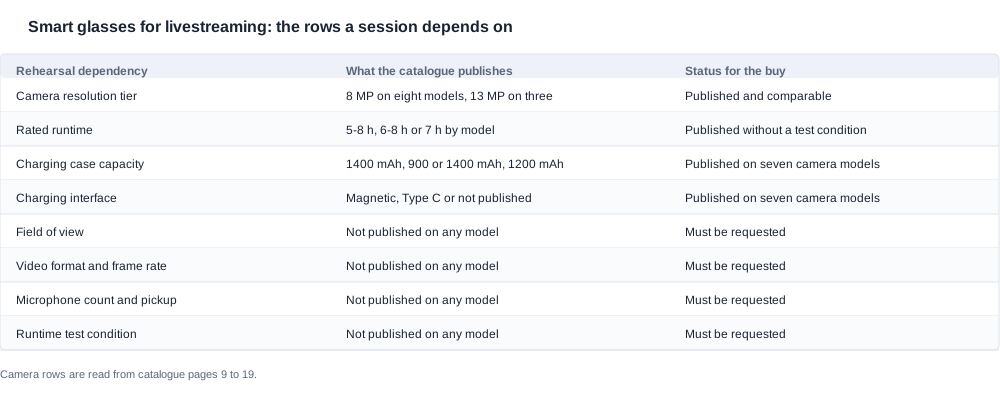
The camera side of the range publishes the rows that matter most here, and they should be read as tiers rather than as a single specification. Eleven camera models are published, and the resolution tier splits them eight to three: eight models publish an 8 MP camera, and three publish 13 MP — the L2 Utral and the S7, and the L1 Pro. For a channel whose audience is watching on a large screen, that three-model subset is the shortlist, and a buyer who treats the eleven as one product group will spend months comparing prices across models that are not in the same competition.
The runtime rows split the same set into three bands as well. The S7 and the V03, and the V06 and the V03 Pro publish a rated five to eight hours; the KY06 and the MT5 publish six to eight hours; and the CY05 and the CY03, and the L2 Utral and the MT6, and the L1 Pro publish roughly seven hours. None of these figures carries a test condition, and none of them is a session-length guarantee, because a rating measured at one volume level, one signal condition and one duty cycle will not describe a presenter running four hours of continuous capture in a room with live audience noise. What the numbers do support is a capacity calculation: how many sequential sessions a presenter could attempt in a day before a charge becomes necessary.
The third row that decides the deployment is the charging case. Seven camera models publish a charging case — five with a capacity, the CY03 and the CY05, and the L1 Pro — each at 1400 mAh, the L2 Utral at 900 or 1400 mAh as a configuration choice, and the MT6 at 1200 mAh in a foldable case, with the KY06 and the MT5 naming a case without publishing its capacity. Four camera models publish no charging-case row at all. That distinction is not a detail for a live deployment; it is the difference between a presenter who can carry a second cell and a presenter who has to find a socket, and sockets are not available in most places where a channel actually streams.
The camera rows a livestreaming deployment can order from
Resolution tier, runtime tier and the second cell
The table above separates the published rows from the rows that have to be requested, which is the structure a procurement file needs. Three published rows carry most of the commercial weight: the resolution tier, the rated runtime and the case position. Everything else in the table is a gap, and each gap has to be closed with a document before the fleet is ordered rather than after the pilot is booked.
The resolution tier is the easiest of the three to under-use. An 8 MP camera is not a defective 13 MP camera; it is a different product for a different channel, and the eight models that publish 8 MP cover price points a live channel can actually sustain across a fleet. The 13 MP models are for the flagship channel and for any use where the frame is cropped rather than reframed. A buyer who specifies 13 MP across the whole fleet because the flagship stream looks better is paying a resolution premium to make a first-hour problem into a fleet-wide cost.
The runtime tier has to be converted into an operating plan rather than quoted as a session length. The honest conversion is: published runtime divided by a realistic duty cycle gives the number of usable sessions, and the duty cycle is what the acceptance run measures. That is also why the acceptance run has to happen on the same units that will be deployed. A runtime measured on a sample unit in a quiet room is not the runtime of a device on a presenter in a live venue.
The case decision is the one with the largest single commercial effect and the smallest line in the quotation. For a presenter-based channel, the second cell is the difference between a programme that can survive a long day and one that cannot, and it also determines the weight and volume of what the presenter carries to a session. For a fleet buyer the case is a per-presenter accessory with its own minimum order quantity, and that quantity — one per presenter, not one per device — is the number that decides whether the spare is actually present on the day.
The rows the rehearsal programme has to cover instead
Six rehearsals, and each one rests on a row that is not published for any model in the range. Start-up rests on the app name, the connection procedure and the control scheme. The room check rests on the microphone count, the pickup distance and the processing mode. Failure recovery rests on the runtime condition and on the indicator behaviour, neither of which is published with a condition. Framing rests on the field of view, the video resolution and the frame rate, none of which is published. The backup rests on the charging interface and the case position, which are published, and therefore on the parts of the system the buyer can actually control. The audience rules rest on the recording behaviour and the transfer path, neither of which is published.
This is the central procurement fact about a livestreaming deployment, and it is worth stating plainly to anyone comparing quotations: the same device produces a different operating cost for different buyers because the buyer, not the factory, closes the gaps. A buyer who requests those rows before the order gets a rehearsal programme that can be written. A buyer who skips the request gets a rehearsal programme that has to be discovered by failure, in front of an audience.

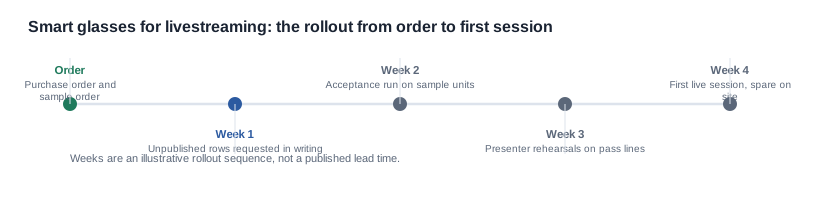
The flow above is the sequence we would put in a deployment plan, and each step produces a pass line rather than a feeling. A pass line is a sentence the presenter can say afterwards — "the device connected from a locked screen in under a minute" — and it is the only kind of evidence that survives contact with a presenter who is nervous.
Verifying the deployment before the first live session
The request that settles the programme
The verification work in this category is a document exercise, and it can be completed in one message to the supplier if the request is written narrowly enough. The following eight rows are the ones the six rehearsals depend on, and each of them needs to arrive as a written answer that can be filed with the purchase order.
- The app name and the connection procedure, per model. A rehearsal cannot be written against an unnamed app, and a buyer who expects a presenter to find the right one on a marketplace listing is asking the presenter to do procurement work on air.
- The control scheme for the capture trigger. Which control starts a recording, which stops it, and whether that control is a physical button or a gesture.
- The indicator behaviour. What light or sound the device produces while recording, because a presenter who cannot see the indicator cannot tell whether the stream is live.
- The field of view and the video format. The video resolution and the frame rate, per model.
- The microphone count, the pickup distance and the processing mode, per model.
- The runtime test condition. The volume level, the duty cycle and the signal environment the rated runtime was measured in.
- The transfer path. How captured media reaches the streaming software, and which steps in that path are manual.
- The recording behaviour and the transfer behaviour for an unattended device. Whether the device records when nobody is interacting with it, and what happens to that recording.
The eighth row is the one a brand owner should insist on. A device that records continuously and streams on demand publishes the people in the room to an audience that did not consent to it, and in a live setting the presenter is the only person who can refuse. That refusal is a rehearsal, and the rehearsal is a training cost that belongs in the rollout plan rather than in the incident log.
The acceptance run
Once the eight rows are in hand, the deployment needs one acceptance run on sample units, and it needs to be the same units that will be deployed. The six steps are a cold start from a locked screen on a full charge, an audio check in the real room at the real hour, a deliberately induced link and battery failure with the recovery timed, a framing check judged on a monitor rather than on a phone, a timed switch to the spare unit with the case open, and a refusal drill for the audience rules.
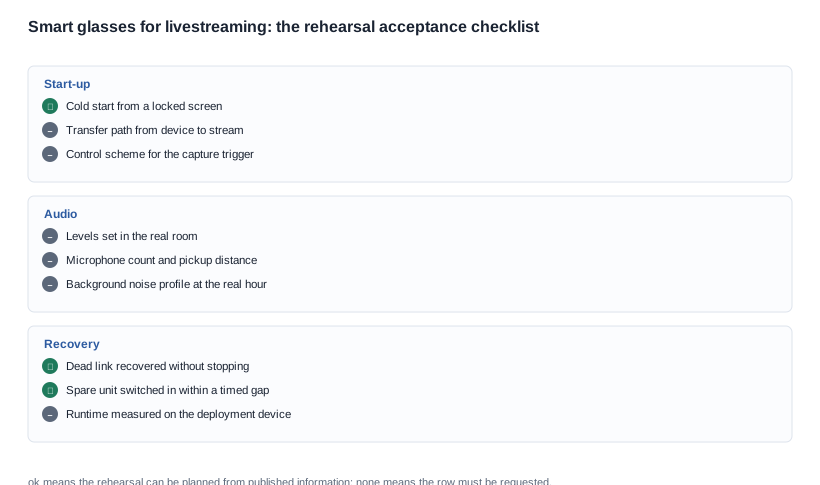
The checklist above marks which rehearsals can be planned from published information and which depend on the requested rows. Two of them — the recovery drill and the timed switch — can be planned from the published rows, because the charging interface and the case position are published. The rest need the documents. That is a useful way to see the deployment: the part of the programme that the factory can support is the part that concerns power, and the part the buyer owns is the part that concerns behaviour.
The acceptance run should produce three artefacts, and all three belong in the procurement file. The first is a measured recovery time for the induced failures, because a recovery that takes twenty seconds is a programme that ends in a gap rather than a recovery. The second is a measured runtime on the deployment units under the venue's conditions, which becomes the duty cycle the fleet plan is built on. The third is a signed pass line per presenter, because the training cost is per presenter and the fleet is per presenter.

Where a livestreaming deployment goes wrong on air
Every failure below reaches the audience before it reaches the buyer, which is why each one is written here as a preventive step rather than as a warning. The pattern is the same in all six cases: a symptom on air, a root cause in a document nobody wrote, and a preventive step that costs almost nothing before launch.
The training was a manual read. Symptom: a presenter who freezes on the first live session. Root cause: start-up was never rehearsed cold, from a locked screen, with nobody able to intervene. Prevention: rehearse the cold start with the phone locked and the device in a pocket.
The audio check was done in a quiet room. Symptom: a stream that is unusable in the actual venue. Root cause: the microphone rows are not published, so the room was the only available source of an answer, and the room was not tested. Prevention: run the audio check in the venue at the hour the channel actually broadcasts.
The failure drills were skipped. Symptom: a session that ends rather than recovers. Root cause: the drills were treated as a formality because nothing failed on the day. Prevention: induce the failures deliberately on a sample unit and time the recovery.
The framing was never judged. Symptom: a stream that is technically correct and visually wrong. Root cause: the field of view is not published and the presenter learned the shot by checking a phone screen rather than a monitor. Prevention: judge every shot on a monitor at the delivery resolution.
The refusals were not rehearsed. Symptom: a presenter placed in an awkward position on air with the brand's name attached to it. Root cause: the audience rules were written down but never practised, so they were improvised. Prevention: rehearse the refusals in the same session as the lines.
The backup was never timed. Symptom: a visible gap in the stream when the primary unit fails. Root cause: the backup existed as a plan on paper, with no case open and no measured swap time. Prevention: time the switch twice, in the rehearsal, with the case open and the spare charged.
The fleet was sized on the sample. Symptom: a busy day where half the presenters run out of power. Root cause: the duty cycle came from a rated runtime instead of from a measurement, and the four camera models with no published case were given a presenter with no second cell. Prevention: size the fleet on the measured runtime and on the case configuration that the channel will actually carry.

What a trained livestreaming deployment costs commercially
Terms that carry room
The commercial terms worth negotiating in a livestreaming deployment are unusual in this category because most of them are about the presenter rather than the device. The spare unit per presenter is the first one, and it is the line that decides whether the backup rehearsal is possible at all; the right quantity is one per presenter who streams, not one per device, which is often a larger number than the device order itself. The accessory set and its minimum order quantities follow from it, including the charging interface per presenter, which has to match the interface of the model ordered, since magnetic and Type C configurations are not interchangeable within one case.
Delivery splitting is worth attention for a different reason. A live channel usually opens in one market or one venue set before the fleet expands, and a first order split across two deliveries lets the second delivery carry the corrected training pack. Payment terms tied to acceptance rather than to shipment is the natural structure for a deployment whose acceptance criteria are a rehearsal pass line, because the buyer has something objective to point at.
The warranty period and its response time are worth specifying in hours rather than in days for this use case, since the cost of a device out of service is a cancelled slot rather than an idle device. Returns terms need a route for a presenter's device that fails during a session, which is a different event from a defect found in the box. And the pilot order terms are worth defining precisely, because a pilot of five presenters with a named pass line is a measurable procurement instrument, while a pilot of five units with no pass line is a discounted sample.
Terms that carry none
Three costs in this deployment are not negotiation targets, and a buyer who spends leverage on them loses the room that is actually available. Certification cost and lead time are settled by the programme and by whoever runs the test for the destination market for the destination market, and they are incurred once per product family rather than per unit, so they belong in the launch budget rather than in the unit price negotiation. Tooling is a one-time cost that should be quoted as a separate line and amortised across the order, because a quotation that folds tooling into the unit price hides both the size of the tooling and the point at which it stops being payable. And the runtime rating itself is not negotiable: it is a published row for a given model, and the only legitimate response to a rating that is too low for the channel is a different model or a different duty cycle.
What we publish for the livestreaming use case, and what we will not claim
The working rule we apply: in this category the rehearsal programme, not the feature list, is what makes a livestreaming deployment work, and the six rehearsals exist because the rows they depend on are not published for any model. We will not publish an app name, a connection procedure, a control scheme, an indicator behaviour, a field of view, a video format or a runtime test condition for a model where the manufacturer has not provided one, and we will not present a rated runtime as a session-length guarantee. Where a figure is published we will say which page of the catalogue it comes from and what it does not say: the 158 g figure for the MT6 is the weight of the glasses body with its battery and camera and not of the foldable case, the IP54 marking belongs to the V06 and the S7, and the Bluetooth version of the camera models is not published for any of them.
What we will do is give you the six rehearsals, the pass lines, the request list and the published rows that apply to each model, so that the training cost can be planned before the fleet is ordered rather than discovered afterwards. Send us the number of presenters, the session length, the venue conditions and the models you are comparing, and we will tell you which rows are documented, which have to be requested, and what the case configuration does to the number of usable sessions per presenter per day.
Related reading
- Each model and its rows — Camera and audio smart glasses range
- The commercial side of the same question — the pros and cons of livestreaming with glasses
- What a deployment reveals over weeks — long-term use for livestreaming
Tell us the number of presenters, the session length and the models you are deploying, and we will tell you which rows are documented and which the rehearsal programme has to cover.


