

Smart glasses pricing: a set of conditions, not a number
The answer a buyer can act on this week
The unit price in a smart glasses quotation is the least informative line on the sheet, because it is the line every supplier can produce and the only one the buyer is tempted to accept. A quotation becomes comparable only when eight other lines are attached to it: the configuration string, the one-time costs, the quantity break points, the packaging, the accessories, the freight and duty, the cash total, and the period the price holds for. Verify in that order and the price stops being an opinion and starts being a derived figure. Verify out of order and you will usually find a supplier who is cheap on the unit line and expensive on everything the unit line was hiding.
Two failure modes cause most of the disappointment. The first is comparing two quotations that describe different products, which is not a price difference at all but a scope difference wearing the costume of one. The second is treating the first order's numbers as the programme's numbers, when the first order carries setup work that the second order does not and the second order carries a volume break that the first order never reached. A price verified properly is a price you can forecast twice.
Who is reading this and what they are managing
The reader is a brand-side sourcing manager, a channel buyer or an importer who already has quotations in hand and has to choose between them, or who is opening a new programme and has to decide what goes into the specification before anything is quoted at all. Either way the question underneath the price question is the same: does this configuration, at this volume, with this documentation scope, land in my warehouse at a total I can put in a business case and defend to a finance team.
The thing being managed is not a gap between two unit prices. It is a landed cost that nobody has written down, a compliance scope that nobody has priced, a packaging decision that will be made after the purchase order, and a margin that was calculated on the wrong denominator. Buying smart glasses at a good unit price and losing money on the landed total is the single most common commercial outcome in this category, and it is entirely avoidable with a structured read of one document.
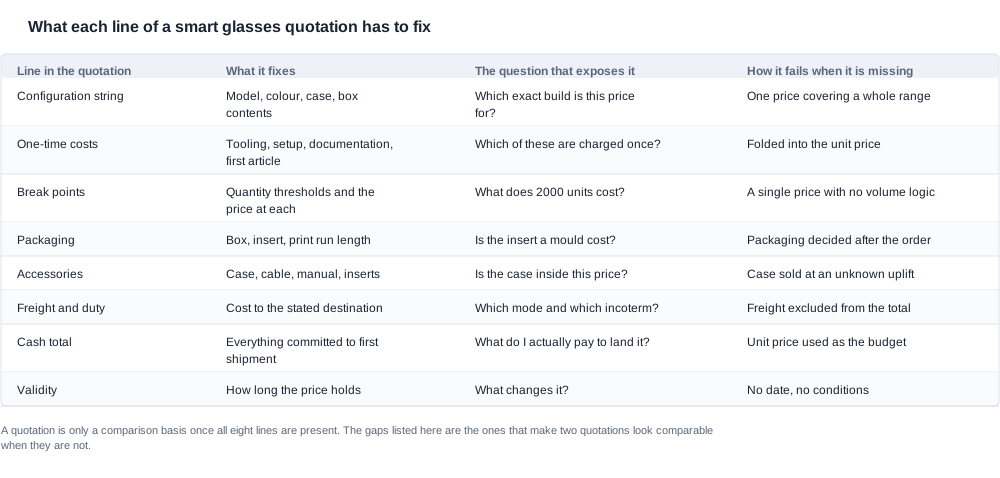
The table is the working version of the quotation template. Each row names a line, what that line fixes, the question that exposes whether it is real, and the shape it takes when it is missing.

What each line of the quotation has to fix
Why the configuration line comes first
Everything downstream of the configuration is arithmetic. Before any number is compared, the configuration has to be written down as a string that a factory would recognise as a build: the model code, the colour, the charging case option, the lens option, the box contents, the packaging artwork, the destination market and the volume. A quotation that quotes one price for a family of models has not given you a price; it has given you a starting position for a conversation.
The published catalogue makes this concrete rather than theoretical, because the range is genuinely branched. The L2 Utral is published in two case sizes, 900 mAh and 1400 mAh, and those are two different products with two different bills of materials. The V03 Pro has no charging case in the box at all, while the L1 Pro and the CY05, and the CY03 each ship with a 1400 mAh case and the MT6 ships with a 1200 mAh folding case. The KY06 and the MT5 carry a case whose capacity is not published. The V03 Pro is published with a photochromic lens option, and the range also carries a separate AI electrochromic model alongside it. Colour options differ per model rather than running across the range. Each of those is a price-relevant fork, and each one is invisible in a quotation that says only "smart glasses".
The pixel tier is the other fork that moves the cost. The camera models split into an 8 MP group of eight models — the MT6 and the KY06, the CY03 and the V03, and the CY05 and the V06, and the MT5 and the V03 Pro — and a 13 MP group of three — the S7 and the L1 Pro, and the L2 Utral. A quotation that says "8 MP camera glasses" without naming the model has not fixed the specification, because the battery, the case and the charging method differ across that group of eight.
The lines that turn a quotation into a total
A camera model that ships with a charging case is not one product but two, and the second one is quoted by the buyer as an accessory while the supplier builds it as a product with its own cell, its own charging circuit and its own set of test requirements. The same applies to the packaging. A moulded insert is a tooling cost amortised across the print run, not a printing cost, and a buyer who treats it as a per-unit line will misjudge both the first order and the repeat.
Freight and duty belong on the sheet for a reason specific to this product. Every model in the range carries a rechargeable cell, so the mode is partly chosen for the buyer, and the freight quotation for a cell-bearing consignment is not comparable with a general cargo rate. The duty depends on the origin and the classification code, and the classification can differ depending on whether a charging case travels in the carton.
The line most often missing is the cash total: unit price multiplied by quantity, plus the one-time costs, plus the packaging setup, plus freight and duty. That is the figure the business case has to use and the figure the finance team will ask for. A quotation without it has been quoted per unit and will be compared per unit, which is exactly the comparison that produces the wrong decision.
Comparing two quotations that are not quoting the same thing
Four reasons two sheets look comparable and are not
The first reason is scope. One supplier prices the documentation work for the markets named in the enquiry and the other does not, so the second sheet is lower by the amount of the compliance work. Nothing is wrong with either number; they are prices for different scopes, and the buyer has to add the missing scope back before comparing.
The second reason is volume treatment. One supplier applies a break at the buyer's quantity and the other treats the enquiry quantity as a one-off, so the unit lines differ by a margin change rather than by anything in the product. Ask where the break sits and whether the quoted price is the one that applies at the ordered quantity.
The third reason is the one-time line. A supplier who folds setup, artwork and documentation into the unit price produces a lower-looking unit price and a higher first-order cash number. A supplier who shows them separately produces a higher-looking unit price and a smaller first commitment. Both structures are legitimate. Comparing them at the unit line is comparing two different products.
The fourth reason is the accessories scope. One quotation includes the charging case, the cable, the insert and the manual in the box; the other lists them at an unknown uplift, or omits them and expects a separate order. The catalogue data above makes this visible: whether a case is in the box, and at what capacity, changes per model, and a buyer who does not specify it inherits whatever the supplier's default is.
The protocol that makes the comparison fair
Set both quotations into the same eight-row template before reading any number, and send the template back with the gaps marked. Where a supplier cannot fill a row, that empty row is the most valuable information on the sheet, because it tells you which cost you are going to discover later.
- The configuration string — model code, colour, case option, lens option, box contents, artwork, destination market, volume.
- The one-time costs — tooling, artwork, moulded insert, documentation work, first-article approval, each shown separately.
- The quantity break points — the quantity against the price at each threshold.
- The packaging — box, insert and print run length, with the moulded part identified as tooling.
- The accessories — the case, cable, manual and inserts that travel in the carton.
- The freight and duty — quoted to the named destination, on a mode that suits the cell.
- The cash total — the sum that the business case has to use.
- The validity period — how long the price holds, and what invalidates it.
Then compare in three passes. The first pass compares like with like on the configuration line, and any difference here ends the comparison until it is resolved. The second pass compares the cash total for the first order at the ordered quantity, including the one-time lines each supplier showed. The third pass compares the second order, because the one-time lines have fallen away by then and the volume break is the only thing left that moves the unit number.
Ask each supplier the same two closing questions, because they determine whether the numbers are stable. First: which line is doing the work in this price? A supplier who can name the driver has a stable number, and one who quotes a price without a driver has quoted a number that will move and will not say why. Second: what does the second order look like at the next break? The driver is usually the main controller, the camera tier, the case option or the volume, and the first three are decisions rather than accidents, which means they are still yours to make.
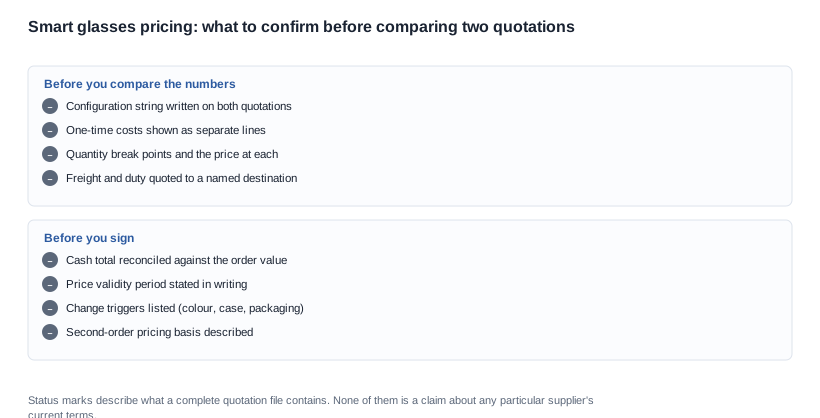
The checklist is the same eight-row template written as a set of things to confirm, in the order they should be confirmed. Nothing on it is a claim about any supplier's current terms; each line is an artefact a buyer can request in writing.

Where a quoted price stops being true
Five ways the number moves after the signature
The signed quotation freezes a configuration, a volume, a scope and a date. Everything that changes afterwards changes the price, and the changes fall into a short, predictable set.
A configuration change is the first and the most common. Swapping the L2 Utral from the 1400 mAh case to the 900 mAh case, adding the photochromic lens option to a V03 Pro, changing the colour way on a V06 from the published set to something new, or changing what sits in the box, all reopen the bill of materials. A supplier who treats a configuration change as a courtesy is telling you the quotation was a starting position.
A scope change is the second. Adding a destination market after the quotation was priced adds compliance work to a programme that was costed without it, and the marginal cost of a second market is not the same as the first one because the testing and the assessment are per product family and per market while the handover work is largely fixed.
A volume miss is the third. If the ordered quantity lands below the break the price assumed, the arithmetic reverses and the unit price rises. If it lands above the next break, the buyer has paid more per unit than required. Both are avoidable by writing the break table into the quotation with the quantity next to each price.
A supplier-side change is the fourth. A component substitution, a second-source part or a process change made inside the factory will move the cost, and whether it is passed through depends entirely on whether the quotation said what happens when it does. This is the point at which the change-notification clause in the purchase order becomes a pricing clause, because an unnotified change is a unilateral price adjustment.
A rush is the fifth and the most expensive per unit. An expedite against a quoted lead time is normally paid for in freight, in overtime and in the risk that the expedited units are the ones that were queued behind a problem.
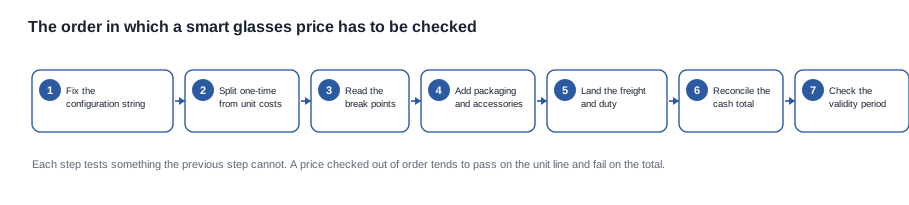
The flow is the sequence the eight rows were designed to support. Each step tests something the previous one cannot, and the order is not a preference.
What to write into the purchase order so the price holds
Four clauses do most of the work. Specify the configuration string by model code and option, not by description. Attach the break table with quantities against prices, and state which row applies at the ordered quantity. State the validity period and list what invalidates it, because a price without a validity period has no defined end. And attach the change-notification route, including the notice period and the right to re-price or reject.
Beyond those, the worth negotiating hardest is the remedy for a unilateral change, because that clause determines whether the notification route has any force. A buyer who has a change clause with no consequence has a suggestion rather than an agreement.

The commercial terms that decide the landed number
Which terms answer to volume
The unit price is the term that answers most directly to volume, and beyond it the things that amortise: packaging setup, artwork, moulded inserts and the compliance work that covers a configuration across several markets. A first order carries the whole of the amortised set spread over the smallest quantity, which is why the second order is always cheaper per unit for the same product and why a business case built on the first order's unit price will overstate the cost of the programme.
Breaks are the term where a buyer's judgement matters most, because the break table is the supplier's price as a function of volume and reading it tells you where the supplier's own cost curve sits. A break at a round number with a large step suggests a quantity that was set to be reached. A break with a small step suggests a cost that genuinely falls. Either way, the useful question is not "can you do better at five thousand" but "show me the table and tell me which quantity you would actually recommend", because a supplier who recommends the quantity that suits the programme is telling you something a price negotiation never will.
Which terms answer to the scope of the file
The compliance work is a scope, and the scope is the part worth arguing about. A file that covers one model and one market has a known cost, and a file that covers the programme and can be reused has a considerably larger one. The testing and the assessment of the model against each market are per product family and per market, so an unnecessary market in the quotation is a cost the buyer chose rather than a cost that was imposed. Asking which market in the list is actually required, and removing the ones that are not, is often worth more than arguing about any unit price on the sheet.
Tooling and artwork behave the same way. They are one-time costs that fall away on the repeat order, and their negotiability is almost entirely a function of how long the buyer intends to run the programme. A buyer who can say what the run length is has a real conversation; a buyer who cannot will be quoted the amortised cost.
The lines that keep a price intact
The terms worth putting in the agreement rather than in the negotiation are the configuration string, the break table, the validity period, the change-notification route and the remedy for a unilateral change. The terms worth negotiating in the negotiation are the break points themselves, the scope of the documentation work, the packaging setup, and the split between one-time and recurring cost.
There is one category that resists all of this. Certification itself, the testing behind it and the assessment of the model against each market are priced per family and per market, and the time they take cannot be compressed by a buyer who wants it sooner. What a buyer can do is remove the markets that are not required, consolidate the models into one file where the catalogue allows it, and start the sequence early enough that the fixed cost is not competing with the launch window. That is a planning decision rather than a pricing one, and it is the only one available on this line.
One comparison worked through, and the boundary we draw
A hypothetical buyer comparing two sheets
The scenario is a worked reasoning exercise, not a customer project, and no client, supplier or order is described. Assume a buyer is opening a programme for camera-equipped smart glasses for resale into the European Union and the United Kingdom, and has two quotations in front of them. The brief is an 8 MP model with a 1400 mAh charging case. On the published catalogue rows, that brief narrows the field to the CY03 and the CY05, both of which are published as 8 MP with a 290 mAh cell and a 1400 mAh case, and neither of which publishes a charging method. The L1 Pro has the right case but a 13 MP camera. The L2 Utral has a 13 MP camera and a case listed as 900 or 1400 mAh. The MT6 has an 8 MP camera but a 1200 mAh folding case.
The first quotation quotes a unit price, includes the case in the box, and shows a packaging setup line with no documentation scope. The second quotes a slightly higher unit price, excludes the case, and shows a documentation scope for both markets plus artwork and a moulded insert. The second sheet looks more expensive on the unit line and is cheaper on the first-order cash total, because the first quotation's setup is not the whole setup. The comparison cannot be finished until both are returned in the eight-row template, and the template is what exposes that neither sheet states the charging method, which for both shortlisted models is not published.
The programme then moves to the next stage with the difference between the two suppliers narrowed to three things: the case inclusion, the documentation scope for the second market, and the break table. The decision on the case is made on the catalogue row rather than on price, because the brief fixed the capacity. The documentation scope is priced by asking what the second market actually requires for this configuration rather than accepting a bundled figure. The break table is requested in writing, and the buyer's own volume assumption is checked against it before anything is signed.
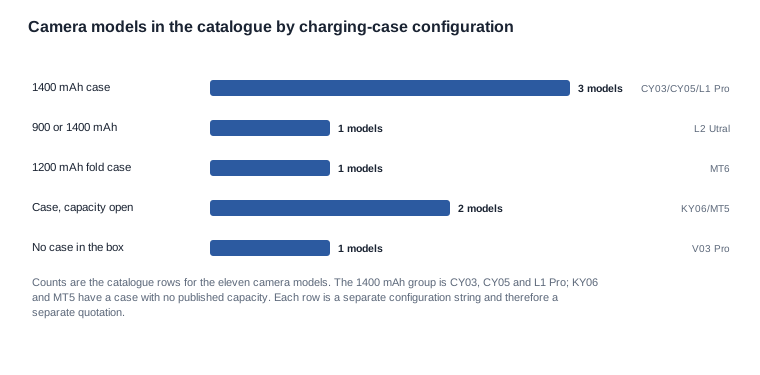
The chart is the case dimension that made the difference visible. It is the reason the case option is specified before the price is compared, and the reason a quotation that omits it cannot be compared at all.
What we publish, and what we keep inside the quotation
Stated plainly: the configuration facts are ours to publish and the commercial terms are not. We publish the electrical rows, the pixel tiers, the case capacities and the charging methods as they appear in the catalogue, because those rows decide which configurations exist and therefore which quotations can be compared. We do not publish a unit price, a tooling figure, a non-recurring cost or a price tier, because those are terms and terms belong in a quotation with a configuration, a volume and a date attached to them. We would rather tell a buyer that a price without a configuration is not a price than print one.
We also do not fill a specification gap with a typical figure from the general data. Where the catalogue is silent — and it is silent on some rows, including the charging method for four of the camera models and the Bluetooth version for the camera series — we say so and convert it into a question to put in the enquiry, which is a more useful output than an invented number.
The details that make a price comparable
Send the models you are considering, the quantity, the destination markets and the box contents you need, and we will tell you which of those configurations exist in the catalogue, which rows are open on our published data, and which questions are worth putting to every supplier in the round rather than to one.
- How the price is put together — procurement pricing
- The list version of the eight rows — pricing checklist for first order
- The errors that survive a first round — pricing common mistakes
Send the configuration, the volume and the market, and we will tell you what is fixed by the catalogue and what is still open on the quotation.


