

Smart glasses pricing mistakes that are arithmetic rather than commercial
Smart glasses pricing mistakes are mostly arithmetic, and that is good news: an arithmetic error is the cheapest kind of mistake to find and the cheapest one to fix. Eight of the mistakes buyers make in this category are made in the comparison, not in the factory and not in the negotiation. They happen when two quotations are put side by side and a number from one column is read as if it meant the same thing as a number from the other. The product is rarely the problem. The unit of measurement is.
The catalogue rows behind those comparisons are published, they are precise, and they are not comparable with one another without a stated convention. A 100 mAh cell and a 55mAh*2 cell are both cell figures. A 5~8 h runtime and a ~7 h runtime are both runtime figures. A charge time of two hours or less and a charge time of about one hour are both charge-time figures. Drop them into a column and they look like the same quantity. They are not, and the difference between them is large enough to change which supplier looks cheaper.
This article takes the eight mistakes one at a time. For each one it states the symptom you will actually see, the root cause underneath it, the catalogue row that exposes it, and the correction. It then gives a verification path that turns a corrected comparison into a record you can file, the commercial consequences if the corrections are skipped, a worked comparison, and a plain statement of what we publish about price and what we will not estimate.
We publish no unit price, no minimum order quantity, no production lead time and no tooling figure, and we will not put a number on this page to make the argument feel finished. Every figure below is either a published catalogue row or a method for comparing quotations you have already received. None of them is a price, and the distinction matters, because most of the eight mistakes happen in the space between a published specification and a commercial number.

Who signs the order and what the comparison is actually deciding
The buyer who reaches this problem is usually one of three people with one of three situations. A brand-side procurement manager is renewing an existing programme and needs to know whether a second factory is genuinely cheaper or merely quoting a different product. A channel buyer is placing a first order in a category they do not manufacture and has two supplier answers that read like the same offer. An importer is extending a range with a new model and has to decide whether the new line goes on the same bill of materials or its own.
In all three cases the decision in front of the buyer is not which product is better. It is which comparison is valid, because a comparison built on mismatched units is not a small error. It produces an order, and the order is what the mistake becomes.
The fear underneath the task is specific. A buyer in this category is not worried about a bad headphone. The fear is a shipment that arrives against a configuration nobody quoted, a delivery date that slips while the units sit finished, a documentation position that does not cover the model the buyer actually ordered, and an after-sales burden that lands on a small team with no spare capacity. Those four are the reason a pricing comparison matters more than the price does.
The supply chain explains why the comparison carries so much weight. This category is assembled, not invented: the cells, the camera module, the electronics, the optics, the housing, the case and the packaging are all sourced, and the factory's work is the assembly, the test and the pack. Two factories quoting the same model will differ in what they hold — a different cell, a different case, a different charging interface, a different firmware branch, a different level of documentation — and those differences are what the unit price is actually pricing. When a buyer compares two numbers without knowing which of those differences each number absorbed, the buyer is not comparing two products. The buyer is comparing two undisclosed configurations and calling the result a price gap.
That is why the negotiating space in this category is wider than the unit price suggests, and also why it is easy to spend that space on the wrong line. A buyer who wins a small percentage on the unit price and loses the case, the artwork, the documentation scope or the per-configuration minimum has made the programme worse, not better. The arithmetic mistakes described below are the ones that hide that outcome inside a spreadsheet, which is why they are worth correcting before the negotiation rather than after the invoice.
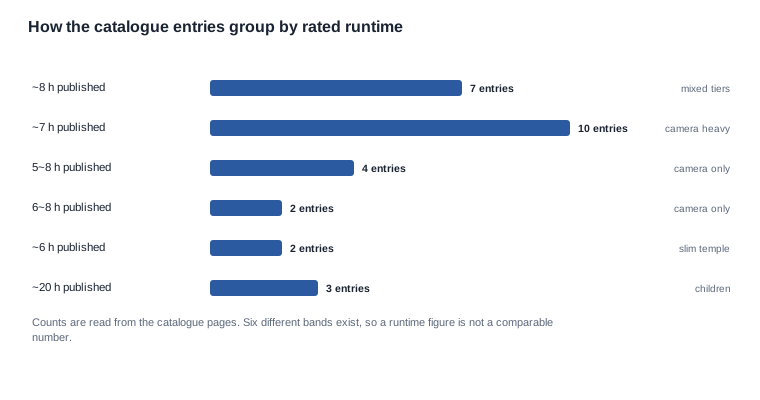
The chart above is the clearest single illustration of the problem. The catalogue publishes six different runtime bands. Three of them are written as a range, two as an approximation and one as a nominal figure for the children's lines. A buyer who writes "8 hours" in a comparison sheet has silently converted five different published statements into one, and has done it before any supplier was contacted.
Eight comparison mistakes and the catalogue row that catches each
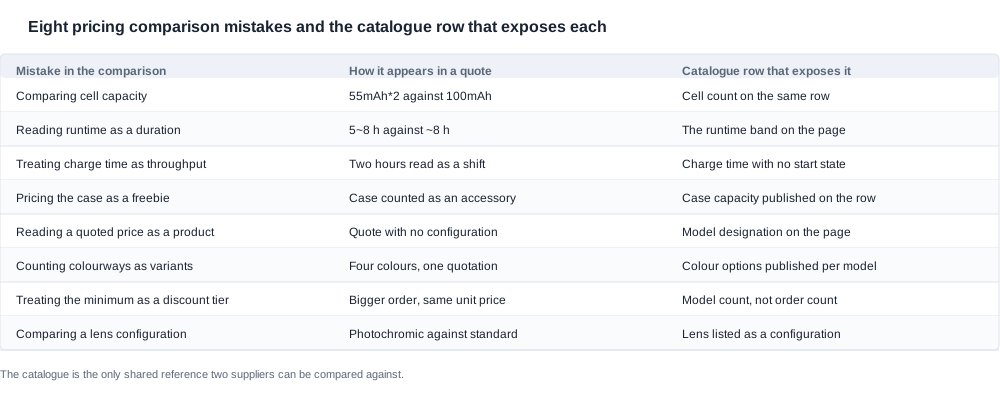
Each mistake below is written in the same shape: the symptom is what appears on the sheet, the cause is why it appeared, the catalogue row is where the truth is published, and the correction is the instruction you can give the supplier or apply yourself. The catalogue is the only reference two suppliers can be argued from, which is why it appears in every line.
Mistake one: reading a cell capacity without the cell count
The symptom is a comparison row that shows 100 mAh on one side and 110 mAh on the other, with the second side treated as the larger battery. The cause is that the catalogue publishes cell values and cell counts together, and the count is not part of the number. The rows read 100mAh for a single cell and 55mAh*2, 90mAh*2 and 70mAh*2 for paired cells. A 55mAh*2 row and a 100mAh row are two cells of 55 mAh and one cell of 100 mAh. Reading the first as 55 and the second as 100 produces a gap that does not exist.
The correction is to write the cell count next to every capacity, every time, including in a spreadsheet cell formula. If the arithmetic in the comparison is more than a single cell, the derived total has to be marked as derived, because a total that appears beside a catalogue value will be read as a catalogue value by the next person who opens the file. This is the single most common arithmetic error in this category, and it is invisible precisely because both numbers are correct in isolation.
Mistake two: reading a runtime band as a point value
The symptom is a comparison sheet where a 5~8 h row has become "6 hours" and a ~7 h row has become "7 hours", and the two are now one point apart instead of a band against a band. The cause is that a range and an approximation are different claims. The catalogue publishes a range for the V03 and the V03 Pro, for the KY06 and the S7, and the MT5 and the V06; it publishes an approximation for the L2 Utral, the CY03 and the MT6, and the L1 Pro, and the CY05, the D11, the D12, the D17, the photochromic entry and the bone conduction entry; and it publishes a nominal figure of about twenty hours for the A05, the A06 and the A07.
The correction is to copy the band exactly as published and never to convert it to a midpoint. A midpoint is a claim about typical performance that nobody made, and if a range is quoted in a comparison the supplier has to be asked what the bottom of the range corresponds to, because the bottom of the range is what the end customer experiences.
Mistake three: reading a charge time as a shift length
The symptom is a buyer scheduling a warehouse against a published charge time. The cause is that the catalogue publishes charge time for every entry, with twenty-six at two hours or less and the D17 and the ZH12 at about one hour, and it publishes those figures without a starting state and without a termination criterion. Two hours or less tells you the upper bound on a full charge. It does not tell you how long a charge from flat takes, and it does not tell you whether "complete" means full.
The correction is to treat charge time as a specification, not a schedule input. If a shift plan depends on it, the plan needs a measured figure on the actual units under the actual protocol, and that measurement belongs in the sample programme rather than in the catalogue row. The related trap is comparing a magnetic charge with a Type-C charge as if the interface were a detail: the cradle, the cable, the current, the thermal behaviour and the contact life are all different, and one of them is what your warehouse will actually touch every day.
Mistake four: leaving the charging interface out of the comparison
The symptom is a comparison that has two rows for the same model and no column explaining why the numbers differ. The cause is that the charging interface is published per model and falls into three groups. Seventeen entries publish magnetic charging, seven publish Type-C, and four — the CY03 and the L1 Pro, and the MT6 and the CY05 — publish no charging method at all, only a charging case capacity of 1400 mAh, with the MT6's case foldable at 1200 mAh.
The correction is to write the interface into the comparison and to treat an unpublished interface as an open question rather than as magnetic. Those four models are the classic source of a wrong assumption, because a cased model with a magnetic-looking presentation is easily assumed to be a magnetic-charged model. It is not established. Ask.
Mistake five: counting the charging case as a free accessory
The symptom is a landed cost model that carries the glasses unit and no case, against a supplier quotation that includes a case, followed by a conclusion that one supplier is more expensive. The cause is that a cased configuration is a second physical object in every parcel. The catalogue publishes case capacities of 900 mAh and 1400 mAh for the L2 Utral, 1400 mAh for the CY03 and the L1 Pro, and the CY05, and 1200 mAh for the foldable MT6 case. The KY06 and the MT5 have a case with no published capacity, and the V03 Pro has no case at all.
The correction is to decide whether the case is inside the order before the comparison is built, and to price the case in the unit that carries it — the freight parcel, the master carton, the retail packaging and the battery transport paperwork all change when a case is added. Comparing a cased quotation with an uncased one and calling the difference a price difference is the same category of error as comparing cells without counts.
Mistake six: reading a quoted price as a product price
The symptom is a supplier answer that looks like a final number, signed off internally, compared against another number, and then the wrong specification is ordered. The cause is that a quotation is a number attached to a configuration, a volume and a date. Change any of the three and the number moves, and the supplier is not obliged to warn you which of the three you have changed.
The correction is to require a written configuration reference on every quotation, using the model designation exactly as the catalogue prints it, and to treat an answer without one as a conversation rather than a price. This is where a catalogue entry without a model designation becomes commercially awkward: it is publishable as a product but it is hard to place on a purchase order, on a document, or on a customs description, and the buyer who wants a branded line needs a string that can be carried through all three.
Mistake seven: counting colourways as separate product variants
The symptom is an inventory plan that assumes one line, followed by four or six separate minimums once the supplier's own minimum is applied per configuration. The cause is that the catalogue publishes colour options per model — three for the V03 Pro, four for the V06, three for the S7 — and a minimum order quantity is normally a per-configuration quantity. Four colours of one model is four configurations, each with its own floor.
The correction is to count configurations, not units, before the plan is committed. The number of configurations multiplied by the per-configuration minimum is the real order size, and it is the number that determines the working capital in the programme, not the unit count that appears in the headline volume. The catalogue publishes colour options for some models and not for others — the V03 Pro carries three and the V06 carries four — and a model whose page lists no colour options is a model whose colour range still has to be established, which makes it one more configuration question and not one fewer.
Mistake eight: comparing a lens configuration with a standard one
The symptom is a supplier offering a photochromic configuration at a price close to the standard one, and a buyer who assumes the difference is small because the specification pages sit next to each other. The cause is that the catalogue publishes the V03 Pro as a camera platform with a 220 mAh cell, a five-to-eight hour runtime, Type-C charging, flexible temples, three colour options and a photochromic lens listed as a configuration. A lens option is not a colour swatch. It changes the optical description, and in a camera platform it changes the imaging description as well, and it carries its own setup and its own documentation review.
The correction is to treat any configuration that adds an optical element as a separate line in the comparison and to ask what documentation accompanies it. The same logic applies to the dedicated photochromic entry, which publishes a Bluetooth V5.4 radio, a 100 mAh cell, a seven-hour rated runtime and magnetic charging, and which publishes no model designation at all.
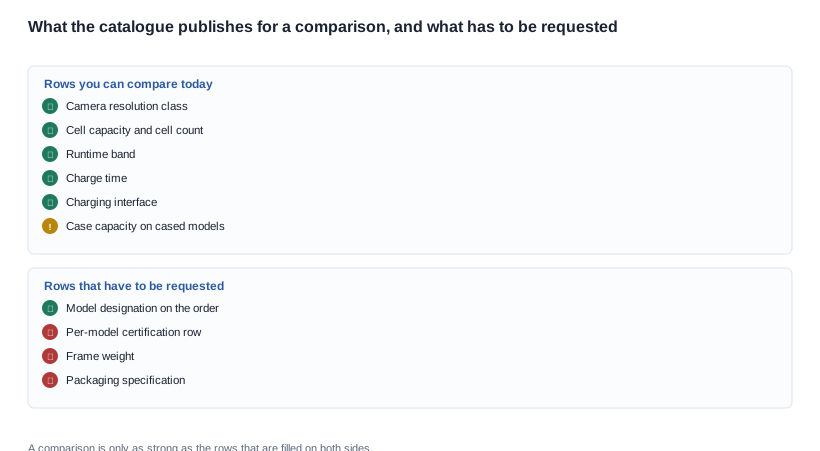
Read the checklist as a coverage map rather than a to-do list. The rows in green are the ones a comparison can be built on today, because the catalogue publishes them for the model in question. The rows in amber are published for some models and not others, and a comparison that mixes them is comparing a populated cell with a blank one. The rows in red are not published at all, and every one of them is something you have to request in writing before the comparison can be defended.
That last group deserves a note. The catalogue includes a company-level export certification page, and it does not carry a per-model certification row. It publishes no CE marking, no FCC record, no RoHS statement and no REACH statement for any model, and it publishes no patent count and no certificate numbers. Buyers in this category ask about CE, FCC and RoHS in every conversation, and the honest answer is that these are attention items to raise with a supplier, not facts to read off our pages. The same applies to frame weight: the catalogue publishes exactly one weight, 158 g for the MT6 glasses unit including its cell and camera and excluding its foldable charging case, and no other model publishes a weight at all. The warehouse weight of the MT6 case is not published. Any other frame weight you see attached to this category is an inference, and an inference is not a specification.

Turning a corrected comparison into a record you can file
The point of correcting the arithmetic is not to win an argument. It is to produce something you can file, send to finance, and show to a colleague in six months when the question is why the landed cost came out where it did. The difference between a corrected comparison and an uncorrected one is that the corrected one can be reconstructed, and an uncorrected one can only be repeated.
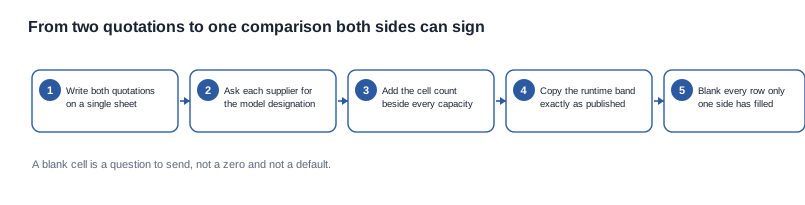
The order of operations matters, because each step assumes the previous one passed and a failure at any step tells you what the next step would have told you.
Ask both suppliers for the model designation in writing, first. Everything else is downstream of it. A designation fixes the catalogue page, which fixes the cell count, the runtime band, the interface, the case and the colour options. If a supplier cannot give you a designation that matches the catalogue, stop there; the rest of the comparison is against an undefined product.
Transcribe the catalogue rows, do not paraphrase them. Write 55mAh*2 as the catalogue writes it, write 5~8 h as the catalogue writes it, write "charging method not published" where the page has no charging row. Paraphrase is where the arithmetic errors enter, because a paraphrase is where a band becomes a midpoint and a cell count disappears.
Blank every row that only one side has filled. A blank cell is a question to send. It is not a zero, and it is not a value copied across from the other column. This is the discipline that keeps a comparison honest, and it is the one most often skipped because the sheet looks incomplete.
Resolve the blanks before the negotiation, not after. Each blank is a request, and the list of requests is short: the charging method for the four cased camera models that do not publish one, the case capacity for the KY06 and the MT5, the frame weight for every model except the MT6, the per-model certification position for every model, and the model designation for the entries that have none.
Attach a written configuration to every price on the sheet. Model designation, options, quantity, destination, validity period, and the delivery term. A price without those five is a starting point for a conversation, and treating it as an offer is the last of the eight mistakes in a different dress.
Sign the sheet as a record. A comparison that two suppliers have seen and acknowledged is a shared basis for a negotiation. A comparison that lives in one buyer's spreadsheet is a private opinion with numbers in it, and it will be re-argued at every stage.

Where a two-quotation comparison loses money commercially
The eight mistakes are arithmetic. Their consequences are commercial, and they arrive in a predictable order.
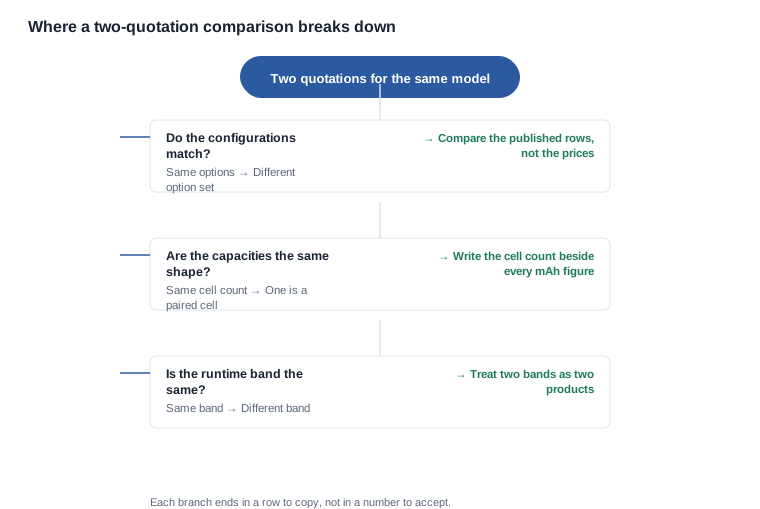
The configuration you never priced becomes the configuration you order. If the comparison did not carry the model designation, the order that follows it is made from memory, and memory is where the case, the interface and the lens option go missing. The order then arrives and it is not the order that was approved, and the first remedy is not a refund, it is a second order at a different price.
The minimum arrives as a surprise and the working capital moves. The per-configuration minimum multiplied by the number of configurations in the plan is the real order size. A plan built on a unit count alone produces an order that is either larger than the cash available or smaller than the supplier's floor, and the second one produces a lead time that is longer than the plan assumed because the configuration had to be scheduled in.
The documentation gap becomes a launch date. A per-model certification position that was never requested, applied for or attached to the order is a task that has to be completed before the goods can move in some markets. Because the catalogue does not publish per-model certification rows, this task is invisible until someone asks for it, and asking late converts a paperwork task into a schedule problem.
The margin is set on a cost model that was never true. This is the consequence that is hardest to see and the most expensive. A landed cost built on a cell comparison that was wrong, without a case, with a charge time treated as a shift length and with the colourways counted as one variant, will produce a price that looks competitive and a channel that does not. The arithmetic errors do not announce themselves. They just move the number.
That said, the negotiation is not a one-way street, and a corrected comparison gives a buyer more room rather than less. Here is what a corrected comparison lets you negotiate that a broken one does not.
The scope lines, because scope is what the price is pricing. A quotation that names a model, a cell, an interface, a case and a documentation scope can be broken into its parts and compared part by part. A quotation that names only a model cannot, and the buyer ends up negotiating the one number the supplier chose to be immovable.
The per-configuration structure. Once the configurations are counted, the commitment can be made against a configuration count rather than a unit count, which is a much stronger position than a unit commitment on an unspecified product.
The delivery term, the payment nodes and the packaging. These are not in the unit price and they are all negotiable once the configuration is written down. They are invisible while the comparison is broken, because a buyer with an invalid comparison has nothing firm enough to negotiate against.
The documentation scope, as a precondition rather than a request. A corrected comparison names the model, which lets you attach the documentation requirements to that model instead of asking generically. The ask becomes specific, the supplier's answer becomes checkable, and the buyer's leverage moves from a request to a condition.
One warning applies to all of it: a corrected comparison is still a comparison of quotations you have received, and quotations in this category are not published policy. Two suppliers can produce genuinely different numbers for a genuinely identical configuration, and the reasons can be commercial rather than technical. The correction tells you that a gap is real. It does not tell you that a gap is a margin to take.
A worked comparison, and what we publish about price
A worked comparison
The sequence below is a hypothetical case rather than a client project, and it shows the order of the steps rather than an outcome.
Assume a channel buyer placing a first order of a camera platform into three markets, holding two supplier answers. Supplier A offers a model with a 220 mAh cell, a five-to-eight hour runtime band, magnetic charging and no case, and quotes a unit price. Supplier B offers a model with a 290 mAh cell, a seven-hour rated runtime, a charging case of 1400 mAh and no published charging method, and quotes a unit price that is visibly higher.
Step one, the buyer asks for the designation on both sides. Supplier A's answer names a model whose catalogue page publishes a 220 mAh cell, magnetic charging and a five-to-eight hour band. Supplier B's answer names a model whose page publishes a 290 mAh cell, a 1400 mAh charging case and no charging method row. Both answers are now checkable against the same pages, and the buyer's spreadsheet has a product on each side rather than a claim.
Step two, the buyer transcribes the rows without paraphrasing. Supplier A's cell goes in as a single-cell figure. Supplier B's cell goes in as a single-cell figure too, because that model has one cell and a separate case; the case capacity goes into its own column and is not added to the cell. Runtime goes in as a band on one side and a rated approximation on the other, kept in their own notation. Supplier B's charging method cell is left blank, because the page has no such row.
Step three, the buyer sends one list of questions, and it is short. The charging method for Supplier B's model. The case capacity and case weight for both if a case is in scope for either. The frame weight for both. The per-model certification position for both. The model designation and the delivery term on the quotation. Two of these rows exist because the catalogue does not publish them, and the buyer would rather ask than assume.
Step four, the buyer decides the case before the comparison is closed. The channel's listing describes a product that recharges away from a wall, so a cased model is in scope and an uncased model is not, whatever the cell figures suggest. That single decision removes the largest apparent gap between the two answers, because a cased configuration carries a second object in every parcel, a different carton, a different freight weight and its own battery transport paperwork.
Step five, the buyer negotiates with the configuration written down. The comparison now names a product, an option set, a case, a documentation scope and a delivery term on each side. The negotiation is about scope and terms rather than about a headline number, which is the only form of negotiation in this category that survives a spreadsheet audit.
The result of the walk-through is not a cheaper supplier. It is a defensible decision, a shorter list of unknowns, and a schedule that has one identified precondition instead of four unowned risks. The decisive moves were all made before the deposit, and none of them involved the unit price.
What we publish, and what we will not estimate
We publish the configuration facts and the structure of the cost, and we will not print a price on a page for a product that has not been specified. We will quote against a defined configuration, show the drivers, and separate the recurring block from the non-recurring block. We will not present a quotation as published policy, and we will not publish a price list that would be wrong for most of the rows in it.
What the catalogue publishes is the model data: camera resolution class, cell capacity with its cell count, rated runtime, charging interface where the page has one, charge time, case capacity where the page has one, the IP54 marking on the V06 and the S7 only, Bluetooth version where the page has one, the colour options per model, the 158 g MT6 glasses unit weight excluding its foldable case, and the 35 dB amplification gain of the bone conduction entry. That is the whole of it.
What we do not publish, and will not estimate: minimum order quantities, unit prices, production lead times, tooling and non-recurring engineering figures, frame weights for every model except the MT6, sensor part numbers, field of view, video specifications, ingress test report numbers, certification numbers, patent counts, acoustic figures, battery transport test report identifiers, and the case weight for any model. We also publish no health, vision, eye-protection or hearing-aid efficacy claim for any product in any market, in any configuration, and a device whose function is to capture, notify and connect is not a clinical intervention. If a channel is built on a medical or eyesight claim, this is the wrong category, and we would rather say so before the sample order than after the listing copy is written.
We will also not tell you that our price is competitive, because without a published price for either side that statement is not checkable by you. What we can do is take a buyer's cost model, mark which of the eight mistakes it is exposed to, and tell you which published rows the requirement actually touches and which ones you will have to establish on your own units.
Three things to do before the next supplier call
Send the model designation request first, and require the catalogue page alongside it. Everything else in the comparison is downstream of it, and a designation without a page reference is still an unverifiable answer.
Send the eight-cell correction list as a single attachment, not as a paragraph. Model designation, cell count written out, runtime band copied as published, charging interface or an explicit statement that it is not published, case capacity or an explicit statement that it is not published, frame weight or an explicit statement that it is not published, per-model certification position, and the number of configurations in the plan. A supplier who answers all eight has a documentation habit. A supplier who answers two has told you something you need to know before the deposit.
Send us the two candidates, the configurations, the destination and the channel, and we will tell you which published rows the requirement touches. We will mark the rows the catalogue answers today, the rows that have to be requested from the supplier, and the rows that will have to come from a measurement on your own sample units. The cost structure is under procurement pricing, the first-order version is in pricing checklist for first order, and the worked sequence is in pricing case example.
Related reading
- The first-order version — pricing checklist for first order
- The worked example — pricing case example
- The shape of the cost — procurement pricing
Send us the two candidates and the configurations, and we will tell you which published rows the requirement actually touches.


