

The cost of an ingress rating is not the laboratory fee, and a buyer who models it as the laboratory fee makes the wrong trade. IP rating smart glasses cost factors is a four-stage breakdown: the smallest change that produces the rating, the change that costs real money, the variant tax nobody budgets for, and the test programme itself. The stage that surprises people is the third one, because it is paid per variant rather than per product.
Our range illustrates why this matters. The models carrying IP54 are the sport platforms V06 and S7, both on magnetic charging. Several Type-C platforms in our catalogue carry no ingress marking at all. Whether that is because the Type-C design cannot reach the same rating, or simply because nobody asked, is not stated — and that distinction is exactly what a cost conversation should establish.
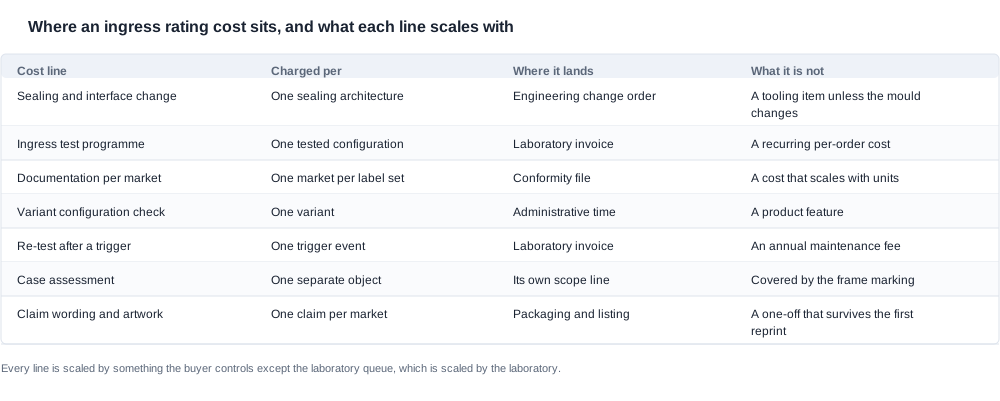
IP rating: four cost lines, one that decides
A quotation for a rated product usually arrives as one number on one line, and the one number is almost always the laboratory fee. Behind that line sit three other charges, and only one of them is fixed at the point of quotation.
The engineering line. Getting a frame from "no marking" to "a marking" is a set of design decisions — a seal line, an interface treatment, a port cover, a button seal — each of which is a tooling item, an inspection item and a validation item. This is the smallest line on the invoice and the one most often left out of the quotation entirely, because a supplier treats it as "our normal product" rather than as a change. The question that separates a supplier who has scoped the work from one who has not is simple: can they name the specific items that changed?
The test line. A laboratory fee and a queue. The fee is per configuration, and the queue is set by the laboratory rather than by your order size. Pressing on either of them does not make the product arrive faster, and a supplier who offers to accelerate the test for a larger order is offering something the laboratory sets, not the factory.
The documentation line. The declaration of conformity, the technical file, the model list, the labelling per market. In a range with several models and several markets, this is the part that quietly multiplies, because each model list is a separate question and each market is a separate label set.
The variant line. This is the one that is hardest to see and most expensive to discover. Every colour, every logo and every private-label derivative is a configuration question. If the change touches the enclosure, the seal or the interface, the marking may no longer apply — and the re-validation cost is per configuration, so it compounds with the range rather than with the order.
The line that decides the budget is the last one, and the reason is arithmetic rather than technical. The engineering line is paid once. The test line is paid once per tested configuration. The documentation line is paid once per market. The variant line is paid once per variant, and a brand that launches two colours of one model, in one market, with one logo, has three configurations to account for before anyone has counted the second market.

Why a per-configuration cost behaves like a per-variant cost
This is the mechanism that surprises buyers, so it is worth stating precisely. A rating does not attach to a product family. It attaches to a configuration: a frame, with a particular port, particular contacts, particular interfaces, in a particular material, in a particular colour. Two units that differ in any of those dimensions may not be the same rated product, even when the electronics are identical.
Now put a variant range next to that fact. A brand sells the same frame in three colours. If the colour is a paint or an anodised surface treatment, the configuration may or may not have changed — a colour that changes the surface treatment but not the joint, the seal geometry or the interface is often still the same configuration, and a competent supplier will say so. A logo that changes nothing structural is the same case. A private-label derivative that changes the temple profile, the hinge, the port or the contact arrangement is not the same configuration, and it is a separate question for the test programme.
The commercially useful way to say this is that the variant tax has two rates, and the question is which one applies. The low rate is a documentation confirmation: no hardware is touched, the supplier re-checks the configuration against the tested one and confirms in writing that the marking still applies, and the cost is administrative. The high rate is a re-validation: the tested configuration no longer covers the variant, so the variant either has to be brought back inside the covered configuration — by capping an exposed contact, by restoring the original interface — or it has to be tested separately.
The trade-off a buyer is actually making here is not between paying and not paying. It is between a narrow range and a broad one. A narrow range — one frame, one colour, one logo, one market — is cheaper to qualify and cheaper to document, and it is also the range a customer is most likely to describe as boring. A broad range costs more to qualify and produces more configurations, and each of those configurations is a place where the marking can quietly stop applying. The correct question is not "how many variants can we afford" but "which variants do we actually need in the first year", because every one of them carries a per-configuration document obligation that does not expire when the colour is discontinued.
When to add a variant. Before the first order is placed, every colour, logo, packaging derivative and market that will ship inside the qualification window belongs in the configuration list, even if the engineering team regards it as cosmetic. Adding it later is possible, and the cost of adding it later is a re-validation plus a schedule re-plan, which is why the number of configurations in the quotation is worth arguing about with the same attention as the unit price.
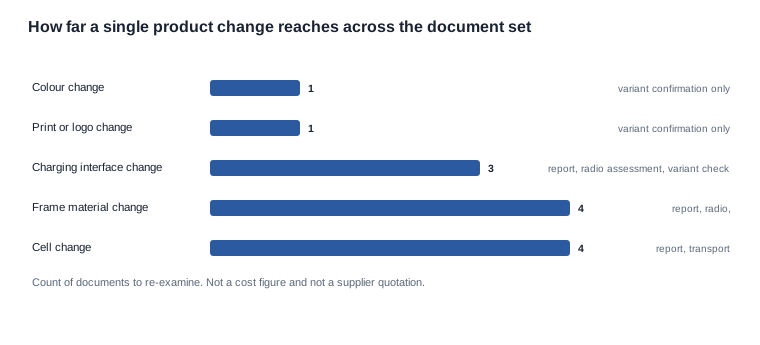
The chart above counts how many items in the document set each kind of change reaches. It is not a cost figure and it is not a supplier quotation, but it makes the compounding visible: a colour change touches one confirmation, a frame material change touches the test report, the radio assessment, the substance declaration and the variant confirmation together. The second kind of change is the one that turns a four-variant programme into a four-variant programme with four re-validation questions attached to it.
The practical consequence for a buyer is that the variant count has to be known before the quotation is requested, not after it is accepted. A supplier who prices "one model, one test" is quoting the cheapest possible variant count. If the launch plan has three colours and two markets, the honest quote is built on six configurations, and any quotation that does not mention the configuration count has not priced the thing that dominates it.
The quotation request that turns a lump sum into a cost model
A cost model is not a bigger quotation. It is the same quotation decomposed into named lines that are scaled by something the buyer controls. Here is the request, in the order that produces usable answers.
Ask for the change list before the fee. Seal, interface, port, button, material — the specific items that have to change to reach the level being quoted. The answer tells you whether you are buying a seal change or a platform change, and those are two different conversations about the product. "Minor redesign" is not an answer; it is a sign that the work has not been scoped, and a scoped version of the same supplier will give you the item list in a second email.
Ask which configurations the marking covers. A list per configuration, not per family. "All our models" is the answer that leaves the cost model incomplete, because the number of configurations drives the re-test exposure and the documentation volume.
Ask for the test programme and its own cost. The standard, the edition, the number of samples, the laboratory and the lead time. These are separate items, and a supplier who bundles them into one line has hidden which one is which.
Ask for the variant policy as a rule, not a price. A rule — "if the change does not touch the enclosure, the seal or the interface, the marking carries over and we confirm it in writing" — is cheaper and more durable than a per-variant price, because it keeps working when the range changes after the first order.
Ask for the re-test trigger and its price. What specific change forces a re-validation, and what does it cost. A supplier who cannot name the trigger is telling you the answer will be "it depends", which means the cost is unbounded and the programme carries an open risk.
Ask which parts were tested. The product as sold, or the electronics bare, changes the answer considerably and is the single most useful question in the list. A rating established on a bare board tells you about the board.
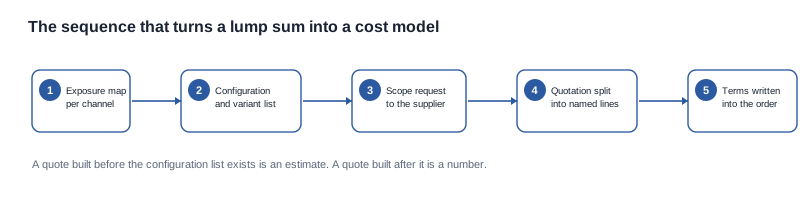
The sequence matters more than the individual questions. Exposure first, because the level follows the exposure and the level sets the engineering. Configuration list second, because it sets the count on every line that follows. Scope request third, because it is what makes the supplier quote against your configuration rather than against their catalogue. Quotation split fourth, because only then is there something to compare. Terms written into the order last, because a criterion that lives in an email is not binding and a criterion in the purchase order is an acceptance standard.
Twelve questions to put to a supplier before you accept a rating quotation
These are the questions to ask, in this order, in one message. A supplier who answers all twelve has a documentation habit; one who answers four is telling you something you need to know before the deposit, not after it.
- Which specific items change to reach the quoted level — seal, interface, port, button, material?
- Is the change a new mould or an existing mould with a different insert?
- Which configurations does the quoted marking cover, listed one by one?
- Does a change of colour, print or logo alter the covered configuration in your assessment?
- Which parts were tested: the product as sold, or the electronics bare?
- Which ports, contacts and interfaces were fitted on the tested sample?
- What standard and which edition was the test made to, and which clause applies?
- Which laboratory performed the test, and what is the queue time for the slot?
- How many samples does the programme consume, and who owns them afterwards?
- What document set will we receive, and in what form, at what point in the schedule?
- Which changes trigger a re-validation, and what does a re-validation cost?
- For each market we intend to sell in, which label and instruction set applies?
The reason the list is ordered this way is that the first six questions determine the shape of the cost and the last six determine whether the cost holds. A buyer who asks questions six through twelve first will get precise answers to the wrong part of the problem.
What to do with the answers. Score them against a single rule: every answer must name an item, a document or a date. An answer that names none of those three is a marketing answer, and marketing answers do not get into the cost model, however plausible they sound.

The re-test trigger: the term that decides whether the number holds
Most cost models survive contact with reality. The ones that do not all break in the same place, and it is worth naming that place because it is a contractual term rather than a technical one.
The trigger is the sentence that says which changes invalidate the rating. Without it, a component substitution, a supplier's "equivalent" part, or a switch to a different seal material can happen mid-programme and be classified as a purchasing decision rather than an engineering change. The rating then quietly stops covering the product, and the cost of finding out is a re-validation, a reprint and a returns cluster, none of which was in the budget.
There are three ways to write the trigger, and they are not equal in strength.
- The narrow version names specific items — seal, port, contact, interface, material — and requires notice before any of them changes. It is easy to administer because a procurement team can recognise those items on an incoming purchase order.
- The broad version requires notice before any change that could affect the ingress performance. It is safer, and it is close to unusable, because every supplier proposes changes somewhere in the programme and the clause then fires constantly.
- The outcome version puts the burden where it belongs: the supplier confirms in writing, per variant and per production lot, that the shipped configuration remains within the covered configuration list. It requires more administration on the supplier, and it is the version that actually holds.
The right answer is usually the narrow version plus the outcome version, which is also how a competent buyer frames it: name the items so the procurement team can spot them, and require the confirmation so the engineering change is caught even when it is disguised as a purchase order change.
There is a related commercial point about where the cost of a triggered re-validation sits. If the trigger fires because the supplier changed something, the cost is the supplier's. If it fires because the buyer asked for a colour, a logo or a market that was not in the original scope, the cost is shared, and the share should be agreed before the trigger is written rather than after it fires. A trigger clause with an unstated cost allocation is a clause that will be argued about at exactly the moment the programme is least able to absorb a delay.
The red flags in a trigger clause. Four patterns show up repeatedly, and each one is worth naming because each one hides an unbounded cost behind a comfortable sentence.
- The clause lists only major changes, leaving the supplier a definition of major.
- The clause covers the seal and the port but not the material, so a material swap passes under it.
- The clause requires notice but assigns no cost, so the cost falls to be argued rather than to be paid.
- The clause covers the change but not the model list, so a change that preserves the configuration still invalidates the document.
Signs that a supplier's cost model is a number with a scope problem. Three symptoms cover most cases: a quotation that will not be broken into lines, a variant policy expressed as "it is the same product", and a total cost that is materially lower than the second supplier's without any line that explains the difference. In each case the difference is usually the configuration count, and the fix is the same — a request for the covered-configuration list, sent before the purchase order rather than after it.
Before you order, the practical test is simple. Take the quotation and the configuration list side by side and check that every line scales by something you can count. If a line scales by "it depends", it is not a line yet, and the total is not a price.

Costing a three-configuration sport line from the catalogue rows we publish
The scenario below is assembled rather than reported. No client sits behind it and no qualification we have carried out produced it; it is built from the catalogue rows we publish so that the four cost lines can be counted in the order they actually occur.
Assume a mid-size outdoor brand that wants to sell into three markets, with one frame in three colours, one of which carries a private-label logo for a retail partner. The brand already holds a marking on a comparable sport platform and wants to know what the second platform costs to bring into line.
Step one: the exposure. The brand's customers sweat on the temples, ride in rain and carry the product in a dusty bag on a rack. That is a splash-and-dust exposure. The brand's channel does not include swimming, washing down with a pressure washer, or marine use, so the higher water levels are out of scope — and saying that explicitly is what stops the programme buying an expensive level it will not use.
Step two: the configuration count. Three colours, one logo derivative, three markets. The brand asks the supplier to state, in writing, which of those six combinations are separate configurations and which are not. The answer is that the three colours of the standard frame are one configuration, because colour does not touch the joint or the interface, and that the private-label derivative is a second configuration, because the logo placement changes the temple treatment. Two configurations, three markets, six label sets.
Step three: the quote request. The brand asks for the change list, the covered-configuration list, the test programme, the variant rule, the re-test trigger and its price, in one message. The supplier's reply is a quotation with six named lines rather than one lump sum, which means the brand can see where the money is and can compare the lines with a second supplier instead of comparing the totals.
Step four: the trigger. The brand writes the narrow trigger — seal, port, contact, interface, material — plus the per-lot confirmation, and agrees in advance that a buyer-initiated addition outside the original scope is a shared cost while a supplier-initiated component change is the supplier's.
Step five: the schedule. The brand's timeline has the qualification in the middle and the season stock at the end, and the laboratory queue is the only duration nobody in the chain can shorten. The brand therefore asks the supplier for the earliest sample slot at the point of quotation, rather than after the artwork is approved.
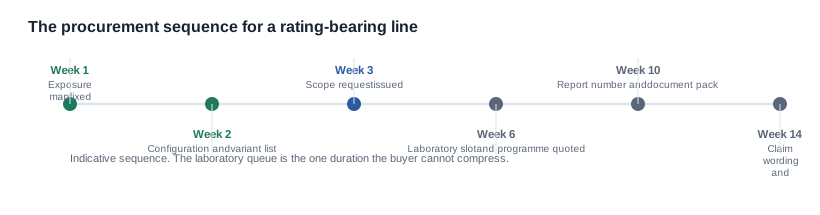
The result is a cost model with two configurations and three markets, not a number. The decisive decisions were all made before the quotation was requested, and none of them was about the laboratory fee.
What our catalogue will and will not put a number against
We publish the markings we hold and the absences we hold, because a buyer who checks a claim should be able to check ours first.
In our catalogue the IP54 marking appears on the V06 and the S7, as an annotation. We publish no third-party test report number, no standard, no test condition, no sample size and no laboratory behind it, because the company has not confirmed them. No other model in the range carries a published ingress marking, and no charging case in the range carries one either. The catalogue publishes a weight for exactly one model: 158 g for the MT6 glasses body, which includes its battery and camera and excludes the foldable charging case. The charging case holds 1200 mAh and its own weight is not published.
We do not publish the cost of reaching any level, and the reason is not secrecy. A cost figure without a scope, a configuration list and a variant policy is a number that cannot be compared with another supplier's, because it does not say what is included. A buyer comparing two quotations line by line will catch a difference in scope; a buyer comparing two totals will not, and will usually conclude that the cheaper quote is the better one.
What we can do is tell you which rows of the catalogue are shared across the range and which genuinely vary, help you build the configuration list that makes a cost model real, and tell you which of our models already carry a marking. Send us the variants, the target level and the markets, and we will tell you which lines the cost actually sits in. The background is under IP ratings and durability, the upgrade side is in IP rating upgrade considerations, the customisation route is OEM and ODM customisation, the misconceptions are in IP rating myths, and the sample route is sample evaluation.
Where the cost model comes from
Send us the variants and the target level and we will tell you which lines the cost actually sits in.


