

If you have never worked with an ingress protection code before, this article is for you. The subject is smaller than it looks. There are two digits, each describing a different hazard, and the whole system exists to replace a marketing argument with a measured result. What takes the effort is not the code itself but the gap between it and the words people use around it, and this guide is mostly about that gap. It is written for a buyer who has to put a marking on a box and defend it.
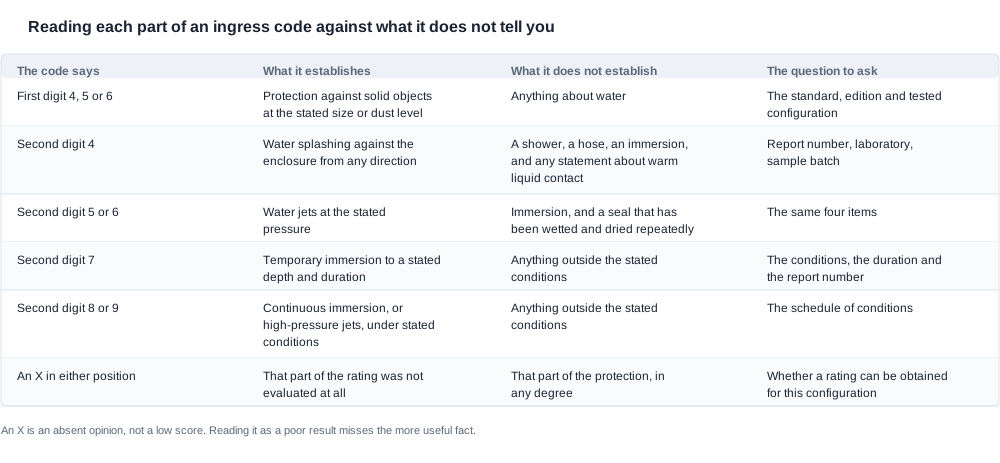
IP rating: two characters, two hazards, and X
Three readers of the same code, and what each one needs
A buyer new to the category needs to know what the two characters mean, what an X means, and which of the two digits a competitor's marking is actually talking about.
A procurement manager needs to know the same thing, plus the question to ask so the code becomes evidence rather than a label.
A channel buyer needs to know which words the code supports and which it does not, because the words are what ends up on the box.
The two digits
The code is written as the letters IP followed by two characters. The first character rates protection against solid objects, and the second rates protection against water. The letters IP are the international standard for the enclosure protection code, and the scale for each digit runs from 0 to 6 for solids and 0 to 9 for water.
A letter X in either position means that part of the code was not evaluated. This is worth pausing on, because it is not a low score. It is an absent opinion, and a product with X in the water position has no tested water protection of any kind.
The first digit, in plain terms. A 4 in the first position means that objects larger than 1.0 millimetre cannot get in, which is what keeps a finger away from the electronics. A 5 means limited dust ingress is permitted — enough dust may enter to interfere with operation in a severe environment, but not enough to impair safety. A 6 is dust tight, and it is the top of the scale.
The second digit, in plain terms. A 4 means protection against splashing water from any direction, which is the condition most products in this category are tested to. A 5 adds low-pressure water jets. A 6 covers powerful water jets. A 7 covers immersion to one metre for thirty minutes. An 8 and a 9 cover continuous immersion and high-pressure, high-temperature jets.
The one to remember is the difference between 4 and 7, because that is where the commercial damage happens. A splash rating and an immersion rating are not two points on a scale; they are two different experiments with two different fixtures, two different seals and two different engineering demands.
What each digit does and does not establish
| The code says | What it actually establishes | What it does not establish | The question to ask |
|---|---|---|---|
| A first digit of 4, 5 or 6 | That solids larger than the specified size cannot enter the enclosure, at the tested dust type | Nothing about water | The standard applied, and the tested configuration |
| A second digit of 4 | That the product withstands water splashing from any direction, under the test conditions | It is not a shower rating, not a hose rating and not an immersion rating, and it says nothing about sustained liquid contact at temperature — which is what sweat is | The report number, the laboratory and the sample batch |
| A second digit of 5 or 6 | That the product withstands water jets at the stated pressure | Nothing about immersion, and nothing about a seal that has been wetted and dried repeatedly | The same four items |
| A second digit of 7 | Temporary immersion to a stated depth and duration | The stated conditions and the stated duration are the whole claim — a marking without them is incomplete | The conditions, the duration and the report number |
| A second digit of 8 or 9 | Continuous immersion or high-pressure jets, under stated conditions | Nothing beyond the stated conditions, which are in the marking's own schedule | The schedule of conditions |
| An X in the first position | That solids protection was not evaluated | Nothing about solids at all | Whether a rating can be obtained for the configuration |
| An X in the second position | That water protection was not evaluated — an absent opinion rather than a low score | Nothing about water at all | Whether a rating can be obtained for the configuration |
Where our own catalogue stands on the code
Two models in our range carry an ingress marking — the V06 and the S7 — both annotated IP54 with no third-party test report number published. Every other model in the range publishes no ingress marking at all, and no charging case in the range carries a marking. The IP ratings explained page covers the standard and the ingress glossary covers the vocabulary, the how the protection works page covers the mechanism, and the sport smart glasses range page lists the models and their published rows.
The four report items that turn a marking into a specification
This is the part of the subject that matters commercially, and it is a list of four items rather than a body of theory. A marking on a catalogue page tells you that a supplier says the product carries that code. A document tells you what was tested, on what, and under which configuration. Only the second kind can carry a claim on a product page that survives a question from a retailer, a reviewer or a customer.
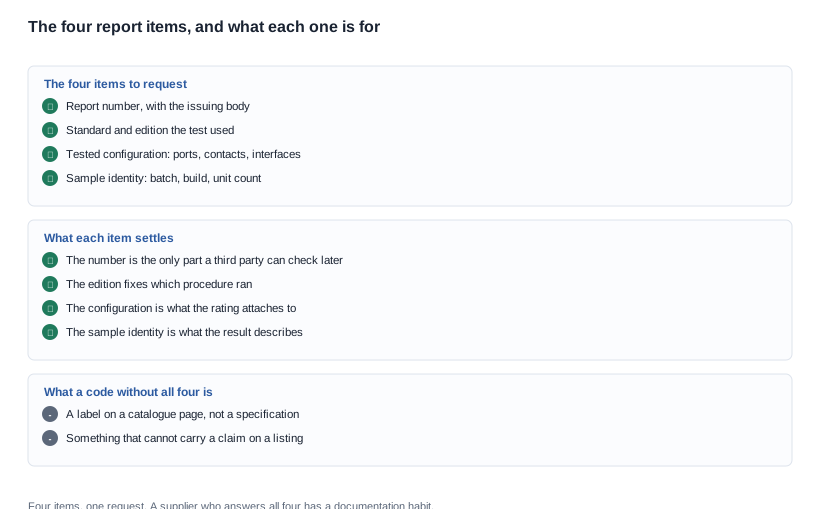
The report number. This is the only part of a compliance document that a broker, a marketplace, a customs inspection or your own compliance team can resolve later. Ask for the list of numbers, with the issuing body and the validity dates, in the body of the email, before the first sample ships.
The standard and the edition. The edition matters because procedures are revised, and a rating established under one edition is not automatically a rating under another. A supplier who names the standard but not the edition has given you half of what you asked for.
The tested configuration. Which ports, contacts and interfaces were fitted on the sample when the test was made. This is the item beginners skip, and it is the item that determines whether the marking covers the unit in your packaging.
The sample identity. The batch, the build and the number of units tested. A result describes the samples it was made on, and knowing which samples lets you trace a later question back to a specific build rather than to a year of production.
How to ask. One request, four items, sent in writing, before the sample order. A supplier who answers all four has a documentation habit, and that habit is worth more to a buyer than any number in their price list. A supplier who answers one is telling you something you need to know before the deposit rather than after the shipment.
A first-call list, written out. A beginner should not improvise this list in the first call, because the order of the questions is what makes the answers comparable between suppliers.
- What is the report number, and which body issued it?
- What are the validity dates on that report?
- Which standard and which edition was the test made to?
- Which clause of that standard applies to this level?
- Which configuration was on the tested sample — ports, contacts, interfaces?
- Was the article under test the finished product, or the electronics alone?
- How many samples were used, and what batch and build were they from?
- Does the model list on the report contain the exact model designation I would order?
- Which change to the product would invalidate the report?
- What document set will I receive, and when?
Those ten questions are not equal in weight. Questions one and five are the two that change the commercial position of the product, and they are the two a supplier is most likely to answer obliquely on a first call. Questions three and four are the ones that let your own compliance team check the answer later, and they are the ones that cost nothing to request.
What to do with the answers. Confirm the model designation on the document against the model you are ordering, character by character. Confirm the validity date has not passed. Confirm the configuration list against the unit you have in front of you. A mismatch on the model designation is a stop condition rather than a query, and the questions to ask at that point are which model the report does cover and whether the report can be re-issued against yours.
The cost of getting this wrong. A specification you cannot defend is not a specification, and the total cost of an undefendable ingress claim is not the laboratory fee — it is the reprint, the returns cluster, the marketplace listing suspension and the compliance correspondence that follows. That total cost is the number to set against the cost of doing the qualification properly, and it is the reason the four items are worth an email.
Reading a competitor's datasheet without copying its claims
A beginner's first real task is usually not buying anything — it is reading a competitor's specification sheet, and a technical buyer who has never seen an ingress code before can be badly misled by a page that is internally consistent and commercially overstated.
What a datasheet usually shows. A two-character code, often in a table of specifications, often in the same font and weight as a runtime figure or a weight figure. Nothing on the page tells you whether the code was tested, who tested it, or on what configuration. The code is presented as an attribute of the product, and the temptation is to treat it as one.
What the same code means in three different documents. In a laboratory report it is a result with conditions attached. In a catalogue it is an assertion about a product. In a listing written by a marketing team it is whatever the reader infers. The three are not interchangeable, and the gap between the first and the third is where the returns and the complaints live.
The comparison that is fair. When you compare two products on their ingress position, compare the failure mode each one leaves open, not the digits. A splash-rated product in a channel where products are regularly soaked is a returns line. An immersion-rated product in a dry channel is a cost on the bill of materials. And a product with no marking and honest copy is a defensible commercial position rather than a weak one.
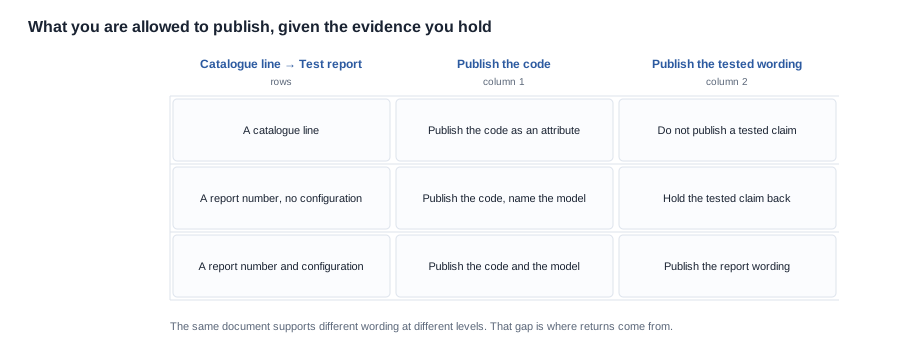
The matrix above is the whole publishing question. It has three rows — a catalogue line, a report number without a configuration, and a report number with a configuration — and two columns, one for what you may say at the level of the code and one for what you may say at the level of a tested claim. The same document supports different wording at different levels, and that gap is the thing that catches a brand out six months after launch.
The copy to avoid. "Waterproof" on the strength of a splash code. "Rain-ready", "sweatproof", "swimming safe", "shower-proof" — none of which a splash code supports. A code with no report number is also a code you cannot describe as "tested", "certified" or "verified".
Where a beginner's reading goes wrong, and what it costs
Six errors account for most of the trouble, and each one is cheap to prevent at the quotation stage and expensive to prevent after launch.
"Waterproof" was read into a 4. Symptom: a customer in sustained rain returns the product, and the return reason is recorded as "not as described" rather than as a defect. Root cause: a splash rating was read as a general one. Prevention: publish the digit, then publish the sentence the digit means, and put the exclusions next to it.
The two digits were read as one number. Symptom: a dust rating is quoted in a sales conversation as though it were a water rating. Root cause: the code was read as a single scale. Prevention: compare each digit separately, and use the IPX4 example — a device marked IPX4 is not less dust-proof than one marked IP54; it is simply not rated for dust, which is a different statement entirely.
An X was read as a low score. Symptom: a product treated as having some protection when it has none. Root cause: an absent evaluation was read as a failed one. Prevention: remember that X is an absent opinion, and that nobody has an opinion about that half of the product.
The marking was carried across from another model. Symptom: a claim on a product with no marking. Root cause: a family-level inference. Prevention: check the specific model's row, and check the document's model list against the unit in your hand.
The case inherited the frame's rating. Symptom: water in the case, and a claim against the brand that nobody can answer because the case was never a separate question. Root cause: a separate enclosure was assumed to inherit a rating. Prevention: ask about the case separately, every time, and decide explicitly whether it carries any claim.
The rating was treated as permanent. Symptom: a product that passed at launch fails in month twelve, and the returns team has no framework for the failure. Root cause: seal ageing is not captured by an ingress test, and the code describes the product as it left the factory. Prevention: ask the seal question — material, replaceability, expected service life — and test repeated wetting and drying on a sample rather than a single splash.
The general lesson. Every one of these six is a reading error rather than a manufacturing error, and every one of them is detected by a document request that costs an email. That is the reason this guide spends more space on paperwork than on physics.

Your first week: the order to do things in
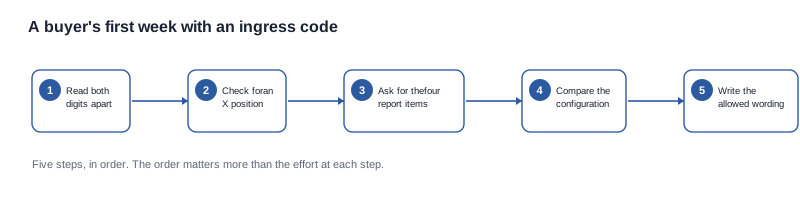
On day one, read both digits apart. Take any marking in your range, your competitor set or your inbox and write out what each character means separately. Note where an X appears. You are building a reference you will use every week, and an hour of this saves an argument later.
On day two, write the exposure. One line per channel: what the product meets, for how long, and what happens after. If a line reads "occasionally, in the rain", you have a splash case. If it reads "under a pressure washer", you do not, and the codes are not comparable.
On day three, request the four report items. One message, same format, to every supplier. Report number with the issuing body, standard and edition, tested configuration, sample identity.
On day four, compare configurations against units. Take the ports, contacts and interfaces from each document and check them against the sample you hold. Where a charging contact is exposed on the shipped unit and was capped on the tested sample, the marking does not cover the product in your packaging.
On day five, write the wording. The sentence that will appear on the box, the sentence that will appear in the file, and the sentence that will appear in the purchase order. Three documents, one wording. The exclusions go next to the claim, not in a footnote.
Then keep it. A rating has a shelf life as a claim, because the configuration behind it can change while the marking stays on the page. Putting the configuration check into the change control procedure is what stops that from happening silently.
The two trade-offs you are actually making in week one. The first is between breadth and evidence: a broad range with thin documentation is easier to launch and harder to defend. The second is between speed and defensibility: a launch that precedes the document request is faster and creates a claim that has to be withdrawn later, and withdrawal is more expensive than delay. Neither trade-off has a free answer, and both are easier to reason about when the criteria are written before the purchase order rather than after the shipment.
A short checklist to run before you commit to a supplier. Four lines, and every one of them is a question that has a document behind the answer.
- Is the report number resolvable, and does the model on it match what I am ordering?
- Does the tested configuration match the unit in my hand, port by port and contact by contact?
- Is the case inside the claim or outside it, in writing?
- What wording does this evidence support, and what am I deleting from the listing?
When those four are answered, the remaining work is ordinary procurement. When they are not, no amount of price negotiation will fix the position the buyer is in.
What we publish for a buyer who has never seen an ingress code
The code is simple and the vocabulary around it is not, and a buyer who asks the four report items ends up with a specification while a buyer who reads the phrase ends up with a liability. We will not publish a test report number, a standard, a tested configuration or a seal material that the documentation does not contain, and we will not extend one model's marking to another or to any charging case.
Concretely, and in the order a beginner will need it: in our catalogue the IP54 marking appears on the V06 and the S7 as an annotation, and no other model carries a published ingress marking. No charging case in the range carries one either. The unit weight is published for exactly one model in the whole catalogue — 158 g for the MT6 glasses body, excluding its foldable charging case — and we publish no capacity, no minimum order quantity and no lead time, because we would rather show an empty field than a plausible-looking one.
Our contribution to that is the two digits, the meaning of X, the four report items and the one test that closes the configuration question. The IP ratings explained page covers the standard, and the sport smart glasses range page lists the models and their published rows.
Related reading
- The standard, the vocabulary and the mechanism — IP ratings explained
- The range model by model — sport smart glasses range
Give us the models, the environment and the destination markets, and we will tell you which markings are published and what evidence they need.


