

An ingress protection rating is the most widely over-interpreted number in this product category, and the over-interpretation happens at the point of sale, where a buyer who has been told a product is IP54 waterproof ships it into a downpour and it fails. The rating is not a marketing adjective, it is a laboratory result, and the gap between what it means and what buyers assume it means is the subject of this article.
The short version: a code with a solids position of 5 and a water position of 4 is a dust-protected and splash-protected marking. It is not a waterproof marking, and the difference is not a technicality you discover later — it is the difference between a claim your channel can defend and a claim your channel will test on your behalf. But there is a second, more useful thing this article does, which is to work backwards from the environment: name the environment a product actually lives in, map it to the water step that addresses it, and then decide whether the marking you have quoted is the right one.
For the marking in our catalogue, on the V06 and the S7, the code is IP54. That is the published position, and it is a modest one. Nothing in this article changes it.
IP rating performance: a laboratory result, an environment
The short answer, and the two questions that decide the buy
The over-interpretation is a substitution error: a buyer treats a code as though it were an adjective, and an adjective is resolved by interpretation while a code is resolved by a test report. So the practical method is not to argue about the meaning of IP54 but to convert the channel into an environment, map the environment onto the water step that addresses it, and check the marking against that mapping.
Two questions do the work. The first is what the product actually meets in service — not what it might meet, but what it does meet on an ordinary day in the channel. The second is what the customer will do after the water arrives, because the handling step is where the failure usually occurs. A product that meets splash and is then dried properly performs well; a product that meets splash and is charged while wet does not, and the second outcome is not a rating failure.
The IP code itself comes from IEC 60529 and has two independent parts. The first position rates protection against solid foreign objects, the second against water, and a letter X in either position means that position was not evaluated at all, which is why a code such as IPX7 is a water rating with no dust opinion attached to it.
For our published marking, the first position of 5 means the enclosure limits the ingress of dust, with dust protected against anything larger than a certain size under test conditions, and the second position of 4 means protection against water splashed against the enclosure from any direction. That is the definition, and it is the whole of the definition.
The buyer who needs to know where the boundary sits
The buyer who benefits from this is usually a channel buyer or a brand product manager who has just been asked by a customer whether the product is suitable for their environment, and who does not want to answer with a marketing adjective. The useful output is not the code — the buyer already has the code — but the sentence that says which of the customer's environments the code does and does not answer.
That sentence is worth having in writing, because it converts a support conversation into a lookup. And it is worth having before launch, because the version you can publish before launch is a line on a product page, and the version you need afterwards is a support script that has to be written under time pressure and then applied to a customer who has already bought the product.
The three misreadings the environment mapping is meant to prevent
A rating treated as a durability claim. In this category the failures reported through channels are more often wear and drop than water, and the code says nothing about either. A retailer whose product fails at a hinge will not be reassured by an ingress marking.
A rating quoted for the charging case. A closed, unused case adds nothing to the rating of the unit inside it, and a case that has been closed in a wet bag has not protected anything by virtue of being closed. No charging case in our range carries a published rating.
A rating presented as permanent. The marking describes the unit as it left the factory. Seals compress, elastomers age at different rates from the surrounding housing, and a replaceable nose pad or temple tip fitted by the customer can introduce a path the original build did not have.

Mapping a service environment onto the four water steps
The four water steps, stated as behaviours rather than as digits
A code is only usable if the buyer can translate it into a behaviour, and the translation is short. A second position of 4 is protection against splashing water from any direction: droplets, spray and sweat arriving from any angle, with no sustained pressure and no submergence. A 5 is water jets from any direction. A 6 is powerful water jets. A 7 is temporary immersion to a stated depth for a stated duration, commonly quoted as one metre for thirty minutes. An 8 is continuous immersion under agreed conditions, and a 9 is high-pressure, high-temperature jets.
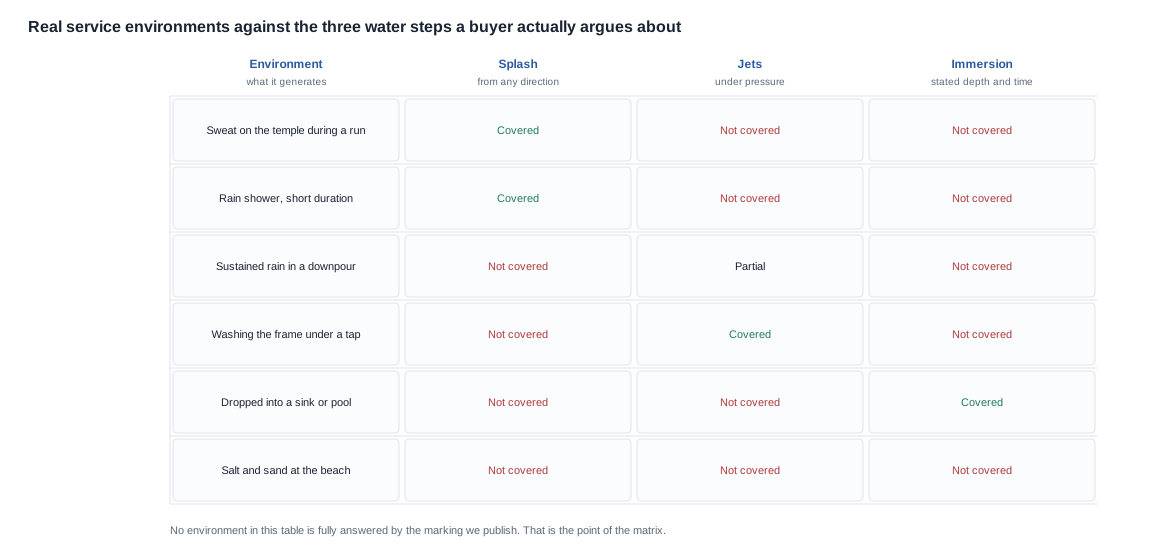
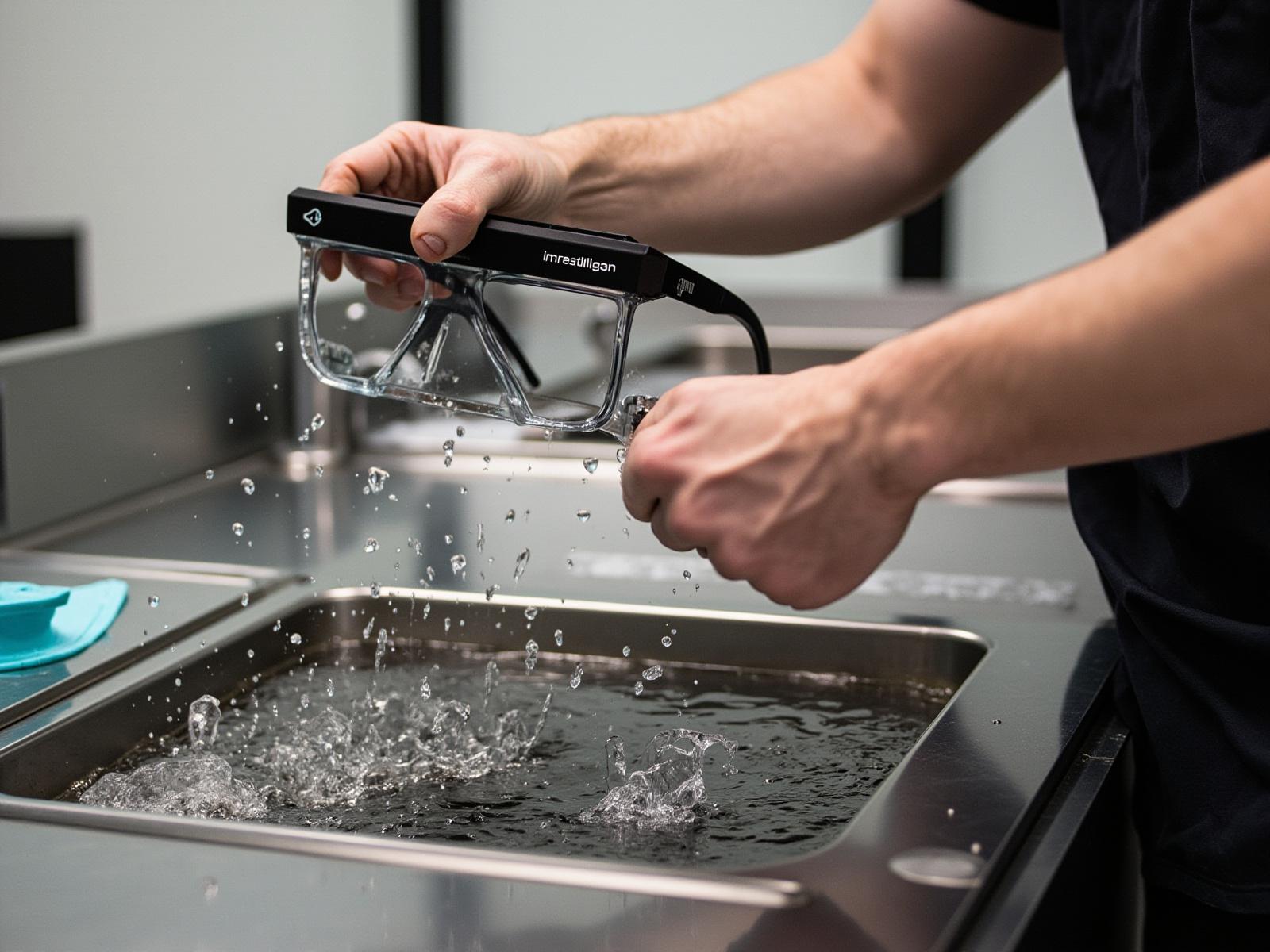
The four steps buyers actually argue about are 4, 5 and 7, and they are not equally relevant to a wearable channel. Step 4 covers the ordinary case. Step 5 covers the case where a customer rinses the frame under a tap, which is common in a kitchen or a bathroom and rare in the outdoor channel. Step 7 covers immersion, which is rare in most channels and central in one — a swimming pool, a marina, a boat.
What no water step covers, at any level, is salt and sand. A beach channel and a poolside channel both generate exposures that are erosive and abrasive rather than simply wet, and those are governed by separate ageing standards that a buyer should ask about as a distinct question rather than assuming that a higher water step implies them.
The scenarios a buyer will actually be asked about
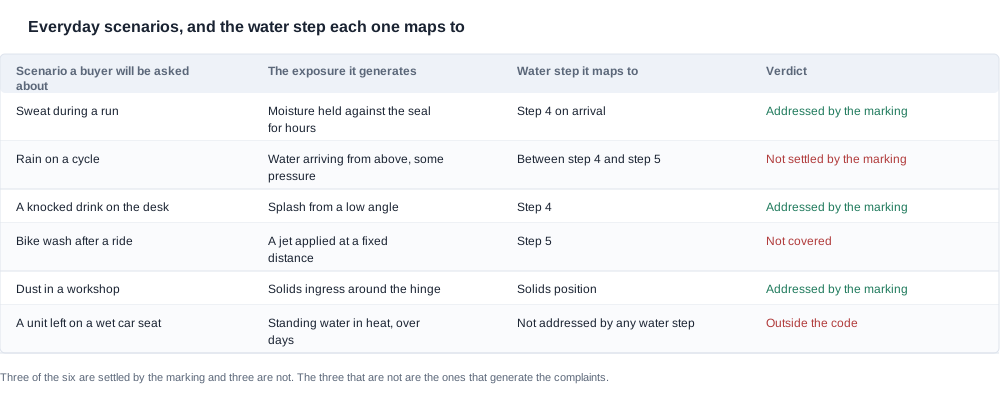
The table below is the set of questions a customer asks, mapped onto the exposure each one generates and onto the step that addresses it. It is the version of the answer that goes into a support script.
| Scenario a buyer will be asked about | The exposure it generates | The water step it maps to | Verdict |
|---|---|---|---|
| Sweat during a run | Moisture held against the seal for hours | Step 4 on arrival | Addressed by the marking |
| Rain on a cycle | Water arriving from above, with some pressure | Between step 4 and step 5 | Not settled by the marking |
| A knocked drink on the desk | Splash from a low angle | Step 4 | Addressed by the marking |
| Washing the frame under a tap | A jet applied at a fixed distance | Step 5 | Not covered |
| Dust and grit around a hinge | Solids ingress, at the solids position | Solids position 5 | Addressed by the marking |
| A unit left on a wet car seat | Standing water in heat, over days | Not addressed by any water step | Outside the code |
Three of the six are settled by the marking and three are not. That ratio is the single most useful number in this article, because it tells a buyer that a splash-rated product answers the majority of the questions their channel will ask, and identifies precisely which questions it does not answer.
The one that surprises people is the wet car seat. It is not an immersion case in any technical sense — the product is not submerged — but it combines standing water with sustained heat over days, which is a seal ageing condition rather than an ingress condition. No water step addresses it, and the only answer is a care instruction telling the customer not to leave the product in a vehicle.
The decision that comes out of the mapping
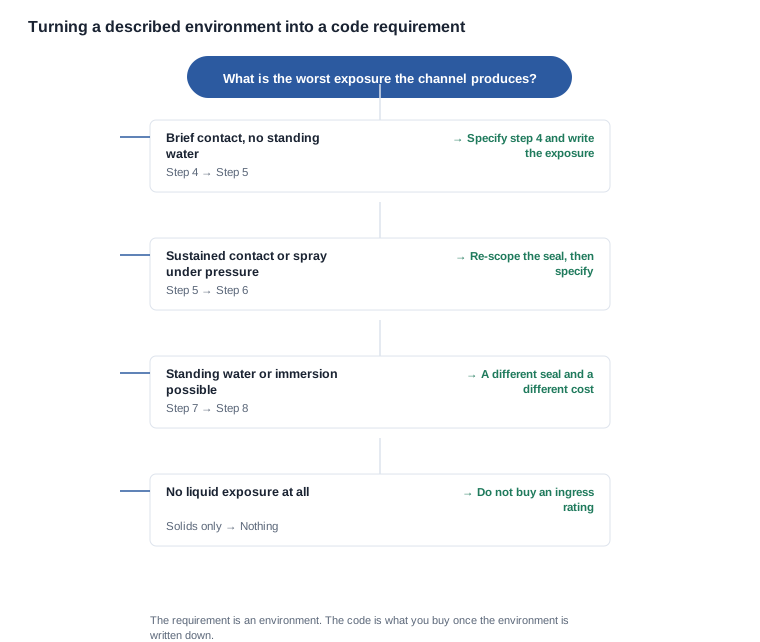
The mapping produces a decision, and the decision is not always the one the buyer arrived with. If the channel produces only step 4 exposures, a splash-rated product is sufficient and buying a higher step is money spent on a capability the channel will not use. If the channel produces sustained rain or tap rinsing, then a splash rating is not sufficient, and the requirement has to be rewritten as a step 5 requirement — which is a different seal, a different fixture and a different cost, and a decision that has to be taken before the design is frozen rather than discovered in the field.
The environments a splash code does and does not answer
The six exposures, and what the marking actually settles
The six exposures in the table above each produce a different outcome, and they are worth separating into three groups.
The first group is fully addressed. Sweat at the temple, a knocked drink, dust around the hinge — these are the splash and solids conditions the marking was made for, and a buyer can publish a claim about them with the evidence in hand.
The second group is partly addressed. Sustained rain sits between two water steps, and the honest position is that the marking does not claim it. It does not claim it because the second position of 4 is a splash condition, and a sustained rain exposure is a duration condition that a splash test does not evaluate. Buyers who describe the marking as "rain-capable" are making an inference the report does not support, and the inference fails on the first customer who reports it.
The third group is not addressed at all: immersion, salt spray, sustained heat, and anything involving a jet of water. A buyer whose channel includes any of these has a different requirement, and the right move is to write that requirement down rather than to negotiate with the marking.
Where the first year of service changes the answer
A rating is a factory measurement on a new unit, and the number that matters at month eight is not the one on the box. Seals compress and take a set. The plastic and the elastomer in a moulded housing age at different rates, which is where a leak eventually starts. A replaceable nose pad or temple tip that a customer fits themselves can introduce a path that the original build did not have. Salt and chlorine attack metals and degrade elastomers faster than clean water does, so a coastal or poolside product has a different service life from a dry indoor one.
This is why the marking should be treated as a starting point rather than as a permanent property, and why the failure-handling question belongs in the after-sales material. Buyers who do not ask what happens to a product that has been in the sea will not be the ones complaining, and the ones who will complain will be exactly the ones nobody prepared for.
The commercial consequence is a warranty structure rather than a copy structure. A warranty set against a calendar period assumes the product behaves the same in month one and month twelve, which is not true of a seal. A warranty set against a measured failure rate by cause, reviewed as the data arrives, handles the drift properly — and the criteria for that data are the exposure categories in the table above, recorded per incident.
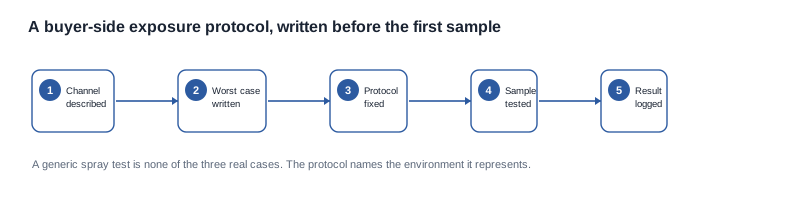

Turning an environment description into a written test protocol
The protocol, and why it has to be written first
A buyer-side test is worth running, and it is worth nothing if the protocol is written after the result is known. The protocol should fix three things before the first reading: the exposure, the duration and the pass condition. The exposure is the specific thing the channel produces — sweat at the temple for two hours, a splash from a low angle, a rinse under a tap, salt spray on the contacts. The duration is what makes the difference between a splash and a soak. The pass condition is what counts as a failure: water inside the enclosure, corrosion on the contacts, a function failure, a combination.
The reason to write it first is that a buyer who runs three tests and then chooses the one that passed has not verified anything, and will not know that they have not verified anything until a customer reports the failure that the discarded protocol would have caught.
The protocol for a splash-rated product in a sweat-and-dust channel is short, and it is worth running on the first article rather than on a late sample. Wear or simulate the sweat exposure for the duration the channel implies, expose the unit to the dust condition the channel implies, and then check for water ingress, for corrosion at the charging interface, and for any function change. The charging interface belongs first in the protocol, because it is the designed opening and it is where the failure will appear.
The evidence question, stated honestly
Here we have to be careful about our own position. Our catalogue carries the IP54 marking on the V06 and the S7 as a specification annotation. It does not carry a third-party test report number, the laboratory, the test date or the sample condition, because the company has not confirmed those. So the honest statement is: the marking is a catalogue annotation, and the evidence behind it is not something we can quote. We will not convert it into a test-backed claim by writing around it.
If you are buying, this is what to ask for: the report number, the standard the test was run against, the number of units tested, the condition of the samples before testing, and whether the tested configuration matches the configuration you are buying. A supplier that has the report answers all five. A supplier that has a marking on a PDF answers none of them.
And when the report comes back, read what the test actually covered. A report on a bare enclosure, or on a unit with a different battery or a different case fitted, does not cover the product you are shipping — and in our range the camera-equipped models and the audio-only models are separate platforms with separate enclosures, so a marking established on one is not a marking on the other by default.
The environment questions to put to the supplier
The mapping exercise above produces a set of questions that belong in the supplier qualification, and they are worth sending as a list rather than as a conversation because the answers determine whether the marking is even the right requirement.
The questions are these. Which environments does the marking cover, expressed as exposures rather than as a code. Which environments does it explicitly exclude. What is the tested configuration, including the charging interface and whether it was capped on the tested sample. What ageing or mechanical testing exists alongside the ingress test, and under what conditions. What the seal material is, whether it is replaceable, and what service life has been measured. And what the factory holds in production that keeps the result true after the first shipment.
Verifying the answers is the point rather than the questions themselves: the first two should be answered in the supplier's own words without any prompting, and a supplier who cannot state the exclusions unprompted is a supplier who has not read the document either. The last question is the one that separates a type test from a process, and it is the one that decides whether a repeat order is safe.
The criteria for accepting the answers are the same in every case. An exposure, not a code. A configuration, not a product name. A measured value, not a typical one. And where a value is genuinely not available, a written statement that it is not published, which is a far more useful answer than an estimate that nobody can defend later.
Which exposures our two marked models answer, and where they do not
The catalogue position, model by model
Two models in our range carry the IP54 marking: the V06, an 8-megapixel camera sports model, and the S7, a 13-megapixel camera sports model. Both are published with an ergonomic design and a removable inner frame, alongside their battery, resolution and runtime figures. Both use magnetic charging, and for each of them the catalogue publishes no charging-case row at all. That is an absence in the publication rather than a statement that no case exists, so a buyer who needs the case configuration has to ask for it.
Everything above is a catalogue statement, and it is worth separating from the question of evidence. We publish the marking because the catalogue states it. We publish no third-party test report number, no standard, no test condition, no sample size and no laboratory behind it, because the company has not confirmed them to us. For the camera-equipped models the catalogue also does not publish a Bluetooth version, so a requirement that turns on radio version has to be raised with us separately rather than read off the product page.
No other model in the range carries a published ingress marking, and no charging case in the range carries one either. We publish the unit weight for exactly one model in the whole catalogue — 158 g for the MT6 glasses body, which includes its battery and camera and excludes the foldable charging case — and we publish no seal material, no interface protection method and no seal service life for any model.
The boundary, stated as a buyer can use it
Here is the sentence we would put in a product page for either model, and the one we would put in a support script. The marking covers dust ingress and splashing water from any direction, on the shipped configuration. It does not cover immersion, water jets, pressure washing, salt spray, sustained heat, drop or flex, and it is not a lifetime guarantee. The charging case carries no ingress rating of its own.
That sentence is narrow, and the narrowness is the point. A buyer who publishes it has a claim they can defend to a customer, a retailer, a broker or a customs inspection, and who can point at what it does not cover rather than at what they hope it covers. A buyer who publishes "waterproof" has a promise with no document behind it, and in the outdoor channel the customer is the person who tests it.
A worked scenario: a gym brand that should not buy a higher rating
This is a hypothetical case rather than a client project, and it is here to show how the mapping changes a procurement decision in the opposite direction to the usual one.
Assume a fitness equipment brand launching a smart-glasses line into a commercial gym channel, with a small trail-running side channel that accounts for a minority of units. The brand's instinct, having read a dozen supplier pages, is to ask for the highest water step it can get, on the assumption that a higher number is a safer purchase. The supplier has quoted a splash-rated camera sports model as the natural fit, and the brand's product manager wants to know whether to pay for an upgrade.
The first step is the exposure map, channel by channel. The gym channel produces sweat at the temple across a ninety-minute session, plus incidental splashes from floor cleaning, and produces no rain, no tap rinsing and no standing water. The trail channel produces sweat and intermittent rain over multi-hour sessions. Applying the table above, the gym exposure sits at step 4, the trail exposure sits between step 4 and step 5, and nothing in either channel reaches immersion.
The second step is the decision, and it is the opposite of the one the brand expected. Because the dominant channel does not generate anything above a splash exposure, a higher water step would buy a capability the channel never exercises, while adding seal cost, a qualification queue and a longer lead time to a programme whose margin is already set by the gym equipment rather than by the glasses. The correct decision is to buy the splash-rated configuration, to write the sweat exposure into the specification as the requirement, and to write the trail exposure as a separate line with a handling instruction attached.
The third step is the catalogue consequence, and it is the one the brand had never considered. Its gym channel needs no ingress marking at all. The brand therefore also qualifies a smaller, unmarked model for the gym-only volume, and reserves the marked camera sports model for the trail side channel where the exposure is genuinely harder. That reallocation comes directly from the exposure map, and it reverses the assumption the brand arrived with — that the unmarked product is the cheaper and therefore weaker one.
The fourth step is the copy, which follows from the map rather than from the code. The gym listing describes sweat resistance and splash protection, names the trail exposure as the boundary, and points at a care instruction for the case and the contacts. Nothing in it needs the word waterproof, so nothing in it carries that risk.
The outcome is a lower cost of goods, a shorter qualification path, and two listings that are narrower and therefore defensible. Every decisive step came from writing the environment down, and none of them came from the digits.
What a buyer should take away from the mapping
The practical output of this exercise is a two-line document. The first line is the environment, written in the words the channel uses: what the product meets, for how long, and what the customer does with it afterwards. The second line is the requirement, written as a code with its conditions and the report number attached.
Everything else — the commercial terms, the test protocol, the warranty structure — follows from those two lines. And a buyer who has them can answer a customer's environment question without inventing an answer, which is the outcome that actually protects the programme.
Related reading
- The rating codes and what each one permits — IP ratings explained
- The models in our range that carry a published marking — sport smart glasses range
- The test evidence behind a specification claim — certification checklist
- What to do when a unit has been in the water — after-sales support
Tell us the environment the product will live in and how the claim will be worded on the box, and we will tell you which rating that claim needs and which of our models actually have one.


