

Most of the questions a buyer asks about an ingress rating have the same answer, and the answer is short: the code decides, and the code is two characters. The work is in establishing what the code was measured on. This article takes the eight questions that come up repeatedly, gives the short answer for each, and states the follow-up question that turns a short answer into a usable one. That distinction is what separates a buyer who can put a defensible claim on a listing from one who is relying on a phrase.
For a sourcing team the practical stake is that an ingress rating is the cheapest technical claim to make and the most expensive one to get wrong. It costs a few characters to write "waterproof" on a listing page. It costs a technical file, a laboratory report, a model list and a re-validation obligation to stand behind the code underneath it — and only two models in this range even carry an ingress marking.
IP rating: what it settles, what documents carry
An ingress rating is read in two characters, and each one carries a defined meaning. The first digit covers protection against solid objects. The second covers protection against water. The common levels in the second position are: 4, protection against splashing water from any direction; 5, protection against low-pressure water jets; 6, protection against powerful water jets; and 7, protection against temporary immersion to a stated depth and duration. A rating of 8 is continuous immersion, and it is a different product class.
The code therefore settles suitability, and suitability is what the code is for. It tells a buyer that a unit has been assessed against a defined exposure, and it does so in a way that two suppliers can be compared on.
What the code does not settle is whether the rating applies to the product in the buyer's hand. That is a documentary question, and it has four parts: which configuration was tested, which report number covers it, which models the report names, and what change obligation follows from a future modification. A buyer who has the code and nothing else has a suitability answer and no evidence.
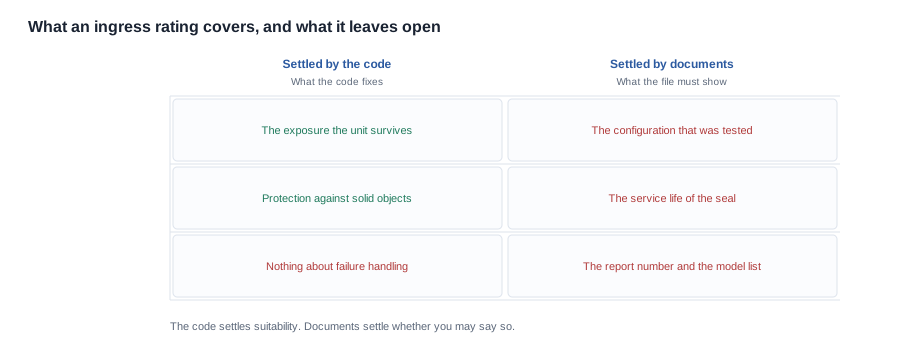
There is also a third category, which is the one most rating claims actually fail on: what happens when the product fails anyway. A rating describes a boundary condition for a new unit. It says nothing about ageing, nothing about failure handling, and nothing about the warranty. Those are policy questions, and they are decided by the party placing the product on the market, which is the buyer.
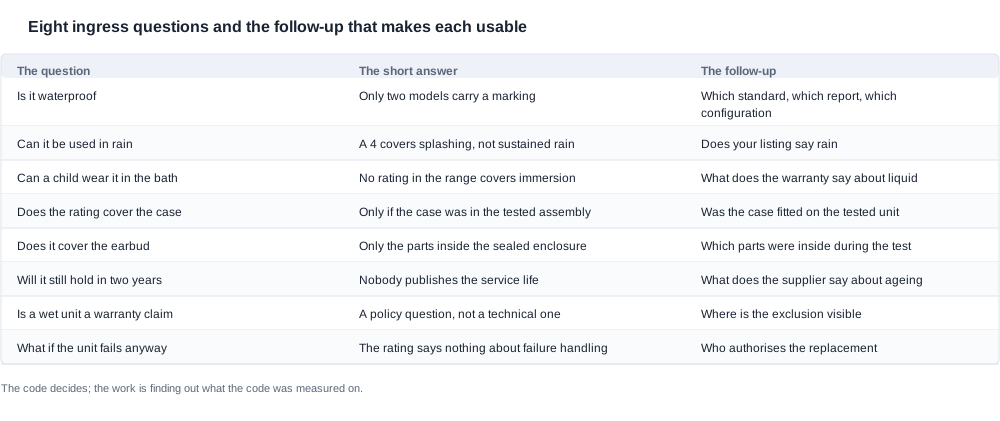
The eight questions buyers ask, and the follow-up that makes each usable
Is it waterproof
For most of this range, the honest answer is that no ingress rating is published at all. Two models carry a marking. The follow-up that turns the answer into something usable is: which standard, which report, and which configuration.
Can it be used in the rain
The answer depends entirely on the second digit, and it is usually not the answer the buyer wants. A 4 covers water splashed from any direction — a shower, a splash. It does not cover sustained rain, because rain is a duration condition and a splash test is not. The follow-up is whether the claim in your listing says rain.
Can a child wear it in the bath
No, and this one should be answered explicitly in any listing aimed at a family audience, because the question is asked by parents rather than by buyers. No rating in this range covers immersion. A 4 covers splash; a bath is immersion; a 7 is the level that covers immersion to one metre for thirty minutes. Note also that a 7 covers the water and not the chemistry, so even that is not a swimming product. The follow-up is what the warranty says about liquid ingress, and where that wording is visible.
Does the rating cover the case
Only if the case was in the tested configuration, and this is the question that catches people out. A rating attaches to an assembly, and the assembly includes the case. The CY03 and the L1 Pro, and the CY05 publish a 1400 mAh case, the L2 Utral publishes a 900 or 1400 mAh case, and the MT6 publishes a foldable 1200 mAh case. A case is a substantial part of the enclosure on any of them, so a rating measured without the case is a rating on a different product.
The follow-up is whether the case was fitted on the tested unit, and whether the case being shipped is the same one.
Does it cover the earbud
The rating applies to the assembly, and which parts of an assembly sit inside the sealed enclosure is a design question rather than a marketing one. For a frame-form product with a single audio unit, the question is which parts are behind a seal and which sit in an open frame member. For a two-earbud product, the question is whether the rating covers the complete pair, one earbud, or the charging case — and a rating published for a case is not a rating for an earbud.
The follow-up is which parts of the product were inside the enclosure during the test.
Will the rating still hold in two years
Nobody publishes this, and the honest answer is that the rating describes a new unit. Seals compress and take a set, elastomers age, moulded parts move with temperature, and a replaceable nose pad or temple tip fitted in the field can introduce a path the original build did not have. Salt and chlorine accelerate all of it, so a coastal or poolside product ages faster than a dry indoor one.
The follow-up is what the supplier says about the service life of the seal, and whether the warranty and the failure-handling policy reflect that a wet unit may be unrecoverable.
Is a wet unit a warranty claim
That is a policy question rather than a technical one, and it should be settled before the product ships. A splash-rated product that has been immersed has been used outside its rated condition, and the standard position is that it is not covered. The risk is that this gets decided in a support conversation rather than in the terms, and that the customer finds out afterwards.
The follow-up is what the exclusion says, and whether the wording is visible at the point of sale rather than only in a linked policy.
What if the unit fails anyway
That is a separate question from the rating, and it is the one that actually determines the cost. A rating tells you whether a product is suitable for an environment. It does not tell you what happens when it fails, and the failure handling is what the customer experiences.
The follow-up is what the process is, who authorises the replacement, and what happens to the returned unit.
Why only two models in the range carry an ingress marking
In our catalogue the IP54 marking appears on the V06 and the S7, and on no other model. That is two models out of twenty-eight, and the reason is worth understanding because it changes how a buyer should read a model with no marking at all.
The Bluetooth audio family carries no ingress rating, and for an open-ear design with a sound port and a microphone port that is a structural point rather than a documentation gap. An open acoustic port is an opening in the enclosure by design, and an opening is exactly what an ingress rating measures. The same reasoning applies to the bone conduction entry, which carries no rating, and to the camera models, whose charging cases are part of the assembly.
Two consequences follow for a buyer.
The absence of a marking on an audio platform is information. It tells you the design does not claim to be sealed, which is a legitimate product decision for a category where the acoustic path has to be open. A buyer who wanted a sealed product and has been offered an open-port audio platform has been given a mismatch, and it is better found during the shortlist than during the channel.
The presence of a marking on a camera platform is not yet evidence. The V06 and the S7 publish IP54 as a catalogue annotation. There is no third-party report number, no standard, no test condition, no sample size and no laboratory behind it, because the company has not confirmed them to us. A catalogue annotation tells a buyer what the catalogue states. It does not tell a buyer what was tested, and it cannot be quoted as a tested rating.

Turning a catalogue marking into a report you can file
Six steps, and the third is where most buyers stop too early.
- Ask for the report number rather than the report. A number can be resolved in an issuing body's register; a PDF forwarded by email cannot be checked.
- Resolve the number in the issuing body's register and confirm that it is active and that it covers the standard the claim is based on.
- Check the model designation character by character. A report naming a variant designation does not cover a related model, and this is the most common documentary defect in this category.
- Establish which ports, contacts and interfaces were fitted on the tested unit. A configuration with a port cover fitted is not the configuration with the port open.
- Compare that list against the unit physically in the buyer's hands. This is where a substitution becomes visible, because the unit in the box is the unit that matters.
- Put the acceptance criteria into the purchase order. A criterion that lives in an email is not binding. A criterion in the purchase order is.
The documents to request before an ingress claim goes on a listing
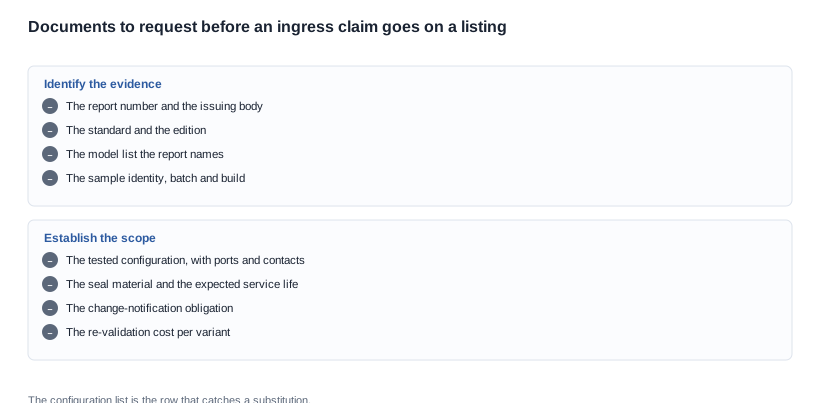
Two groups, and the second group is the one that catches a substitution.
Identify the evidence. The report number and the issuing body. The standard and the edition. The model list the report names. The sample identity, the batch and the build.
Establish the scope. The tested configuration, with ports and contacts. The seal material and the expected service life. The change-notification obligation. The re-validation cost per variant.
That last row deserves attention, because it is the one that is invisible until it is expensive. If a supplier intends to change the seal material, the port geometry or the case design, the report may no longer cover the product, and the re-validation cost falls on whoever asked for the change. A buyer who wants a private-label finish, a different temple tip or a revised packaging insert needs to know whether that touches the tested configuration before it is ordered, not after.
Where the conformity route fits alongside the ingress claim
An ingress rating is a technical claim about a design, and it sits inside a wider conformity picture that a buyer has to handle separately. For a radio-enabled product placed on the European market, the radio part of the assessment runs through the Radio Equipment Directive (EU) 2014/53/EU, and the conformity route determines what has to exist in the technical file behind the CE marking. For the United States, the radio part runs through the FCC equipment authorisation route.
The point of raising it here is sequencing rather than detail. An ingress claim changes the tested configuration, and a change to the tested configuration can trigger a re-validation obligation inside a conformity file that is otherwise complete. A buyer who adds a water-resistance claim to a product after the file is assembled has created a document cycle that nobody priced. The order that avoids it is to settle the ingress claim first, then build the file around the configuration that the claim requires.

Where the ingress rating stops and the warranty policy begins
This is the part of the subject that is usually left out of a technical conversation, and it is the part that determines the cost of a failure.
A rating is a boundary condition for a new unit. It answers a suitability question: is this product appropriate for this environment. It does not answer what happens when the product is used outside its rated condition, it does not answer how a failure is diagnosed, and it does not answer who pays. Those three are policy, and they are set by the party placing the product on the market.
Three policy decisions need to be made before a channel launch.
The exclusion wording, and where it is visible. The standard position is that a unit that has been immersed has been used outside its rated condition and is not covered. The decision is not whether to hold that position — it is whether the customer can see it at the point of sale or only in a linked policy that nobody opens.
The failure-handling route. A product whose failure mode is diagnosable and whose replacement route is clear turns a warranty claim into a shipping decision. A product without a defined route turns every water complaint into a negotiation, and negotiation is more expensive than replacement in every scenario a buyer will meet.
The replacement authority and the returned unit. Who authorises the replacement, on what evidence, and what happens to the returned unit. This is the difference between a claim that resolves in a day and a claim that runs for a month.
The commercial questions that belong with the technical ones
The ingress rating is not only a technical matter, and a buyer who treats it as one usually discovers the commercial part late.
A rating narrows the channel and therefore the volume. A product that can carry a water-resistance claim opens doors to outdoor, fleet and industrial channels. A product without one does not, whatever its other specifications. That is a market-sizing fact and it belongs in the business case, not in the compliance file.
A rating that cannot be evidenced is a liability on the listing. In most consumer markets, a claim on a listing page that cannot be substantiated is treated as a misleading claim, and the remedy is a withdrawal and a notification rather than a correction. In a channel that publishes listings for many sellers, the consequence is usually a delisting and a supplier score that takes longer to recover than the original listing took to earn.
The re-validation obligation is a commercial term. If the buyer wants a variant, the cost of re-validating the ingress rating for that variant has to be identified before the variant is designed. A private-label finish that appears trivial can carry a laboratory cost and a schedule that dwarfs the finishing charge it was attached to.
The warranty cost is a forecast, and it belongs in the model. A splash-rated product used in a wet channel has a different expected return profile from a dry-use product, and that difference should be in the commercial model rather than discovered in the returns data. The lever is the failure-handling route, not the rating.
How to choose when the ingress position is part of the shortlist
Buyers who put ingress into the selection criteria usually find that the decision is simpler than they expected, because the number of genuinely distinct positions is small.
Position one: a tested rating with a report that names the model. This is the only position that supports a claim on a listing page, and it is also the position that supports a channel conversation with a compliance reviewer. If a shortlist contains one supplier here, the question is whether the configuration matches, not whether the rating is high enough.
Position two: a tested rating on a related configuration. The rating is real but it covers a variant. This position is workable with the right work — a model list that matches, a written confirmation of what differs, and a stated position on whether a re-validation is required — and it is a legitimate choice for a buyer who is not prepared to fund laboratory time.
Position three: a catalogue annotation. The catalogue states a marking without a report behind it. This position supports an internal statement about what the catalogue says and it does not support a customer-facing claim. A buyer who wants a listing claim from this position is asking for work that has not been done, and the honest way to handle it is to find out what that work costs before deciding.
Position four: no ingress position at all. This is where most of this range sits, and it is a legitimate answer for an indoor channel. It becomes a problem only when the channel requirement assumes otherwise, and the right move at that point is to change the channel requirement or to change the platform — not to describe an unsealed product as protected.
The trade-off across these four is straightforward: the higher the position, the more the buyer can claim and the more the buyer must be able to evidence. What a sourcing team should not do is jump from position four to a customer-facing claim, because the gap between those two is a laboratory report and a legal exposure, not a wording change.
The claim we will write and the claim we will refuse to write
Concretely, we publish the marking exactly as the catalogue states it, and mark everything else as open. The IP54 marking appears on the V06 and the S7, as an annotation, with no third-party test report number, no standard, no test condition, no sample size and no laboratory behind it, because the company has not confirmed them. No other model in the range carries a published ingress rating.
We will not describe a splash-protected product as waterproof, rain-capable or immersible. We will not describe an audio product as protected when no rating is published for it. We will not present a catalogue annotation as a tested rating, and we will not infer a per-model position from the company-level export capability described on the catalogue front page.
What we will do is take a specific model and one of these eight questions, and give you the answer our documentation supports together with the question we would put to a supplier who has more. For the V06 and the S7, the answer is that the catalogue states IP54 and the report is not available to us; the question is for the supplier, and it is the same six-step sequence above. For any other model, the answer is that no rating is published and the question is whether one can be commissioned for the configuration the buyer actually wants.
The codes and what each one permits are at IP ratings explained, the vocabulary is at the ingress glossary, the physical mechanism is at how the protection works, and the models that carry a marking are at sport smart glasses range.
Related reading
- The codes and what each one permits — IP ratings explained
- The vocabulary we work with — the ingress glossary
- The physical mechanism — how the protection works
- The models that carry a marking — sport smart glasses range
Send the model and the question, and we will give you the answer and the follow-up.


